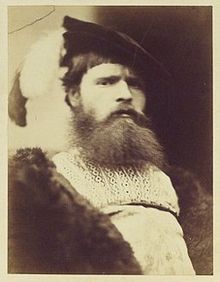
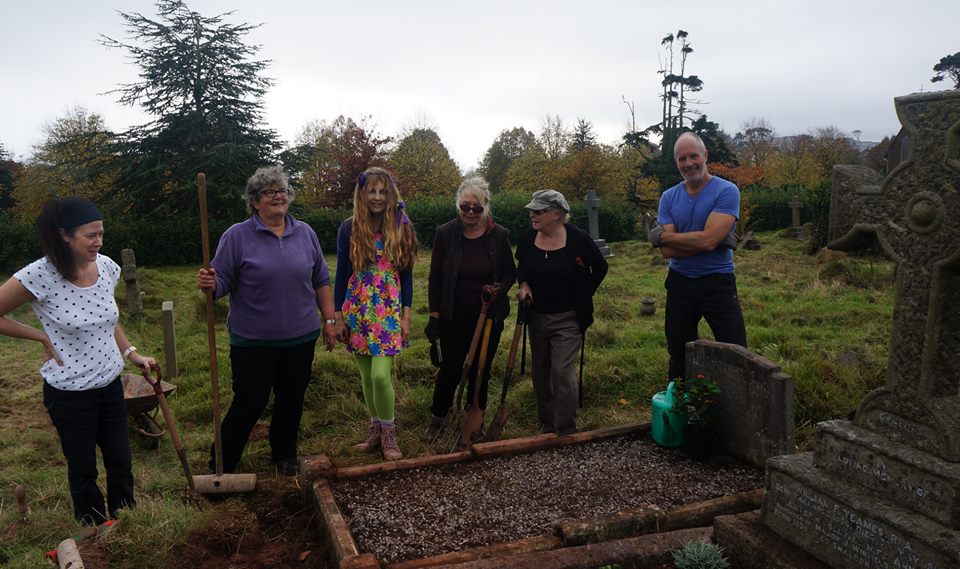
On Saturday 31st October the working group cleared the grave of William Frederick Yeames, a famous artist who came to Teignmouth later in his life for the benefit of his health.
Yeames was born on 18th December 1835 in Taganrog, Russia where his father was the British consul. He was the fourth child of William and Eliza May Yeames. After the death of his father in 1842 and a change in family fortunes, the family moved to Dresden where Yeames began studying painting. They subsequently moved to London in 1848 where Yeames learned anatomy and composition from Sir George Scharf, who was director of the National Portrait Gallery. He also took art lessons from F A Westmacott.
In 1852 he travelled to Florence where he studied with Enrico Pollastrini and Raphael Buonajuti. During his time there he painted at the Life School at the Grand Ducal Academy, drawing from frescoes by Andrea del Sarto, Ghirlandaio and Gozzoli. Continuing on to Rome, he painted landscape studies and copied Old Masters, including the frescoes of Raphael in the Vatican.
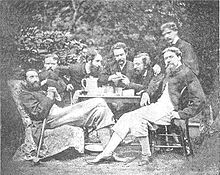
In 1859 he returned to London and set up a studio in Park Place. He joined the loose association of artists known as the St John’s Wood Clique who mostly lived in the St John’s Wood area of London. They modelled themselves on ‘The Clique’, an earlier group of English artists formed by Richard Dadd in the late 1830s. The group concentrated on subjects of an historical nature and narrative paintings in which the story was revealed by close study of the actions and expressions of the subjects. In Yeames’s work this technique evolved into the genre known as the ‘problem picture’, in which the narrative of the image creates an unresolved dilemma or paradox for the viewer.
While their work was popular with the public, the St John’s Wood Clique found it difficult to get their work displayed at prestigious galleries and the Royal Academy because it never received critical acclaim. Yeames managed to overcome this problem; he did exhibit there and was made an Associate (ARA) in 1866. He specialised in Tudor and Stuart subjects, but did not always portray the events they depicted with historical accuracy instead using them as inspiration, or thought provocation.
On 18 August 1865 Yeames married Anne Winfield, daughter of Major James Stainbank Winfield of the East India Company. As an aside, it is interesting that Teignmouth’s most famous artist, Thomas Luny, at one time worked in studios close to the East India Company in London and was commissioned to do a number of maritime works for them.
Although a prolific artist, Yeames was also librarian of the Royal Academy and curator of the Painted Hall at the Royal Naval College, Greenwich. Gradually, however, his eyesight deteriorated and he last exhibited in 1910. In 1912 he suffered a seizure from which he never fully recovered.
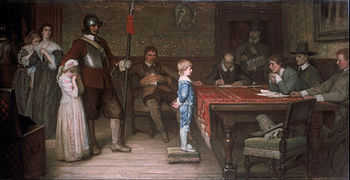
His most famous painting, now on display in the Walker Art Gallery in Liverpool, is entitled “And when did you last see your father?” Painted in 1878, it depicts a scene in an imaginary Royalist household during the English Civil War. The Parliamentarians have taken over the house and question the son about his Royalist father (the man lounging on a chair in the centre of the scene is identifiable as a Roundhead officer by his military attire and his orange sash). Yeames was inspired to paint the picture to show the crises that could arise from the natural frankness of young children. Here, if the boy tells the truth he will endanger his father, but if he lies he will go against the ideal of honesty undoubtedly instilled in him by his parents – an artistic interpretation of moral dilemma.

He and Anne moved to Brimley House in Higher Brimley Road, Teignmouth for the benefit of his health and celebrated their Golden Wedding Anniversary in 1915. William Yeames died three years later on 3rd May 1918. Both he and Anne are buried in the Old Cemetery.
His life was documented in a biography by his niece a few years later – “Art and Anecdote: Recollections of William Frederick Yeames, His Life and His Friends”. I found the final paragraph especially poignant:
“And on the cross which marks the spot where we laid him, in that beautiful hillside cemetery, within sight of the sea, changeful as life itself, on one hand, and the still purple moors on the other, my aunt had the same word inscribed which marks the tomb of Albert Durer in Nüremburg :
EMIGRAVIT.”
(Note: “Emigravit” is short for the Latin expression “Ex hac vita ad Dominum emigravit” – “He emigrated from this life to the Lord.”)
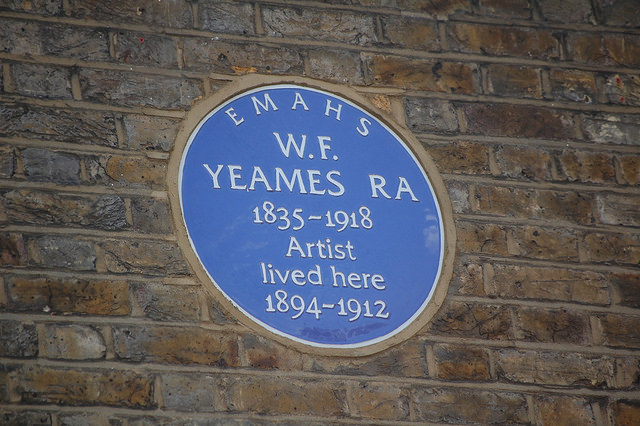
Finally, in 2000, a blue plaque commemorating Yeames was installed at his former home, 8 Campbell Road, Hanwell, London, where he lived from 1894 until 1912.
Maybe Brimley House should carry such a plaque as well?
The inscription on their grave (MM77) reads:
EMIGRAVIT
(barely visible at the base of the cross)
William F Yeames RA
Born Taganrog 1835 Died 3rd May 1918
And of his beloved wife ANNE
Daughter of Major J Winfield Indian Army
Born 1839 Died Shaldon 26th Nov 1934
The above information has been compiled from the following sources:
Wikipedia – William Frederick Yeames …..
Wikipedia – St John’s Wood Clique …..
General Books …..
Art and Anecdote: Recollections of William Frederick Yeames, His Life and His Friends, M H Stephen Smith, published by Hutchinson & Co, London
 Teignmouth Old Cemetery
One thought on “William Frederick Yeames”