
Love never dies
It is rare to find a grave with a reference going back almost 2000 years and, of course, when you do it prompts curiosity and research.

“Uxorem vivam amare voluptas, defunctam religio” was written in the first century AD by the Roman poet Statius and re-surfaces on the cross of a grave in plot PP35 in Teignmouth cemetery. This is the resting place of Annie Frances Lumsden who died on February 12th 1942. There are various translations, but the gist is – “To love a living wife is pleasure, to love a dead wife is religion”. The intent is to show that love never dies but just takes a different form.
She was joined seven years later by her husband James who is referred to on the headstone as “journalist”, another unusual finding. It turns out that he was slightly more than a journalist as the short notice of Annie’s death in the Arbroath Guide of February 14th 1942 reveals:
LUMSDEN – At a nursing home in Teignmouth, on the 12th February, Annie, the beloved wife of James Lumsden, late editor of the Leeds Mercury, and third daughter of the late James Francis, West Seaton.
James, the ‘journalist’, was actually the editor of a significant provincial paper and had a background knowledge that encompassed ancient roman poetry. His life embraced a swathe of turbulent history in the first quarter of the twentieth century.
Family Background

The eldest son of James and Jane Eliza Lumsden James was born in Banff, Aberdeenshire, Scotland on 29 April 1861. He was probably brought up in quite a cultured environment since his father is declared in consecutive censuses from 1861 as being a lawyer’s clerk, then a writer and by 1881 the Sheriff Clerk Deputy of Banffshire. A short biography in the Leeds Mercury of 23 October 1909 reveals that James was also the grandson of Major Leith of Leith hall, Aberdeenshire, and a kinsman of Sir James Leith who “fought so gallantly at Badajoz and Salamanca”.
By 1881 James himself was studying for an Arts degree at Aberdeen University (Kings College). However, in a letter he wrote some 30 years later he refers to winning a prize in geology at university in 1883 (this could have been at Edinburgh University which he also attended, according to the Leeds Mercury).
So it’s not clear exactly what subject he took his degree in but we do know that he chose to enter journalism (perhaps influenced by his father’s own aspirations as a writer?). The Leeds Mercury biography explains that he started on the Aberdeen Free Press under Dr Alexander, then moved on to a staff role at the Glasgow Evening News followed by the Scottish Leader where “he served under Sir T. Carlaw Martin”. Within eight years he had married Annie and by 1891 they are shown as living in Edinburgh with two children – James Francis (age 2) and Dorothy (age 1). James’ career had obviously progressed as he is now described as a newspaper sub-editor.
By 1895 they had had one more son Charles, born around 1892, and the family had moved to Leeds where James was now sub-editor of the Leeds Mercury. Sadly their first son, James Francis, died in March 1896, aged 7 but by 1901 they had two more sons – Lewis and Kenneth. It was also around about then that was probably the start of James’ most significant contributions to journalism. Their final son, Alastair Quentin, was born in 1906.
Journalistic Landmarks
In its obituary of James Lumsden the Yorkshire Post of March 4th 1949 commented:
At the turn of the century, when newspapers were passing through an intensely formative period, he was a pioneer in journalistic practice
Here are some of his landmark contributions.
Canada

From about 1890 people from Europe were being tempted to emigrate to Canada, in what is now known as the third wave of immigration. One of the main attractions being advertised was the vast expanse of the wheat belt which offered large portions of cheap land and opportunity for settlers.

During the harvest of 1902 James, as representative of the Leeds Mercury, travelled through Canada as one of a small journalistic party to experience first hand Canadian life in a way that had never previously been afforded to a ‘group of enquirers from the Old Country’. The outcome of this was not only a comprehensive series of articles in the Leeds Mercury but also a definitive 400-page book – ‘Through Canada in Harvest Time, A Study of Life and Labour in the Golden West’. The articles themselves were subsequently compiled into a shorter pamphlet ‘Westward’.
The book is a compilation of facts and statistics woven into James Lumsden’s own impressions and interpretation of what he encountered. There are also some amazing contemporaneous photos of Canadian life and scenery. Here are just a few:
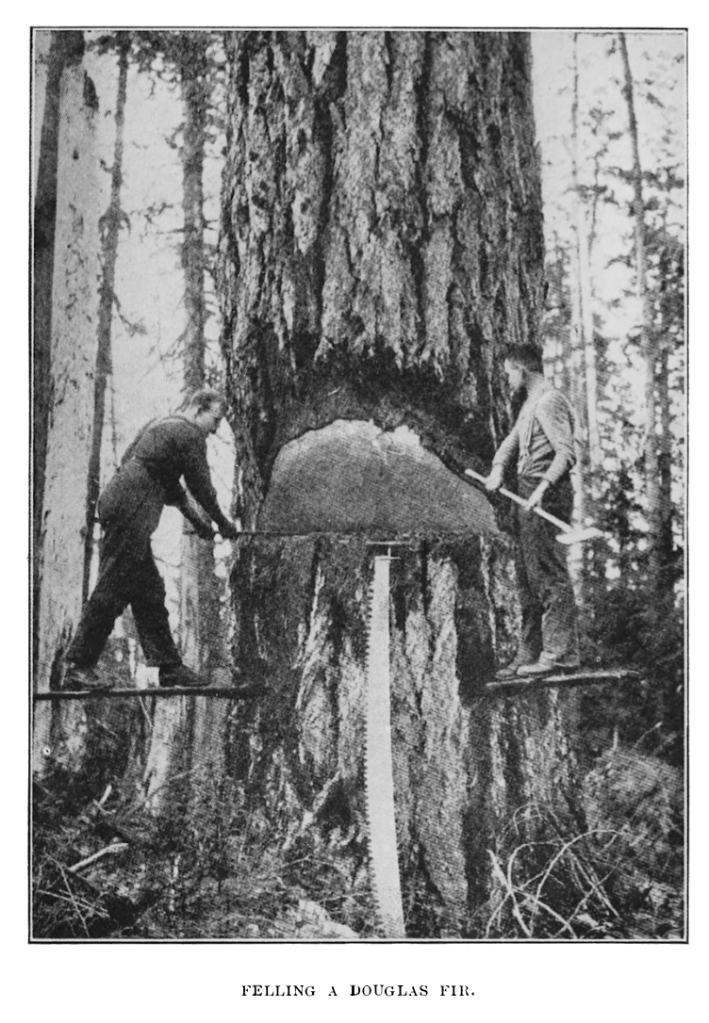


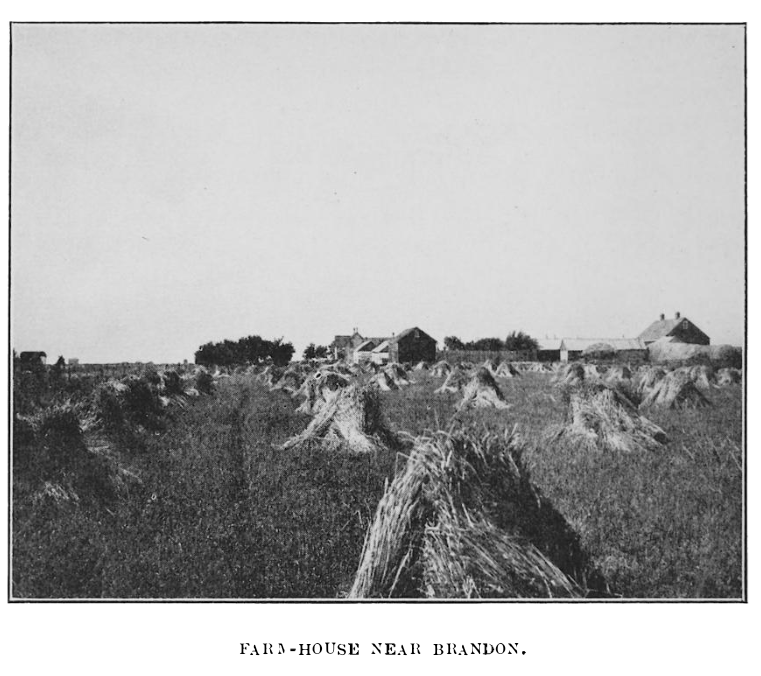
In his own words, James’ aim in producing the book, articles and pamphlet was:
The author dedicates this book to the workers of England, Scotland and Ireland hoping that it may inspire many to seek new homes in a land which, though it may not ‘flow with milk and honey’, assuredly offers to all who are not impatient of toil better opportunities of attaining comfort, independence and fulness of life than are to be found in any of the Old World States.a pioneer in journalistic practice”
The book received very many positive reviews. Here is one from the Daily News (London) of 6 November 1903:
THE NATION OF THE FUTURE.
‘Through Canada in Harvest Time’ By James Lumsden. T. Fisher Unwin. 6s
There is a spirit of exhilaration and triumph about Mr. Lumsden’s record of his “Journey Through Canada in Harvest Time.” “The Land of Optimism,” “The Land of Vast Horizons,” “The Imperial Granary,” “The Nation of the Future,” are the kind of epithets that occur throughout the pages. The author travelled with company of journalists from sea to sea in a tour specially planned to exhibit the wealth and progress of the country. The journey was a kind of universal fete, a series of festive banquets —festive though, in places like Winnipeg, unaccompanied by alcoholic refreshment. Each little township or city fought with its neighbour in a desire to exhibit unbounded hospitality and explain its own illimitable resources and future.
“To advertise the superior merits of one’s town or province,” says Mr. Lumsden, “seems to be the sole and darling occupation of every community.” The deputation returned to England with a kind of confused sense of entertainment and kindliness, of the breaking up of waste lands and the development of the great wheat fields; towns springing into existence in a night and a day, and all the exultant advance of a young nation towards boundless material prosperity.
“In England,” says the author, “99 men out of 100 despair of becoming rich or owning property before they are five-and-twenty. In America a man does not abandon hope of dying rich, however old he is.” This universal ambition after wealth, though not, perhaps, the highest of human motives, is the force that is converting the black-land plains into a vast sea of corn, an ocean of golden grain, “through which the train rolls as a ship rolls through the blue waters of the sea”. It is a force also which is driving railways into the heart of the mountains, creating scattered towns in impossible places, as the mineral wealth of the Western province is dragged out of the soil. The general mental atmosphere in the mid-West at least has not yet attained civilization. It is a barbaric advance in which the prize goes to the strongest and the only reputable virtues are courage, tenacity, and energy. But it is a barbaric advance which is above all things alive, which has eliminated poverty, which has determined on the future progress of the children. “Seminaries of learning,” says the author, “are as numerous and conspicuous in Canadian cities as convents and churches are in the cities of Spain”.
Far from complaining of the school tax, it is a subject of honest pride. Mr. McKay, the Mayor of Brandon, spoke of the citizens of the “Grain City of the West” as a community to be envied and admired, because they enjoy the distinction of paying the heaviest school taxes in Manitoba.
Here in a sudden flash is a revelation of an infinite distance between the spirit of this new race and the tired acquiescence of the old world.
It is principally in a series of brilliant pictures, pictures of almost intoxicating advance, that the great dominion appears in these successive chapters. At the beginning is the emigrant ship crowded with the forlorn wreckage squeezed out from Europe, mostly of Eastern origin. Then comes Quebec with its strange commingling of the “progressive and utilitarian spirit of the new world with a full measure of the Frenchman s love of art, the polish, the culture, the sensuousness inseparable from the French character”. Montreal is a great industrial city without the factory hand, male or female, of a type produced in England which is not known in Canada. Mr. Lumsden can find no real poverty, pauperism being unknown. “Everything conveyed an idea of happiness and contentment such as I had never witnessed before.” Then the lakes with the industrial development round their borders. And, finally, all the splendid materialism of the west; miles upon miles of the wheat in harvest time, miles upon miles of the ranching land; the vast mountains with their wealth of timber and metal; and beyond them, “God’s country,” which, in the Indian legend, “lies beyond the Rocky Mountains’’—the most enchanting of all the lands which own and maintain Britain’s sway. “No other portion of the Empire can match its scenery and its delicious climate, none excels it in fertility, and none can boast of greater or more varied mineral riches.”
Mr. Lumsden is not blind to the other side of the picture. The great rush of emigration at present is from the Slavs, the Eastern States of Europe and from America, and it is difficult to prophesy how far those will assimilate with the English ideals. The great need of these Western territories is the family life which will rear in the healthy world of out-of-doors, a race whose future may be better than our dreams.
Most disappointing feature of Western farming life at present is that a large number, probably the majority, of the farmers are not adopting that method of life which commends itself to right-thinking men. Wheat and dollars engross their intellect and energy. Among the English-speaking farmers little effort has been made to make the farms the homes of happy families.
On the whole the picture is one of unbounded optimism, the spirit of Whitman’s Pioneers taking “the task eternal and the burden and the lesson,” while the older races have halted “over there beyond the seas.”
News of the book even reached Teignmouth as briefly described in the Teignmouth Post and Gazette of 6 November 1903:
The book which Mr. Fisher Unwin has just published by the title of “Through Canada in Harvest Time” is another sample of the work of the journalist turned author. The writer, Mr. James Lumsden, is a pressman whose experience must be approaching the close of its teens, and, as might be judged from his extremely able survey of Canadian resources and industry, his attention has been closely devoted to commercial subjects. Mr. Lumsden has been attached for more than ten years to the staff of one of the Leeds newspapers, and at an earlier period he was similarly engaged in Aberdeen, Glasgow, and Edinburgh.”
By 1904 the shorter pamphlet had emerged and was being advertised by the Leeds Mercury.
WESTWARD!
48 large Pages and Three Maps.
A PRACTICAL HANDBOOK
FOR EMIGRANTS
TO THE
CANADIAN WEST
By JAMES LUMSDEN
Author of “Through Canada in Harvest Time.”
Those who contemplate emigrating to WESTERN CANADA during the ensuing season, and all who are desirous of obtaining the latest information on the resources of the Dominion, should secure copies of this indispensable guide. The information contained takes the form of answers to the questions invariably put by intending Colonists. Those who desire to learn how to reach Western Canada, the costs of the journey, the prospects and openings for settlers of all classes will find in “WESTWARD” practical information and advice, in the most succinct, intelligible, accurate, and attractive form.
“WESTWARD” has been specially written by Mr. JAMES LUMSDEN in order to meet the wishes of a large number of readers of “The Leeds and Yorkshire Mercury,” to which the author has contributed numerous articles bearing upon Canadian subjects. All facts and figures have been brought up to date, and only those topics are dealt with which the author’s experience shows that emigrants are interested in. These topics are treated more fully and lucidly than in any other publication.
“WESTWARD” contains a magnificent folding map of Canada showing all the railways, both those already constructed and those authorised to be built by the Dominion Government. It also contains up-to-date maps of Manitoba and the Western Territories, on which all the newest towns are indicated.
“WESTWARD” also contains special chapters about Cattle, Sheep, and Dairy Farming in Saskatchewan, Assiniboia, and Alberta; also chapters upon the Industries and Commerce of Canada.
James the Editor
The significant piece of work which James had carried out on Canada and the immigration question stood him in good stead for promotion; so it was probably no surprise to anyone that he was appointed editor of the Leeds Mercury in 1905. It coincided with the purchase of the paper by Lord Rothermere who added it to his growing portfolio of newspapers.
The paper announced the changeover in its issue of 16 December 1905:
JOURNALISTS HONOURED.
PRESENTATIONS TO FORMER
“MERCURY” EDITORS.
About eighty representatives of West Yorkshire journalism were present at a gathering in Leeds on Saturday evening, when presentations were made to two of the oldest members of the profession in the country—Mr. Thos. Riach, who for many years was a reporter, London representative, and finally editor of the Mercury ; and Mr. W. S. Cameron, for many years editor of the Leeds Mercury Weekly Supplement.”
Mr. Riach, who. through illness, was unable to be present, was presented, with a richly worked, silver rose bowl and a handsome mahogany revolving bookcase, while Mr. Cameron received a beautifully chased silver salver and a purse of gold, together with articles of jewellery for his two daughters.
Mr. Phillips, editor of the Yorkshire Post, in making the presentations, alluded to the arduous nature the journalist’s calling, and remarked that during all the years Mr. Riach and Mr. Cameron had been connected with the Mercury they had won the affection and the regard of all their colleagues in the profession. Those who had been brought into the closest touch with them agreed that they had won affection that- would last throughout life. (Applause.) Mr. Phillips alluded particularly to Mr. Cameron’s services to the Institute of Journalists, and, referring to Mr. Riach’s editorship of the “Mercury,” he said that never was the editor of a paper held in higher esteem by the outside public and by those who were opposed to his political opinions. (Applause.)
Mr. James Lumsden, who succeeded Mr. Riach in the editorial chair of the ‘‘Mercury,” said he had worked with Mr. Riach and Mr. Cameron for thirteen years, and as one who could speak with a more intimate knowledge than was possible to anyone who had not worked with them, he could unhesitatingly declare that Mr. Riach and Mr. Cameron did in reality possess all those qualities which the outside world believed they possessed. (Applause.) He never knew two more lovable men or finer journalists. (Applause.)
Mr. Cameron, who was visibly affected, said that from the bottom of his heart he thanked those who had spoken for all they had said, and assured them that the events that night would be a precious comfort and an enduring memory to himself and the members his family.
Returning to James Lumsden’s obituary in the Yorkshire Post of 4 March 1949, they remarked:
When he took over the editorship of the Leeds Mercury it was a leading Liberal paper but old-fashioned in outlook. In his hands it became the most up-to-date paper of the day. A more elaborate technique of news display came into use and the Mercury was one of the first papers in the country to use photographs as a daily feature.
Germany
It wasn’t long before James was travelling again as part of the new style of journalism. This time it was Germany, the year 1907 and the Leeds Mercury of 24th May reported:
JOURNALISTS’ VISIT TO GERMANY
EDITOR OF LEEDS MERCURY
ONE OF THE PARTY
An event to which Germans are looking forward with keen expectancy is the forthcoming visit of British Journalists to Germany. Great preparations have been made for the entertainment and instruction of the guests in Hamburg, Berlin, Dresden, and other cities embraced in the tour.
Germans realise the unique importance of a body of newspaper visitors. They know the great power that can be wielded in the future by those “chiels amang them taking notes,” specially coming to publish to all the world everything they hear and see. The visitors go to Germany as the guests of Prince Hatzfeldt, and the Kaiser and Prince von Bulow have intimated their intention to receive them. At Dresden they will have the King of Saxony as one of their hosts.

Everything that Germany has to show will, as far time will permit, be shown to the visitors. The schools of art and science, the famous seats of learning, the picture galleries and opera-houses, great industrial and manufacturing establishments, ports and shipping, and everything that contributes to the might and fame of modern Germany will be open to the inspection of the men of the quill. Our readers will be pleased to learn that the party will include Mr. James Lumsden, the Editor of the Mercury. Mr. Lumsden’s impressions of Germany will in due course be unfolded in our columns, the series of articles commencing next week. The journalists will sail from Dover for Bremerhaven, on board the Norddeutscher-Lloyd Zeiten, on Sunday.
The trip led to another long series of articles by James Lumsden in the Leeds Mercury in which he paints a picture of a Germany that was going from strength to strength. It is perhaps summarised in this short paragraph from June 1st 1907:
Modern Germany is in many ways much more wonderful, and a much grander object-lesson, than the United States of America. Out of the distracted and heterogeneous elements of the old German States, Kingdoms, Principalities and Free Cities to constitute an Empire comparable in organised might and material magnificence to the Empire of Trajan and Hadrian, was a task far more formidable than the rearing of a brand-new empire on a Prairie continent.
By the end of his series of articles though James was sounding a prescient warning about a “Pan-Germanic” strategy which envisaged extension of the German Empire through Austria to the Adriatic in the south-east and through Belgium, Holland to as far as Poland in the north. This was predicated on pacts with Russia, France and Italy to acknowledge and not contest the new borders. It also required an increase in naval strength as a deterrent to intervention by Great Britain. Here are some extracts from that article of July 9th which focuses on Lumsden’s fears:
MODERN GERMANY
PAN-GERMANISM WOULD INVOLVE
EUROPE IN WAR
HOW BRITAIN WOULD BE EMBROILED
British people never seriously concerned themselves with the Pan-Germanic opinions so enthusiastically propagated in the closing years of last century ……
PAN-GERMANISM MUST HAVE NAVY- It is not a mere coincidence that as Pan- Germanism has receded into the background, German naval ambition has been more loudly proclaimed and more vigorously prosecuted…..
WOULD GREAT BRITAIN GO TO WAR? The writers who delight in forecasting these events are agreed that Great Britain will not stand idly by. We would do something, but exactly what seems uncertain. So much would depend on France. If the French would fight, then France and Great Britain would wage a land war against Germany. Britain, allied with France, would, in defence of the Low Countries, play the part against German aggression which, allied with Germany, she played against France in the eighteenth century.
No such war would be possible if Germany had a fleet able to give account of itself against the British Fleet at sea. The schemes of Louis XIV and Louis XV were wrecked, and France was ruined, by their failure to crush England’s naval power. The same island Power with its enormous navy would prove fatal to Germany’s ambition to succeed where the Bourbon monarchs failed.
Germany now has a sea commerce to protect, a commerce the destruction or interruption of which would paralyse her industries and overwhelm her with internal disaster too terrible to admit of the prosecution of any war. Until she is ready with her navy she could not make war on any Power which can count upon British assistance. Hence the policy boldly enunciated in the inspired preamble to the Navy Act of 1900: “Germany must have a fleet of such strength that war, even against the mightiest, naval Power, would involve risks threatening the supremacy of that Power.”
Germany has discovered that the price of industrialism is either peace at any price or war at the cost of an invincible navy as well as an invincible army. Then why, it may be asked, not abandon Pan-Germanism, which is only a sort of national mental malady, driving a prosperous country that should be filled with happiness and contentment into war? Is Pan-Germanism a mania or a passion which, as jealousy maddens an individual, has maddened a nation, driving them, contrary to reason and self-interest, into gratuitously provoked war with those who would gladly live at peace? JAMES LUMSDEN.
Political Aspirations
In 1909 James decided, to many people’s surprise, to embark on a new path – politics – by standing as the Liberal candidate for Ayr. He was probably well-positioned for such a move since he had reasonable connections in Sir T Carlaw Martin from his early career and Lord Rothermere as owner of the Leeds Mercury. He had also obviously established strong credentials through his work on Canada and Germany. His candidature was announced in October but sadly he had to withdraw in December on the advice of his doctor. We could leave the story there but it does provide a golden opportunity to learn more about James the man and his views on a range of subjects.
Let’s start with this short report from the London correspondent of the Aberdeen Daily Journal of 22 October:
Mr James Lumsden, editor of the Leeds Mercury, has been adopted as Liberal candidate for the Ayr Burghs – much to the surprise of his journalistic friends in London, who had no idea that hoped to figure in politics after this fashion. Mr Lumsden, I happened to learn the other day, is a native of Banff, where his father was Sheriff Clerk Depute. As those who have happened to meet him are aware, Mr Lumsden is not cast in a commonplace mould. Macaulay is stated to have remembered everything he ever read, and, after a fashion, Lumsden is an up-to-date Macaulay. The beginnings of things are a variety of his sauce for the events of today. One of his own methods is a new way of editing a newspaper in the provinces. He remains in London in touch with all movements in the hub of the Universe, and directs the Leeds Mercury over private telegraph wires and telephones.
The Leeds Mercury of 21 October laid out the challenge he would be facing:
The Executive of the Ayr Burghs Liberal Association last night adopted unanimously as their prospective candidate Mr. James Lumsden, editor of the Leeds Mercury …..
…..The Ayr Burghs are at present represented by Mr. Younger, a Conservative, who captured the seat from Mr J. Bobbie, the then sitting member at the last general election, by a majority of 261.
In challenging the Tory majority in this division, Mr Lumsden is taking on no light task, for the constituency has always been a somewhat uncertain one. In 1892 it returned a Gladstonian Liberal by the narrow majority of 7. In 1895 it returned a Conservative with a majority of 335 which was increased to 590 in 1900. At the by-election in 1904 it once more swung round to Liberalism, and returned Mr. J. Dobbie by a majority of 44, but at the genera! election of 1906 it reverted to Toryism again, the present Member, Mr. George Younger, defeating his former rival by 361.
At an internal meeting of the Executive of the Liberal Assembly James was forceful in his views, as reported by the Scotsman of 21st October:
VIEWS ON HOUSE OF LORDS
AND SCOTTISH HOME RULE
At a meeting of the Executive of the Liberal Association for the Ayr Burghs in Ayr last night, Mr James Lumsden, editor of the Leeds Mercury, was unanimously adopted prospective Liberal candidate for the constituency.
Mr Lumsden, who was present, made a speech, in the course of which he said that at the foundation of all the social evils from which the country was undoubtedly suffering was the thoroughly iniquitous, the absolutely unnatural system of land tenure, which had come down to us as a relic of feudalism. If the people did not support the Government now by a movement which Lord Rosebery called revolutionary – he had no objection to the word revolution as a mere word – they would never get the-opportunity again. With regard to the liquor traffic, he was thoroughly in accord with the Chancellor of the Exchequer in his proposal to institute a system of high licences for public-houses. He believed the system of high licences was almost the only means now available for the recovery by the State of its control of that vast monopoly, and its just-share of the produce of that monopoly
HOUSE OF LORDS “A PREPOSTEROUS BODY”
As to the House of Lords, something had to be done, and he was certainly in favour of a sweeping amendment, and should support a Liberal Government in any scheme they might devise for the curtailment of the powers of that preposterous body. (Applause) He was in favour of the abolition of the veto, but he would go further than that. He thought it was high time hereditary Peerages should be abolished, and that if they were to have an Upper Chamber – and he thought they should have that – it should be filled with men who had won their spurs in the Lower Chamber. He was in favour of Scottish Home Rule. He had been in favour of Home Rule before Mr Gladstone introduced his Home Rule Bill and before the question had entered the arena of practical politics. He did not see why there should not be a federation of the three kingdoms on the lines of that of the Dominion of Canada, of Australia, or Germany for federal legislation. He was not in favour in the meantime of interfering with the Church of Scotland, in view of recent tendencies in the Churches themselves to work out the problem of union.
These were definitely some revolutionary views (almost Marxist in relation to land reform!) and within a month James had acquired a reputation of being a “radical candidate”, something the Scotsman picked up on when they reported his first meeting in Ayr on 7th December:
AYR BURGHS RADICAL CANDIDATE
AND THE LORDS
Mr James Lumsden, the Radical candidate for the Ayr Burghs, last night addressed his first meeting in that capacity in the Town Hall, Ayr. Mr William Robertson presided. The hall was crowded. In the course of his remarks, Mr Lumsden said that though the great issue now before the country would be the power of the House of Lords, the repeal of the House of Lords (Applause) the electors would have to deal with the question of Tariff Reform. They were told that the proposed tax upon land was revolutionary, dangerous, and experimental, but could anything be more dangerous, revolutionary, or experimental than for a country like this to go in for Protection? The House of Lords had thrown out the best measures of the Liberal Government. We were told that the House of Lords had passed the Old Age Pensions Act, but they would not allow them an atom of credit for that. They had passed the Act for no better reason than the fear of their own skins. They had shown bitter hostility to the measure, and if they did pass it they had taken care, like Pontius Pilate, to wash their hands of it. (Applause) The supreme moment had come when they had the opportunity to end that power which stood between the people and Scotland. If they were men they would end that power which stood between them and Scotland, from which the majority of the youth were shut out as being less valuable than a sheep or a red deer.
On the motion of Provost Hunter, a vote of thanks was unanimously passed to Mr Lumsden.
One wonders what James might have achieved if he had been elected. Those doctor’s orders may have put paid to his candidature but in its announcement on 22nd December, the Scotsman continued with their epithet of ‘radical candidate’ for James Lumsden:
RETIREMENT OF RADICAL CANDIDATE
FOR AYR BURGHS
Mr James Lumsden, editor of the Leeds and Yorkshire Mercury, prospective Radical candidate for the Ayr Burghs, has, by his doctor’s orders, retired from the candidature. In a letter to the Ayr Liberal Association, Mr Lumsden expresses deep regret that it should have been necessary for him to take that course, and thanks the Association for the kindness he had received at their hands.
Then came 1912
A Titanic Year
Returning to James’ obituary in the Yorkshire Post:
A scoop still remembered by newspapermen came with the sinking of the Titanic. Largely because of Mr Lumsden’s knowledge of seafaring matters, while other newspapers were still waiting for confirmation of the radio reports which were coming in the “Mercury” came out with headlines giving almost an exact figure for the loss of life, beating the rest of the country by 24 hours.
The Leeds Mercury headline for 16th April 1912 ran across a whole page as:
TITANIC DISASTER
UNPRECEDENTED LOSS
1683 DROWNED
The article gave a detailed time-line and account of events through from: 10.25pm on the evening of Sunday 14th April when the Titanic reported that she had struck an iceberg; to half an hour later when she messaged that she was sinking by the head and women were being loaded into lifeboats; to the last signals from the Titanic at 12.27am on the Monday morning; and then the rescue missions by the Carpathia, the Olympic and the Virginian; and the “Ominous message from Halifax” through Reuter’s agency on Monday night which broke the news internationally that the Titanic had been reported as sinking.
A selection of photographs from that edition of the Leeds Mercury …..

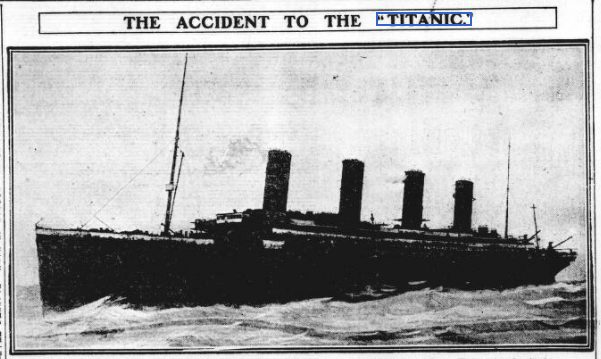


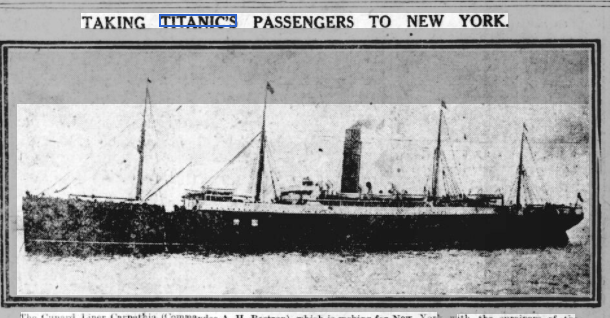


The National Food Supply
1912 was also the year of James Lumsden’s next book – ‘Our National Food Supply’, published by Fisher Unwin. It received good reviews.
The Daily Herald of April 17th reported:
This little book is interestingly suggestive and provides ‘abundant food for reflection’ while it very seriously deplores the lack of a properly organised system of food production for the body. Mr James Lumsden is to be congratulated on the careful and cautious way in which he handles a subject which has been so widely discussed already, and upon which so many opinions have been expressed. He certainly succeeds in enunciating some important truisms in a new way, and insinuates his opinion in quite a pleasant style …..
And the Islington Gazette of March 13th is equally complimentary about the way he addresses what was then judged to be such an important and apparently controversial topic:
A striking little shilling volume on ‘Our National Food Supply’ by Mr. James Lumsden, the editor of the Leeds Mercury, takes up a subject which affects the whole population. It is generally admitted that our dependence on foreign nations for our food supply is undesirable, but many people regard it as a regrettable necessity. Mr. Lumsden disproves the necessity, and shows the disastrous consequences which invariably follow wasteful ways in nations, as well as in individual lives, are rapidly coming to maturity.
Increase of population and wealth in other countries is forcing up the prices and diminishing the available supplies of food. A high standard of agriculture and the cultivation of every rood of cultivable English soil is needed, and more needed in England than in any other country, not only to prevent the possibility of famine, but to furnish for our highly-developed manufactures that natural home market of independent primary producers, for lack of which British manufacturers are deprived of the most profitable and most stable of all possible markets, and are rendered over-dependent upon the remote, barbarous and semi-barbarous nations of the earth.
The article gives an interesting glimpse of a British view of other countries and, over a hundred years on, there is some resonance with the continuing debate over Brexit and Britain’s place in the world!

No doubt James would have been pleased with the reviews but perhaps of greater worth to him was the accolade from Alfred Russel Wallace, one of the leading intellectuals and polymaths of his time. He started as a naturalist who independently proposed the theory of evolution by natural selection. A great admirer of Charles Darwin, Wallace produced scientific journals with Darwin in 1858, which prompted Darwin later to publish ‘On the Origin of Species’ the following year; in some people’s opinion, Wallace was the uncredited discoverer of the theory of evolution attributed to Darwin in the annals of history.
Wallace held the prestigious Order of Merit, awarded in 1908, and was a Fellow of the Royal Society. In an interview on 13 March 1912 about his publication ‘The Great Strike and After – Hopes of a National Peace’, Wallace referred to Lumsden’s work:
A wonderful little book has just been published by a Mr. Lumsden on our food supply. People demand a big Navy to protect our sea-borne food; but what protection will Dreadnoughts afford when the wheat crop fails in those areas from which we now draw the materials for bread? Our one and only protection is to grow our own wheat. And it can be done.
Wallace also made further mention of Lumsden in what turned out to be his final book.
James wrote a letter of thanks to Wallace, a letter which is held in the Alfred Russel Wallace collection:
The Leeds Mercury
Leeds
6th March 1912
Alfred Russel Wallace LL.D, <S.C.L?>
Dear Sir,
I must thanks you very heartily for the kind way in which you have written about my little books on the Land Question. To explain how much I appreciate your letter I would need to enter into a long story beginning with the happiness I felt in reading your “Island Life” which I <got> as a prize for Geology at <Sheridan?> University in 1883 or1884. In the winter of 1884 I read your “Land Nationalisation” and Henry Georges’ “Progress and Poverty.” I could not tell you what your many & varied books have been to me, but so great a place have your writings had in my regard all these years that the commendation of no other man could have filled me with such pride and pleasure.
I do not at all dissent from your contention that on the death of landholders their land should revert to the nation. For many years I have held that in that way ample justice would be done to them. But I am not hopeful of convincing our people of a moral truth so contrary to their prejudices, or of persuading our politicians to address themselves to a task so difficult. Like many others I have of late years suffered from a waning faith in human progress, but events like the Railwaymen’s & the miners’ strikes should be a lesson to cure us of despondency and to reprove that timidity which would shrink from [illeg.] <abolish?> <justice?> even when we know that in order to save humanity every jot and tittle of the laws of God and Nature must be fulfilled. I do certainly feel that in these past mutinies of underpaid workers we may discern the tremors of the industrial volcanism which in time will acquire energy to shatter the superencumbent weight of capitalism.
Your letter will encourage me to go on with the tasks that lie to my hand & write with industry. In <journalism> a man is always being tempted to turn from the straight and narrow path of truth-worship for the pleasure gardens of profit and popularity.
Might I request permission to publish your letter[?] It would give me great pleasure, and would I am sure powerfully inspire the appeal we wish to make to the Government and to the nation.
Again thanking you, believe me
Yours most Sincerely
James Lumsden
The Winds of Change
1912 may have brought a major scoop and accolades but the year also marked the start of significant changes in the lives of the Lumsden family.
Career Move
Firstly, James left his position as editor of the Leeds Mercury to become editor of the Daily Record and Mail in Glasgow. The reasons for the move are not clear: personal?; promotion?; troubleshooting? We do know though that several years later he returned to the Leeds Mercury. His departure was marked by a presentation at the Hotel Metropole, Leeds, as reported in the Leeds Mercury of 25th November:
A MERCURY PRESENTATION
Parting Gift to Mr.James Lumsden
Members of the Leeds Mercury staff gathered in full force at the Hotel Metropole, Leeds, on Saturday evening to make a presentation to Mr. James Lumsden, who recently left the “Mercury” for the “Daily Record and Mail,” Glasgow.
The testimonial (supplied by Messrs. John Dyson and Sons) consisted of a handsome silver tea kettle and service, forming, as the inscription stated, a token of the affection and esteem in which Mr. Lumsden is held by the staff in all departments of the office.
Mr. G. A. Clifff (manager) presided at the gathering, and referred to some of the outstanding events in the history of the “Mercury” during Mr. Lumsden’s twenty years’ connection with it, and to the prominent part Mr. Lumsden had taken in many of them. The presentation was made by Mr George H. Lethem who succeeds Mr. Lumsden, and appreciative words were spoken by Mr. E. Outhwaite (representing the literary department), Mr. G. B. Smith (composing department), and Mr. Walter Johnson (composing department).
In acknowledging the gift, Mr Lumsden referred with pleasure to the fact that not only had every member of the staff oontributed to the presentation fund, but that almost every member of the staff was present to meet him and wish him good luck, a wish which he heartily reciprocated.
Opportunity was taken at the gathering to offer good wishes to Mr Lethem on taking up his new duties.
A cordial vote of thanks was awarded Mr. Cliff for presiding on the proposition of Mr Outhwaite seconded by Mr. Joseph Wilkinson who has been on the composing room staff of the “Mercury” nearly fifty years.
A varied programme was admirably sustained by Mr. G. R. Lister, Mr. John Fraser, Mr. U. Broadbent, Mr. E. Guest, and Master Joe Gibson, who contributed songs; whilst Mr. W. Marshall gave a recitation. Mr. Chas. Pounder rendered valuable service at the pianoforte.
The First World War
It was only three years earlier that James had visited Germany and written about the threat of pan-Germanism and the question of whether Great Britain would go to war. The fears he expressed were soon realised and hit home personally.

James and Ann’s two eldest sons joined up to serve. The elder, Charles, was a Captain in the North Scottish Garrison Artillery. He survived intact, married during the war and subsequently emigrated to Australia in 1922. The younger of the two, Lewis Maxwell, was less fortunate. He enlisted in December 1915, was mobilised in August 1916 and discharged on medical grounds in November 1916. It appears he was severely injured because he is shown in the 1939 register as “incapacitated” and still living with James and Anne.
The start of the war held a surprising and potentially serious challenge for James as the editor of the Glasgow Daily Record. In retrospect it looks like a case of freedom of the press versus national security. The newspaper and James as an individual were taken to court and both charged under the Defence of the Realm Act with crimes that carried imprisonment and heavy fines as potential punishment. The full hearing was published in the Daily Record but here is a local summary from the Western Times of 30th November:
CIPHER CODE.
Glasgow Newspaper Co. and Editor Summoned
SECRET COMMUNICATION
In Glasgow Sheriff Court yesterday, the trial took place of a complaint under the Defence of the Realm Act. The charge was against the proprietors the “Glasgow Daily Record and Mail,” and James Lumsden, of Beaumont Gate, Glasgow, the editor of that newspaper. It was set forth that they did, between June and September 1st, 1915, without lawful authority or excuse, use or have in their possession, or under their control, a cipher code or other means adapted for secretly communicating naval or military information, that said cipher code or other means of secret communication not being intended and used solely for commercial or other legitimate purposes, contrary to the Defence the Realm Regulations 1914, paragraph 22a, whereby they were each liable on summary conviction to six months’ imprisonment or a fine not exceeding £100, or to both such imprisonment and fine. Mr. T. B- Morison, K.C., Solicitor-General, and Mr. Wark, Advocate, conducted the case for the Crown; Mr. J. Anon Clyde, K.C., M.P., and Mr. D. Jamieson, Advocate, represented the defendants.
Detective-Lieut. Weir, of the Glasgow Central Division, sworn, deposed that on August 31st he, accompanied by another detective officer, went with search warrant to the offices of the “Record” and also to the residence of Mr. Lumsden, from whom he learnt that his sub-editor, Mr. Campbell, was in London. Witness showed Lumsden the copy of a code, whereupon the defendant went to a drawer and took out papers. The originals, he said, were drawn up by Campbell. The code was applicable to the North of England, the other was applicable to Scotland. Lumsden further told him his defence would be that both codes were used for commercial purposes.
The Solicitor-General took the witness through the codes put in; as exhibits they disclosed that particular words and phrases were to be used in private wires, addressed by the “Record” correspondents to that paper from the East Coast towns in certain eventualities. The Editorial instructions were to be regarded as private and confidential, and by strict adherence to them the ” Record” was to be placed in possession of information earlier than the news could be transmitted at Press rates. Certain towns were given Christian names; possible grants were classified and by receipt of telegraphed and telephoned messages the Editor was to be put in a position to despatch special reporters and photographers.
Detective-Inspector McGimpsie, in corroboration, said that Lumsden informed him the private wires came quickly, but that Press messages were kept back.
Other evidence included that of Major Hall, an officer on the staff, whose duty it is to administer certain sections the Act. He was of opinion that the code used by defendants conveyed naval and military information which it was undesirable to collect or publish. The code laid emphasis on “definite places.”
On the close of the case for the Crown, Mr. D. Cormac, of the Edinburgh staff of the “Record,” was called for the defence. He worked out the details of and distributed the code in January this year. Other newspapers of repute, he said, made similar arrangements at a time when prohibitions were imposed by the Press Bureau but he denied that there was intention to deceive the postal authorities. There was great irregularity in the telegraph service, and Press telegrams were severely held up. The restrictions of the Bureau became progressively more stringent, but it was not until June this year that he became aware that any regulation made this code improper. The Editor had nothing to do with it but a code was handed to him after it had been drawn up.
Replying to the Solicitor-General, witness said the code became practically useless on January 20th after the issue of the official circular of that date.
Mr. Alexander Campbell, formerly assistant to Mr. Lumsden, now gave as the reason for the code that news sent in the ordinary way was irregularly dealt with. It was delayed to certain papers and let through to others. The code was his own, and was introduced to dodge the people in the post-office who were holding up Press telegrams, but there was no intention to publish anything unauthorised by the Press Bureau.
Mr. James Lumsden, examined in his defence, said that almost from the outbreak of the war there was delay and want of uniformity in dealing with telegraphic communications, and he put a letter from Mr. Edmund Robbins, Manager of the P.A., on the subject of that complaint. Witness passionately declared that any suggestion that he had used this private code for any but a purely journalistic purpose was a foul imputation and utterly despicable.
Mr. Clyde, for the defence, submitted that the whole theory of the prosecution was ill-founded. It was perfectly legitimate for a newspaper to obtain, by use of a code, information that a certain event had occurred, but, under the section, that was not conveying naval or military information. It was simply taking steps to get news to submit to the censor.
Sheriff Craigie will give judgment next Monday.
Judgment duly came a week later. The impression is that the judge regarded the prosecution as a storm in a teacup. James was technically found guilty but there was no imprisonment and no large fine. Both James and the newspaper were fined £10 each.
By 1917 James had returned to the Leeds Mercury as editor and was also writing political articles for the Sunday Pictorial, another paper in the stable of Lord Rothermere, which was later to become the Sunday Mirror. Perhaps partially influenced by his own sons’ experiences he was particularly scathing about what he saw as the government’s mismanagement of the war.
His virtually full-page Sunday Pictorial article of 4th November 1917 began:
THE “TOO LATE” GOVERNMENT AGAIN?
WE MUST GET RID OF OUR FAILURES-
THE PLAIN DUTY OF MR. LLOYD GEORGE
By JAMES LUMSDEN (Editor of the “Leeds Mercury”)
The distinguished journalist and man of letters and a close student of the war, Mr. Lumsden in the following brilliant article gives expression to opinions that are rapidly growing in the public mind in regard to the Government.
“Too late in moving here, too late in arriving there—too late in coming to this decision, too late in starting that enterprise —too late in preparing. The footsteps of the Allied forces have been dogged by the mocking spectre of ‘Too Late’! Unless we quicken our movements, damnation will fall on the sacred cause for which so much gallant blood has flowed …..”
By whom were those words spoken; about whom were they spoken; and when?
By the present Prime Minister, Mr. Lloyd George, about the late Government, of which he was then a member, but not then the head. They were spoken nearly two years ago – in December, 1915.
Almost exactly a year later the old Government fell under the weight of this reproach. It was “too late,” at all events, to save itself. It fell. On December 7, 1916, Mr. Lloyd George became Prime Minister, and there entered upon office a Government that was not to be “too late.” Another year passes. The public waits and watches. Men fight on and suffer. And after that year of further watching, waiting and suffering, what happens? What do we see? Sincere and thinking men are beginning to ask themselves if ghosts of the old hesitations, compromises and delays are haunting the men who came in to quicken the pace. Is the “mocking spectre of too late” still dogging the footsteps of the Allies?
The remainder of the article presented an insightful analysis of everything that was going wrong with the war “strategy”. He concludes with the following admonition:
….. how much longer will the Government wait? How much longer will it remain “too late”? I know of no other man who can fill Mr. Lloyd George’s place. In our hour of need we have reposed in him dictatorial power, and only desire that he should make full and immediate use of it.
The theme continues, as the Sunday Pictorial of 12th May 1918 explains:
THE PRIME MINISTER AND THE ARMY
THE NATION SICK OF CONSTANT INTRIGUES –
NOTHING MATTERS BUT THE WAR
By JAMES LUMSDEN
Mr. James Lumsden is the well-known North of England publicist. As Editor of the great Liberal newspaper, the “Leeds Mercury,” his name is a household word from Trent to Tweed.
IN the North of England people cannot understand the controversies that distract and paralyse the Government in the conduct of the war.
I meet men in many and varied ranks of life, and frequently join in their conversations. I have learned their views, and I have repeatedly been struck by the unanimity with which artisans, munition workers, shopkeepers and business men denounce the waste of time, the waste of effort and the misdirection of thought caused by the never-ending succession of parliamentary crises that end in smoke.
The plain folk of the industrial north are longing for peace. They have worked hard for victory. They have expended their time, their labour, their energy, their savings upon the cause of their country. They have freely given their nearest and dearest – their sons, their brothers, their husbands, their fathers. They have shrunk from no sacrifice, and be the sacrifice what it may, they never will shrink. But they want the war to go on uninterruptedly, unflinchingly, straight to the end with the one resolute, undeviating purpose of securing victory.
The remainder of the article explores the internal political wrangling that seems to frustrate the public by portraying a war strategy in disarray.
The Post-War Years
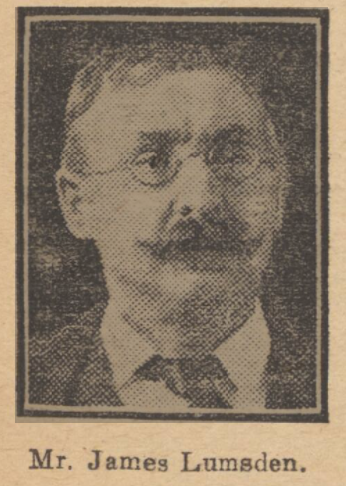
By 1925 James had retired from his position as editor of the Leeds Mercury.
He was still writing as well for the Sunday Pictorial, later Sunday Mirror, and continued to contribute for at least the next three years. He covered a wide range of topics. Here are extracts from just a few.
A post-war trip to Germany resulted in a view of Germany’s regrowth compared to England’s lethargy (14 October 1923):
WHY SET GERMANY ON HER FEET?
HER PLANS ALL READY FOR COMMERCIAL WAR.
German industry not crippled ….. Before the war trade was easy compared with what it is now. The ever-swelling volume of world trade kept British mills going, but that increase has completely stopped. For what remains nations will have to fight as they have not fought for ages, and no nation is so well equipped for the fray as Germany. Those who know what her resources and technical superiority really are, know that the result of “putting Germany on her feet” would be to put England on her back.
The so-called “Garden Cities” were emerging as a solution to the housing crisis (1 June 1924):
GARDEN CITIES FOR NEWLY-WEDS
WHERE HOUSING PROBLEM IS EASILY SOLVED
JUNE is the month of marriages. With its festal raptures and its hard, practical problems it has again come round. These problems, grave in all ages, were, as all know, intensified by the war. The house shortage was more than a handicap; to engaged couples it often created a virtually insuperable obstacle. Nine couples out of ten cannot wed unless they can get a house. Has the Garden City come to the rescue of these young folk?
In a defence of modern civilisation he explored what he saw as the myth of the idle rich (13 July 1924):
IS WORLD GETTING BETTER?
MODERN CIVILISATION THE FINEST OF ALL.
In a speech at Oxford recently, a Rhodes scholar from the United States made the sweeping indictment that all one could learn in England was the old accomplishment of sitting down, of dignified indolence, of doing nothing with propriety.
….. In England, in Western Europe, in America, in all new countries, the ratio of the destitute to the well-to-do is lower than ever it was before. It is lowest where industrial development is highest.
He finishes with a strange comment on the “woman problem”:
It is the crowning glory of “this our poor civilisation” that none hitherto has sustained in comfort, in security, in virtue, in free, useful and beautiful lives, such a large number of women, relatively and absolutely. More than any previous civilisation ours has solved the woman problem. Such a civilisation cannot be a failure altogether.
The subject of women obviously preoccupied him for a while: “Are Men Jealous of Women”, “Problem of the Restless Sex. Woman to Blame for the Erring Husband”, “Woman Not Greatest Sinner. But Even Modern man is Not Degenerate.”
From 1925 onwards his articles were mainly focussed on trade, the colonies and specifically Australia.
Perhaps influenced by his father’s earlier views on better opportunities in the colonies, his son Charles had emigrated to Australia in 1922 with his family – wife Margaret and two sons Charles Henry James and Rhoderic Rothmere. In December 1925 James, his wife Annie and son Lewis embarked on a trip to Australia, most likely to meet up with the rest of the family. It appears that Lewis stayed five years – he is described on the return passenger manifest as a farmer and gave his destination address as “Oban”, Stoke-in-Teignhead.
James’ articles on the colonies continued the theme of “opportunity” which his earlier book on Canada had promoted. At the same time though they lamented Britain’s demise in trade and industry and offered cautious words about the problems of emigrating.
Titles included:
“Men the Colonies Really Need – City Workers Often Make Best Settlers”
“Buy British Empire’s Goods – Our Salvation and Dominions’ Prosperity”
“Migration of Our Industries – Staple Trades return to Former Haunts”
“Why Emigration has Failed – Not Enough Knowledge of Life Overseas”
“Yellow Eye on Australia – Empty Spaces an Incitement to Covetous Eastern Races”
“Fill Australia’s Empty Spaces – Must Open Doors to Coloured Labour”
etc. etc.
After 1928 references to James Lumsden have virtually dried up – presumably he was enjoying a true retirement and had left his days of writing behind him. At some point they moved to Devon because the family appears in the 1939 Electoral Register as living at “Oban” in the borough of Torquay, parish of Stoke-in-Teignhead if the details on Lewis’s passenger manifest of 1930 are correct. Lewis was living with them as was their daughter Dorothy (now Dorothy Andrews) and her husband Stanley, an electrical equipment salesman.
James died in 1949 and was buried in Teignmouth Old Cemetery on 4th March alongside his wife Annie. The Latin inscription on the cross which started this story is accompanied by two others. There is a formal inscription:
In Loving Memory of Annie Francis Lumsden
Born at St Vigeans, Angus Scotland in 1864
Died at Teignmouth 1942
James Lumsden (Journalist)
Husband of the Above
Born at Banff Scotland 1861
Died at Teignmouth 1949
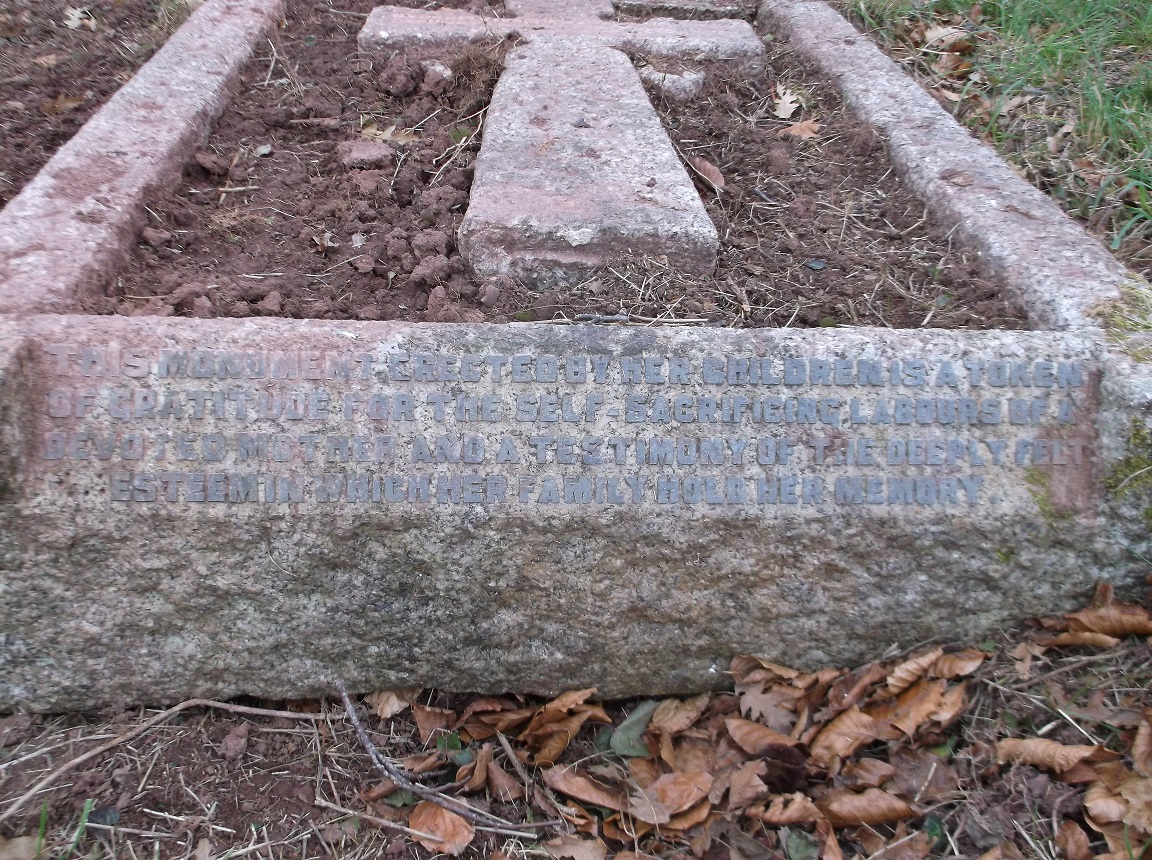
Although this story has been predominantly about James, it started with Annie and it is fitting to end it with her as well with the third inscription which is a poignant dedication to her on the kerbstone at the foot of the grave:
This Monument Erected by Her Children is a Token
of Gratitude for the Self-Sacrificing Labours of a
Devoted Mother and a Testimony of the Deeply Felt
Esteem in which Her Family Hold her Memory.



Sources and References
There is an addendum to the story after this main list of references.
Extracts from contemporary newspapers are referenced directly in the text and are derived from British Newspaper Archives.
Ancestry.com for genealogy
Wikipedia for general background information
Thanks to June Snell for some help in tracking down “Oban” in Stoke-in-Teignhead
Other sources, with hyperlinks as appropriate, are as follows.
Letter from James Lumsden to Alfred Russel Wallace (Citation: “WCP2737,” in Beccaloni, G. W. (ed.), Ɛpsilon: The Alfred Russel Wallace Collection)
Reference by Alfred Russel Wallace to James’ book on National Food Supply
Through Canada in Harvest Time, James Lumsden, Fisher Unwin, 1903:
Our National Food Supply, James Lumsden, T F Unwin, 1912:
Latin verse – the Silvae by Statius:
Latin verse – translation
Anecdotes of Painting in England Volume 2 By Horace Walpole:
Bust of Lady Venetia Digby:
APPENDIX

The Greco-roman poet, Publius Papinius Statius, was born in Naples in 43 AD. Victorious in many poetry contests he received the golden crown from the hand of the emperor Domitian at the Alban festival. There is a prolific collection of surviving poetry amongst which is an anthology of five books called the “Silvae” which reveal much about Statius’ life. Particularly notable in that anthology are his poems on loss, including consolations on the death of a wife.
The link with Teignmouth cemetery comes in the fifth book in which he gives greetings to his friend Abascantus. It starts with a short prologue:
Omnibus affectibus prosequenda sunt bona exempla, cum publice prosint.
Pietas quam Priscillae tuae praestas et morum tuorum pars et nulli non conciliare te, praecipue marito, potest.
Uxorem enim vivam amare voluptas est, defunctam religio.
The second line refers to Abascantus’ wife Priscilla – “The devotion you give your Priscilla is both part of your own character and must win you everyone’s sympathy, every husband’s especially”.
I am sure that Statius would never have imagined that the third line would have transcended the centuries. There are various translations, but the gist is – “To love a living wife is pleasure, to love a dead wife is religion”. The intent is to show that love never dies but just takes a different form.

The line reappears 1600 years later. Sir Kenelm Digby was passionately fond of his wife Lady Venetia who, according to Lord Clarendon, was of extraordinary beauty and as extraordinary fame.
Venetia died mysteriously in her bed in 1633 at the young age of 33, only eight years after her marriage. At Goathurst, where they lived, are two busts of her in bronze; on the pedestal of one is written, as decribed by Horace Walpole in 1871 “the tender line Uxorem vivam amare voluptas defunctam religio”.

 Teignmouth Old Cemetery