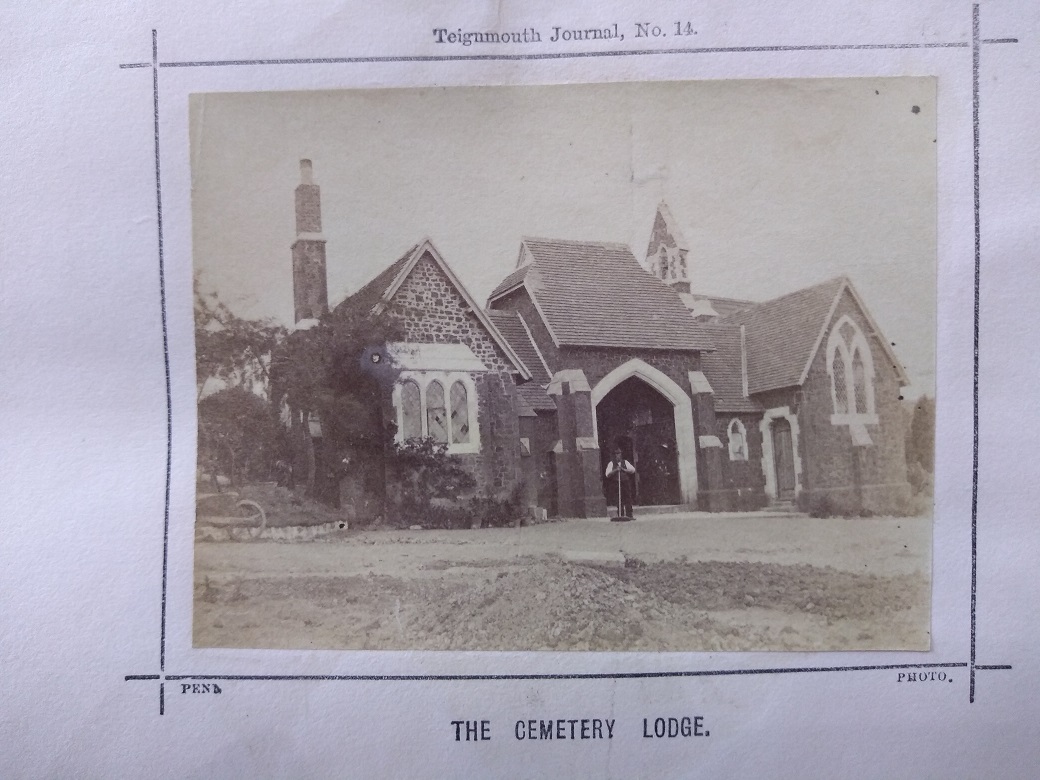
In 1875 a new publication appeared in Teignmouth – the “Teignmouth Journal”, produced by W. Rogers Penn who together with his wife Emma ran a stationery and printing shop in Fore Street. The journal was published monthly and lasted for two years. It was an eclectic mix of local news, including minutes of council meetings and other organisations, articles, poems, serialised stories etc. as can be seen from the contents pages of the first volume:

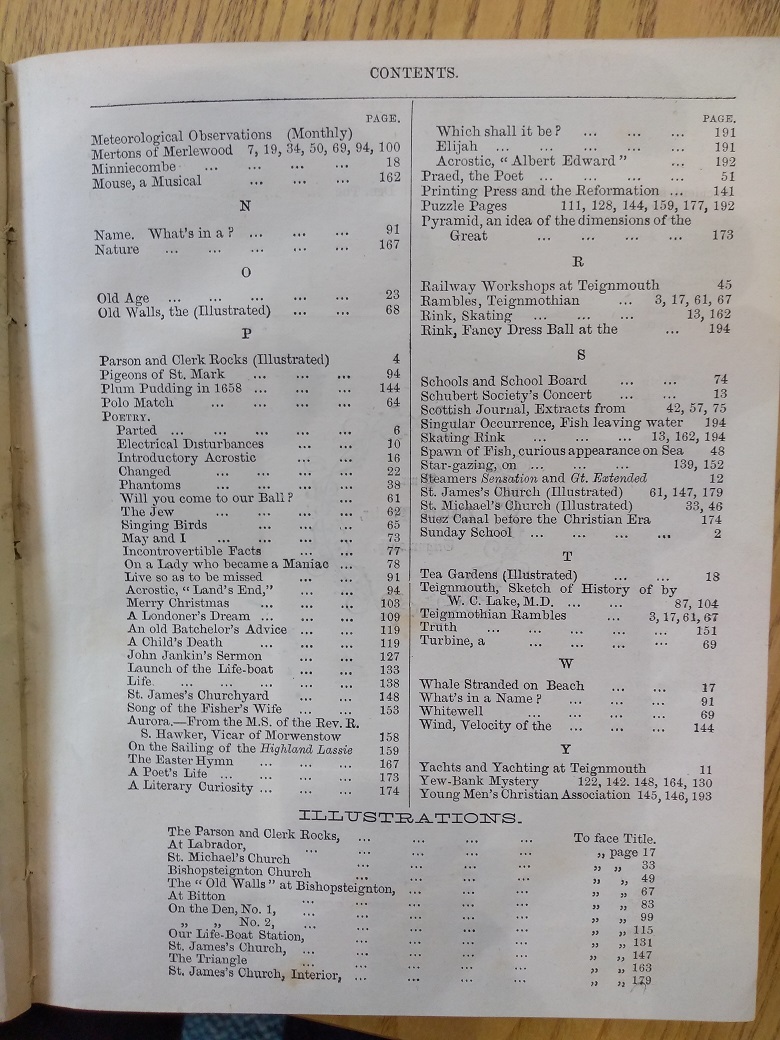
In particular there was a regular feature about rambles in the Teignmouth area. One of those rambles included a walk up to and through the cemetery which gave Mr Penn the opportunity to provide some insights into the cemetery. He was also apparently an amateur photographer, which is an appropriate link with the last blog about the Teignmouth photographic pioneer, Samuel Poole.
Here is his description and a copy of the original photograph which accompanied it, sourced from the SW Heritage Centre in Exeter.

About three-quarters of a mile from the town we pass the Cemetery which we will turn aside for a few moments to examine. Here one of the first things which strikes the visitor is the number of persons who have been brought from a distance for burial.
Strangers will do well to bear this fact in mind when they hear of the death rate of a watering place being 20 or 17, or even 15 per 1000, because in most cases it gives very erroneous idea of the salubrity of the climate. They must remember how many invalids are sent to the sea-side as a last resource when all other remedies have failed, in hope of patching up the constitution already past all human skill – but literally only to die and so swell the death-rate.
And here I would call attention to the report of our Medical officer, made at the last monthly meeting of the Local Board, where he states that the death-rate of Teignmouth for the last quarter has been only a fraction over 11 per 1000 – one of the lowest rates I believe in the Kingdom – and this in spite of the statement put forth by Dr. Rhind of Torquay, some time since presumably with the intention of misleading strangers as to the comparative healthiness of Torquay and Teignmouth. Such facts as the above show the matter in a different light. Can Torquay boast of a lower rate than ours?
The Cemetery was opened in 1855. It then covered about two acres divided into consecrated and unconsecrated, with a neat chapel in each portion. It was pleasantly laid out and planted with shrubs and flowers. For some years past this has been found inadequate to the demands of the two parishes, and an additional piece of land has been lately added, the present extent being something over four acres.
Invalids and others who cannot enjoy a longer walk may pass on through the lower gate, cross the New Road, and down the Buckeridge Road, through Brimley, back to the town: or: the return may be along New Road to the Dawlish road and so home as described in a former ramble: or; by following the steep and rugged lane (Rocky lane) opposite the New Road near the Cemetery the return may be by the way of Coombe and Coombe Vale – a situation by the bye, than which none is more suited for the residence of an invalid, being perfectly sheltered from the cold and trying winds, but open to the full influence of the sun, and consequently being somewhat too relaxing for those in robust health.
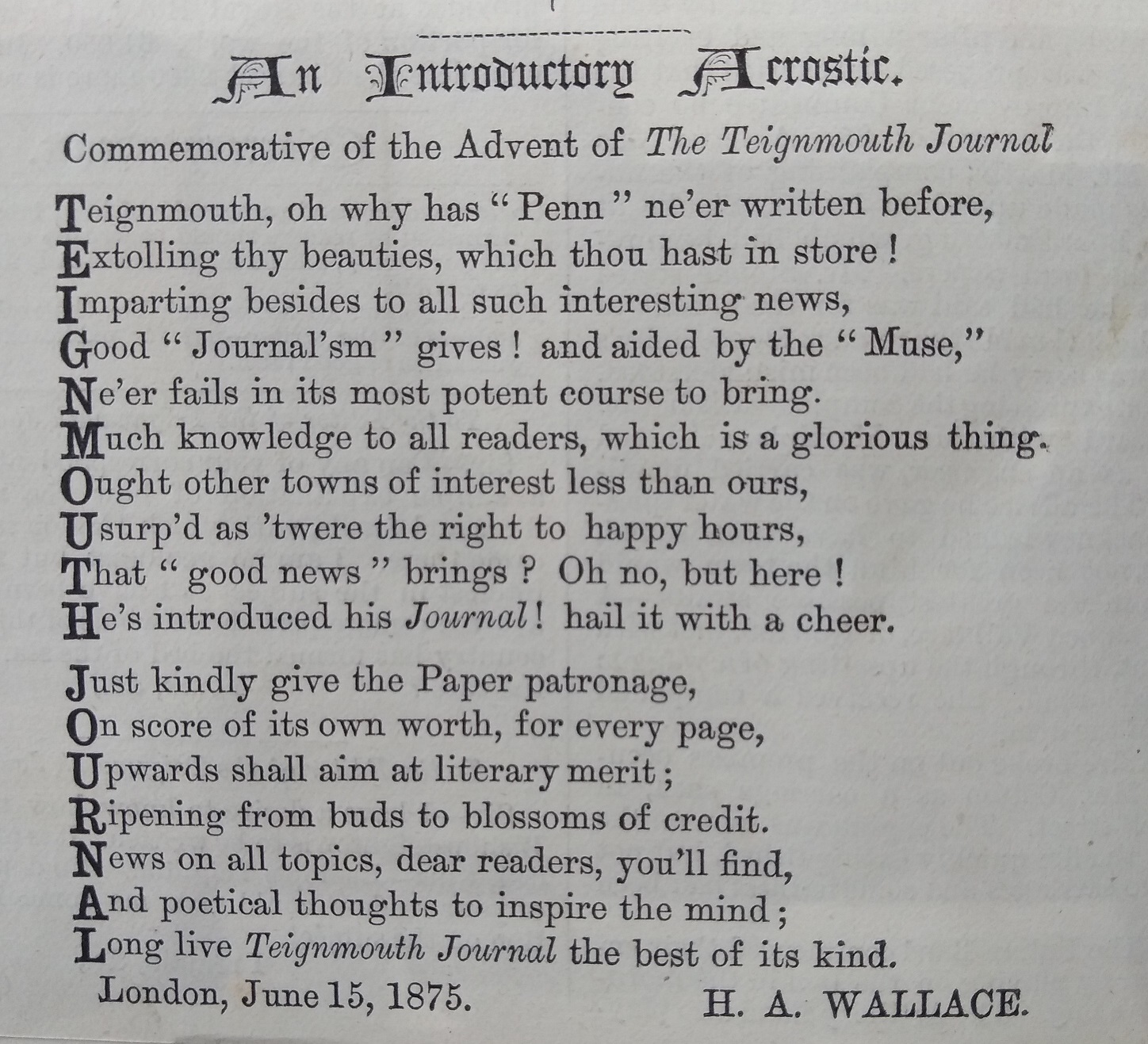
The launch of the Teignmouth Journal and its publisher William Rogers Penn was applauded in an acrostic poem that appeared in the first issue:
The fact that the Teignmouth Journal lasted only two years came as no surprise to the archivist at the SW Heritage Centre who explained that similar publications produced by individuals came and went as the effort required to keep them going took its toll. However, the Teignmouth Journal came to an abrupt end because William Rogers Penn died, probably unexpectedly, on 17th February 1877 aged only 39.
His death was noted in the Exeter and Plymouth Gazette of 23rd February 1877:
The funeral of Mr. William Roger Penn took place yesterday (Thursday). Ministers of various denominations, and a large number of tradesmen, paid their last token of respect by following the remains to the grave. The deceased was much respected, and by his honest, upright principles, had won the friendship of all connected with him. The coffin was of polished oak, with brass mountings.
He is buried in plot L9 of Teignmouth Old Cemetery, an area that remains to be cleared.


William and his family had not been in Teignmouth that long. He had started his own career as a land agent, surveyor, auctioneer and appraiser in Bromsgrove in 1859 as this extract from the Staffordshire advertiser of 31st December 1859 shows:

Judging by the amount of publicity in the newspaper archives for the next six to seven years it appears that he did very well in this profession. But in 1866 he changed both his location and profession; he had married his wife Emma in 1863 and the family now moved to King’s Heath where William seems to have established himself as an agent for an Assurance Company:

On the second of March 1867 their third daughter Charlotte Lucy was born but sadly died four years later on 20th November 1871 from “diphtheritic croup”. It was after this that they seem to have decided to move to Teignmouth, where their son was born almost exactly a year later. They ran a stationers and printers in Fore St, where they were also agents for the Western Times and Western Mercury. Following his death the business was transferred to his wife but there is nothing in the archives to suggest how her life in Teignmouth subsequently progressed. Emma herself died on September 13th 1912 and was buried with her husband William in the same plot, L9, in Teignmouth Old Cemetery. Her funeral had a slightly longer coverage in the Western Times of 24th September 1912:
At the Cemetery, Teignmouth, the funeral took place of Mrs. Penn, widow of Mr. W. Rogers Penn, late of Teignmouth. Mr. Penn at one time kept a stationery and newsagent’s business in Teignmouth, and was editor of the old “Teignmouth Journal”, a few copies of which are still treasured by their fortunate owners. The mourners included Mr. Prosser Penn, Mr. Walter Penn, sons of the deceased lady, two friends from California, and Messrs. J.J.O.Evans and T.R.A. Tothill, the latter representing his mother, who was Mr. Penn’s chief assistant when he kept his Teignmouth business. A service was held at St. James’ Church before proceeding to the Cemetery.
Returning to William Rogers Penn, he obviously had an amateur interest in photography. He had been commended for a couple of photographs he had taken of the Hop Pole Inn in Bromsgrove and is recorded in the Teignmouth Journal as giving a magic lantern show:
May 23rd. An entertainment of Dissolving Views, with accompanying descriptive papers, was given by W. Rogers Penn in the Assembly Room, London Hotel, before a large audience, in aid of the Young Men’s Christian Association, the subject being the Arctic Regions ….. The views were much admired, especially the Icebergs by day and moonlight and with the Aurora Borealis.
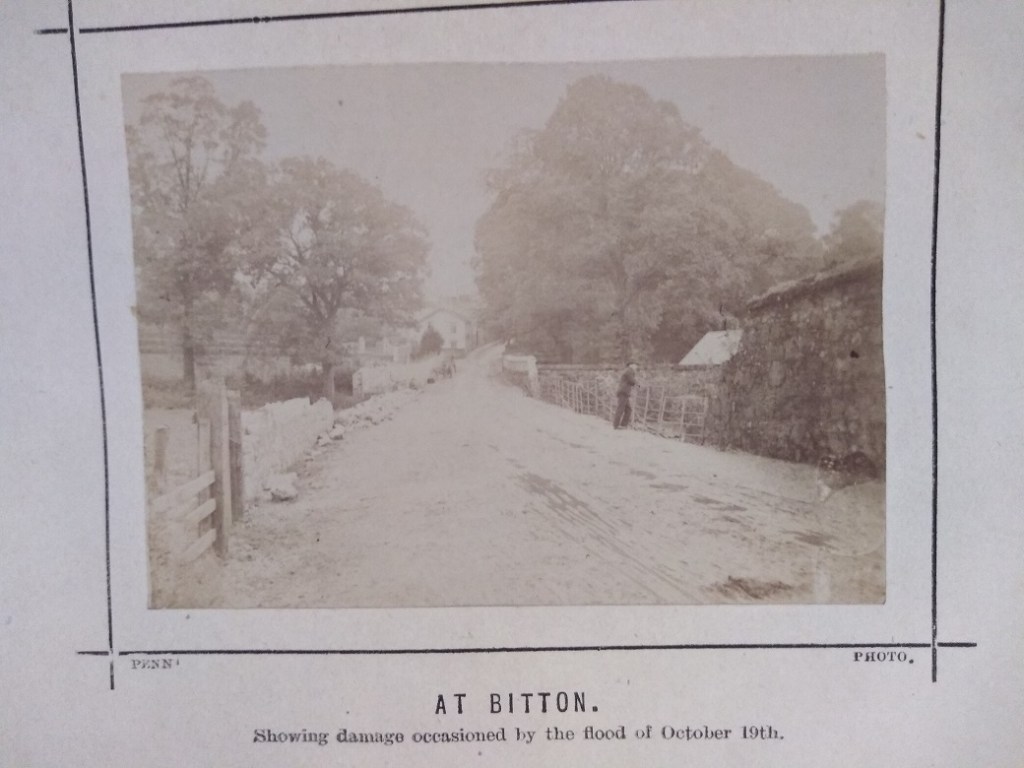
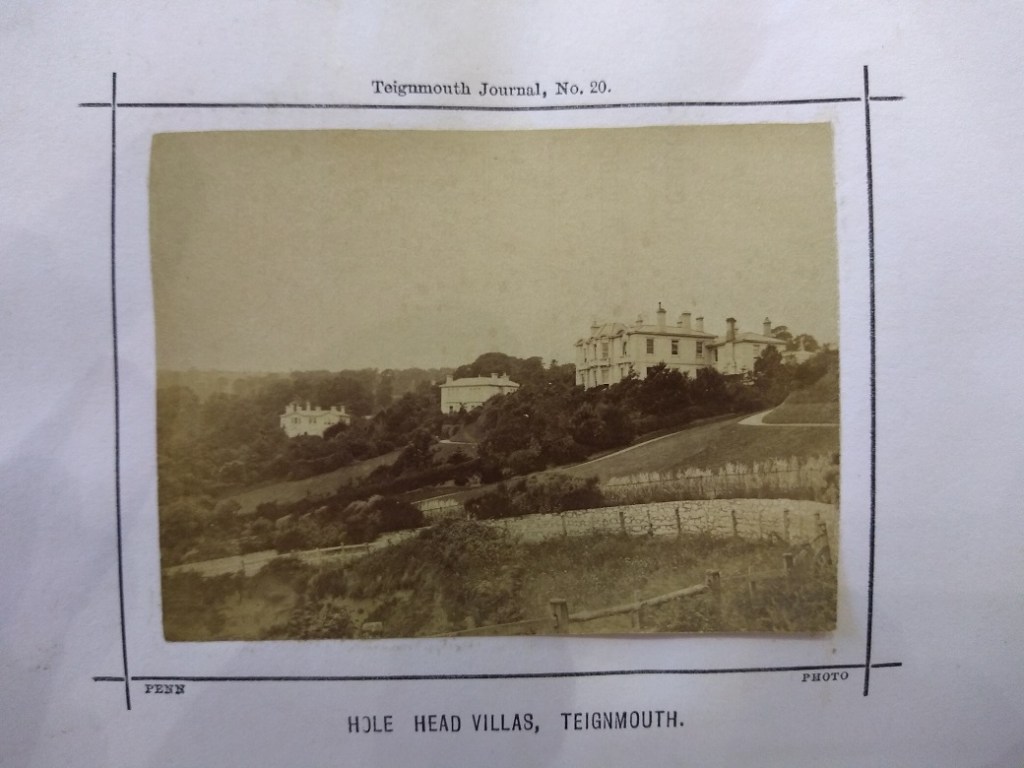
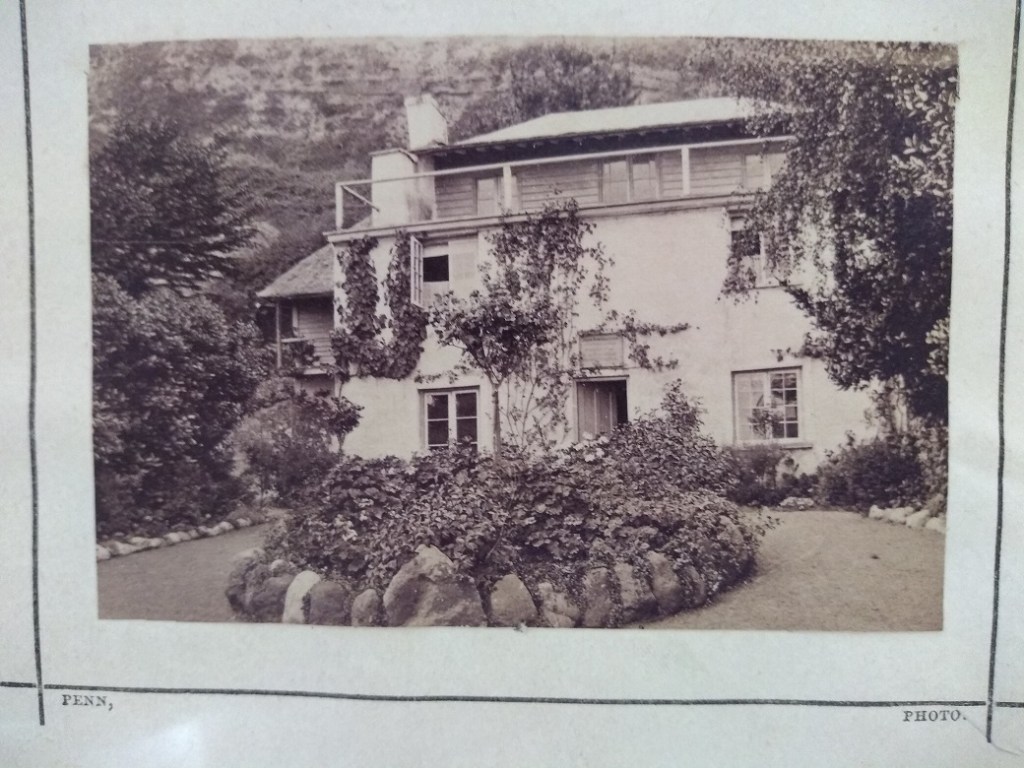
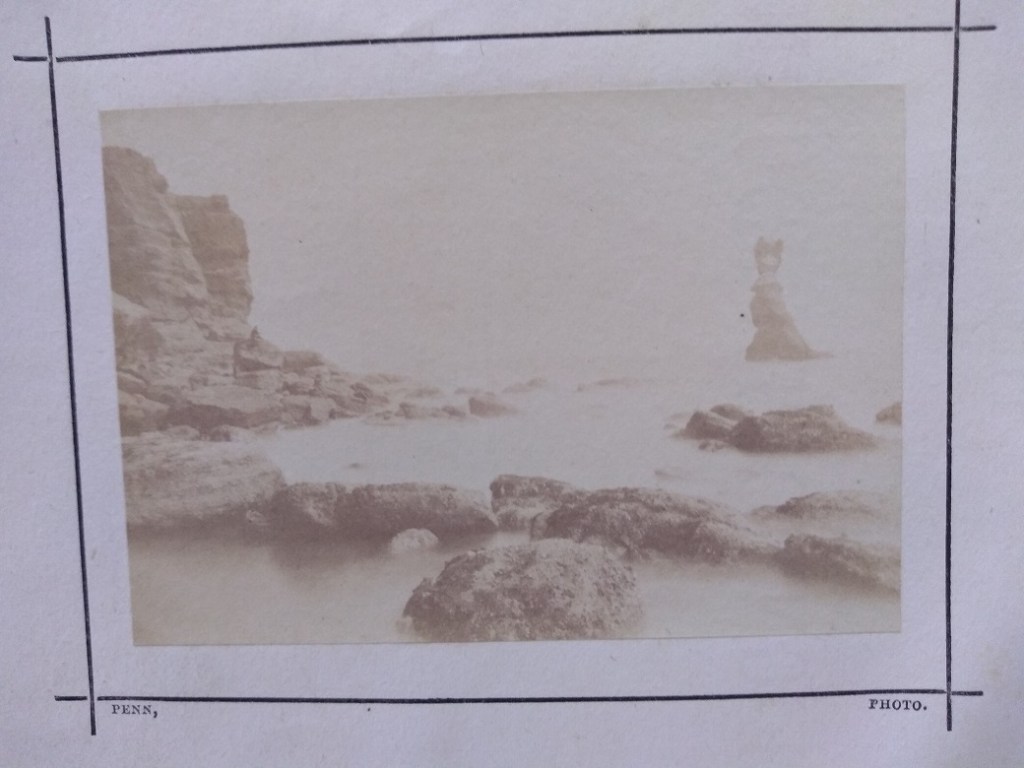
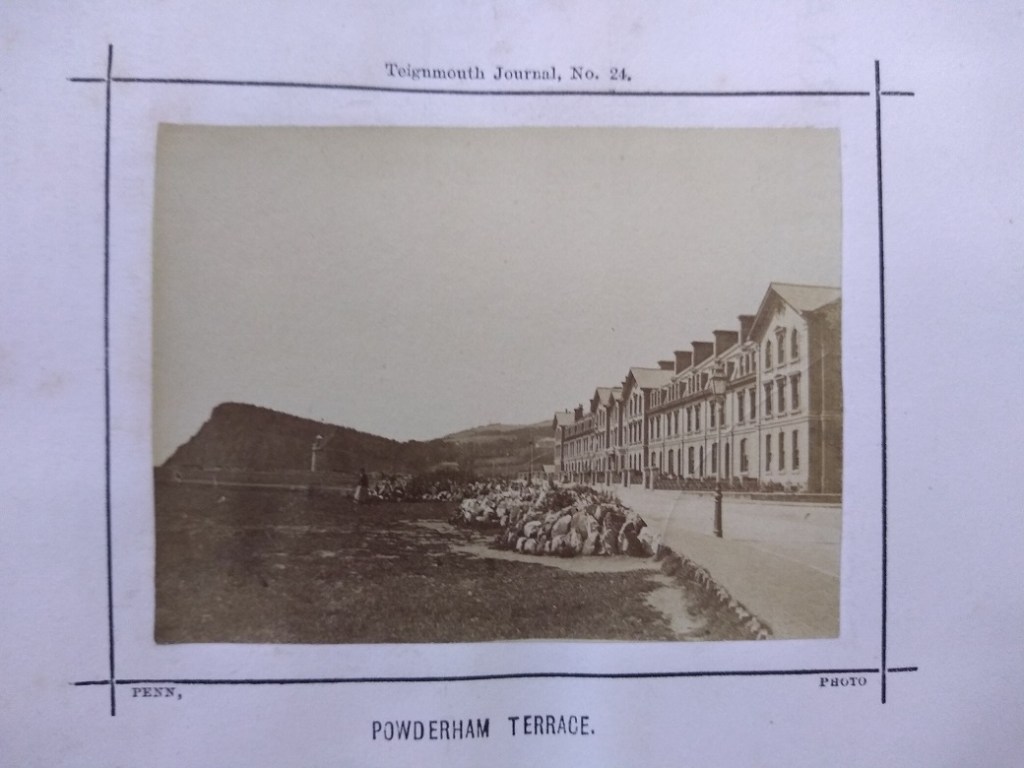
His legacy of the Teignmouth Journal included a number of his own photographs of the area, some of which are shown here to conclude this story:





Acknowledgements
The research for this story was prompted by a photograph from Viv Wilson MBE (a copy of William Penn’s original Cemetery Lodge in the Teignmouth Journal). The SW Heritage Centre was able to provide access to original source material.
Sources and References
Extracts from contemporary newspapers are referenced directly in the text and are derived from British Newspaper Archives.
Freebmd and Find My Past for genealogy
The Teignmouth Journal
 Teignmouth Old Cemetery