Introduction
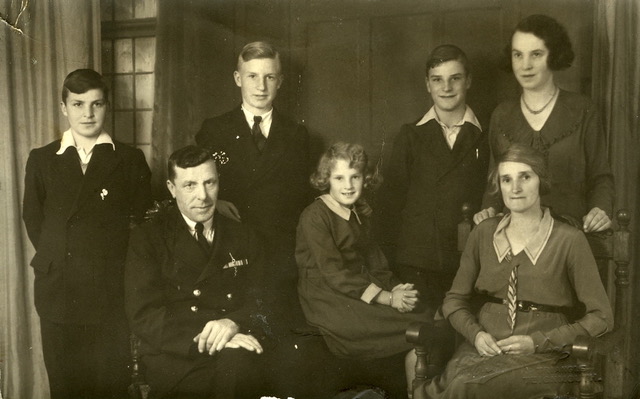
Graham White is another follower of the Friends of Teignmouth Cemetery who contacted us again after the post about our “Celebrating Five Years”. He has done considerable research into the lives of his grandparents, Thomas Miles Bloomfield and Mary Ann Phillips Bloomfield. There is remarkable resonance between Thomas’ story and that of Samuel Brokensha, the distant cousin of Mike Brokenshaw who gave his story in an earlier recent post – both served in the navy and subsequently the coastguard service ….. but 80 years apart!
Most of the stories we publish are based on standard historical research from documented sources. So it is wonderful to be able to present this story with its unique personal family details that can only come from the family directly.
This is Thomas’s story, as told in Graham’s own words, with some limited editing to fit within this blog. There are two partners in a marriage and Graham has produced an equally fascinating biography of his grandmother, Annie, which will feature in an upcoming post.
In Summary
Thomas Miles Bloomfield grew up in a close-knit working-class family which, while not well off, would have been considered reasonably comfortable with a grace and favour railway house and two incomes.
He was the only one in the family to take the services as his career and this was dominated by The Royal Navy and The Coastguard service. From the time he left his home in 1900 his life was about service, the sea and travel until he arrived in Teignmouth in 1928 when he settled down with his family. Annie passed away when she was young in 1935 leaving him to bring up the children.
Family stories suggest he was much loved and was well respected in his adopted town and in particular around the fishing community in Ivy Lane (Editor’s Note: Samuel Brokensha also lived in Ivy lane!)
Childhood
Thomas Miles Bloomfield was born in the village of Burnham Sutton or Dale Hole Holkham, Norfolk, England. His father, Thomas Miles Bloomfield (snr), was the licensee of the Victoria Inn from 1881-1883 (and a butcher and cattle dealer at the same time) which was in Burnham Westgate, a village that is now a part of Burnham Market. His parents (my great grandparents) were recorded as publicans at this address in the 1881 and held the licence to 1883.
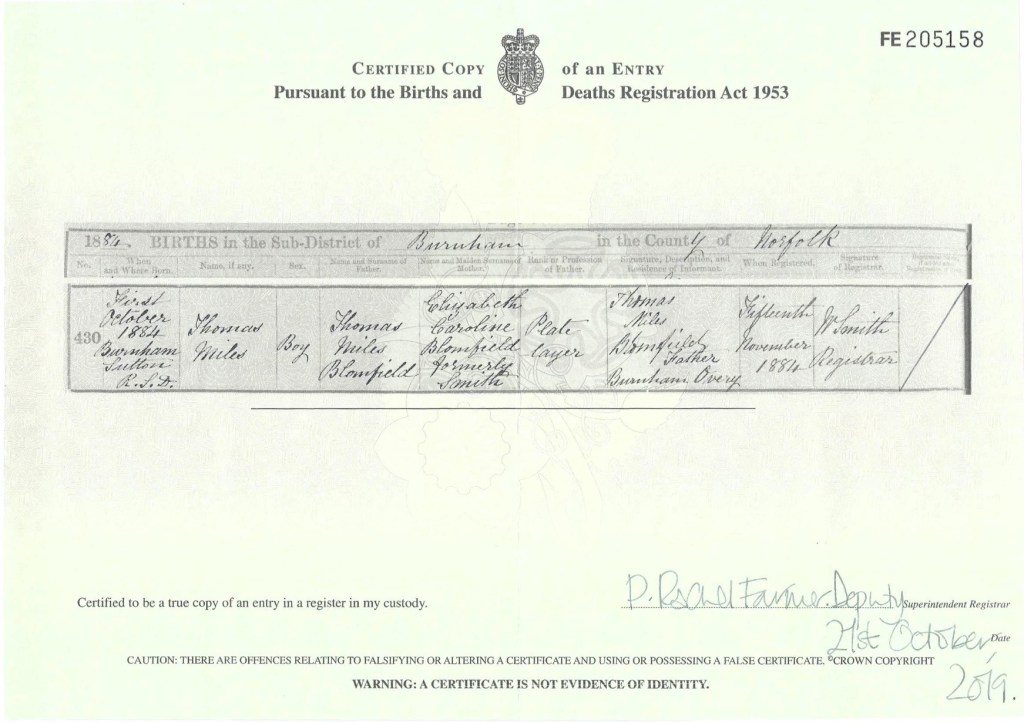
There is some confusion arising from Thomas Miles’s birth certificate contradicting all other known information about him. It records the family surname, including his, as Blomfield, his birth place as Burnham Overy, and his birthdate as 1st October 1884.
The surname could be explained by misspelling but this version was used as the family surname in previous generations including at some time his parents. In all other known documentation about him, his parents and his siblings, the family name is given as Bloomfield.
His birth certificate in 1884 records his birth place as Burnham Sutton but he was baptised in Holkham in July 1885. However, his younger sister and brother, Lucy Bridget and John William were registered as being born in Holkham, which was the village (and part of the Holkham Hall Estate) located close to the Great Eastern Railway (GER) gatehouse, where the family moved to around 1885/6 when the railway was first opened. The residence of his father; Thomas Miles senior, on the birth certificate, is stated at Burnham Overy and his occupation is shown as a Platelayer, which confirms his change in job from publican to railway worker. So, Thomas Miles (jnr) was probably either born in Burnham Sutton at the Victoria pub when his father had relinquished the licence and changed his job or in the Dale Hole GER railway gatehouse.
The family had definitely moved to Dale Hole GER railway gatehouse, Holkham, by 1885 – 1886. His father’s occupation was still Platelayer and his mother’s occupation was Gatekeeper (railway) by the time of the next census in 1901. The move would have coincided with the railway opening in 1886.

His parents lived at the railway gatehouse address for over 20 years and were registered living there in the 1901 and 1911 Census with the same occupations on the railway. This remote house now sits between the junction of the A149 and the B1155 immediately adjacent to the north west boundary to the Holkham Hall Estate. Today, the building still exists and is called Snuggles Cottage.
The cottage is very remote, sitting in the lee of a small hill which must have formed part of the railway embankment on a blind bend on the A149 road, being almost equidistant between the villages of Holkham, Burnham Overy and Burnham Overy Staithe. The land lying to the north is flat leading to low lying fields and the salt water marshes and the expansive beaches of Norfolk on the North Sea. It is very open to the easterly on shore gales.
The house is only 1.3 miles away from Burnham Thorpe where Horatio Nelson was born and a few hundred metres from the Norfolk Coast. Maybe this was the inspiration for Thomas Miles going to sea! One thing clear is that he had a love of trains, which was inspired by being brought up in a railway crossing gatehouse. This was passed onto myself and my elder brother when he took us regularly to watch the trains on the Teignmouth seafront promenade leading towards Spreypoint close to where the whale bone was positioned alongside where a pill box defence emplacement was erected during WWII.
The whole family of 7 lived in this very small railway gatehouse. The children would have been real-life ‘railway children’. They would also have spent much time on the vast beaches, close by, and collecting shoreline shellfish which is abundant there. I always remember great Aunt Grace, wife of sibling John William, sending to my mother, in the post, samphire, which grew in the salt marshes around the Norfolk coast.
The family also must have been intrigued by the gentry living in Holkham Hall. There is no evidence that any of them worked in the hall or its estate but as some of the children were christened in the Holkham Estate church it suggests that they were allowed into the lower village.
Thomas Miles started his schooling in the Holkham Village School, a part of the Holkham Hall estate, in July 1892. His elder brother Harry had started at the same school in July 1890 and his younger sister, Lucy in July 1894. There are no records of when any of the family left the school but Thomas Miles would most likely have left when he was 14.
Royal Naval Service
His service record shows that he enlisted in the Royal Navy on the 16th January 1900 when he was 16. He was previously employed as a labourer. His service career (not taking into account his coastguard career when he was posted, for a short while, to South Ventnor in 1914 as a Coastguard Boatman) was almost 19 years.
He appears to have signed up for a 12 year commission, on his 18th birthday, in 1902. He was due to leave the Royal Navy in 1914 and clearly was already contemplating a new career in the coastguards’ section which was, at that time a part of the Admiralty. (The ownership was not relinquished by the Admiralty until 1923 when it’s role was redefined as a coastal safety and rescue service and thereafter overseen by the Board of Trade).
Bearing in mind the outbreak of WWI was July 1914, he was reposted to Victory 1 in Portsmouth on 1st of August 1914. It is reasonable to assume that he was either requisitioned back to ship service, or he volunteered, as a part of the war effort.
For details of his postings see the attached Service Record and Postings record in Appendix 2.
After his training, his career until WWI appears to have been mainly around the manning of mothballed or reserved ships, primarily around Portsmouth. He was promoted through the ranks to Petty Officer.

On his return to Royal Naval service in 1914, at the commencement of WW1, he was first posted to The Empress of Japan, and then HMS Lunka which patrolled the east coast of Africa, Tanzania and Zanzibar in the south and up to the Yemen and India in the north. He remained in this area for the rest of the war. The photo shows him in Aden in 1916 and bears the inscription “To my dear little daughter Eva Mary from her loving father at Aden on her dear little birthday 10.11.16″
The log book of HMS Lunka does not suggest a lot of active engagement with the enemy but the mission of this ship, being stationed in the area, would have been to stop the enemy or their allies’ shipping reaching or leaving the German Colonies in and around East Africa, and thus stopping troop and supply movements. HMS Empress of India did engage in some direct enemy action in the Red Sea. It is thought that his short attachment to HMS Empress of Japan was only to take him to his permanent posting on HMS Lunka.
Marriage, family and death
He met his wife; Mary Ann Phillips Hutchings (known as Annie) in Ventnor in 1913. She was a Devon girl from East Prawle, Chivelstone, and was living in one of the coastguard cottages looking after her brother-in-law, William George Eastman, and his 3 children (1911 Census only shows two children as the eldest daughter, Melita, was sometimes sent to relatives due the illness of her father). William George was married to Betsy Eva who was Annie’s elder sister. She had died in June 1909. Annie had moved to live with her sister and her family either when their mother died in 1901 or when her sister became ill sometime before 1909. (This cannot be confirmed but circumstantial evidence suggests that she was with her sister from 1901). It is understood that William George also became ill shortly after his wife Betsy died and he passed away in 1913, a month before Thomas Miles met Annie.
Thomas and Annie married in Ventnor Holy Trinity Church on the 1st of June 1914 and their first child; Eva Mary (Mary) Bloomfield, was born on the 10th November 1915. Thomas would not see his daughter until 1919 when he came back from his Indian Ocean war service in the Royal Navy. Annie and Eva Mary stayed in West Street Ventnor until his return.
They eventually had 5 children, but only Eva Mary was born in England.
Annie passed away on 12th December 1935 at their coastguard station home at no 1 Ivy Lane, Teignmouth.
Thomas Miles passed away at Teignmouth Hospital on 28th June 1953.
Coastguard Career
On return from his WWI service, Thomas Miles was posted initially to Victory I Portsmouth and then reposted to Ventnor as a Leading Boatman in the Coastguards on the 28th May 1919. He did not stay long and on the 26th August 1919, he was posted to Belmullet, County Mayo, Eire and the family moved with him. This was at the time that the Irish War of Independence had commenced after the Soloheadbag ambush in January 1919 (which by coincidence involved the death of an R.I.C. Constable who was born in Belmullet).
Thomas Miles was stationed at Bellmullet, Blacksod Point and Buncrana all in the same area until 23rd February 1921. During this time the ‘Troubles’ were spilling over into this region. In October 1919 a young boy was shot by a sentry guarding the local wireless station. In June 1920 an R.I.C. constable was killed and three injured during a riot on the main street. In late August 1920 a local coastguard station (undetermined) was attacked. The raiders were interrupted by a police patrol and shots were exchanged. The raiders escaped but not before the coastguard station was destroyed.
It is not known if Thomas Miles or his family were directly involved, or how they were affected by any of these conflicts, although they were inescapably in the middle of everything going on. The only known reference to the dangers of the job, at this time, was that he carried a gun for protection. This information has been passed down through the family. The Coastguards were particularly disliked because they not only represented the ‘oppressive British’ but they inhibited the smuggling activities, much which was more to do with local crime rather than a part of the political differences.
On the 24th February 1921 he was posted to Cloghy (Cloughy) near Portaferry, in Northern Ireland.
The next period of his career and the location of his family is not clear. Information thereafter is not on his service record, as by now the Coastguards were transferred to the Board of Trade, as mentioned earlier, and his Royal Naval Service career was now finally over, but his Coastguard Service continued. However, he was certainly still at Cloghy on the 6th June 1925 as my mother, Vera Ellen, was born in Portaferry on this date.
Sometime between June 1925 and July 1926 he was posted to Drummore near Stranraer Scotland. Records have not been found relating to this posting. However, Eric Bloomfield, his son, recalled going to school in Stranraer. In one of the two post card albums in existence, originally owned by Annie, his wife and then by her daughter Eva Mary Bloomfield, there is a page dedicated by A Galloway of 36 St John Street, Stranraer dated 12th July 1926. They therefore had moved sometime in the preceding 12+ months from my mother’s birth place.

A Coastguard in Teignmouth
On the 4th December 1928 Thomas Miles was posted to Teignmouth Coastguards as HM Coastguard. He was promoted to Station Officer on 1st November 1942 and retired on 1st June 1946 so his service at Teignmouth covered the entire second world war.
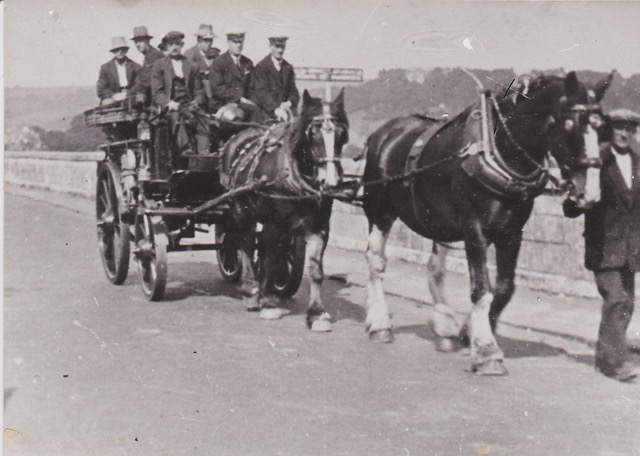
There are three Coastguard commendations for him during his time at Teignmouth:
4 September 1931, CGM 21298
With reference to the report on Form CG15 forwarded by him relating to the rescue of a man and a woman who were cut off by the tide at Ness Rocks, Shaldon, on the 27th August, the Inspector is informed that the Board highly appreciate the good work done this occasion by Coastguard TM Bloomfield and Messrs D. Chapple, F. Tiltman and W Hook enrolled members of the Teignmouth Life Saving Company. Signed D. J Killingback
19 August 1932, CGM 23277
With reference to the report of the 16th August forwarded by the District Officer Torquay relating to the rescue of three young ladies cut off by the tide near Maidencombe on the 10th August, the Inspector is informed that the Board highly appreciate the excellent work done on this occasion by CG Bloomfield, whom it is observed made hazardous ascent of a cliff in order to effect this rescue. This communication which has been noted in the records. Signed N C Orton 19 August 1932
23 August 1939 CGM TH/3/30
With reference to the report on Forms CG 15 and 15A regarding the rescue of a person from the cliffs at Maidencombe, Devon on August 9th, the Board note with satisfaction the service performed by Coastguard T M Bloomfield, Teignmouth, on that occasion.
All of these events received considerable national press coverage.
Other instances of his actions were recorded in the Teignmouth Post and Gazette of 24 April 1936:
Bundle Head Incident
Girl Stranded 300 feet Up Cliff
Rescued by Teignmouth Coastguards
Three hundred feet up a cliff, and unable to ascend or descend, was the predicament a young lady visitor to Littleham, near Exmouth, found herself in after she had attempted to scale Bundle Head, between Labrador Bay and Ness Cove, Shaldon, on Thursday afternoon.
According to a story related to Mr A. S. Williams, manager of the Labrador Hotel, by the girl’s companion, who was accompanied by three children, the party had come from Exmouth, and after clambering around the rocks her friend expressed the intention of climbing up the cliff at Ness Cove. She tried to dissuade her, and after walking on a little way, turned round and saw that the girl had climbed a considerable way up Bundle Head and was in difficulties. She quickly went to the hotel and reported what had happened.
Mr Williams told a ‘Teignmouth Post’ representative that the lady was so excited that he could not make out how high the girl had climbed, but he immediately sent a number of men along with tackle with the intention of effecting a rescue if she was only 50 or 60 feet up. They found, however, that she was near the top, and Mr Williams, who is a member of the intelligence branch of the Coastguards, then phoned the Teignmouth Coastguard Station and Station Officer T. Bloomfield, accompanied by Coastguard A. Ruse and Master Eric Bloomfield left for the scene of the occurrence with the cliff rescue apparatus.
On arrival, Mr. Bloomfield was lowered over the edge of the cliff, and having fitted the ‘breeches’, the girl was pulled to the top apparently little worse for her experience.
In a sequel to the Bundle Head Rescue, the following report appeared on May 1st 1936:
Trapped Girl Thanks Coastguard
Miss Elitta Carles has written from The Bungalow, Littleham, thanking Coastguard Station Officer T. Bloomfield and his colleagues for rescuing her from Bundle Head on Thursday of last week. She explains that she could not thank them at the time as she could not speak English very well. Miss Carles is, apparently, a Belgian and it is hoped that her experience of being trapped 300feet up the cliff will be a lesson to other would-be ‘mountaineers’.
In conversation with a ‘Teignmouth Post’ representative, Mr Bloomfield said from below, the cliffs look comparatively easy to climb, commencing with a gradual slope, but further up the ‘face’ is almost sheer and the earth loose. “It would be a 100 to 1 chance finding a firm rock to complete the climb” remarked Mr. Bloomfield, who did not think much for the chances of a person who commenced to slip.
Unfortunately, there is not only this risk of a rock giving way, for people finding they are unable to either up or down are likely to lose their heads with serious consequences. It is a mystery how Miss Carles got as high as she did, clad as she was, according to an eye witness, in a heavy leather coat and stout wellington boots. She must have been one of the hardy species of her sex, for apparently, she was perfectly cool, calm and collected when rescued.
Having reached Labrador a few minutes after the arrival of Mr. Bloomfield and his party, our representative found the telephone situated at the top of the cliff-lift a useful medium for information, for from an advantageous point at the Hotel, Mr Williams, the manager, was able to give him a running commentary as to how the rescue work was proceeding.

World War II
There is no known information recorded of any specific Coastguard activity, associated with him, at Teignmouth during the War although there are some references to actions involving Teignmouth Coastguards in the press.
PHOTO SELECTION FROM 1942/43
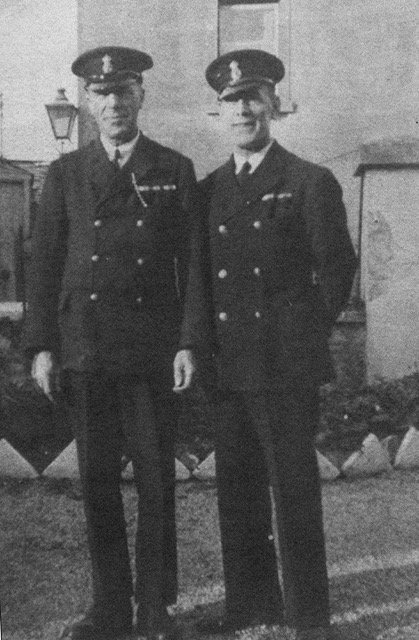


In the Viv Wilson book, ‘Teignmouth at WAR 1939-45’ she writes:
Chief Tom Bloomfield (L) and Bert Parrick at Ivy Lane. (see Photos addendum) These two men kept watch from the Coastguard look-out at the foot of Cliff Walk day and night through the war years and witnessed many incursions. On one occasion a German pilot made a slow approach, as if on photographic reconnaissance. He flew up the river and returned past the Ness before dropping bombs in the sea. Eye witnesses say that it appeared that the pilot had no wish to damage Teignmouth.
Some local people camped out overnight up in Eastcliff meadows rather than risk being buried alive at home.
The Sprey Point look-out could not be reached from the sea wall, blocked by anti-invasion barricades. The railway line was used for access and there was great sadness on two separate occasions when auxiliary Coastguards Tom Barnes and Frank Riddle were killed by trains’.
The following anecdotal information has been handed down through the family:
My mother, Vera Ellen White (nee Bloomfield) recalled an incident when she was in the back garden area, with her father, between Ivy Lane and Foresters Terrace overlooking the back beach. She recalled a German plane came down the River Teign from the direction of Newton Abbot and it strafed the houses. She and her father crouched down behind the beach wall that still exists today between Ivy Lane and Foresters Terrace.

On VE day a coastguard rocket was fired in celebration by Thomas Miles Bloomfield together with his future daughter-in-law (Sheila) who was on leave from the ATS.
Retirement

Thomas Miles retired from the Coastguard Service on 1st June 1946. He moved from the Coastguard House in Ivy Lane and bought East Cliff Cott, Mere Lane Teignmouth. He clearly still wanted to live right next to the sea. He lived there with his daughter, Vera Ellen White, her husband Leonard and subsequently their two first children; Norman Miles and Graham Lennard. He would take his grandchildren to watch the trains at the end of the promenade close to East Cliff Bridge.
He pursued his hobbies being a member of The Den Bowling Club, watching the horseracing at Newton Abbot Races and following from afar his Norwich City football team, ‘The Canaries’.
He also opened a Weighing Machine kiosk on the east side slope outside Teignmouth Pier which he operated during the summer until his death in 1953. The scales were given to the boxing club after his death.
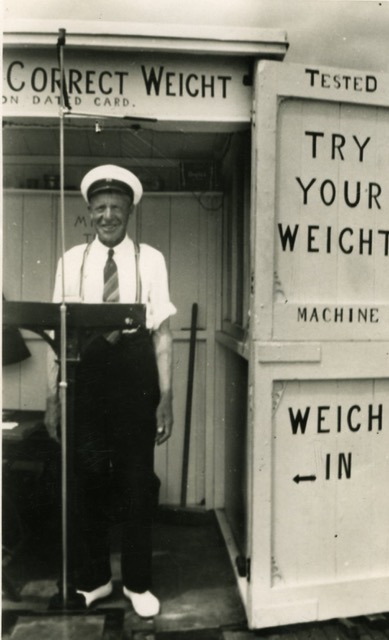

Dedicated to my grandfather.
“The more I learnt about him the more I understood what made him the man he was. I just wish I could have had the chance to know him.“
Graham Lennard White, grandson and son of Vera Ellen White (nee Bloomfield) 13th June 2020
Thomas’s funeral was marked in the local paper:


Thomas and his wife Annie are buried in plot KK74 in Teignmouth Old Cemetery.
Original photo plus recent images


Graham has compiled some other notable interesting facts about Thomas and his family which are included in Appendix 1 to this story. Appendix 2 includes a genealogical summary and pertinent documents.
Graham’s Thanks, Acknowledgments, Sources and References:
- Alan Bloomfield Grandson
- Diane Hook – Teign Heritage
- The Wilson Archive – (Teignmouth at WAR 1939-1945)
- Holkham Hall Archives
- Newspaper archives
- Wikipedia – Belmullet
- Service Record
- www.norfolkpubs.co.uk/utility
- Family archives and photo albums
- Naval History Archives
- HMS Lunka Service Log Web page: https://www.naval-history.net/OWShips-WW1-09-HMS_Lunka.htm
- HMS Empress Of India Log Web page: https://www.naval-history.net/OWShips-WW1-08-HMS_Empress_of_Japan.htm
Appendix 1: Notable Interesting Facts
- His mother, Elizabeth Caroline, was also employed by the GER railway company as the gatekeeper for the railway crossing at Dale Hole, near Holkham, Norfolk. She would have been only one of a handful of women employed on the UK railways for such a job.
- A part of his Coastguard duties was to daily turn the lights on and off on the Teignmouth promenade Lighthouse. It is thought that at one stage it was gas lit.
- His sister; Bessie Bloomfield, became the servant of Andrew Bonar – Law MP in the 1911 Census when she was 30 years old. Bonar – Law became the UK Prime Minister 1922-23 (even though he was Canadian) and was the Leader of the Unionist Party. He formed an alliance with Lloyd George in 1916 and became the Chancellor of the Exchequer and a member of the War Cabinet.
- His brother, Harry Bloomfield, was killed on the 16th August 1917 during the 3rd Ypres Offensive (The Battle of Passchendaele). Interestingly Bonar-Law was pro the Passchendaele Offensive. History has subsequently questioned this decision.
- Actions at Blacksod Coastguard Station, in 1944, where the Thomas Miles Bloomfield was stationed in the 1920’s, contributed to the course of the Second World War, not that Thomas Miles or anyone else outside the top brass military would have known.
One of the duties of the Coastguard, which my grandfather would have done when he was stationed there, was to take regular weather readings and transmit these back to a central control, in England, for collation. Blacksod sits at the most westerly position on the British Isles. Ted Sweeney was the Coastguard man and Lighthouse keeper, at Blacksod on the 3rd June 1944 where he sent his hourly met reports, direct by phone, to London. His 2.00am report contained an ominous warning of a Force 6 wind and a rapidly falling barometer at Blacksod. It was his report from this Coastguard station, which convinced General Dwight D Eisenhower to delay the D-Day invasion for 24 hours to the 6th June. This was after Ted Sweeney’s forecast had been double checked by telephone from London at 11.00 am later the same day. He was asked to re-read the whole report over the telephone. Then at 12.00 pm on June 4th Ted sent a latest report that predicted an improving weather forecast that was immediately passed to Eisenhower and the allied commanders. In the early hours of the 5th June, following this report from Blacksod, the D Day invasion order was given. The rest is history, as they say!
The Irish Independent reported that evidence from Met Eireann forecasters reveals how the Blacksod day forecast changed the course of history. Despite years of planning, in the days leading up to the attack, the Allied invasion would depend on one crucial and uncontrollable factor – the weather. Although separate observations were taken at various locations by Royal Air Force, Royal Navy and the United States Army Air Force meteorologists, an accurate forecast from the Irish Meteorological Service, based on observations from Blacksod on Mullet peninsula would be the most important. The D-Day Museum in Portsmouth was presented with Sweeney’s original Blacksod observation sheets, collated by the Irish Met Service, and including the actual weather observations which proved so crucial to the invasion. - Friday 11th March 1938 Thomas Miles Bloomfield was one of a number of Coastguard Station Officers who was called to give evidence at Brixham Police Court at the trial of former district coastguard officer; Harry Evans. Mr Evans pleaded guilty to the charge of false taxi expenses and was fined £20, with £30 costs and £4.11s 8d restitution.
Appendix 2: Genealogical Summary
Thomas Miles Bloomfield: 1st or 5th October 1884 (records differ) – 28th June 1953
Born: Burnham Sutton, Norfolk, England
Parents: Father: Thomas Miles Bloomfield 1846 – 1927
Mother: Elizabeth Caroline Bloomfield nee Smith 1845 – 1927
Siblings:
- Eliza b 1877 married and lived locally in Brancaster. Died?
- Lucy b 1879 died 1884 aged 5
- Bessie b 1881 died? – became the servant to Andrew Bonar- Law Prime Minister, WWI War cabinet, First lord of the Treasury, Chancellor of the Exchequer.
- Lucy Bridgit b 1887 – Servant and parlour maid to Charles C Scott KC Died 1956
- Harry b 1883 – killed at the 3rd battle of Passchendaele in WWI 1917
- John William b 1890 – milkman. Died Banbury 1951
Marriage: Mary Ann (Annie) Phillips Bloomfield nee Hutchings at Holy Trinity Church, Ventnor, Isle of Wight, England on 1st June 1914.
Children:
- Eva Mary (known as Mary) (b) 1915 Ventnor, I.O.W. England
- Richard Miles (b) 1920 Blacksod, County Down, Eire
- Eric Malcolm (b) 1921 Cloughy, Port-a-Ferry, Northern Ireland
- Norman (b) 1924 Cloughy, Port-a-Ferry, Northern Ireland
- Vera Ellen (b) 1925 Cloughy, Port-a-Ferry, Northern Ireland
Teignmouth Residences:
- 1 Coastguard Cottages, Ivy Lane
- East Cliff Cottage, Mere Lane
Death: Teignmouth Hospital
Resting Place: Teignmouth Cemetery with his wife Mary Ann (Annie) Phillips Bloomfield


 Teignmouth Old Cemetery