There have been some quirky stories associated with Teignmouth Old Cemetery such as:
This latest story was inspired by a local Facebook post from the group “Dawlish History”.
Setting the Scene
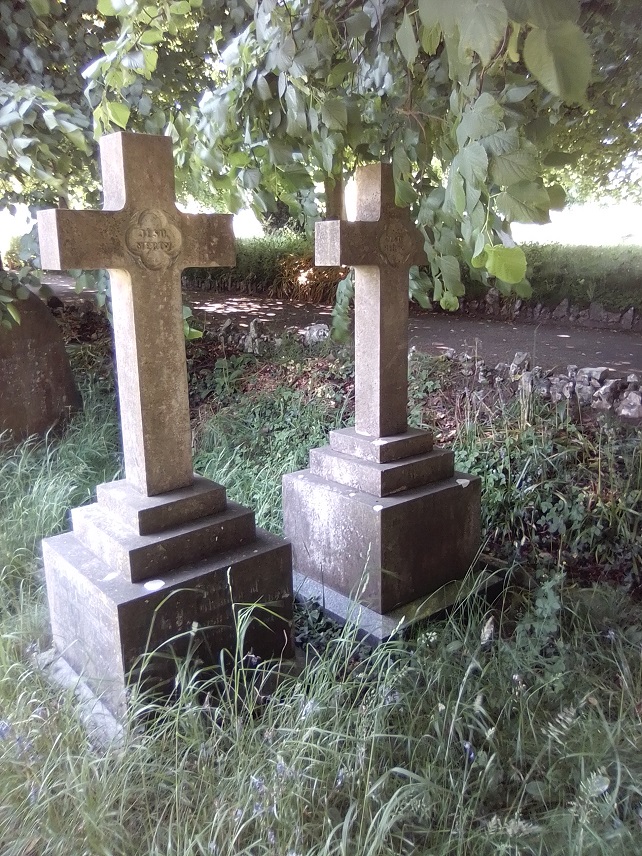
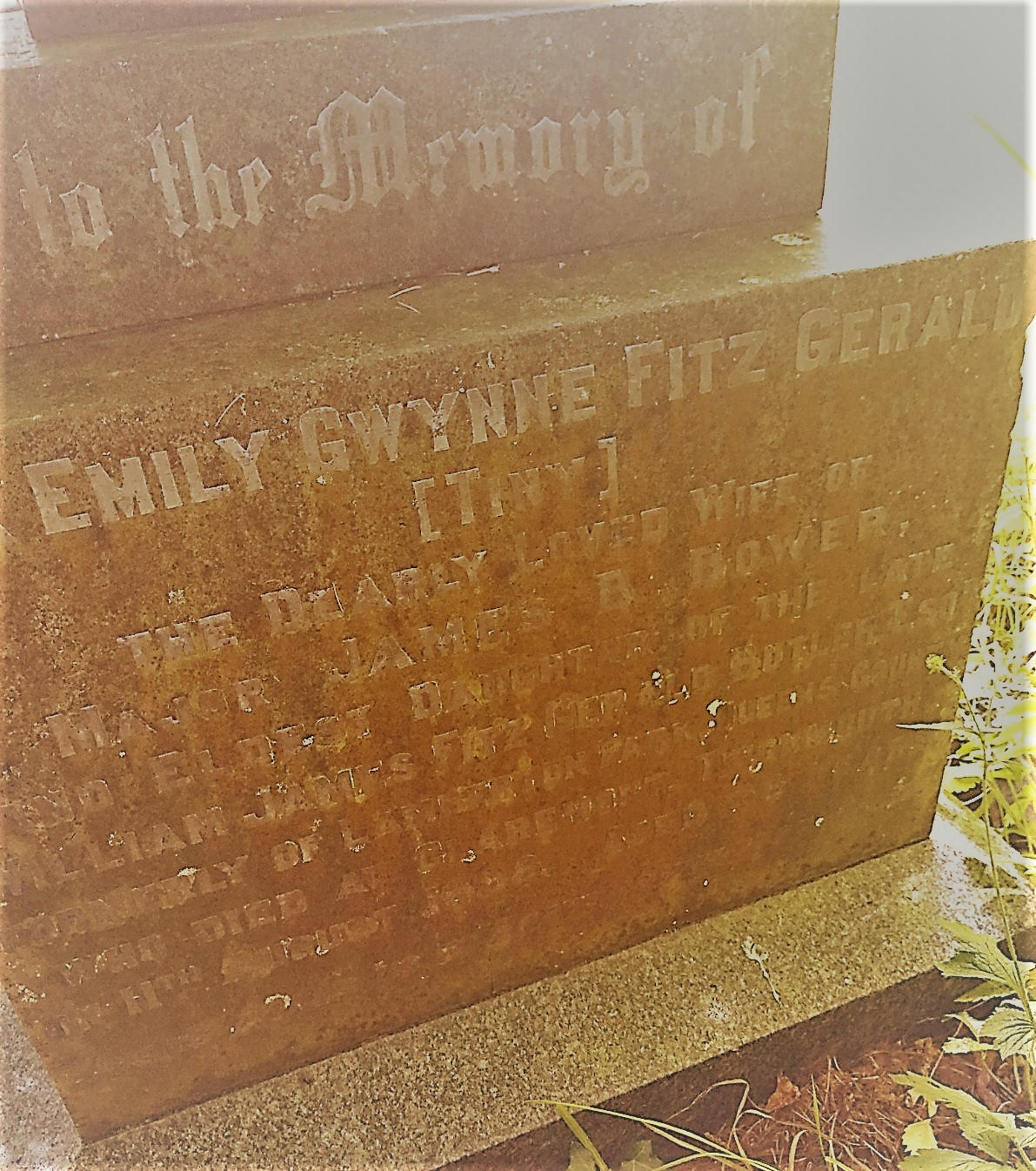
As you walk along the main avenue of Teignmouth Old Cemetery from the Higher Buckeridge Road entrance you pass, on the left-hand side, section O and may notice two identical crosses in a family plot (O115/116) directly next to the avenue. The plot, apparently, is an underground vault. The left-hand cross is for Richard Marsh Marsh-Dunn and his wife Eliza-Ellen Marsh Dunn. They are the parents of their son Major James Bower Bower who is buried in the right-hand grave with his wife Ada Emily.
The Man with Two Names
So the first curiosity about this story is that their son has a different surname!
This came about because James changed his surname in order to benefit from an inheritance from his uncle, James Henry Bower, on his mother’s side. The book “BOWER OF CLAREMONT, Donhead, Dorchester, Lostwithiel, and Weymouth” by H. B. BOWER explains:
“The Rev. James Henry Bower, MA (Oxon.) …. in his Will dated 20 Jan. 1880 makes his nephew, James B. M. Marsh-Dunn his principal heir, conditionally to his assuming the name and arms of Bower, if not, then his estates go to his cousin Edmund Bower, M.D.”
A Military Career
James started his career as a lieutenant in the South Yorkshire King’s Own Light Infantry and served in India from 1872 to 1874. His brother, the Rev. R M Marsh-Dunn also served in the same regiment as a captain, retired as a major and became vicar of St Peter’s at Shaldon. James obtained his captaincy in the 3rd Cheshire regiment and subsequently retired with the rank of major.
A Pillar of the Community
Upon retirement you could infer from his obituary that James became a pillar of the community. As the Exeter and Plymouth Gazette of 3rd March 1920 reported:
“For 30 years he was Vicar’s warden to his brother-in-law, the Rev. J. Vesey, Vicar of St. Michael’s, East Teignmouth, and at the time of his death acted in a similar capacity to his brother, the Rev. R. M. Marsh-Dunn. Major Bower was a member of the Committee of Management and a trustee of the Teignmouth Hospital, and one of the representatives for East Teignmouth on the Newton Abbot Board of Guardians. He was one of the oldest members of the East Devon and Teignmouth Club, and was one of the Commodores of the Teign Corinthian Sailing Club, his yacht, Toad, being always an entrant at the local regattas. He was keenly interested in music, and for several years acted as Secretary of the Diocesan Choral Association.
The Blot
BUT …. There was a blot on his escutcheon, which can only be described as being “caught in flagrante”. The fullest account of this comes from the Western Times of 18th July 1908. Here is a slightly edited transcription:
MAJOR’S DIP
What the PC Saw at Dawlish
A CONVICTION
The magistrates present at Dawlish Sessions yesterday, were Mr. W. A. Daubeny (in the chair), Mr. J. W. C. Washington, Mr. A. McCasland, and Mr. J. Gamlin, when Major Jas Bower Bower, of Teignmouth, was summoned for improper bathing at Dawlish on June 30th. Mr. A. P. Dell, of Teignmouth, appeared for defendant, who pleaded not guilty.
PC Sanders, who is stationed at Teignmouth stated that, in consequence of complaints, he proceeded on the sea wall, at 8.30 a.m., to the further end of the breakwater, in the parish of Dawlish. He secreted himself there. At 8.55 a.m. he saw defendant come along the sea wall and go down the steps on to the sands. Witness came from his hiding place and looked over the wall. He there saw defendant, who was without a costume, bathing in the sea, and about 15 yards from the wall. When defendant came out of the water he carried his clothes up the slope from the steps, and dressed. Witness told defendant what he had seen, and that he should report him. Defendant replied, “I looked to see there was no one about. I had my costume in my pocket, and should have put it on I had seen anybody.” Defendant, in further conversation, asked the constable not to report him.
Mr. Dell: “Did you think you were going to catch the defendant?”
P.C. Sanders : “I did not know who, but I thought I should catch somebody”.
PS Hulland stated that Major Bower came to the Police Station, and said, “One of your constables has caught me this morning bathing without a costume. I hope that nothing will be done in it. I should not wish to have it reported.” PS Hulland replied. “I am sorry, sir; I cannot suppress a report from a constable. When it is made I must forward it to the Superintendent. I sent the constable there in consequence of complaints of someone bathing there on mornings without costume. I am sorry you should be the one to be caught, but I have no option but to forward the report.“
Supt. Wood stated that he received a communication, and saw Major Bower at Teignmouth Police Station. Defendant then asked him if it was not possible to stay proceedings, and Supt Wood replied in the negative, adding the by-laws were made, and it was the duty of the police to enforce them. Supt Wood also told defendant that the constable was sent there to watch in consequence of complaints. Defendant then observed: ” I was careful to see there was no one about before I bathed. There was not a soul on the sea wall from one end to the other, and I was not in the water more than minute or two.” Supt Wood also told defendant he was sorry that he (the defendant) asked the constable to suppress the report, and followed it up by requesting the sergeant to do it. Defendant ultimately remarked, “Is there any way out of it ? Can’t I make donation to some Institution or other ?” He afterwards offered £50 to the Widows’ and Orphans’ Fund, and Supt Wood told him he could not entertain anything like that, and that they had no such fund. Conversation was kept up in the same strain, and eventually defendant observed, “I will give £100.”
Mr. Dell submitted that defendant did not bathe. He undressed and went down to see what the water was like. He found it was rough, and did not go in. Had defendant decided to bathe, he would have put on his costume. It was not likely that Major Bower, knowing the by-law, would have deliberately gone into the water without wearing his costume.
Mr. Washington: You know the old saying that “No man is wise at all times.”
Defendant bore out his advocate’s statement.
Supt. Wood produced (Editor’s note – like a rabbit from a hat) a letter, in which defendant admitted it was the second time for a similar offence.
The Chairman said the Bench were unanimously of opinion that defendant was guilty, and they fined him £1 and costs.
So James was found guilty of “skinny-dipping” but was also obviously desperate that his misdemeanour should not become public. He went up the chain of command to ask that the charge be dropped and, when this didn’t work, he attempted what can only be described as bribery.
He also wasn’t as naïve as he was making out. Evidence that he had committed the offence before showed that he knew exactly what he was doing. Researching back through the newspaper archives revealed his previous offence which played out in much the same way, as described by the Teignmouth Post and Gazette of 28th October 1904 in this edited transcription:
BATHING AT THE BREAKWATER.
At Dawlish Petty Sessions on Friday before Messrs. J. Broad Bissell (in the chair), W. Daubeny, W. Waterfield, E. H. Bayldon, A. McCasland, and H. Hattwill.
Major James Bower Bower, of Claremont, Dawlish road, Teignmouth, was summoned for bathing without a costume at Dawlish, on the 25th September. Defendant pleaded guilty.
PC Friendship said he was on duty in plain clothes on the sea-wall near the Breakwater, between Teignmouth and Dawlish. He saw defendant going down the steps leading to the beach. He took off all his clothes, and in a nude state entered the water. When he came out he proceeded to the steps, where he put on his clothes again. Witness told defendant that he should report him. Defendant replied that he did not know he was doing wrong, and he thought that anyone could bathe without a costume on that side of the Breakwater before ten o’clock in the morning. Defendant also said, “What made you come over here; to try to catch me? You’ve not been here before.” Witness replied that complaints of indecent bathing had been made.
Defendant said the spot where he bathed had been a well-known one for years. He understood that anyone could bathe there without drawers at that spot before ten ‘o’clock in the morning, and had done so himself for 30 years. Notices to this effect used to be affixed near the spot. These had lately been taken down.
Superintendent Wood acknowledged that some years ago the spot was sanctioned for such bathing. The notices had been removed, and there had been no need for fresh notices, as the new bye-laws which forbade it had been published.
The Chairman said that, while accepting defendant’s explanation in a sense, the Bench felt they could not dismiss the case. Defendant would have to pay the costs, amounting to 14s. 6d.
At Peace
Major James Bower Bower, aged 72, died at his home, Claremont, Dawlish Road, Teignmouth shortly before midnight on 1st March 1920. His funeral took place four days later at St.Peter’s Church, Shaldon. The interment followed at the Teignmouth cemetery family vault where the hymn “Here, O My Lord, I see Thee face to face” (A&M 274) was sung. The bell of St. Michael’s church tolled on the hour of interment and the flag of the East Devon and Teignmouth Club was flown at half-mast. (Note: The East Devon and Teignmouth Club had an exclusive membership taken from the gentry and professional middle class; it is now the building known as the Riviera).


Sources and References
Extracts from contemporary newspapers are referenced directly in the text and are derived from British Newspaper Archives.
Book “BOWER OF CLAREMONT, Donhead, Dorchester, Lostwithiel, and Weymouth” by H. B. BOWER, privately printed for the author in Great Britain by E Dwelly, Fleet, Hants, 1929.
References to family genealogy from: thepeerage.com; wikitree.com; findmypast.co.uk
 Teignmouth Old Cemetery