A couple of weeks ago Jacqui, one of the dedicated group of volunteers of Friends of Teignmouth Cemetery, discovered and uncovered a grave in section HH of the cemetery. Her first reaction was “There’s a story here”. That instinct was not wrong but she had under-estimated. There were three stories – people buried in different parts of the cemetery but linked through this discovery.
This is the first story. Frances Maude Waite was only seven years old when she died, tragically killed by a runaway traction engine on 12th June 1896. The event made headlines in the local papers for the next few weeks as the story and its consequences unfolded. It is told here in this verbatim full account, starting with the Bridport News of 19th June 1896:
“TEIGNMOUTH. SHOCKING TRACTION ENGINE ACCIDENT. A CHILD CRUSHED TO DEATH AND A SHOP WRECKED“
On Friday an accident of a shocking character occurred at this pretty watering place. A traction engine belonging to Mr. Roger C. Fenton, of Maidencombe, Torquay, was engaged in drawing three truckloads of bricks from the Hele Brick Works at Torquay to Dawlish. The engine was driven by man named William Maffey, while Mr. Fenton was in charge of the steering wheel. Four other men were also engaged with this road train to look after the waggon, brakes and such like. The engine weighs, probably, ten tons, while the bricks and three trucks could not have totalled much less than 30 tons.
The journey proceeded without mishap until Bitton Hill was reached, when it was found that, although the engine was a powerful one, it was not sufficiently strong to take its load to the summit. One of the trucks was consequently uncoupled, and the remaining two were drawn to the top of the hill as far as Bitton Terrace. The engine was then run back for the third truck, and on this one arriving at the terrace the three were again coupled together and the journey continued towards Teignmouth.
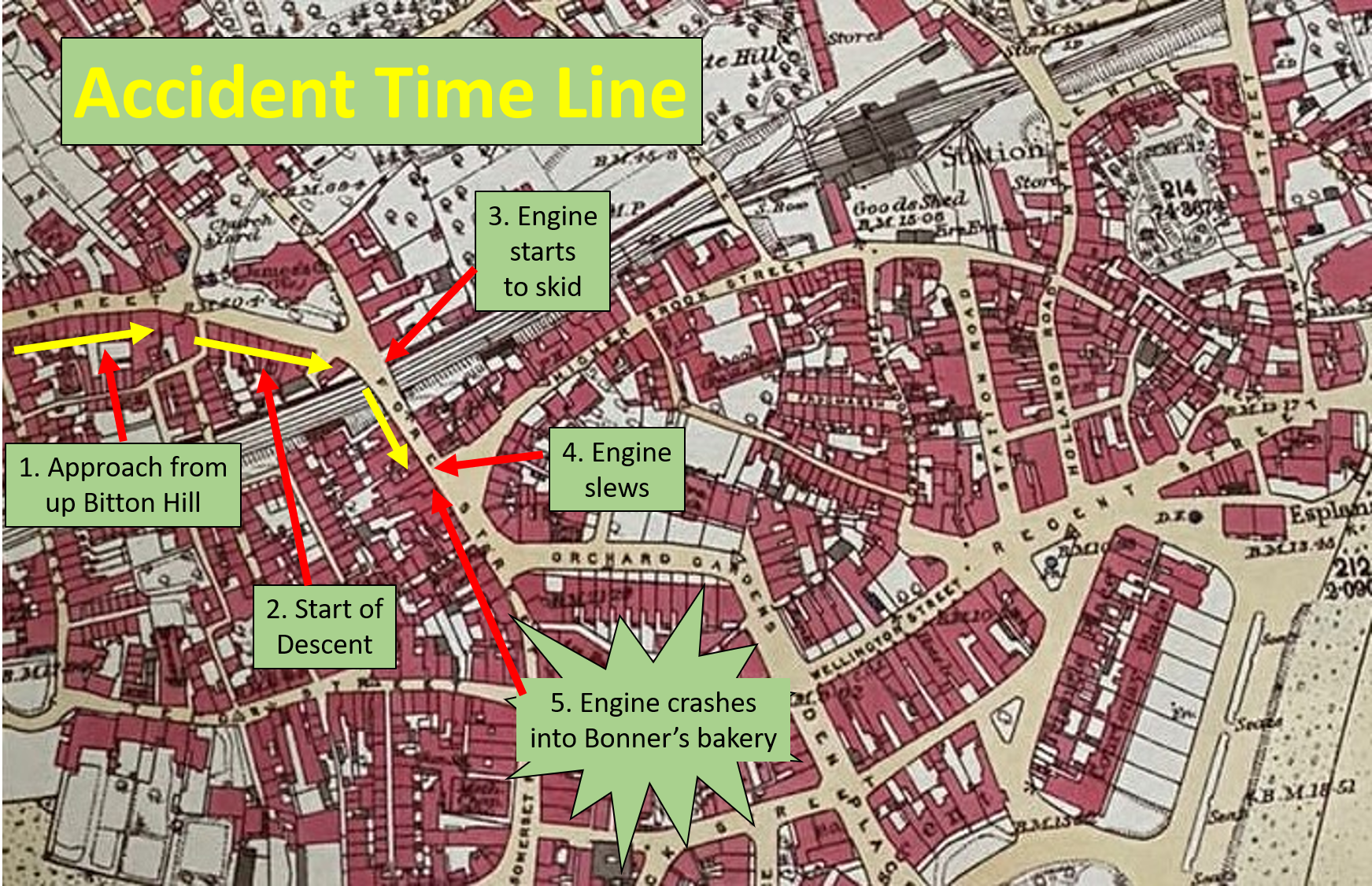
There is a very steep Incline from the railway bridge down Fore Street, and before it reached here several persons considered that the engine was travelling too fast for safety on the slightly inclined road between Mulberry Street and Parson Street.
People commenced to be alarmed, more especially from the fact that Fore Street is so steep. When the engine arrived at the bridge it commenced to “skid”, probably from the weight behind It. The brakes were applied with al! force and the steam was shut off, but the locomotive had evidently “run away”, and some kind of accident appeared inevitable. It was hoped the engine would have been able to be guided into Higher Brook Street, and with this idea Maffey took charge of the steering gear. The turn, however, was not made quickly enough, and it was just opposite to the entrance of the thoroughfare named that the three trucks crashed into the end of the engine with melancholy result.
This area of Teignmouth has changed considerably with the development of the dual carriageway in the 1970s. So here is an extract from an 1890 map of the town showing the street layout as it was then and annotated to mark the events described in the article.
The Bridport News continued:
It was about 20 minutes to 2 o’clock in the afternoon, and, being the dinner hour, there were but few people about, and fortunately, no vehicles. A few minutes later would have seen Fore Street filled with children, for there are two Board Schools in the immediate vicinity of the accident.
Three children were near the shop occupied by Mr. W. H. Bonner, confectioner, and owned by Mr. W. Larkworthy, of Teignmouth. Persons shouted to them to run for their lives, and two of them—one named Clark – took refuge in the doorway of the house in the possession of Mr. C. Lane, greengrocer, 10, Fore Street. The third, Frances Maude Waite, seven years old, daughter of Sergeant lnstructor Waite, of the Teignmouth Company of the 1st R.V., unhappily, was not quick enough, for the engine and trucks crashed into Mr. Bonner’s shop front, pinning the poor little girl to the wall. The other children had a miraculous escape, and were speedily rescued from their dangerous position by Mr. T. Jones, painter, of Fore Street, and Mr. Grainger, who saw the accident happen.
One half of Mr. Bonner’s shop front was completely demolished, and here another narrow escape took place. The shop was in charge of Mrs. Richards, and this lady was sitting by the counter, and close to the window, when she heard a commotion outside. She had simply time to take the faintest glance at what was happening, when the front truck and engine smashed the shop window in and drove the counter two feet from its original position.
Efforts were at once made to get at the child Waite, whom, it could be seen, was fatally crushed. The poor little thing was in such a position that it required a great deal of work before the body could be recovered. There was soon a vast crowd on the scene, and the vicinity of the accident was packed all the afternoon by persons witnessing the operations of recovering the body, and the removal of trucks and engine. First of all the bricks had to be shifted, and these were packed in a heap near the lamp post at Higher Brook Street. Then the two last trucks were dragged out of the way. When eventually the last truck was dragged clear of the debris the body of the unfortunate child fell to the ground, the trunk being fearfully mangled, although the face and head did not appear to be so much Injured.
The remains were quickly taken up and conveyed to the deceased’s father’s house. It is scarcely necessary to say that the parents were overwhelmed with grief, which was intensified by the suspense in waiting for the body to be recovered. Sergeant Instructor Waite previously visited the spot, and was so distressed that he had to be taken home.
Attention was next directed to the removal of the engine, and here a good deal of precaution had to be taken owing to its dangerous position. Happily the work was successfully accomplished, and, the whole of the wheels being got on the ground, the machinery was set in motion, and the engine steamed away from the scene of the catastrophe at 20 minutes to six o’clock.
It was then seen that a wreck had been made of Mr. Bonner’s shop. An iron pillar, supporting the first floor, was smashed in two, pieces of glass and a brass rod were found deeply imbedded in the woodwork of the truck, showing the force of the impact. The contents of the windows were, of course, destroyed, and the large pane of glass in the window on the other side of the doorway was smashed. Some damage was also done to Mr. Lane’s premises. It was ascertained that Maffey had driven the engine for seven or eight months, having been sent down by the makers.
The following photograph from the picture archives of Teign Heritage Centre shows the devastation caused by the crash

The legal system worked very fast in those days and a Coroner’s Inquest was convened for the following day. The full details of that inquest with its analysis of the cause of the accident is picked up by the Western Times of 19th June 1896:
“THE TEIGNMOUTH DISASTER. CORONER’S INQUIRY. VERDICT OF MANSLAUGHTER”.
The inquest was opened on Saturday evening by the District Coroner (Mr. S. Hacker) at the London Hotel. Superintendent Moore was present on behalf of the police. Mr. R. Hall Jordan attended as Clerk to the Urban District Council, and the owner of the engine, Mr. R. C. Fenton, was in attendance, accompanied by Mr. I. Carter, solicitor, Torquay. Mr G. H. Jarvis, member of the Urban District Council, was chosen foreman of the Jury.
At the suggestion of Mr Hamlin, a juryman, all the witnesses (except Mr Fenton) of the occurrence were ordered to remain outside the Court until they were called. Mr Fenton being the owner of the engine was allowed to remain.
Mr. J. T. Waite, Sergt.-Instructor of Volunteers, identified the body as that of his child, Frances Maud, who was seven years of age.
Evidence from the owner, Mr Fenton
Mr. R. C. Fenton, C.C., Maidencombe, said he owned two traction engines. On Friday one of them was on its way from Torquay to Dawlish drawing three trucks of bricks, and he joined it at Kingsteignton. His man, Wm Maffey was in charge of the engine, which was also accompanied by three other men, the regulation number, named Samuel and William Hannaford and Passmore. The trucks contained about 9000 or 10,000 bricks, and they averaged 2½ ton per thousand. The load, therefore, amounted to about 25 tons, added to which was the weight the trucks, making in all about 30 tons behind the engine. No difficulty was experienced on the way from Kingsteignton.
The driving wheel of the engine was seven feet in diameter. The engine which was about two years old, had just been to Rochester where it had been thoroughly overhauled by the makers, Messrs Aveling and Porter. It was 42 horse power, and around London the ordinary load for such an engine was about forty tons. Witness was not aware that under the Act of 1861 the load for each truck was limited to eight tons. The tyres of his trucks were about nine inches wide, and they were provided with diagonal cross bars to enable them to grip the road.
The engine took the load without difficulty up and down the hills until Bitton-Hill near Teignmouth was reached. There, in consequence of the wheels slipping on the stones, one of the trucks had to be dropped halfway up. Witness got off at this point, and the driver first took two trucks to the top, and then returned for the third one which was kept stationary in the mean time by blocks of wood and the drag on the wheel.
The Coroner asked whether it was not a dangerous practice to leave a truck in the middle of a steep hill like that. Witness said he had never found it dangerous. Of course the engine was never disconnected until the driver had made quite sure that the truck was safely fixed.
Proceeding with his evidence, witness said that on the top of Bitton Hill he again rejoined the engine and took charge of the steering. He proceeded without stopping.
The Coroner: Don’t you think it would be a prudent thing to stop at the brow of a hill? Witness: No, there would be no object. The Coroner: But you would lose the impetus would you not? Witness explained that there were two speeds to the engine and it was the usual practice to stop it before proceeding down a hill and alter the machine from the fast to the slow gearing. That was done in the present case.
In answer to the Foreman, witness said that on ascending Bitton Hill something went wrong with the injector, but that did not affect the control of the engine
In answer to a juryman, witness said he had not noticed that some spokes in the wheel by which the brake was worked were defective.
Continuing, Witness said the road in question was much barrelled. On coming down the engine commenced to skid, and the driver took the steering gear. Witness attributed the skidding to the smooth state of the stones on the road. He had been told that the rain had swept away the earth and left a stone surface. Thus, the engine wheels were unable to obtain a grip. At the spot where the accident happened the engine suddenly “slewed round” at right angles to the road. He was thrown from his seat, and for a few moments he was jammed. He quite expected the engine to topple over on its side. Naturally, he was a bit confused. When he looked round he saw that the front truck had smashed into a shop. He did not know that the child was there until his attention was called to it by some bystanders. The engine was not quite touching the footpath, and the extreme bar behind was not touching the wall of the house. How the child got there he did not know. She was apparently killed by the draw bar of the engine.
The Coroner: To what do you attribute the occurrence? Witness said in his opinion it was owing to the fact that the road was barrelled to a height in excess of what was required. Road engineers as a rule, in a 30 feet road, made it six inches higher in the centre than by the side- but this road would exceed that – more than doubIe, perhaps three times as much. Consequently, the engine, if a little bit on one side, would have a tendency to slip along on one side. If the road was level, it would have slipped down straight, there would be no reason why it should go sideways. The Teignmouth Surveyor had told him that it was a slippery sort of stone.
The Coroner: Then you do not say anything about the weight behind the engine? Witness: No; I don’t think it was an extraordinary weight for an engine of that class.
Mr Hamlin (a juryman) suggested that if the road was so high in the centre it would have a tendency to prevent the engine from slipping to one side. Witness said that was a nice point. It might be the result if the centre of the road came directly under the centre the engine.
The Coroner: You do not attribute the accident in any way to the trucks? Witness said he thought a sufficient answer to that was they had come the whole way from Newton, and passed down hills much steeper in perfect safety. The Teignmouth Surveyor had told him that he had himself had trouble on the hill with the town roller. Witness’s opinion was that the engine would have slipped if there had been no weight behind. He had ridden it on a bicycle.
The Clerk to the Urban Council (Mr Jordan) asked whether the act of reversing the gear and stopping the wheels with 25 tons behind would not necessarily cause the engine to skid. —Witness replied that was a difficult matter to say. He thought it would be found that the driver did not reverse the gear until he found the engine absolutely skidding.
Evidence of William Maffey, the driver
Wm. Maffey, the driver, was next called. He was told by the Coroner that he was not obliged to give evidence, but he could do so if he pleased. Witness elected to make a statement.
He said the Board of Trade did not grant certificates to traction engine drivers. He corroborated a large portion of the previous witness’s evidence, and added that on coming to the hill in Fore-street Mr Fenton gave signs to the men to put on the brake. When that was done, the engine was proceeding at the rate of from a mile or mile and half an hour He explained that it was impossible to stop the engine to put on the brakes. If they did it would probably be unable to restart, or if they did start again with the brakes on the machinery would be greatly damaged and the brake gear would be rendered useless.
The engine commenced to skid, and gathered speed as it proceeded. He absolutely lost control of it. It was impossible to steer, and the engine went where it liked. The back of the engine struck the wall by the side of the shop, and the first truck ran against the side of the engine and the shop window. Witness did not know the child was there. He had a mishap at St. Mary Church about a fortnight ago when, consequence of the road having just been watered, the engine skidded and knocked down a doorway entrance to a garden.
Answering further questions, witness said the roads about the district, especially at Torquay, were very slippery owing to their smoothness. Macadamized roads were more dangerous than ordinary country roads. There had been an accident with an engine at Totnes, but it was not their engine.
At this point the inquest was adjourned to be resumed the following day.
Maffey, recalled, said that it was just before he reached the bridge when he put the brake fully on. It was put on gradually. If it was put on tight at first the engine would be stopped. The engine was three or four yards past the bridge when it commenced to slide sideways.
Answering Mr. Hutchings, witness said he shut off steam two minutes before he applied the brake. He had been traction engine driver all his lifetime, but he had never been told how much weight was allowed to be carried.
Evidence of Employees
Samuel Hannaford, an employee of Mr Fenton stated that he was in charge of the trucks. On ascending Bitton-hill the wheels of the trucks slipped round. This often happened. As Mr Fenton thought it was “pretty much of a load”, he had one truck detached and took up two. The engine subsequently returned for the other truck. At the top, while proceeding again with the three trucks, Mr Fenton motioned for the brakes to be applied. Witness put them on the first two trucks, and a man named Passmore applied the brake to the third. They had to go between the trucks to do this. It was all done before the engine commenced to descend the hill. On turning the corner, his notice was attracted to the wheels skidding. He then turned round and said to his mate, Passmore, “Look out, you had better keep away a little, I believe she is going to run away.” He could not say positively that the brake of the engine was on, but the wheels were certainly not revolving. These, he thought, must have been stopped by a reversal of the driving gear. It was not often that the brake alone would stop the wheels of the engine; although he had stopped truck wheels in that way. On reaching the spot opposite Higher Brook-street, the engine suddenly slewed round.
The Coroner: What caused the engine to slew in that way —Witness said he thought the driver must have locked it a little order to get it to the other side.
Replying to further questions from Mr Hutchings, witness said Fore Street-hill had been rendered greasy by having apparently been recently watered in the ordinary manner. The road was not really wet.
If the road had not been recently watered you think the engine would have slipped —No, I don’t believe she would have slipped. If the road had not been watered and if the surface of the road had been rough, the engine, I think, would have gone down all right.
Wm. Passmore, an employee of Mr Fenton gave evidence of a similar character. He also attributed the accident to the slippery state of the road, but he did not notice that it had been recently watered. Every possible precaution was taken.
Evidence was also given by Wm. Hannaford, St. Marychurch, who said that his duty was to walk in front of the engine. When he came to the hill it did not occur to him that it was necessary to warn the driver to stop. He did not think it was so slippery as it turned out to be. The engine had descended hills quite as steep. When the skidding commenced, he ran forward to warn any vehicles that might be in the way.
Evidence from witnesses
Wm. Taylor, labourer, Bishopsteignton, stated that he saw the brakes of the trucks applied near the church gate in Fore-street. On crossing the bridge, the driver reversed the lever, and the engine at once commenced to skid. The road being “sideways” and the trucks being pressing heavily behind, the engine suddenly swerved round. If the road had been level it would probably have gone straight on.
William Edward Granger, house decorator, gave a description of the accident. He pulled away two children, and passed them back to his brother. He then went to the shop door and told Mrs Richards that nobody was hurt. At the same time he noticed someone behind the engine, and on passing round he saw the child jammed to the wall.
Thomas Wm. Jones, who assisted in rescuing the two children from their perilous position, said that when the engine turned, the trucks seemed to “take charge” of the back part. He had seen a good many engines pass down the hill, and most of them, notably Mr Hancock’s, stopped “dead”, at the brow of the hill and put on their brakes and chains.
Mr Hutchings : Then in your opinion the brakes were applied too late? —Witness: That is so.
Evidence from others
William Coram, foreman of the brickworks, where the trucks were loaded, stated that the three trucks contained altogether 25 tons bricks.
Mr Christopher Jones, Surveyor to the Urban Council, stated that the road between Bitton-Hill and the spot where the accident occurred was in excellent condition for all ordinary traffic. There was a rising up Bitton-hill of one in eleven, and from the top of Fore-street hill to the spot where the accident happened was a downward gradient of one in ten. He described Bitton-hill and Fore street hill as good macadamized roads in excellent condition. As they were chiefly used for carriages he aimed at making them as smooth as possible. Fore-street hill was not bevelled excessively. It was a 20ft roadway, and in the centre it was nine inches higher than it was the sides. Near the spot where the accident occurred it was a sideland road. The hill had not been watered on Friday. That, however, was done on Thursday. He examined it immediately after the accident and found it perfectly dry. Limestone was slippery when damp, but that was not used in metalling this particular hill. If an engine once slipped on the hill, it would never recover itself because the stone was so hard. He denied that he told Mr Fenton that his steam roller had skidded on descending this hill.
Answering further questions put by Mr Carter, witness admitted that the roads were watered by salt water. The metalling used was a green stone and it looked damp even when it was dry. His opinion was that the brakes of the engine were not put on soon enough.
In answer to Mr Jordan witness said there was nothing in the state of the road to cause the accident.
The CORONER put three questions to the jury.
(1) What was the cause of the occurrence which resulted in the death of the child;
(2) was that cause produced by neglect or a want of proper care and precautions in the working and management of the locomotive, or was it simply an accident which could not have been avoided by reasonable care and precautions; and
(3) if there was neglect or a want of proper care and precautions who were the persons responsible?
The crucial point was – What caused the wheels to skid? Was it an overpowering weight behind, the smoothness of the road, or that the brakes were not put on soon enough? Also, it was for them to consider whether the provision of the Act of Parliament with regard to the weight to be carried by the trucks was not observed, and whether the occurrence was in any way consequent upon it. It seemed to him a terribly unsafe practice for men to have to go between the trucks when in motion for the purpose of applying the brakes to them.
Whatever the result of their verdict, it seemed highly important that the jury, having regard to the evidence of the engine driver as to the danger and difficulty – the almost absolute impossibility – of controlling traction engines on steep hills and smooth roads (always found in towns), should consider whether it was not their duty to make some urgent representation to the Home Secretary or the County Council as to further regulations. The Act of Parliament applied to the whole of England. But what was safe for the Midlands, where the roads were wide and level, might not be safe for that part of South Devon. The Act gave power to County Councils to make certain regulation but in the regulations of the Council of Devon there was nothing affecting the question of hills. If the jury found that the child’s death was produced by this occurrence, and that the latter was brought about by neglect or a want of proper care and precautions working the locomotive, the persons responsible would also be responsible for the child’s death, and would have to take their trial.
The Verdict
The Jury returned at a quarter to eleven with a verdict of manslaughter against Fenton, the owner, and Maffey, the driver, twelve having agreed with one dissentient. They added the rider that the County Council’s attention be called to the fact that the regulations for traction engines travelling on hilly roads such as South Devon are inadequate and the said traction engines are dangerous to human life and property, and liable at any moment to get beyond control. To prevent further disasters such as took place at Teignmouth on Friday last the jury recommend the said County Council to apply to Parliament to enforce better regulations for locomotives travelling on hilly roads.
Mr Hutchings said the father of the deceased child (Sergt-Instructor Waite), would like to publicly thank Wm. Woodley, who extricated the child by knocking away the bricks after it had been jammed between the end of the engine so many hours. The Coroner concurred and thought it very humane on the part of Woodley.
It being after hours Sergt. Richards proceeded to clear the room, whereupon the Coroner reminded him that whilst on licensed premises that room was a coroner’s court of inquiry and the public were privileged to stay, provided no drink was drawn. This announcement was received with applause.
The Commitment
The Coroner committed Mr Fenton and Mr Maffey immediately from that Court to the Assizes (this week) for trial on the charge of manslaughter, granting bail, Mr Fenton in his own recognizance £100, and two sureties of £100 each; Maffey’s recognizance with £50 and two sureties of £50 each. In both cases the sureties were Mr Chas. Ingram, Torquay, and Mr H. Stanbury, Teignmouth.
The Funeral
The funeral of the little one took place on Tuesday amidst tokens of much sympathy. The coffin was of elm, covered with violet cloth with white metal mountings, and a plate bearing the name “Frances Maude Waite. Died June 12, aged 7 years and six months.” Wreaths and floral tributes were sent in abundance from all parts of Devon. Those who followed as chief mourners were the father and his four daughters. The service at the cemetery was conducted by the Rev J. Metcalfe, and Mr W. Tapper carried out the arrangement.
A week later the case was heard at the Devon County Assizes with the following outcome as described by the Western Times of 26th June:
“THE TEIGNMOUTH TRACTION ENGINE DISASTER”.
Mr. R. C. Fenton and Wm. Maffey, owner and driver respectively of the traction engine which ran away and killed a child at Teignmouth, were placed in the dock. The Grand Jury on the previous day threw out the Bill under which prisoners had been indicted by a Coroner’s jury for manslaughter. Both the accused persons pleaded not guilty.
Mr. Roberts, counsel for the prosecution, said the prisoners stood committed on a Coroner’s inquisition. The Bill had been thrown out the previous day by the Grand Jury. The charge was that of manslaughter negligence in the management of a traction engine which unfortunately ran away and killed a child. He had carefully considered the evidence, and he did not feel he ought, after the Grand Jury had thrown out the bill, to ask the present jury to find a verdict of guilty in this case. He did not think he could establish such culpable negligence as would be necessary in that Court, and under these circumstances he proposed to offer no evidence.
Mr. Foote said that Mr. Fenton felt confident that no charge of negligence could have been successfully brought against him, and while he was prepared to defend himself, he wished to say how deeply he regretted the unhappy death of the unfortunate child.
The learned Judge said as far as he could make out it seemed to him that the accident happened to the engine while descending a hill too steep for it. He should have thought that this was a matter the County Council should take into consideration. Among the many useful things the Council did, they would be doing something additionally useful if they would attend to the preservation of life as well as property. Sometimes one saw a notice that a bridge was not calculated to bear a traction engine; that bicyclists must not ride down a hill, and he should have thought it would be a wise thing to say this hill is too steep for a traction engine. As he understood, the brake in the present case was put on but the hill was too steep and the whole thing went down at full weight. Clearly this was not a proper hill for an engine to go down. County Council powers were unlimited as far as he could make out, and he hoped County Councillors would read what he had had to say.
The jury then returned formal verdict of “not guilty,” and the accused were discharged.
Postscript
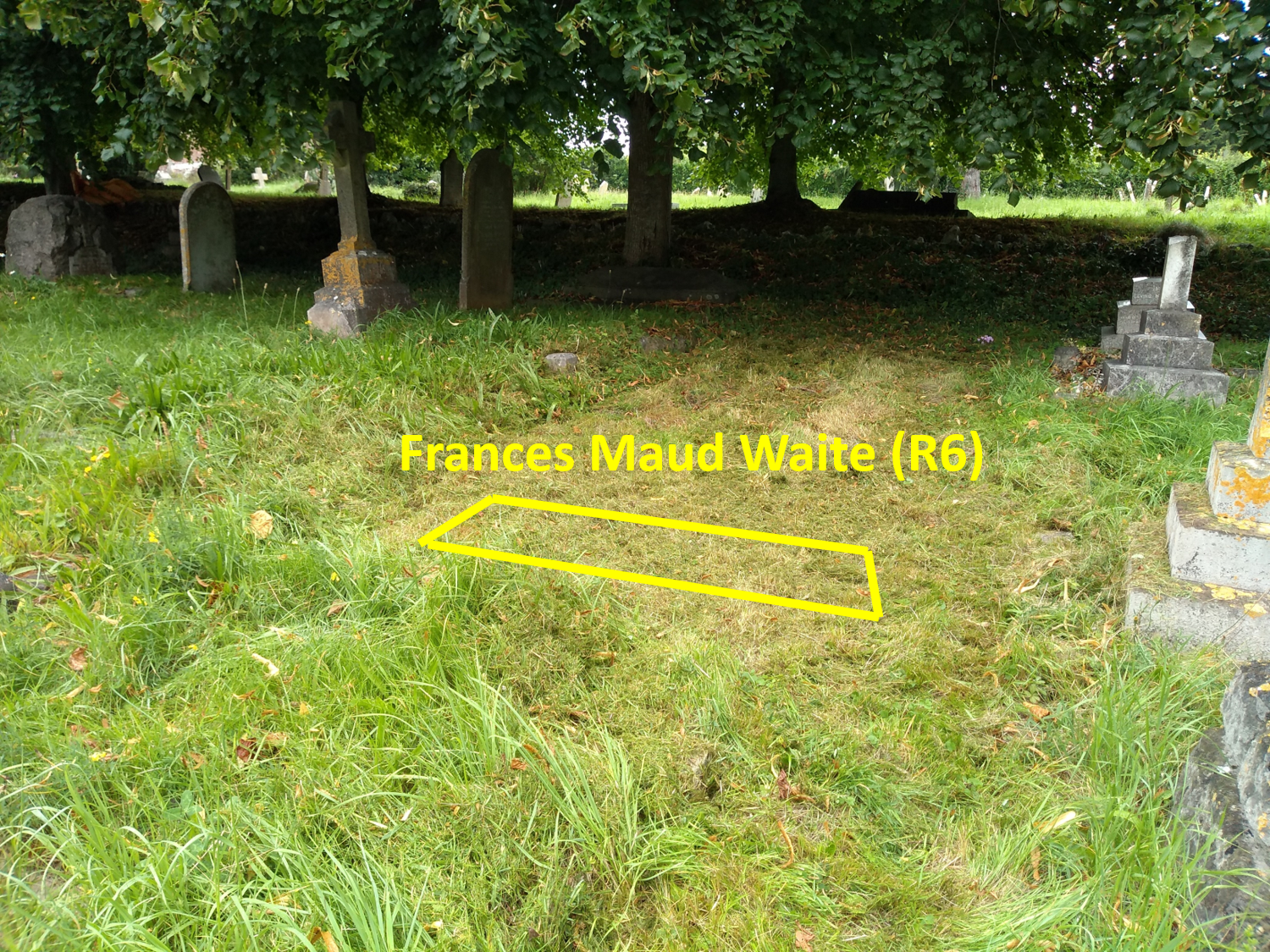
The young child, Frances Maud Waite was buried in an unmarked grave (R6) in an area dedicated to children. Colour-Sergeant J T Waite stood down as instructor to the Teignmouth Rifle Volunteers the following year and moved with his family shortly afterwards to Newton Abbot where he took up the position of assistant bailiff.
Sources and References
Extracts from contemporary newspapers are referenced directly in the text and are derived from British Newspaper Archives.
Acknowledgments
Many thanks to:
Rosemary Booth, archivist at Teign Heritage Centre, for providing the original photograph of the scene of the crash from the THC picture archives. It was this photograph which also prompted the subsequent research.
Gwynneth Chubb for enhancing that picture
Jemima Eastwood for providing an extract from an 1890 map she has showing the specific location of the incident
 Teignmouth Old Cemetery
One thought on “Shocking Traction Engine Accident”