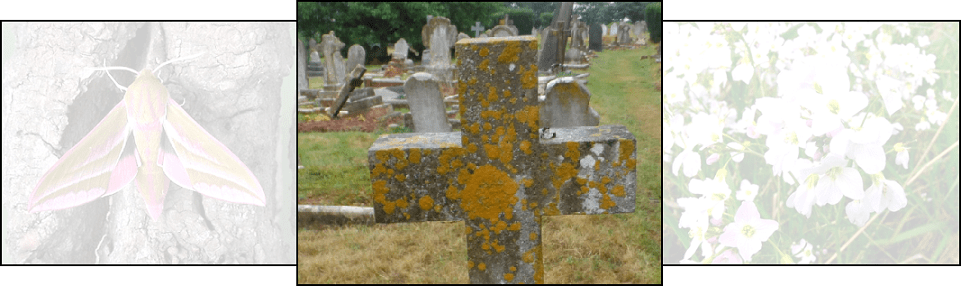
Lichens are special, composite plants consisting of a fungus and one or more algae, functioning as a single, stable unit. They have a symbiotic relationship, each partner benefits from this association. They are slow growing plants that form crusty patches on rocks, walls and trees.
Our cemetery is an ideal site to study lichens, as the buildings, gravestones and trees provide surfaces on which the lichens can grow.
There are two main types of stone:
- Basic stone such as limestone, marble or mortar
- Acid stone such as granite, slate and sandstone
Lichens generally prefer to colonise one or other of these types of stone which helps in the identification process using: Guide to Common Churchyard Lichens Frank Dobson FSC Publications (2004).
Thanks to Kay Large who, apart from being our treasurer, is also our resident ecologist and carried out the survey work and reporting for this part of the web-site.
The following pages cover various areas in the cemetery showing the range of lichens that find a home here. Click on the link to go there directly:
Lichens on Trees ….
Lichens on Buildings ….
Lichens on Graves ….
Lichens on Graves in section DD ….
The ability of lichens to survive and adapt to so many environments gives them a role as one of nature’s markers – of air pollution. If you want to find out more check out Monitoring air quality using lichens
And for the amazing adaptation of other species read about the Peppered Moth, in the nineteenth century, when industrialisation and coal fires led to the disappearance of tree lichens: Moths Count
Want to see more about the cemetery? Just click.
 Teignmouth Old Cemetery