Lives may be cut short in untimely fashion. Their stories may be short; sometimes made more poignant by that brevity. This is one such story.
Background
On the 21st June 1890 the East and South Devon Advertiser reported “Fatal Carriage Accident at Teignmouth”. Mrs Elizabeth Lewarn of Plymouth had been staying in Teignmouth with her family for the benefit of her health. On the previous Saturday, 14th June, she had been enjoying a ride out in a “donkey-chaise”. She had just reached the Den. Meanwhile a local doctor, Dr Piggott, was in his horse and carriage doing his usual rounds. He had reached Brunswick Place when the horse bolted and hurtled uncontrollably down Brunswick Street towards the Den. The inevitable happened. The carriage crashed at top speed into the donkey-chaise. Mrs Lewarn was thrown out, suffered severe injuries and died within the hour.
Five years later it was the Western Daily Mercury that announced another “Teignmouth Fatality”. On Friday 5th April 1895 Albert Tapp had collected a 5cwt load of coke on a pony and trap from the gasworks for delivery to the bakehouse in Wiley Lane. He left the pony and trap unsupervised outside the bakehouse whilst he carried the coke inside. The pony bolted and ran down a young child, Dorothy May Sampson, who was killed instantly.
Do you believe that fate may stalk some people? One person links these two events – James Heller of 43 Parsons Lane. He owned both the donkey chaise and the pony trap. He also bore witness to another fatality – the death of his sister, Emily Martha Heller, in the previous year on February 5th 1894.
This is Emily’s story.
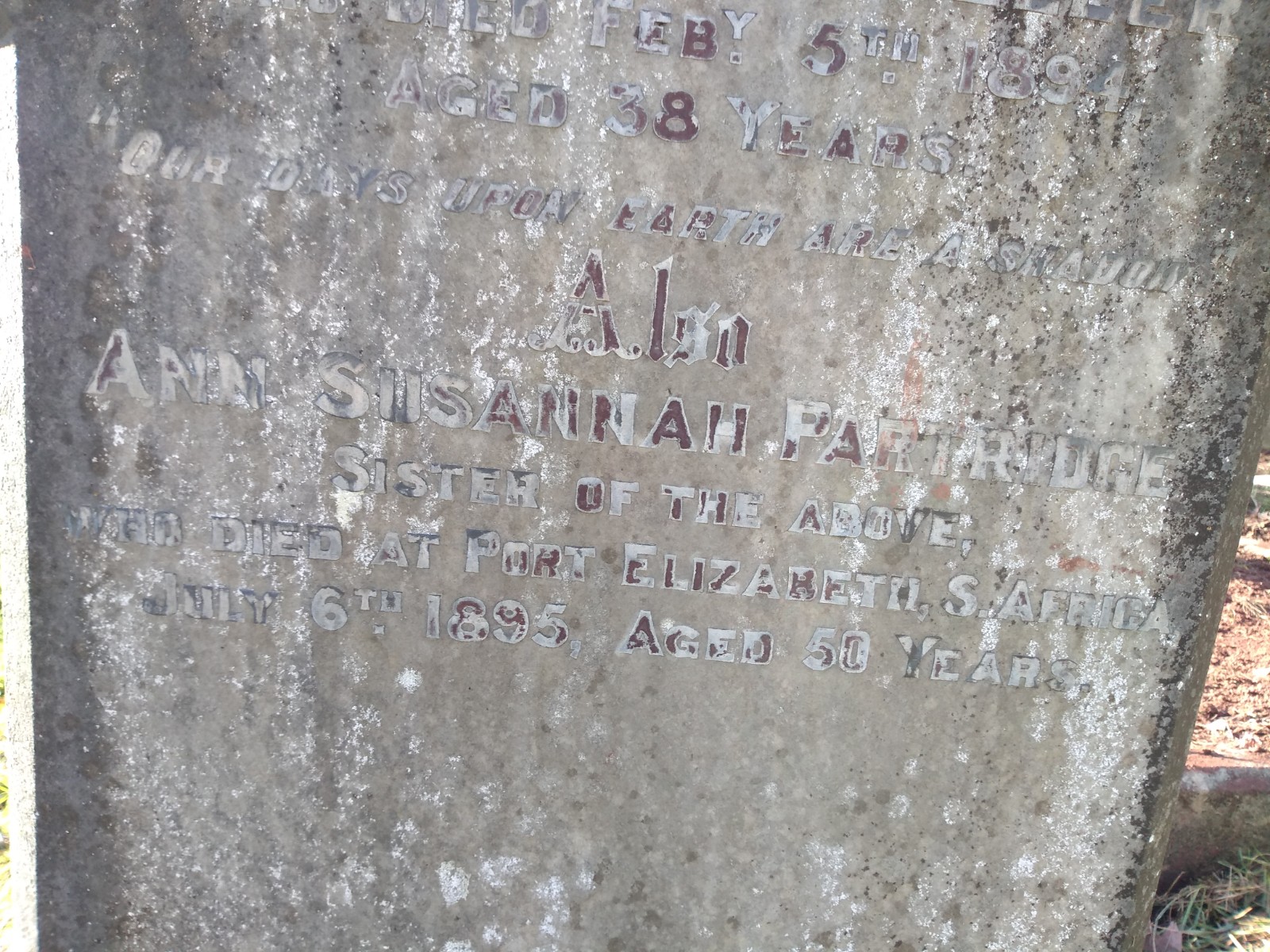
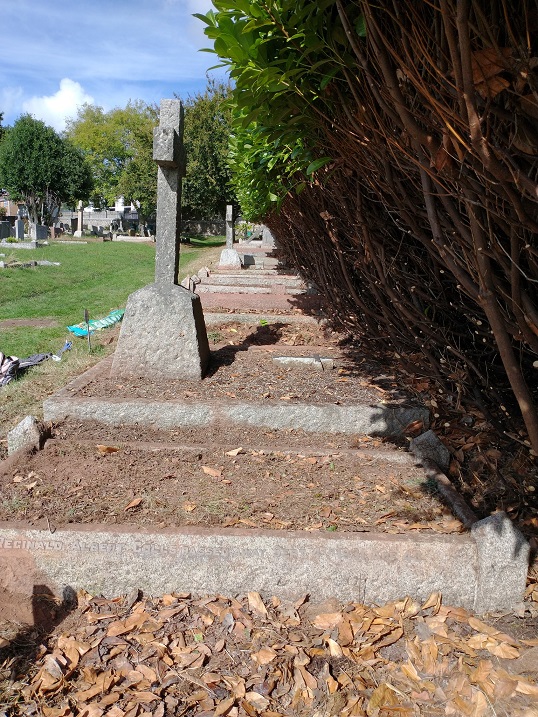
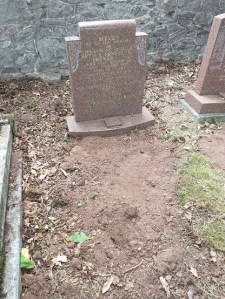
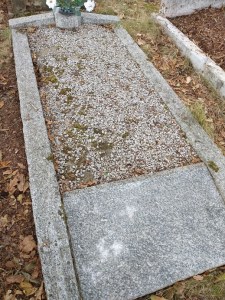
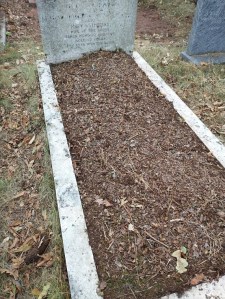
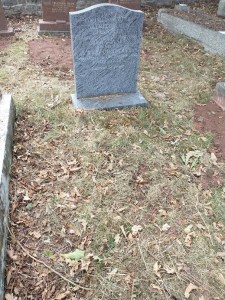
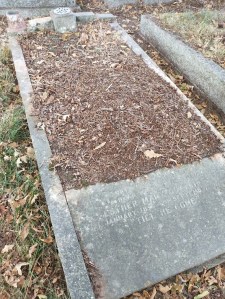
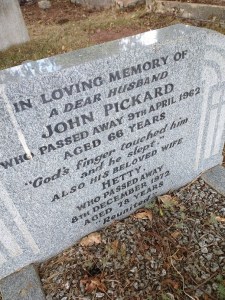
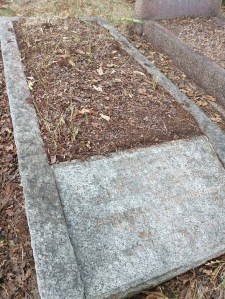
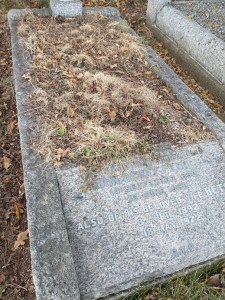
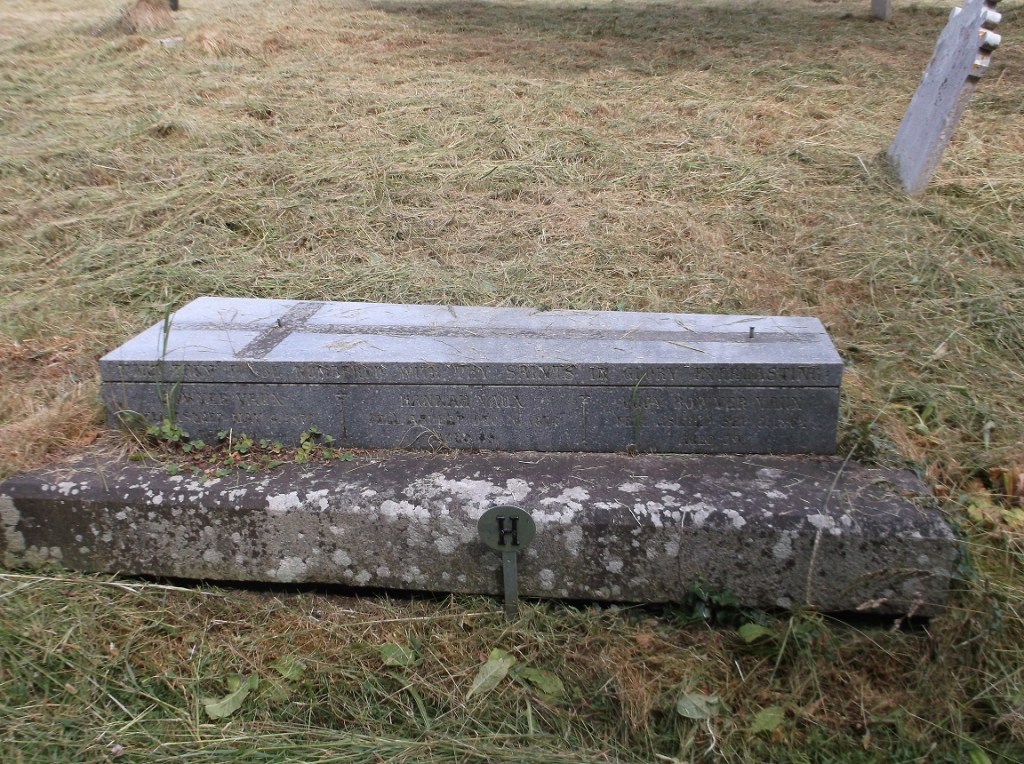
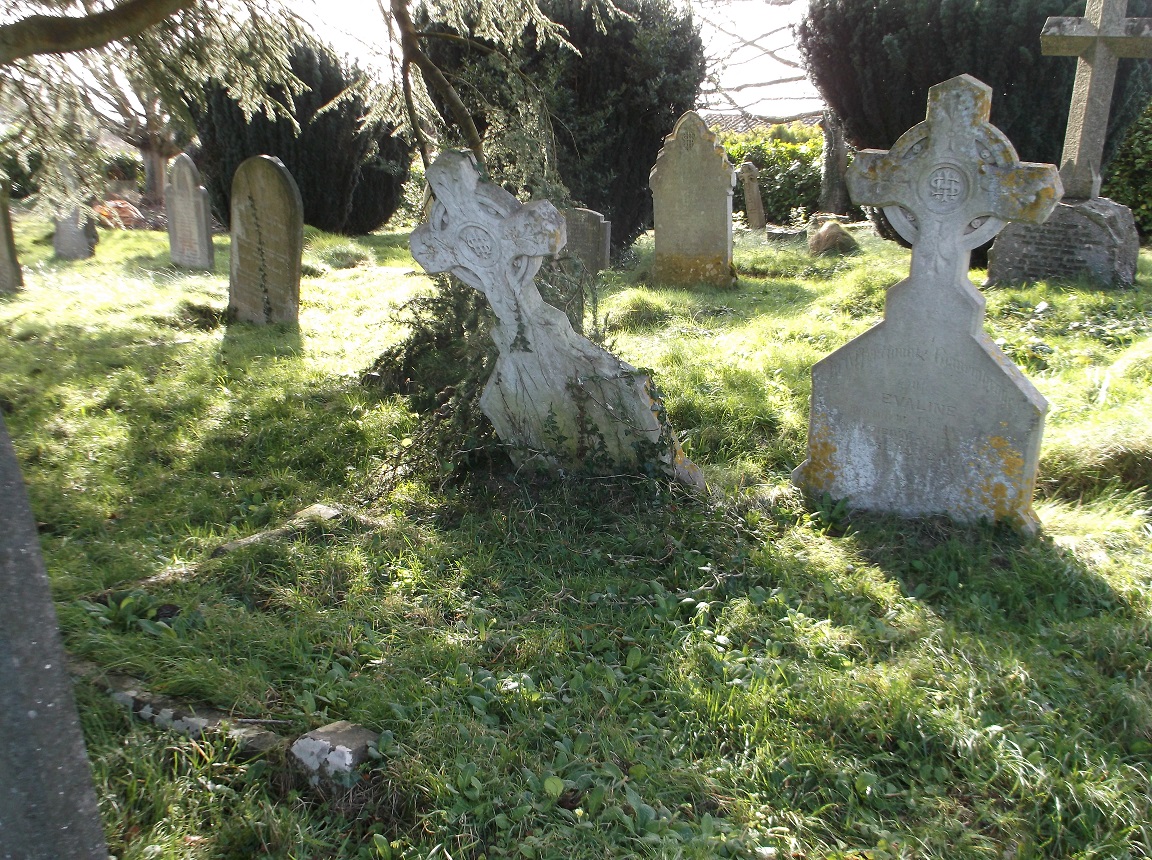
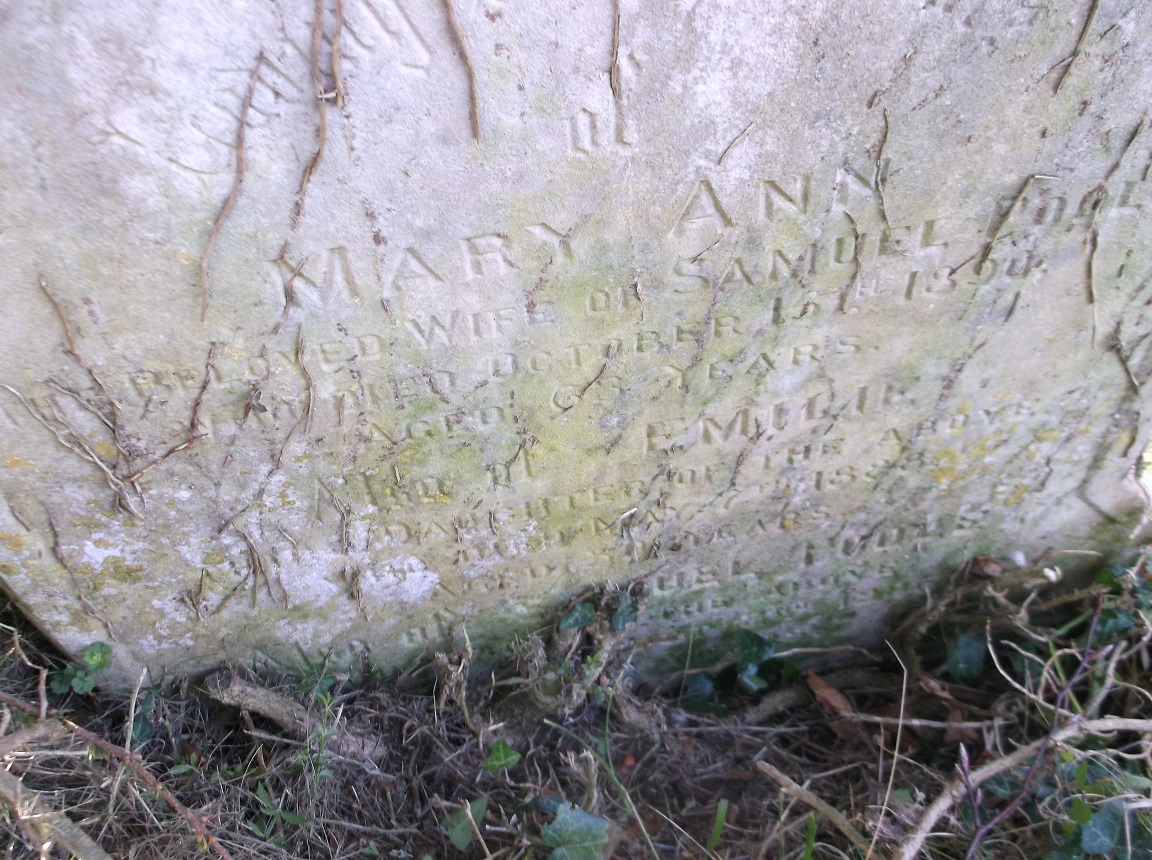
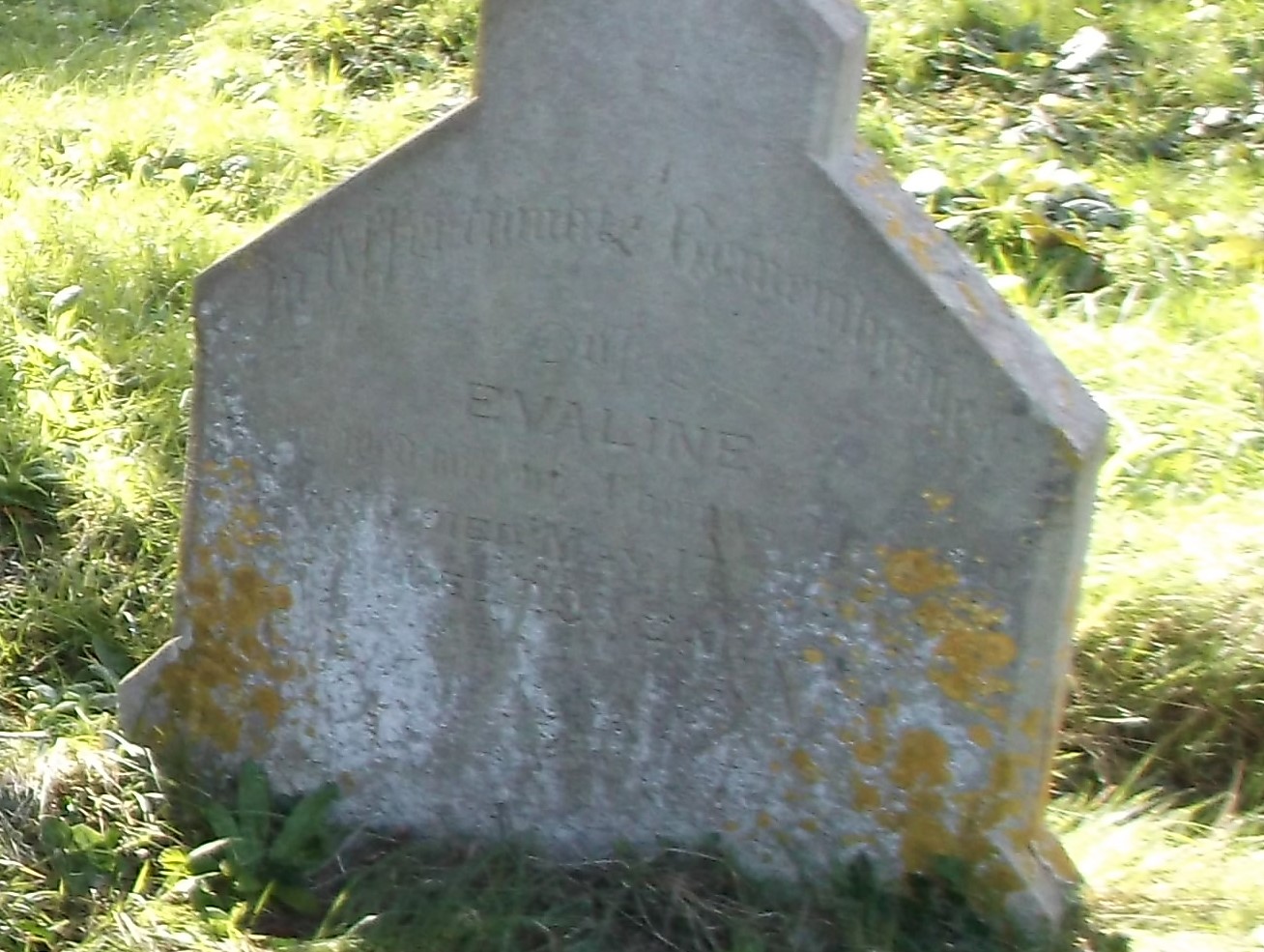
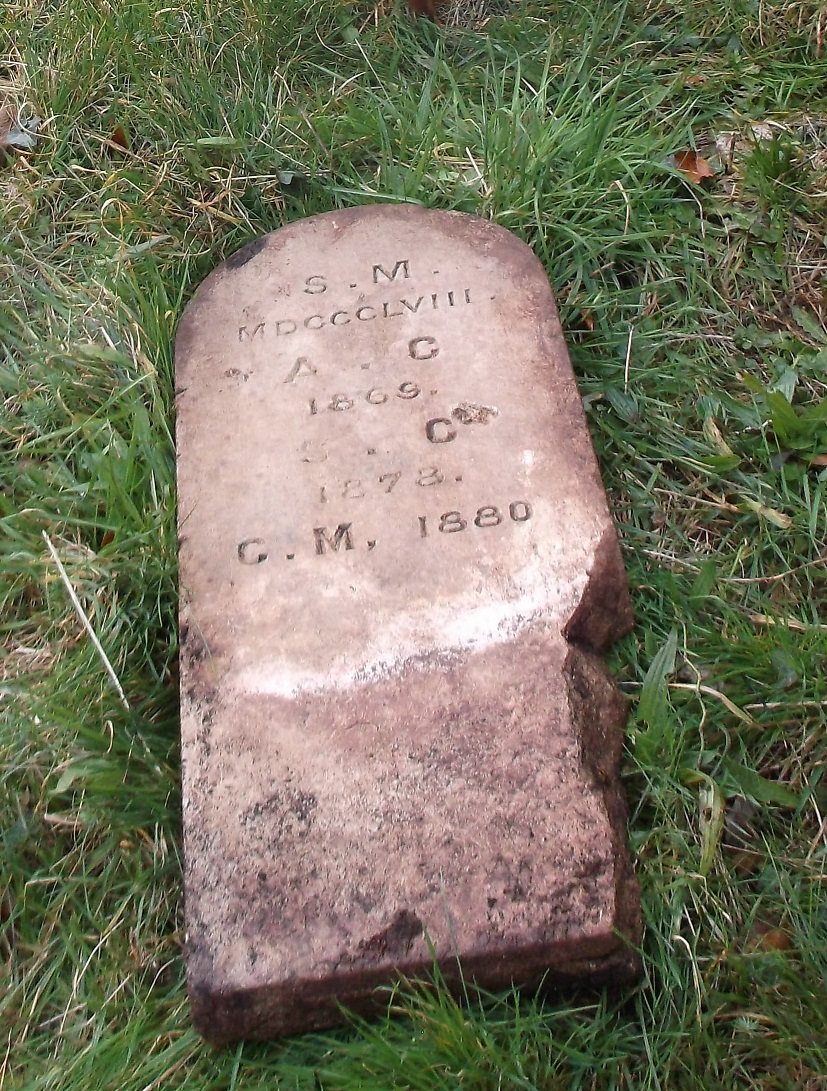
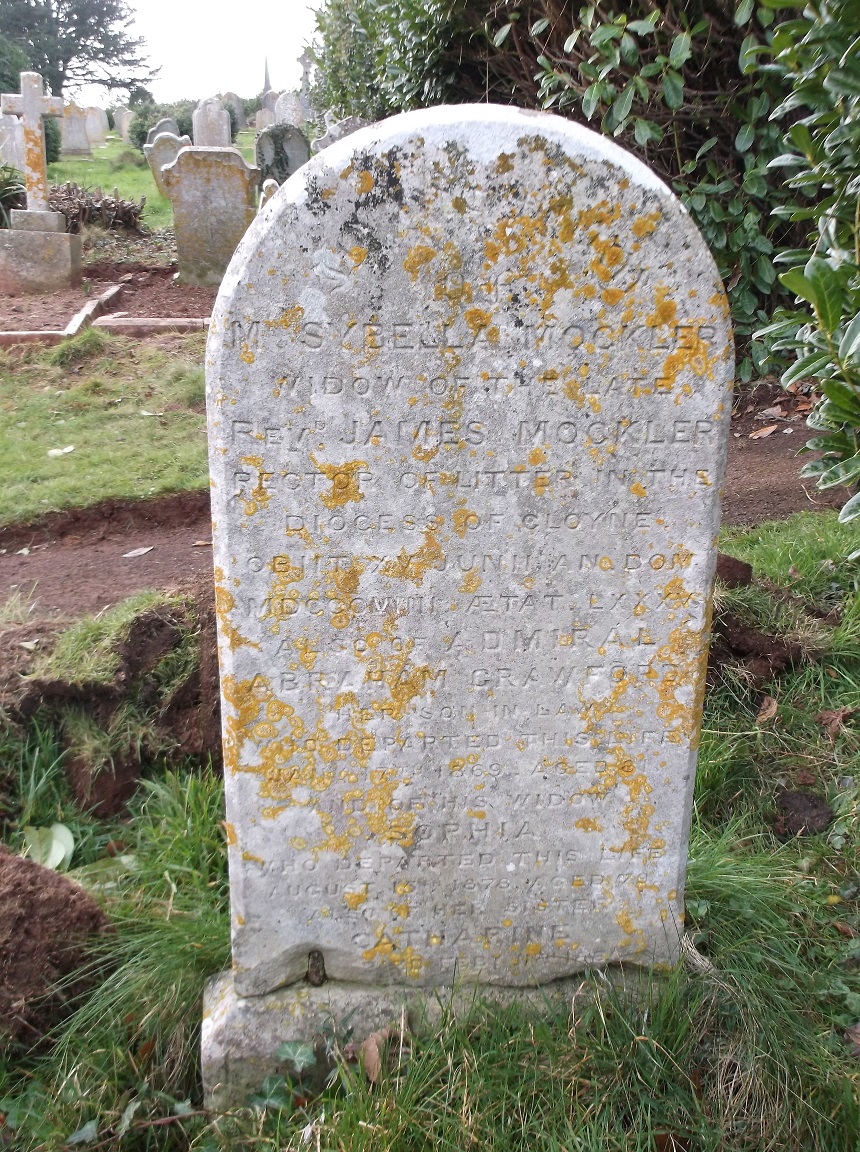
Emily is buried in Teignmouth Old Cemetery and we found her grave recently whilst clearing section N. The grave had been prepared for the interment of two people and the headstone does also commemorate her sister, Ann Susannah Partridge, who died the following year in Port Elizabeth, S. Africa. The burial records though do not show her buried here.
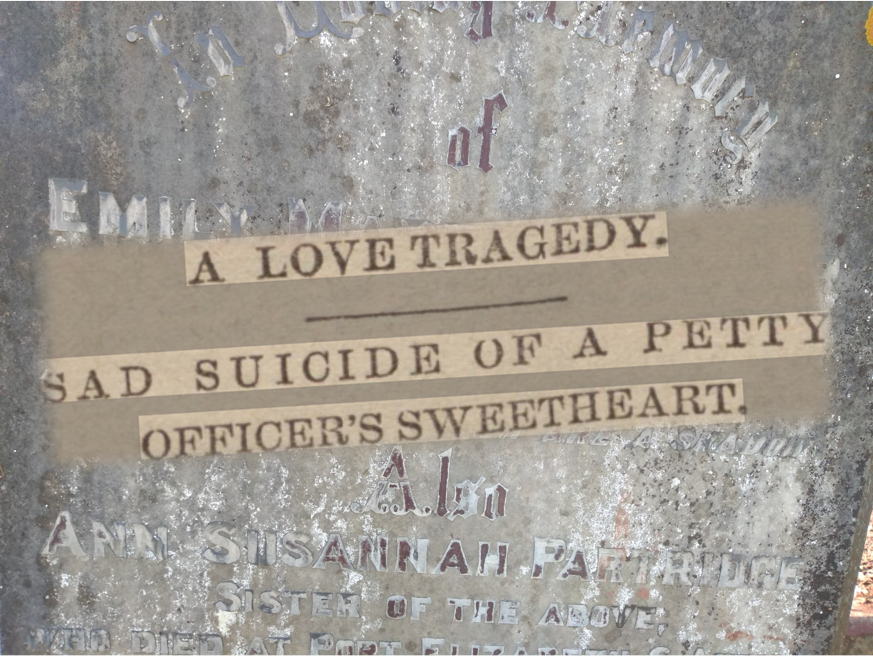
The story of Emily’s tragic death featured in a number of newspapers across the country, with some sensationalised headings.
Emily was aged 38 and had been employed for nearly ten years as a lady’s maid in South Kensington, London. She was single although when her brother James was asked by the coroner at her inquest “Do you know of any love affair?” he confirmed:
“Yes sir. She has corresponded with a young man for some years. He was a first-class petty-officer in the Royal Navy, and they were engaged to be married. When he left Teignmouth for the last time to go to sea he promised to write to her, but he did not do so, and this seemed to prey upon her mind. There was no insanity in the family.”
The last sentence wasn’t quite true, but let’s go back a few years to trace her journey from Teignmouth to London.
Early Years
We start with the 1851 census when an Emily Martha Heller (aged 2) lived with her family at 25 Bitton Street. The family was: her father William, a ‘sawyer’ (an occupational term referring to someone who saws wood, particularly using a ‘pit-saw’ either in a saw pit or with the log on trestles above ground, or operates a sawmill); her mother Agnes; and three siblings – the eldest Frances Ann Louisa (aged 10), then James Bryant (aged 8) and a second sister Ann Susannah (aged 5).
This wasn’t our Emily Martha Heller though. This Emily died the following year and her parents had another daughter in 1855 whom they also named Emily Martha – the Emily of our story. Perhaps our Emily was now already carrying a mental burden of being named after a dead sibling?
By the time of the 1861 census Frances, now a dress-maker, was about to marry Samuel Griffin-Benney and leave home, although still living in Teignmouth. Another brother had come along – William John Heller, aged 9 – and the family was now living at 4 Park St (?).
By 1871 the family had moved to Coombe and Ann had left home too. Like so many unmarried women of that time she had entered service and was now a general servant to the family of George Hester, a maths teacher, also living in Coombe. A mystery appears in the census too – there is a two-year old girl, Kate L, described as a grand-daughter. Could this have been the illegitimate daughter of Ann, or conceivably of Emily? Ann seems to have married a Henry Partridge about three years later. He was a POIC (Petty Officer In Charge) on board HMS Topaze (and may well have been present at the scene of Agnes West’s anecdote described in her book ‘Life among our Blue Jackets’ – see Annex at the end of this story). Ann, Henry and Kate then disappear from the records until Ann’s death in 1895 in Port Elizabeth South Africa is marked on Emily’s headstone.
Oakley, New Road
Emily seems to have followed Ann’s route into service. By 1881 she is shown as a lady’s maid, one of four servants, to Mary Toler living at ‘Oakley’ on New Road (This was the large Victorian building which now forms part of Trinity School. The adjacent photograph, 1947, gives some idea of the splendour of this residence).
It could be a complete coincidence but that same year William Smith Nicholson, retired captain of the Cameronians 26th regiment, together with his daughter Helen Maude and her own lady’s maid, Aline Carboy, were staying nearby in lodgings in Tormoham. (As an interesting aside Capt Nicholson was the cousin of Florence Nightingale). It was about three years later that Emily moved to their household in London as Helen’s new lady’s maid.
Her departure for London seemed to coincide with the death of her mother who had been committed to the ‘Devon County Lunatic Asylum’ in Exminster at least three years earlier and died there in the third quarter of 1884 (perhaps contradicting brother James’ assertion that there was no insanity in the family?). Her father died in 1892 and even though she seems to have returned to Teignmouth off and on it appears from her brother James’ statement that she was also in anguish about the disappearance from her life of the petty officer to whom she was engaged.
We can’t know exactly why she decided to take her own life in 1894 but there had obviously been ongoing traumas which could have affected her and we don’t know why her own mother had been committed to the lunatic asylum – perhaps that overly weighed on her mind too. Our only insights come from the reporting of the inquest into her death. Here is one version of that from the Portsmouth Evening News of 9th February 1894:
A LOVE TRAGEDY SAD SUICIDE OF A PETTY OFFICER’S SWEETHEART
On Thursday evening at the Kensington Town Hall, Mr. C. Luxmore Drew, the West London Coroner, held an enquiry concerning the death of Emily Martha Heller, aged 38 years, a lady’s maid, in the service of Miss Nicholson (daughter of Captain Nicholson), of 5, Mansion place, South Kensington, who committed suicide on Monday under circumstances of a somewhat romantic character.
James Heller, of 43, Parsons street, Teignmouth, identified the body as that of his sister, whom, he said, he last saw in August last.
The Coroner: Do you know of any love affair? Witness: Yes, sir. She had corresponded with a young man for some years. He was a first-class petty officer in the Royal Navy, and they were engaged to be married. When he left Teignmouth the last time to go to sea he promised to write to her, but he did not do so, and this seemed to prey upon her mind. There was no insanity in the family.
Eliza Long, cook at Captain Nicholson’s, said she had worked with the deceased for over ten years. She was always well, except for occasional attacks of indigestion which affected her nerves. She was greatly depressed in consequence, fearing she would lose her situation. Deceased never spoke to witness of her love affairs, but when her niece told witness of her disappointment she was very cross and upset. Deceased appeared perfectly sane, and had never threatened to take her own life. On Monday morning at about half-past eight o’clock witness went to deceased’s room and found her lying on the floor on her face. She was undressed, and groaning heavily. Thinking she was in a fit witness called for assistance. She knew the deceased kept a quantity of salts of lemon, which she used to take ink stains out of linen. A glass containing a white sediment was on the table at the side of the bed.
Eliza Goodman, housemaid, said that the deceased had never threatened to take her life.
Captain Henry Herbert Nicholson deposed that the deceased had resided with the family for nearly ten years, and was a good servant. He knew nothing of her mental condition or of her love affairs, and had never noticed her being depressed or strange in manner. They were on the best of terms, and it was merely her fancy that she thought he had noticed her demeanour.
The Coroner said a number of letters had been left behind by the deceased. They were all couched in the same terms, and one addressed to Miss Nicholson read as follows:
“Sunday, Feb 5th – Madam – I am sure I am mad or I should never do what I am about to, but I feel I cannot live. I have had very strange ideas in my head lately. I am very unhappy, but the doctors can prove I am a respectable woman. No-one is the same to me lately; Captain Herbert looks at me in a very strange way, and I am sure he thinks there is something wrong with me, but thank God I have never been let fall in that way. I have done things I am very sorry for now. I ask of you to forgive me.” After referring to the kind treatment she had always received at the hands of her mistress, the letter continued: “May God forgive me for what I am about to do, but I cannot live. I hope and trust that poor dear Captain Nicholson (father of the previous witness) will recover. I am sure it will make you very happy. May you all forgive me and think of what a poor, unhappy woman I am. Oh, great God! This is a dreadful thing I am going to do; but I cannot live. Good-bye. From your poor, unhappy servant, EMILY HELLER.”
Dr. R. D. Brinton attributed death to oxalic acid poisoning, which was undoubtedly self-administered.
The Jury returned a verdict of ‘Suicide whilst of unsound mind.
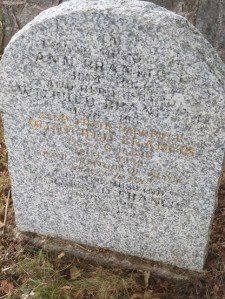
Emily’s body was brought back to Teignmouth where she was buried in plot N135. The epitaph on her headstone reads “Our days upon earth are a shadow”, part of a quotation from Job8:9 “For we are but of yesterday and know nothing, for our days on earth are a shadow”.
Top of Headstone of Emily Martha HellerBottom of Headstone showing sister Ann Susannah Partridge
Family Loose Ends
From the limited information available it would appear that the family in general had more than their share of tragedy.
Her mother Agnes we know died in the Devon lunatic asylum at Exminster. She and her husband William are buried together in the cemetery in plot N52.
Her eldest sister Frances died a widow in the work-house at Wolborough, Newton Abbot.
Her brother James and his wife Elizabeth had no children, presumably because they were unable to have children. They adopted two girls though and are buried together in plot HH38 with the younger of their adopted daughters, Lily May. Their elder adopted daughter Henrietta died in 1970 and is buried in S86 under her birth name Henrietta White together with M A White (died 1888) who was presumably her birth mother.
Sources and References
Extracts from contemporary newspapers are referenced directly in the text and are derived from British Newspaper Archives.
Ancestry.com for genealogy
Wikipedia for general background information
Other sources, with hyperlinks as appropriate, are as follows.
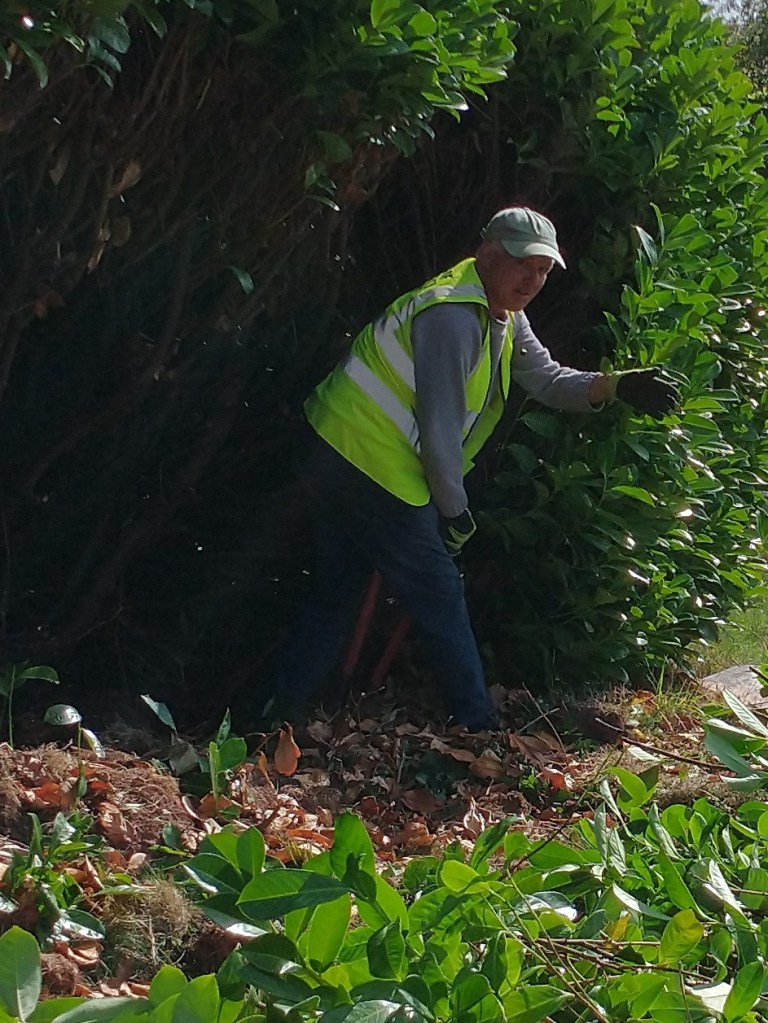
Thanks to one of our volunteers, Geoff Chetfield, for discovering and clearing the grave.
Thanks also to Rosemary Booth, archivist at Teign Heritage Centre, for digging out the information about Oakley and the photograph.
ANNEX: HMS Topaze reference
The ship is notable for an incident when Agnes Weston came on board to plead the cause of Temperance; as she recalled in her memoir ‘Life among the Bluejackets’.
“The Captain of H.M.S. Topaze invited me on board, and the men were mustered on the main deck; they listened very attentively. When I had finished speaking I asked the Captain, ‘Whether any men that wished it might join the Royal Naval Temperance Society?’ He gave a cordial assent, and my eyes roved round to see on what place I could put the pledge-book. I saw what I thought to be a bread tub standing not far off. ‘Could I have that bread tub?’ I asked; ‘it would make a nice little table turned over.’ I saw the Captain smile and tug at his moustache, and the men seemed on the brink of bursting into laughter. ‘Yes,’ he answered, ‘anything that we have is at your command. Here, men, a couple of hands roll over that grog-tub.’ “
Apparently the 60 man crew all signed the grog-tub. The incident is undated in Agnes Weston’s book but probably occurred between 1873 1nd 1877 which corresponds to the time that Henry Partridge was on board. I wonder if that tub is still around today bearing the signature of Henry Partridge?
According to Wikipedia, “Dame Agnes Elizabeth Weston, (26 March 1840 – 23 October 1918), also known as Aggie Weston, was an English philanthropist noted for her work with the Royal Navy. For over twenty years, she lived and worked among the sailors of the Royal Navy. The result of her powerful influence is evidenced in the widespread reform which took place in the habits of hundreds of men to whom her name was a talisman for good. In her day, one man in six in the navy was a total abstainer. Weston’s work included her monthly letters to sailors, Ashore and Afloat, which she edited, and the “Sailors’ Rests”, which she established in Portsmouth. She was the first woman given a full ceremonial Royal Navy funeral”.
Graham White is another follower of the Friends of Teignmouth Cemetery who contacted us again after the post about our “Celebrating Five Years”. He has done considerable research into the lives of his grandparents, Thomas Miles Bloomfield and Mary Ann Phillips Bloomfield. There is remarkable resonance between Thomas’ story and that of Samuel Brokensha, the distant cousin of Mike Brokenshaw who gave his story in an earlier recent post – both served in the navy and subsequently the coastguard service ….. but 80 years apart!
Most of the stories we publish are based on standard historical research from documented sources. So it is wonderful to be able to present this story with its unique personal family details that can only come from the family directly.
This is Thomas’s story, as told in Graham’s own words, with some limited editing to fit within this blog. There are two partners in a marriage and Graham has produced an equally fascinating biography of his grandmother, Annie, which will feature in an upcoming post.
In Summary
Thomas Miles Bloomfield grew up in a close-knit working-class family which, while not well off, would have been considered reasonably comfortable with a grace and favour railway house and two incomes.
He was the only one in the family to take the services as his career and this was dominated by The Royal Navy and The Coastguard service. From the time he left his home in 1900 his life was about service, the sea and travel until he arrived in Teignmouth in 1928 when he settled down with his family. Annie passed away when she was young in 1935 leaving him to bring up the children.
Family stories suggest he was much loved and was well respected in his adopted town and in particular around the fishing community in Ivy Lane (Editor’s Note: Samuel Brokensha also lived in Ivy lane!)
Childhood
Thomas Miles Bloomfield was born in the village of Burnham Sutton or Dale Hole Holkham, Norfolk, England. His father, Thomas Miles Bloomfield (snr), was the licensee of the Victoria Inn from 1881-1883 (and a butcher and cattle dealer at the same time) which was in Burnham Westgate, a village that is now a part of Burnham Market. His parents (my great grandparents) were recorded as publicans at this address in the 1881 and held the licence to 1883.
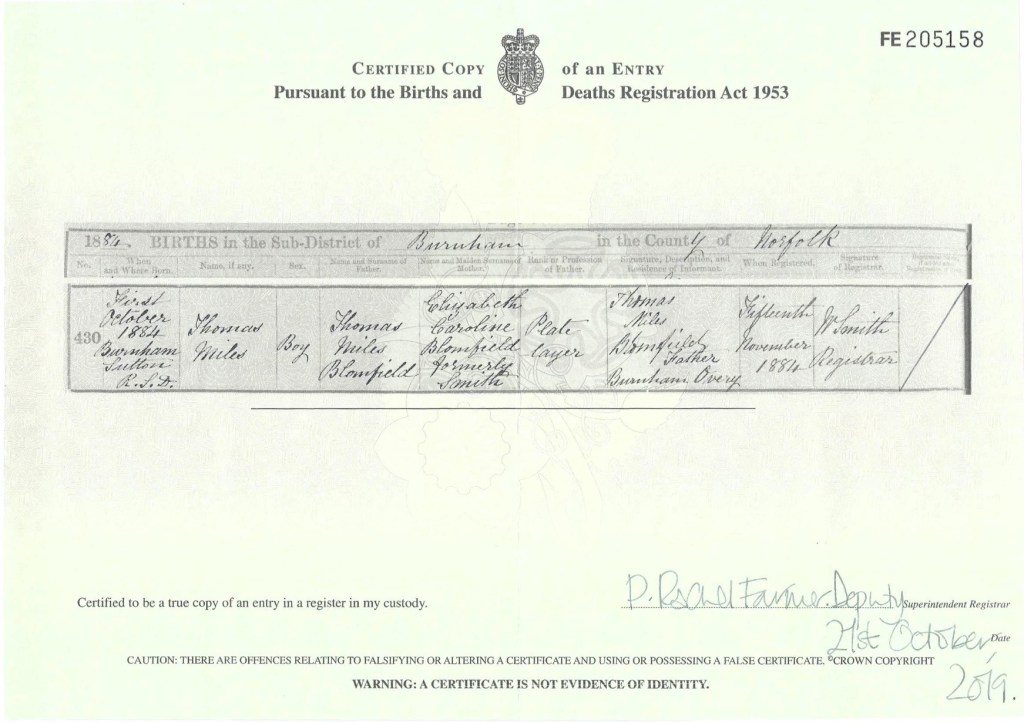
There is some confusion arising from Thomas Miles’s birth certificate contradicting all other known information about him. It records the family surname, including his, as Blomfield, his birth place as Burnham Overy, and his birthdate as 1st October 1884.
The surname could be explained by misspelling but this version was used as the family surname in previous generations including at some time his parents. In all other known documentation about him, his parents and his siblings, the family name is given as Bloomfield.
His birth certificate in 1884 records his birth place as Burnham Sutton but he was baptised in Holkham in July 1885. However, his younger sister and brother, Lucy Bridget and John William were registered as being born in Holkham, which was the village (and part of the Holkham Hall Estate) located close to the Great Eastern Railway (GER) gatehouse, where the family moved to around 1885/6 when the railway was first opened. The residence of his father; Thomas Miles senior, on the birth certificate, is stated at Burnham Overy and his occupation is shown as a Platelayer, which confirms his change in job from publican to railway worker. So, Thomas Miles (jnr) was probably either born in Burnham Sutton at the Victoria pub when his father had relinquished the licence and changed his job or in the Dale Hole GER railway gatehouse.
The family had definitely moved to Dale Hole GER railway gatehouse, Holkham, by 1885 – 1886. His father’s occupation was still Platelayer and his mother’s occupation was Gatekeeper (railway) by the time of the next census in 1901. The move would have coincided with the railway opening in 1886.
Gatehouse Cottage today
His parents lived at the railway gatehouse address for over 20 years and were registered living there in the 1901 and 1911 Census with the same occupations on the railway. This remote house now sits between the junction of the A149 and the B1155 immediately adjacent to the north west boundary to the Holkham Hall Estate. Today, the building still exists and is called Snuggles Cottage.
The cottage is very remote, sitting in the lee of a small hill which must have formed part of the railway embankment on a blind bend on the A149 road, being almost equidistant between the villages of Holkham, Burnham Overy and Burnham Overy Staithe. The land lying to the north is flat leading to low lying fields and the salt water marshes and the expansive beaches of Norfolk on the North Sea. It is very open to the easterly on shore gales.
The house is only 1.3 miles away from Burnham Thorpe where Horatio Nelson was born and a few hundred metres from the Norfolk Coast. Maybe this was the inspiration for Thomas Miles going to sea! One thing clear is that he had a love of trains, which was inspired by being brought up in a railway crossing gatehouse. This was passed onto myself and my elder brother when he took us regularly to watch the trains on the Teignmouth seafront promenade leading towards Spreypoint close to where the whale bone was positioned alongside where a pill box defence emplacement was erected during WWII.
The whole family of 7 lived in this very small railway gatehouse. The children would have been real-life ‘railway children’. They would also have spent much time on the vast beaches, close by, and collecting shoreline shellfish which is abundant there. I always remember great Aunt Grace, wife of sibling John William, sending to my mother, in the post, samphire, which grew in the salt marshes around the Norfolk coast.
The family also must have been intrigued by the gentry living in Holkham Hall. There is no evidence that any of them worked in the hall or its estate but as some of the children were christened in the Holkham Estate church it suggests that they were allowed into the lower village.
Thomas Miles started his schooling in the Holkham Village School, a part of the Holkham Hall estate, in July 1892. His elder brother Harry had started at the same school in July 1890 and his younger sister, Lucy in July 1894. There are no records of when any of the family left the school but Thomas Miles would most likely have left when he was 14.
Royal Naval Service
His service record shows that he enlisted in the Royal Navy on the 16th January 1900 when he was 16. He was previously employed as a labourer. His service career (not taking into account his coastguard career when he was posted, for a short while, to South Ventnor in 1914 as a Coastguard Boatman) was almost 19 years.
He appears to have signed up for a 12 year commission, on his 18th birthday, in 1902. He was due to leave the Royal Navy in 1914 and clearly was already contemplating a new career in the coastguards’ section which was, at that time a part of the Admiralty. (The ownership was not relinquished by the Admiralty until 1923 when it’s role was redefined as a coastal safety and rescue service and thereafter overseen by the Board of Trade).
Bearing in mind the outbreak of WWI was July 1914, he was reposted to Victory 1 in Portsmouth on 1st of August 1914. It is reasonable to assume that he was either requisitioned back to ship service, or he volunteered, as a part of the war effort.
For details of his postings see the attached Service Record and Postings record in Appendix 2.
After his training, his career until WWI appears to have been mainly around the manning of mothballed or reserved ships, primarily around Portsmouth. He was promoted through the ranks to Petty Officer.
Thomas in Aden 1916
On his return to Royal Naval service in 1914, at the commencement of WW1, he was first posted to The Empress of Japan, and then HMS Lunka which patrolled the east coast of Africa, Tanzania and Zanzibar in the south and up to the Yemen and India in the north. He remained in this area for the rest of the war. The photo shows him in Aden in 1916 and bears the inscription “To my dear little daughter Eva Mary from her loving father at Aden on her dear little birthday 10.11.16″
The log book of HMS Lunka does not suggest a lot of active engagement with the enemy but the mission of this ship, being stationed in the area, would have been to stop the enemy or their allies’ shipping reaching or leaving the German Colonies in and around East Africa, and thus stopping troop and supply movements. HMS Empress of India did engage in some direct enemy action in the Red Sea. It is thought that his short attachment to HMS Empress of Japan was only to take him to his permanent posting on HMS Lunka.
Marriage, family and death
He met his wife; Mary Ann Phillips Hutchings (known as Annie) in Ventnor in 1913. She was a Devon girl from East Prawle, Chivelstone, and was living in one of the coastguard cottages looking after her brother-in-law, William George Eastman, and his 3 children (1911 Census only shows two children as the eldest daughter, Melita, was sometimes sent to relatives due the illness of her father). William George was married to Betsy Eva who was Annie’s elder sister. She had died in June 1909. Annie had moved to live with her sister and her family either when their mother died in 1901 or when her sister became ill sometime before 1909. (This cannot be confirmed but circumstantial evidence suggests that she was with her sister from 1901). It is understood that William George also became ill shortly after his wife Betsy died and he passed away in 1913, a month before Thomas Miles met Annie.
Thomas and Annie married in Ventnor Holy Trinity Church on the 1st of June 1914 and their first child; Eva Mary (Mary) Bloomfield, was born on the 10th November 1915. Thomas would not see his daughter until 1919 when he came back from his Indian Ocean war service in the Royal Navy. Annie and Eva Mary stayed in West Street Ventnor until his return.
They eventually had 5 children, but only Eva Mary was born in England.
Annie passed away on 12th December 1935 at their coastguard station home at no 1 Ivy Lane, Teignmouth.
Thomas Miles passed away at Teignmouth Hospital on 28th June 1953.
Coastguard Career
On return from his WWI service, Thomas Miles was posted initially to Victory I Portsmouth and then reposted to Ventnor as a Leading Boatman in the Coastguards on the 28th May 1919. He did not stay long and on the 26th August 1919, he was posted to Belmullet, County Mayo, Eire and the family moved with him. This was at the time that the Irish War of Independence had commenced after the Soloheadbag ambush in January 1919 (which by coincidence involved the death of an R.I.C. Constable who was born in Belmullet).
Thomas Miles was stationed at Bellmullet, Blacksod Point and Buncrana all in the same area until 23rd February 1921. During this time the ‘Troubles’ were spilling over into this region. In October 1919 a young boy was shot by a sentry guarding the local wireless station. In June 1920 an R.I.C. constable was killed and three injured during a riot on the main street. In late August 1920 a local coastguard station (undetermined) was attacked. The raiders were interrupted by a police patrol and shots were exchanged. The raiders escaped but not before the coastguard station was destroyed.
It is not known if Thomas Miles or his family were directly involved, or how they were affected by any of these conflicts, although they were inescapably in the middle of everything going on. The only known reference to the dangers of the job, at this time, was that he carried a gun for protection. This information has been passed down through the family. The Coastguards were particularly disliked because they not only represented the ‘oppressive British’ but they inhibited the smuggling activities, much which was more to do with local crime rather than a part of the political differences.
On the 24th February 1921 he was posted to Cloghy (Cloughy) near Portaferry, in Northern Ireland.
The next period of his career and the location of his family is not clear. Information thereafter is not on his service record, as by now the Coastguards were transferred to the Board of Trade, as mentioned earlier, and his Royal Naval Service career was now finally over, but his Coastguard Service continued. However, he was certainly still at Cloghy on the 6th June 1925 as my mother, Vera Ellen, was born in Portaferry on this date.
Sometime between June 1925 and July 1926 he was posted to Drummore near Stranraer Scotland. Records have not been found relating to this posting. However, Eric Bloomfield, his son, recalled going to school in Stranraer. In one of the two post card albums in existence, originally owned by Annie, his wife and then by her daughter Eva Mary Bloomfield, there is a page dedicated by A Galloway of 36 St John Street, Stranraer dated 12th July 1926. They therefore had moved sometime in the preceding 12+ months from my mother’s birth place.
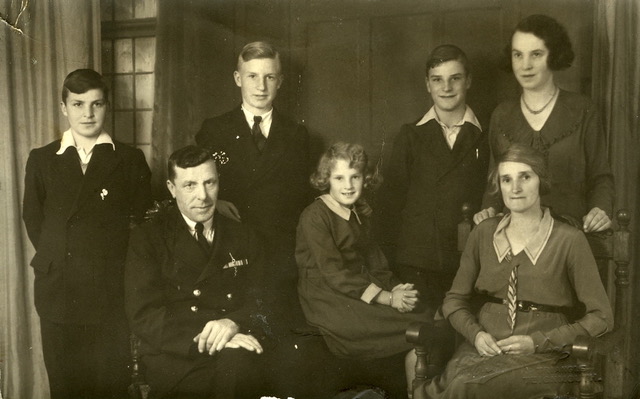
Family Photo 1926/27
A Coastguard in Teignmouth
On the 4th December 1928 Thomas Miles was posted to Teignmouth Coastguards as HM Coastguard. He was promoted to Station Officer on 1st November 1942 and retired on 1st June 1946 so his service at Teignmouth covered the entire second world war.
Teignmouth Coastguards 1930
There are three Coastguard commendations for him during his time at Teignmouth:
4 September 1931, CGM 21298
With reference to the report on Form CG15 forwarded by him relating to the rescue of a man and a woman who were cut off by the tide at Ness Rocks, Shaldon, on the 27th August, the Inspector is informed that the Board highly appreciate the good work done this occasion by Coastguard TM Bloomfield and Messrs D. Chapple, F. Tiltman and W Hook enrolled members of the Teignmouth Life Saving Company. Signed D. J Killingback
19 August 1932, CGM 23277
With reference to the report of the 16th August forwarded by the District Officer Torquay relating to the rescue of three young ladies cut off by the tide near Maidencombe on the 10th August, the Inspector is informed that the Board highly appreciate the excellent work done on this occasion by CG Bloomfield, whom it is observed made hazardous ascent of a cliff in order to effect this rescue. This communication which has been noted in the records. Signed N C Orton 19 August 1932
23 August 1939 CGM TH/3/30
With reference to the report on Forms CG 15 and 15A regarding the rescue of a person from the cliffs at Maidencombe, Devon on August 9th, the Board note with satisfaction the service performed by Coastguard T M Bloomfield, Teignmouth, on that occasion.
All of these events received considerable national press coverage.
Other instances of his actions were recorded in the Teignmouth Post and Gazette of 24 April 1936:
Bundle Head Incident Girl Stranded 300 feet Up Cliff Rescued by Teignmouth Coastguards
Three hundred feet up a cliff, and unable to ascend or descend, was the predicament a young lady visitor to Littleham, near Exmouth, found herself in after she had attempted to scale Bundle Head, between Labrador Bay and Ness Cove, Shaldon, on Thursday afternoon.
According to a story related to Mr A. S. Williams, manager of the Labrador Hotel, by the girl’s companion, who was accompanied by three children, the party had come from Exmouth, and after clambering around the rocks her friend expressed the intention of climbing up the cliff at Ness Cove. She tried to dissuade her, and after walking on a little way, turned round and saw that the girl had climbed a considerable way up Bundle Head and was in difficulties. She quickly went to the hotel and reported what had happened.
Mr Williams told a ‘Teignmouth Post’ representative that the lady was so excited that he could not make out how high the girl had climbed, but he immediately sent a number of men along with tackle with the intention of effecting a rescue if she was only 50 or 60 feet up. They found, however, that she was near the top, and Mr Williams, who is a member of the intelligence branch of the Coastguards, then phoned the Teignmouth Coastguard Station and Station Officer T. Bloomfield, accompanied by Coastguard A. Ruse and Master Eric Bloomfield left for the scene of the occurrence with the cliff rescue apparatus.
On arrival, Mr. Bloomfield was lowered over the edge of the cliff, and having fitted the ‘breeches’, the girl was pulled to the top apparently little worse for her experience.
In a sequel to the Bundle Head Rescue, the following report appeared on May 1st 1936:
Trapped Girl Thanks Coastguard
Miss Elitta Carles has written from The Bungalow, Littleham, thanking Coastguard Station Officer T. Bloomfield and his colleagues for rescuing her from Bundle Head on Thursday of last week. She explains that she could not thank them at the time as she could not speak English very well. Miss Carles is, apparently, a Belgian and it is hoped that her experience of being trapped 300feet up the cliff will be a lesson to other would-be ‘mountaineers’.
In conversation with a ‘Teignmouth Post’ representative, Mr Bloomfield said from below, the cliffs look comparatively easy to climb, commencing with a gradual slope, but further up the ‘face’ is almost sheer and the earth loose. “It would be a 100 to 1 chance finding a firm rock to complete the climb” remarked Mr. Bloomfield, who did not think much for the chances of a person who commenced to slip.
Unfortunately, there is not only this risk of a rock giving way, for people finding they are unable to either up or down are likely to lose their heads with serious consequences. It is a mystery how Miss Carles got as high as she did, clad as she was, according to an eye witness, in a heavy leather coat and stout wellington boots. She must have been one of the hardy species of her sex, for apparently, she was perfectly cool, calm and collected when rescued.
Having reached Labrador a few minutes after the arrival of Mr. Bloomfield and his party, our representative found the telephone situated at the top of the cliff-lift a useful medium for information, for from an advantageous point at the Hotel, Mr Williams, the manager, was able to give him a running commentary as to how the rescue work was proceeding.
Family Photo c. 1933
World War II
There is no known information recorded of any specific Coastguard activity, associated with him, at Teignmouth during the War although there are some references to actions involving Teignmouth Coastguards in the press.
PHOTO SELECTION FROM 1942/43
Grandfather Bloomfield (left) in WW2Thomas, Chief Coastguard, in WW2 fatigues outside Coastguard House, Ivy LaneThomas in uniform at same location
In the Viv Wilson book, ‘Teignmouth at WAR 1939-45’ she writes:
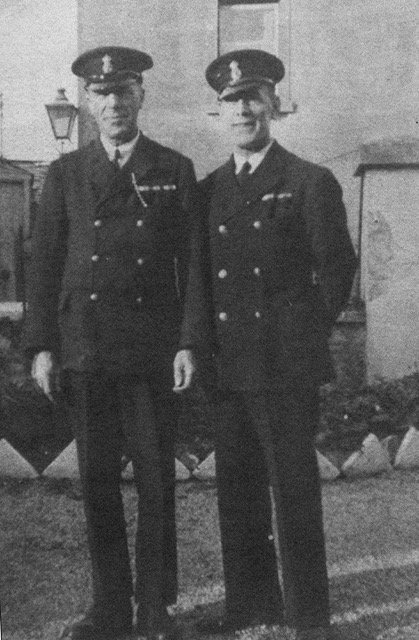
Chief Tom Bloomfield (L) and Bert Parrick at Ivy Lane. (see Photos addendum) These two men kept watch from the Coastguard look-out at the foot of Cliff Walk day and night through the war years and witnessed many incursions. On one occasion a German pilot made a slow approach, as if on photographic reconnaissance. He flew up the river and returned past the Ness before dropping bombs in the sea. Eye witnesses say that it appeared that the pilot had no wish to damage Teignmouth.
Some local people camped out overnight up in Eastcliff meadows rather than risk being buried alive at home.
The Sprey Point look-out could not be reached from the sea wall, blocked by anti-invasion barricades. The railway line was used for access and there was great sadness on two separate occasions when auxiliary Coastguards Tom Barnes and Frank Riddle were killed by trains’.
The following anecdotal information has been handed down through the family:
My mother, Vera Ellen White (nee Bloomfield) recalled an incident when she was in the back garden area, with her father, between Ivy Lane and Foresters Terrace overlooking the back beach. She recalled a German plane came down the River Teign from the direction of Newton Abbot and it strafed the houses. She and her father crouched down behind the beach wall that still exists today between Ivy Lane and Foresters Terrace.
Thomas and Vera
On VE day a coastguard rocket was fired in celebration by Thomas Miles Bloomfield together with his future daughter-in-law (Sheila) who was on leave from the ATS.
Retirement
East Cliff Cott today
Thomas Miles retired from the Coastguard Service on 1st June 1946. He moved from the Coastguard House in Ivy Lane and bought East Cliff Cott, Mere Lane Teignmouth. He clearly still wanted to live right next to the sea. He lived there with his daughter, Vera Ellen White, her husband Leonard and subsequently their two first children; Norman Miles and Graham Lennard. He would take his grandchildren to watch the trains at the end of the promenade close to East Cliff Bridge.
He pursued his hobbies being a member of The Den Bowling Club, watching the horseracing at Newton Abbot Races and following from afar his Norwich City football team, ‘The Canaries’.
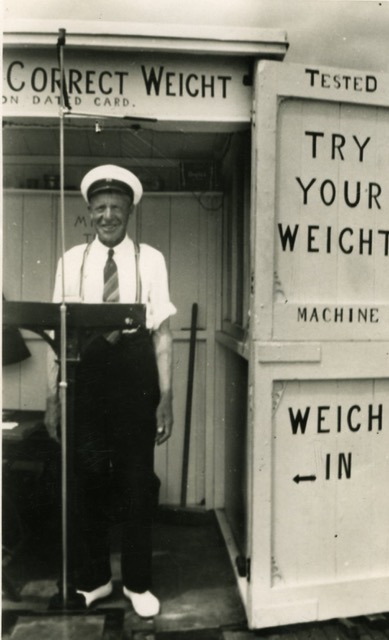
He also opened a Weighing Machine kiosk on the east side slope outside Teignmouth Pier which he operated during the summer until his death in 1953. The scales were given to the boxing club after his death.
Thomas and the Weighing Machine
Dedicated to my grandfather.
“The more I learnt about him the more I understood what made him the man he was. I just wish I could have had the chance to know him.“
Graham Lennard White, grandson and son of Vera Ellen White (nee Bloomfield) 13th June 2020
Thomas’s funeral was marked in the local paper:
Thomas and his wife Annie are buried in plot KK74 in Teignmouth Old Cemetery.
Original photo plus recent images
Graham has compiled some other notable interesting facts about Thomas and his family which are included in Appendix 1 to this story. Appendix 2 includes a genealogical summary and pertinent documents.
Graham’s Thanks, Acknowledgments, Sources and References:
Alan Bloomfield Grandson
Diane Hook – Teign Heritage
The Wilson Archive – (Teignmouth at WAR 1939-1945)
His mother, Elizabeth Caroline, was also employed by the GER railway company as the gatekeeper for the railway crossing at Dale Hole, near Holkham, Norfolk. She would have been only one of a handful of women employed on the UK railways for such a job.
A part of his Coastguard duties was to daily turn the lights on and off on the Teignmouth promenade Lighthouse. It is thought that at one stage it was gas lit.
His sister; Bessie Bloomfield, became the servant of Andrew Bonar – Law MP in the 1911 Census when she was 30 years old. Bonar – Law became the UK Prime Minister 1922-23 (even though he was Canadian) and was the Leader of the Unionist Party. He formed an alliance with Lloyd George in 1916 and became the Chancellor of the Exchequer and a member of the War Cabinet.
His brother, Harry Bloomfield, was killed on the 16th August 1917 during the 3rd Ypres Offensive (The Battle of Passchendaele). Interestingly Bonar-Law was pro the Passchendaele Offensive. History has subsequently questioned this decision.
Actions at Blacksod Coastguard Station, in 1944, where the Thomas Miles Bloomfield was stationed in the 1920’s, contributed to the course of the Second World War, not that Thomas Miles or anyone else outside the top brass military would have known.
One of the duties of the Coastguard, which my grandfather would have done when he was stationed there, was to take regular weather readings and transmit these back to a central control, in England, for collation. Blacksod sits at the most westerly position on the British Isles. Ted Sweeney was the Coastguard man and Lighthouse keeper, at Blacksod on the 3rd June 1944 where he sent his hourly met reports, direct by phone, to London. His 2.00am report contained an ominous warning of a Force 6 wind and a rapidly falling barometer at Blacksod. It was his report from this Coastguard station, which convinced General Dwight D Eisenhower to delay the D-Day invasion for 24 hours to the 6th June. This was after Ted Sweeney’s forecast had been double checked by telephone from London at 11.00 am later the same day. He was asked to re-read the whole report over the telephone. Then at 12.00 pm on June 4th Ted sent a latest report that predicted an improving weather forecast that was immediately passed to Eisenhower and the allied commanders. In the early hours of the 5th June, following this report from Blacksod, the D Day invasion order was given. The rest is history, as they say!
The Irish Independent reported that evidence from Met Eireann forecasters reveals how the Blacksod day forecast changed the course of history. Despite years of planning, in the days leading up to the attack, the Allied invasion would depend on one crucial and uncontrollable factor – the weather. Although separate observations were taken at various locations by Royal Air Force, Royal Navy and the United States Army Air Force meteorologists, an accurate forecast from the Irish Meteorological Service, based on observations from Blacksod on Mullet peninsula would be the most important. The D-Day Museum in Portsmouth was presented with Sweeney’s original Blacksod observation sheets, collated by the Irish Met Service, and including the actual weather observations which proved so crucial to the invasion.
Friday 11th March 1938 Thomas Miles Bloomfield was one of a number of Coastguard Station Officers who was called to give evidence at Brixham Police Court at the trial of former district coastguard officer; Harry Evans. Mr Evans pleaded guilty to the charge of false taxi expenses and was fined £20, with £30 costs and £4.11s 8d restitution.
Appendix 2: Genealogical Summary
Thomas Miles Bloomfield: 1st or 5th October 1884 (records differ) – 28th June 1953
Born: Burnham Sutton, Norfolk, England
Parents: Father: Thomas Miles Bloomfield 1846 – 1927
Mother: Elizabeth Caroline Bloomfield nee Smith 1845 – 1927
Siblings:
Eliza b 1877 married and lived locally in Brancaster. Died?
Lucy b 1879 died 1884 aged 5
Bessie b 1881 died? – became the servant to Andrew Bonar- Law Prime Minister, WWI War cabinet, First lord of the Treasury, Chancellor of the Exchequer.
Lucy Bridgit b 1887 – Servant and parlour maid to Charles C Scott KC Died 1956
Harry b 1883 – killed at the 3rd battle of Passchendaele in WWI 1917
John William b 1890 – milkman. Died Banbury 1951
Marriage: Mary Ann (Annie) Phillips Bloomfield nee Hutchings at Holy Trinity Church, Ventnor, Isle of Wight, England on 1st June 1914.
Children:
Eva Mary (known as Mary) (b) 1915 Ventnor, I.O.W. England
Richard Miles (b) 1920 Blacksod, County Down, Eire
Eric Malcolm (b) 1921 Cloughy, Port-a-Ferry, Northern Ireland
Norman (b) 1924 Cloughy, Port-a-Ferry, Northern Ireland
Vera Ellen (b) 1925 Cloughy, Port-a-Ferry, Northern Ireland
Teignmouth Residences:
1 Coastguard Cottages, Ivy Lane
East Cliff Cottage, Mere Lane
Death: Teignmouth Hospital
Resting Place: Teignmouth Cemetery with his wife Mary Ann (Annie) Phillips Bloomfield
In our newsletter at the end of July I mentioned one of our achievements:
“Five years ago we were confronting what seemed an incredibly daunting task but, looking back, it is amazing how much a small group of hard-working volunteers has been able to achieve in that time ….. In our 12 acre site where over 13,000 people are buried in over 8,000 graves we reckon we have cleared about 40% of the area. This is lots of HARD work, with years of bramble, ivy and anthills covering the graves (often completely)”.
Statistics give the bare facts but, as the saying goes, a picture speaks a thousand words. So here are a selection of pictures to give a visualisation of what has been achieved.
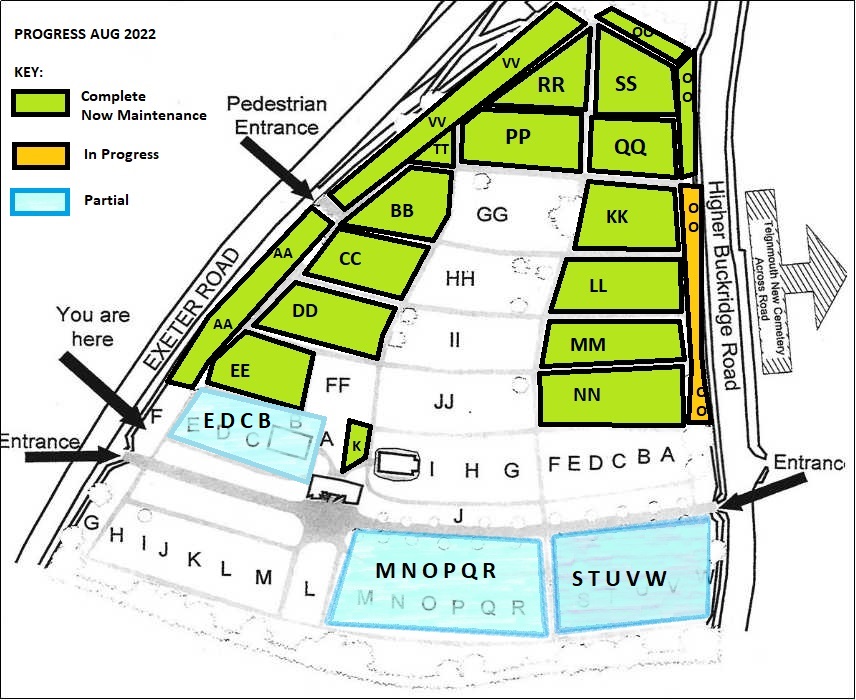
Firstly, here is what it looks like over the site as a whole, upto the end of August 2022:
Sections coloured green have been completely cleared by members of FOTC. But the work doesn’t stop there. There is always re-growth so the more we clear the more there is also to maintain.
Sections coloured orange are work currently in progress and sections in blue are mixed – parts have been cleared whilst some areas have been left for later, either because they are large open areas of unmarked graves or because they are more “challenging”.
The most recent sections being worked on are those sweeping around from the north-western side of the cemetery and down the length of the eastern side – basically the top of section VV and the whole of section OO.
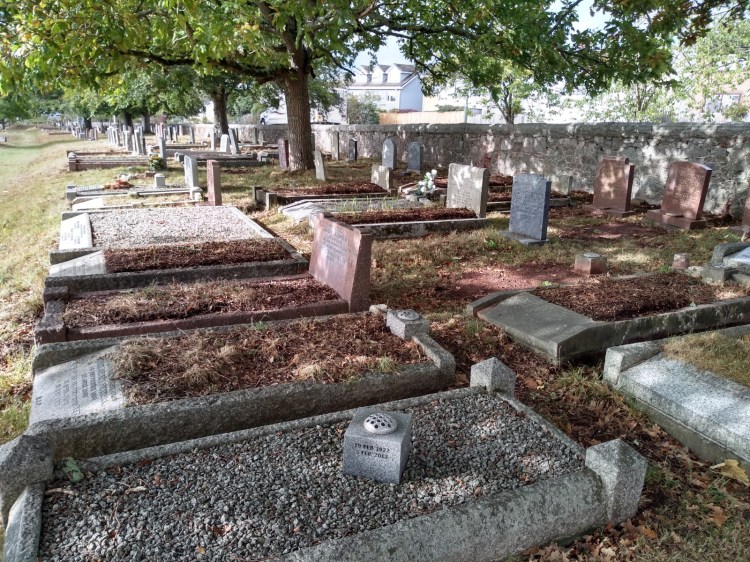
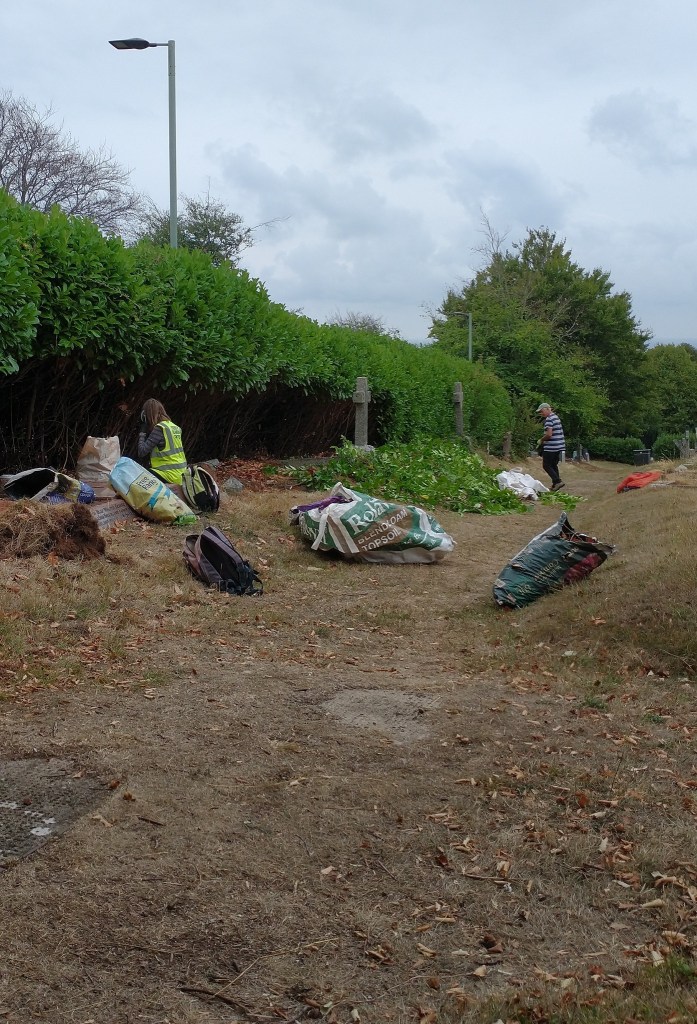
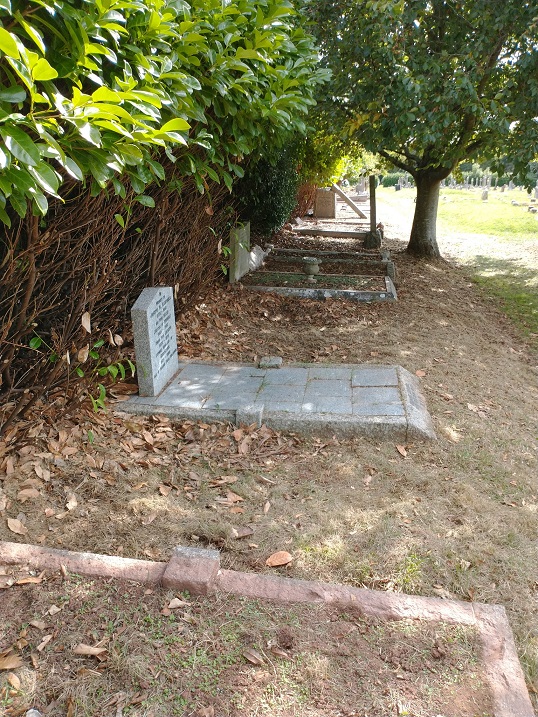
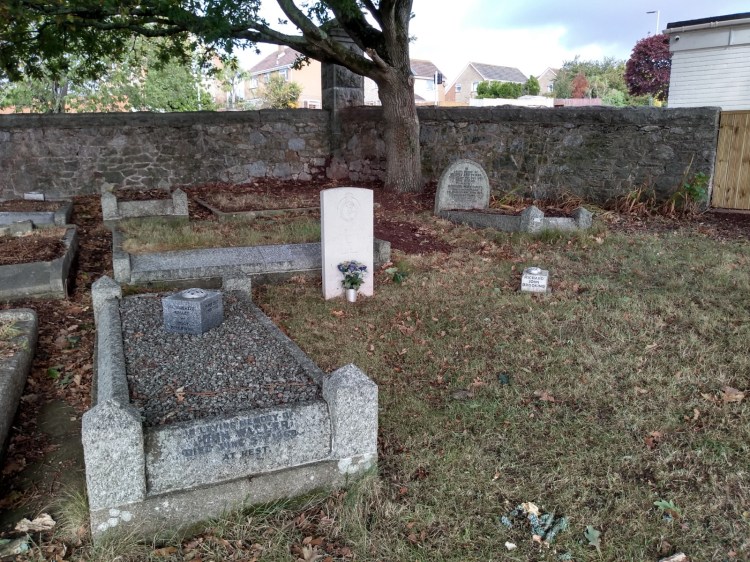
Here are a few photographs with landscape views of that work.
Top end of section VV
Section OO along top of cemetery
Section OO, east side
Section OO, east side, graves being exposed
Section OO, east side ….. and more
Section OO, east side ….. it’s painstaking work
But the effort is so worthwhile
NW Corner of cemetery where sections VV & OO meet
Section OO, east side, start of hedge trimming
Section OO, east side, laurel clippings being bagged up
Section OO, east side, more cleared from below the hedge
Section OO, east side ….. long view
Section OO, east side ….. and tough cutting through the laurel
As we clear areas we discover, of course, who is buried there. Each section is divided into the individual plots in which people are buried. The plots are numbered and, for each section, there is a plot map. The burial records include the plot number for every person buried so these plot maps, in turn, help you in tracking down someone you may be looking for.
Here is an example of section VV showing names of some of those buried there who have clearly identifiable headstones which can be used as a guide to the other plots.
Plot map showing top half of section VV
And here is a selection of graves and headstones from the top part of section VV.
With the celebration of the fifth anniversary of the Friends of Teignmouth Cemetery a number of people wrote in with details of relatives buried in the cemetery. Mike Brokenshaw sent us the following story about Samuel Brokensha, his 3rd cousin four times removed who is buried with his wife Charlotte Mary in plot J61, close to the main chapel.
Quite coincidentally the eagle-eyed amongst you may have spotted Samuel in the previous post about Bowyer Vaux where they both appeared at the inaugural meeting for the establishment of parochial schools in Teignmouth:
This is Mike’s story in his own words with some limited editing for the blog:
Samuel Brokensha, Commander RN
Plot J61 was purchased on 28th July 1858 by Samuel Brokensha of East Teignmouth. On 30th July his wife Charlotte Mary was buried there and on 2nd January 1880 Samuel, despite having passed away in Bath, was laid to rest with her. Samuel was my 3rd cousin 4x removed.
Naval Career
Samuel was born in Mevagissey in 1795, baptised on the 9th August, to Samuel and Mary. (Note that Samuel Snr, along with his brother Luke, was a master in the Royal Navy. The role of master was to run the ship in terms of Navigation, Sailing, Provisioning, Loading and Trimming etc. The master was appointed by, and served under a warrant from, the Board of Admiralty. The captain was the military commander and fought the ship.)
HMS Mars at Battle of Trafalgar – Front right rear ship
Samuel jr entered the Royal Navy 25th March 1806 as a first-class volunteer on board the 74 gun Mars.
Yes, the dates are correct, he was probably just 10 years old, but this was not unusual in those days – Nelson himself entered as an ordinary seaman when he was 12. The Master of the Mars was at that time Samuel’s uncle, Luke Brokensha who, as the master of the Revenge, had been wounded at Trafalgar just a few months earlier. Samuel saw active service against the French and was involved in the capture of several ships.
HMS Ganges at Battle of Copenhagen 1801
In July 1807 he removed to the Ganges, another 74 where the Master was once again none other than his uncle Luke. He took part in expeditions to Copenhagen and to the Walcheren.
HMS Bedford at Battle of Camperdown, 1797
In May 1810 Samuel became a midshipman of the Bedford, 74 guns, in which ship we find him employed in the North Sea, West Indies and off Bordeaux until discharged in September 1814. He obtained his commission as a Lieutenant in March 1815 and until 1831 took part in the coastal blockades.
Coastguard Service
After leaving the navy he joined the Coastguard Service at Folkstone as Chief Officer, in September that year transferring to the Ramsgate Station again as Chief Officer in which service he continued until 1833. Between July 1833 and June 1836, he commanded the Revenue Cutter Lively around the coasts of England after which he returned to the Ramsgate station as Chief Officer until 21 May 1838, on which date he resigned from the service.
Family Life
Samuel married twice, on 27th May 1819 at Higham in Kent to Mary Edwards and, following her death, he married Charlotte Mary Cobb on the 9th Feb 1837 at Palgrave, Suffolk. Following his second marriage he moved to South Devon settling in Teignmouth. We don’t know exactly when he moved to Teignmouth but he is mentioned in newspaper reports from about 1849 onwards. He can be found in the Teignmouth census returns for 1851, 1861 and 1871.
Following the death of his second wife, Charlotte, Samuel continued to live in Teignmouth with his niece from his first marriage, Hannah Edwards. Hannah’s mother died in the early 1860s and we believe that her father Henry (Charlotte’s brother) came to live with them at the Heywoods. Henry died in 1871 and was buried in a grave, now under the hedge, immediately adjacent to his sister.
During his time in Teignmouth Samuel lived in:
Grove House (Now demolished but was on the site of the lock-up garages in Daimonds Lane)
The Strand
Ivy Lane
3 The Heywoods
Activity in Teignmouth
The Teignmouth Improvement Commission
Between May 1849 – Sept 1852 he was a member, and occasionally Chairman, of the Teignmouth Improvement Commissioners. This sparked an interest in what is a piece of social history affecting us all. The fact that it concerns Teignmouth made it more interesting (to me at least).
Boards of improvement commissioners were ad hoc urban local government boards created during the 18th and 19th centuries. Around 300 boards were created, each by a private Act of Parliament, typically termed an Improvement Act. The powers of the boards varied according to the acts which created them. They often included street paving, cleansing, lighting, providing watchmen or dealing with various public nuisances. Those with restricted powers might be called Lighting Commissioners, Paving Commissioners, Police Commissioners, etc.
Older urban government forms included the corporations of ancient boroughs, vestries of parishes, and in some cases the lord of the manor. These were mostly ill-equipped for the larger populations of the Industrial Revolution and the result was that the commissioners developed naturally but not consistently, neither in their responsibilities nor to the extent of their democratic constitution.
Improvement Acts empowered the commissioners to fund their work by levying rates. Some acts specified named individuals to act as commissioners, who replenished their number by co-option.Other commissions held elections at which all ratepayers could vote, or took all those paying above a certain rate as automatic members.
With their ability to raise the money required to fund a large range of facilities, coupled with the fact that there was an element of election, the Commissioners were in effect the forerunners of today’s local council.
Harbour commissioners remained separate in many cases, and they or their successor body are today the competent harbour authority in many UK ports including Teignmouth.
The Teignmouth Improvement Act was passed in about 1836. A number of the minute books of the Teignmouth Improvement Commissioners (TIC) have survived and are lodged in the Devon Heritage Centre in Exeter. The minutes were hand written by the Clerk to the Commissioners who in this case was John Chappell Tozer. (Today TOZERS is a well-known firm of solicitors in Teignmouth). The role of the TIC can be no better explained than by reference to the description at the front of each minute book:
“The proceedings and orders of the Commissioners acting under and in execution of an Act for better paving, lighting, watching and improving the town of Teignmouth in the County of Devon and for supplying the inhabitants thereof with Water, passed in the sixth year of the Reign of King William the Fourth”.
Further indication of the range of responsibilities can be found in an entry that indicates some of the costs of providing services:
Wages paid to the Turncock
12/- per week
Wages paid to the Gasman
15/- per week
Wages paid to the Lamplighter
15/- per week
Thermometer for Gas Station
£3-4-6d
Work on fire plugs in gas house
£2-1-0d
Building wall in Combe Brook
£20-0-0d
Work on Gas Station Smithy cellar and Coke cellar
£32-7-5d
Other posts that were mentioned included Scavenger, Waterman, Policeman (including uniform), Street keeper and Surveyor.
A minute of 4th February 1845 illustrates the powers that the TIC held:
Resolved – That public notice be given by the Crier that all persons are required to sweep daily in front of their houses and that the superintendent do enforce the same by laying information against offenders
Such offenders could be, and were, taken before the magistrates for punishment.
The minutes also show that the restriction in funding often experienced by today’s council is nothing new. At a meeting of 1st Dec 1846 the Clerk read a request from 7 worthies including James Spratt asking for a further 3 gas lamps near Gorway Lodges, at the foot of Woodway Lane and one other. (Note: James Spratt was a hero of Trafalgar where he was a Masters mate on HMS Defiance. The injuries he sustained ultimately resulted in him being posted to command a signal station at Teignmouth. He married a local girl and on leaving the navy settled here permanently in Woodway House that he had built)
The Commissioners response was that:
‘the previous November they had been urged to provide more lighting and that they had agreed to 8 further lights but that they had no means of paying for them. There was a deficiency in the gas account income of £17 with no prospect of an increase in price for gas. The Commissioners have now reduced the price by 2/6 per 1000 cu ft in the hope of increasing consumption. If there is no increase in consumption then income will reduce by £60. In addition the Commissioners have had to pay £500 for the laying of a new gas main’.
We noted earlier that the commissioners could co-opt new members in order to maintain their numbers and this is how Samuel first became involved. At the meeting of Tues 8th May 1849, it was resolved and declared –
‘That Joseph Floyde, who was elected Commissioner on 1st day of September 1846 has departed this life. Whereupon the Commissioners assembled at this meeting nominated and appointed Samuel Brokensha Esq. as a fit person qualified as required by the said Act to be Commissioner in the room instead of said Joseph Floyde.
The said Samuel Brokensha then qualified by making and subscribing the declaration required by the said Act.’
Other Interests
Samuel was Treasurer of the Teignmouth Ladies Bible Society, involved in the Useful Knowledge Society and was a founder and patron of the Teignmouth Peoples Dispensary that provided medicines to the poor.
(Editor’s note: a trawl through the newspaper archives confirms that Samuel Brokensha was a very active member in many aspects of Teignmouth life. A list is appended to this main story)
His Death
Samuel died in Bath on 29th Dec 1879 and was buried with his wife Charlotte.
You will notice that between the death of his wife and his own passing Samuel rose in rank from Lieutenant to Commander RN. Although he had retired from the navy it was common practice in those days to adopt promotions based purely on seniority.
There is a memorial inscription to his niece Hannah on her fathers grave adjacent to plot J61 but until we are able to access the burial records again we don’t know if she is buried there.
Here is a transcription of the headstone on Plot J61. It is very worn but this represents the best guess of a number of our family historians.
Sacred To the memory of Charlotte Mary
The beloved wife of Samuel Brokensha Lieutenant in the Royal Navy And eldest daughter of the late Francis Cobb Esquire of Margate
Her sincere and evangelical piety united to The Private and benevolent disposition That endeared her to her own family Led her loss to be truly mourned By a far wider circle
Entered into rest July 25 1858 Aged 52 years But with the precious blood of Christ 1 Peter 1 C 19
Also Samuel Brokensha Commander RN Husband of the above Who after a long life of usefulness and Christian consistency fell asleep in rest December 29 1879 in the 85th year of his life
Accepted in the Beloved Ephesians 1 – 6
Sources
Devon Heritage Centre Ref 1571A/9/1 to 5 and R230A/0/2/6 – Minute books of the Improvement Commission
Appendix – known activities of Samuel Brokensha in Teignmouth (Editor’s notes)
Member of, and sometime Chair of, Teignmouth Improvement Commissioners
Member of Botanical and Horticultural Society, winning a number of prizes
Subscriber to the Dispensary
Treasurer of the Teignmouth Medical Relief Institution and Dispensary for the sick poor
Member of the Teignmouth branch of the Church Missionary Society
Member of the British and Foreign Bible Society
Committee member (and shareholder) of the Teignmouth Extra Mural Cemetery Company
Treasurer of the Useful Knowledge Society
On the committee of the Council of Education for the development of “Parochial Schools”
Possibly governor of Teignmouth Infirmary
He was also a member of what seems to have been a short-lived movement in Teignmouth to suppress “Popish Practices”!
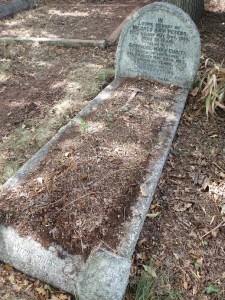
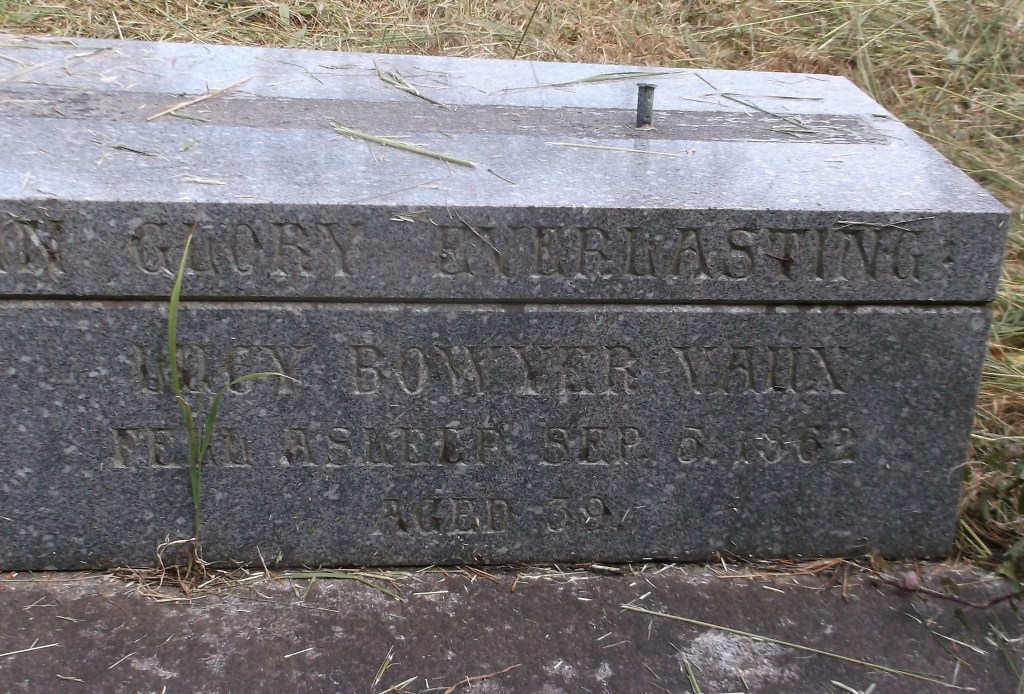
In the last post on the death of James Bond there was a photograph showing the approximate location of his unmarked grave. The reference point for this was the grave in the foreground of the picture. The eagle-eyed amongst you might have noticed the unusual name on that grave. For those not so eagle-eyed, here it is in close-up:
Bowyer Vaux seemed an unusual name worthy of investigation. However, a quick search showed that it wasn’t as uncommon as you might have thought at that time. Also there seemed to be very little about our own Bowyer Vaux. What there was gives one interesting insight into the medical profession at the time. It also provides a serendipitous link into the story for the next post provided by Teignmouth resident Mike Brokenshaw.
Genealogy
Bowyer Vaux was born in Birmingham on the 9th September 1781 into a Quaker family – father Jeremiah and mother Susanna. The Quakers were excellent at keeping their own records so we have this wonderful birth certificate for Bowyer:
Interestingly though he seems to have later left his Quaker roots behind because there is a baptism record for him in 1844.
Bowyer married Hannah Browne on 26th April 1810 and they had five children: Bowyer (b. 1811); Hannah (b. 1816); Susan (b.1821); Lucy (b. 1826); and James (b. 1828).
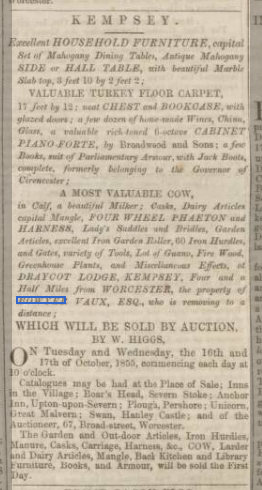
For the whole of his working life the family lived in the Birmingham area, moving to Draycot Lodge, Kempsey after Bowyer retired. In 1855 an advertisement in the Worcestershire Chronicle of 10th October for the sale by auction of house contents suggests that that was the year that Bowyer, his wife and youngest daughter moved to Teignmouth.
The Surgeon
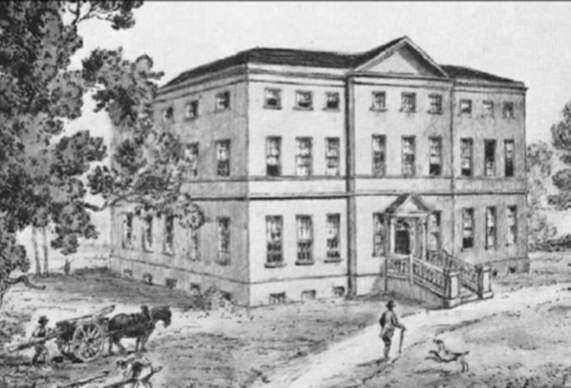
Birmingham General Hospital
Bowyer Vaux was a surgeon who had worked all his life at the General Hospital, Birmingham, before retiring from there in 1843 at the age of 60. He had succeeded his father, Jeremiah Vaux, who was one of the four original surgeons at the founding of the hospital in 1779. He was one of the original members of the Royal College of Surgeons which had been established by royal charter in 1800 and, at the time of his death in 1872, he was the Senior Fellow at the college.
Judging by the apparent lack of papers in his name it would appear that Bowyer was more of a practising surgeon with little aspiration to the academic side of the profession. I wonder if he might have been amused therefore by his mention in despatches after his death in a brief analysis of longevity in the medical profession.
This was the circulating story which appeared in the Express and Echo of 1st January 1873:
LONGEVITY OF MEDICAL MEN. The obituary of The Times and the medical journals have recorded some remarkable illustrations of prolonged existence in members of the medical and surgical professions, who have died in the year which has just closed. It will be seen in the subjoined list that only those who had reached four score years and upwards are published, as Hugh Andrew, M.D., and Peter Miller, M.D., each 94 years of age; Bowyer Vaux, F.R.C.S., 91; ……. The united ages of these 14 gentlemen amount to 1,200 years, giving an average of more than 85 years to each.
This sounds impressive but then the article proceeds to debunk the presumed general conclusion of long life in the medical profession:
Dr. Casper, of Berlin, in his work on the duration of human life, has placed medical men as representing a medium longevity of 56. Artists are represented at 57; lawyers 59; military men 59; farmers and clerks 61; merchants 62; and clergymen 65.
It concludes with advice on living longer:
To prolong life the same authority adds that good temper and hilarity are necessary; violent passions, the inward gnawings of offended vanity and pride, tending to corrode every viscus, and to lay the seeds of future and bodily sufferings. Apathy and insensibility being, unfortunately the best sources of peace of mind, and, as Fontenelle observed, “a good stomach and a bad heart are essential to happiness,” perhaps the best maxim to prolong our days and render them as tolerable as possible is the “Bene vivere et laetari” (Live well and be happy).
On his death the Birmingham Daily Post of 10th May 1872 published a rather strange obituary. Normally you would expect an obituary to focus on the contributions that the person had made in their professional field. Perhaps because of the lack of publications by Bowyer Vaux the paper instead chose to rake up stories from the past that reflected the ‘cut-throat’ business of becoming an elected surgeon and the shenanigans of election-rigging that seemed to be common practice.
THE LATE MR. BOWYER VAUX. Two lines in our obituary on Wednesday announced the death of a professional man once holding a foremost position In Birmingham; but long since forgotten, and to the present generation unknown, even by name. This was Mr. Bowyer Vaux, formerly one of the surgeons to the General Hospital, and in his day an eminent practitioner, not unworthy to rank with Freer, Dickenson, Wood, and others who honourably distinguish the roll of the surgical staff of the General Hospital.
Mr. Vaux carries us back a long long way in the history of the institution. His father, Mr. Jeremiah Vaux, was one of the Hospital surgeons, being elected to that office in 1779, and vacating it by resignation in 1807, when his son, Mr. Bowyer Vaux – then a young man of twenty-five – was nominated as his successor. Mr. Dickenson was also nominated for the vacancy, and a remarkably vigorous contest ensued.
Mr. Vaux had the support of the Soclety of Friends, and especially of the Galton family – then powerful in the Hospital and the town. His friends endeavoured to secure the election by “making” governors; that is, subscribing in the names of persons who might be safely reckoned upon to “vote as they were told.” So far was this device carried, that some persons named Brickwell, living in London, enjoyed the distinction of finding themselves governors of the hospital, to the great advantage of its funds.
When the day of election arrived, it was found that Mr. Dickenson’s friends had availed themselves of the same device, but on a more liberal scale. A series of ready-made governors – Brown, Jones, and Robinson- from the nelghbouring smithies, governors almost without their knowledge, marched up to the poll, and turned the scale In Mr. Dickenson’s favour. The defeated party was greatly disgusted, and an angry controversy ensued; but the case of the Brlckwell family oozed out, and Mr. Dickenson had the laugh as well as the election.
One good thing, however, came of this not too creditable episode in hospital contests. A law was passed enacting that no governor should have the right of voting unless he had subscribed for twelve months before the poll. In 1808 there was another vacancy, on the death of Mr. Tomlinson. Two candidates entered the field – Mr. Bowyer Vaux and Mr. Richard Wood – and a stout contest began. In the midst of the canvassing, however, Mr. Kennedy resigned, and so there were two vacancies. But then another candidate appeared, in the person of Mr. Lardner; and so the fight went on – for in those days Hospital appointments carried with them indisputable pre-eminence, both In professional status and social position, and were consequently fought for as vigorously as if they had been seats for the county. Ultimately, the contest was decided in favour of Mr. Vaux and Mr. Wood, who were elected by a majority of ninety votes.
Mr. Vaux held the appointment for thirty-five years, and resigned it in 1843, just after he had completed the sixtieth year of his age. Soon afterwards he ceased to practise, and for some years past he has been living in quiet retirement at Teignmouth, in South Devon, where he died on the 5th inst., in his ninetieth year.
Bowyer Vaux in Teignmouth
You might have thought that as a retired surgeon, fellow of the RCS, Bowyer might have taken a philanthropic interest in the health issues in Teignmouth – the Infirmary, the Dipensary, public health etc. But, as in his career, there is a remarkable lack of information about what he was involved with in Teignmouth. You get the impression he just wanted to lead a quiet life. His daughter, Lucy, had accompanied them to Teignmouth. She sadly died, aged just 39, in 1862 but there is no word of her death or funeral either in the local press, only in Aris’s Birmingham Gazette.
The only scrap of information is from 1857 when he seemed to be involved in the creation of local parochial schools, as reported by the Western Times of 26th December:
PAROCHIAL SCHOOLS
On Thursday, Dec 17, a meeting called by the committee appointed on the 26th June last, for the erection of schools on the government plan for the joint parishes of East and West Teignmouth, was held at the Assembly Rooms, for the purpose of receiving the committee’s report, and to decide what steps shall be taken – it having been determined to establish separate schools for the parish of East Teignmouth.
There were present the Rev. T.B. Limpson (incumbent of East Teignmouth), in the chair, C.K. Clarke, Esq., T. Harris, Esq., R.R. Moir, Esq., Bowyer Vaux, Esq., Lieut. Brokensha, R.N., Rev. W. Cresswell, Mr. R. Willcocks, Mr. Nicholson, Mr. Bradbeer, and Mr. B.L. Burnett.
The Grave
Bowyer Vaux died on May 4th 1872, ten years after his daughter Lucy and two years before his wife, Hannah (16th December 1874, aged 90). All three are buried in the same plot, H65, one of the oldest sections of the cemetery. Their grave can be used as a marker to locate the unmarked grave of James Bond, subject of the previous post.
Sources and References
Extracts from contemporary newspapers are referenced directly in the text and are derived from British Newspaper Archives.
Genealogy from Ancestry.Com
Other sources, with hyperlinks as appropriate, are as follows.
We saw the death of the fictional James Bond recently in the film “No Time to Die”, but did you know that a real James Bond died 160 years ago in Teignmouth and is buried in our cemetery? He was buried with military honours and reportedly over 3000 people attended his interment.
Who was James Bond?
James was born in 1842 in West Teignmouth and at the time of the 1861 census, shortly before his death, he was still living with his parents, William and Mary Bond, at No. 3 Bickford Lane. This was designated as “West Teignmouth” simply because it lay to the west of the river Tame which flowed into the Teign roughly where Northumberland Place is now located. James was a shipwright so he shared an affinity with the sea with his fictional doppelganger. Did he also share an aspiration to become a Commander RN? We will never know because his life was cut untimely short.
The events leading to his death were documented in the Press over a period of about 18 months but have never been connected together in a single story; so this is that story of events that conspired inexorably to lead to the death of James Bond.
The Ship at the Heart of the Story
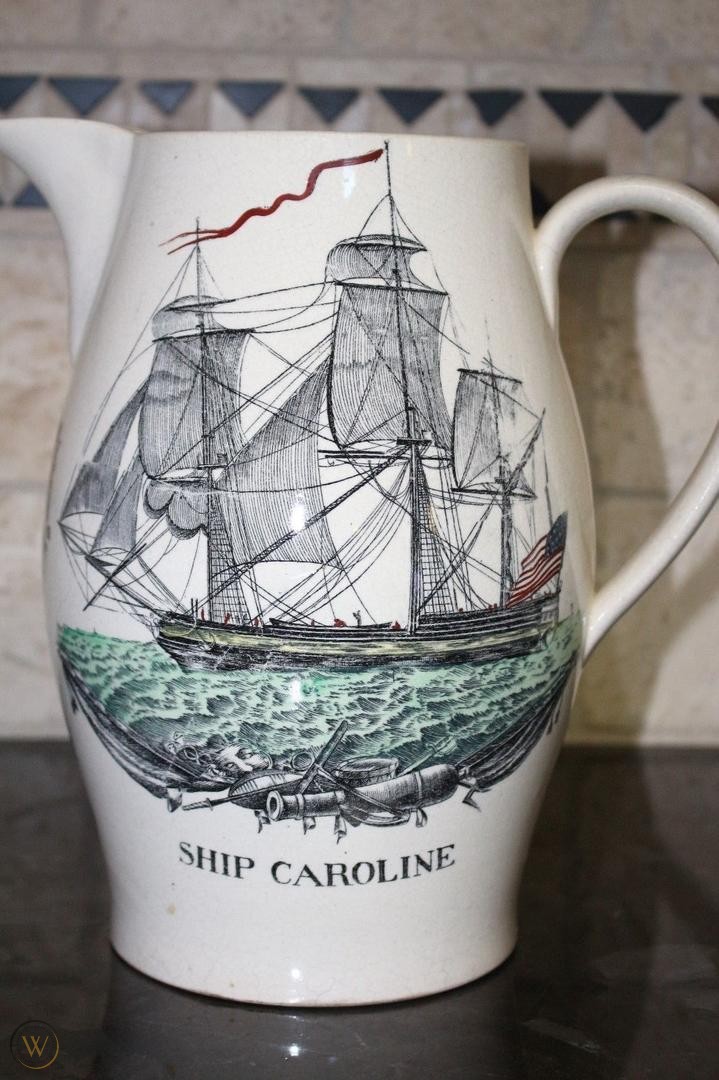
At the heart of this story is an American ship called the Caroline which was based out of Charleston, South Carolina. ‘Caroline’ was a popular name for ships of that time so it’s hardly surprising that, given that Charleston was the largest slave port in America, an earlier incarnation of Caroline was as a slave trader. By the time of our story though slave trading had ended and our Caroline was pursuing the more conventional business of import/export across the Atlantic. There are manifest records of cotton being shipped to Liverpool and salt being shipped to Charleston. Having crossed the Atlantic it is likely she would then have done short-haul trades around Europe to make the overall voyage more profitable.
Motif on James Leech Pitcher
Although we don’t have a picture of the Caroline we do know that she was “full-rigged”, so at least a three-master, ocean-going vessel. We also know that one of the significant products imported to Charleston from Liverpool in the first half of the nineteenth century was “creamware” or “pearlware” – ceramic pottery from factories in Liverpool and Staffordshire. Towards the end of the 19th century James Leech of Staffordshire produced some reproductions of this earlier work. One common motif he used was the “Ship Caroline”, with American flag. So our full-rigged Caroline may well have looked like this transparency image on a James Leech pitcher:
It all started in 1860 …..
Our story starts on 14th March 1860 when the Western Morning News reported:
…..
Contemporary View of Petit Tor Rocks
WRECK OF AN AMERICAN SHIP NEAR TORQUAY
We have to report the wreck of an American ship, which took place about 12 o’clock, on Sunday night, at a spot called Petit Tor, about three miles from Torquay, and not far from Babbicombe. The ship in question is full-rigged, about 600 tons burden, and is called the Caroline, of Charleston. She was bound from Havre to Cardiff, and was in ballast. It appears that on Sunday night the wind was blowing from the south-east, and having missed stays, the vessel went on shore. Two boat crews, consisting of a number of sturdy fishermen, headed by Mr Gasking and Mr Thomas, went off early in the morning to render assistance, and as the tide was favourable, they felt certain that with very little difficulty the ship could be got off. The master of the vessel, however, refused to accept the proffered assistance, and sent off for the Industry, steam-tug, of Teignmouth. When this vessel arrived, the disabled ship had settled well down, with a large hole in her bottom, and all the efforts of the little tug to remove her on Monday, were unavailing. In that exposed part of the coast it is very probable that the wreck will speedily break up, especially if there is any wind.
Over the next few weeks a controversy raged about the exact details of the event. The captain insisted that weather conditions had been bad with thick fog and low visibility. He also claimed that as soon as his ship grounded he was surrounded by fishing boats whose crews tried to board his vessel to claim salvage. The locals’ version was that weather conditions were fine, that advice and assistance had been offered (not boarding) and that the captain’s version was a “Kentucky tale”!
The Salvage
In the event, the Caroline was salvaged by John Bartlett Mansfield, “eminent shipbuilder” of Teignmouth, whose crew were commended for working “with a zeal and energy rarely shewn, and still more rarely surpassed”. Negotiating the Point with the Caroline in tow was no easy task. Mansfield decided to do it in two stages: first grounding her on the bar where she stayed overnight; then, the following day, when wind and tide conditions were optimum she was eventually beached in Teignmouth. There she was speedily stripped of everything that could be sold, as the Exeter and Plymouth Gazette of 16th March 1860 described:
NOTICE IS HEREBY GIVEN that an AUCTION will be held by Mr. W. Cotton, on the Den, Teignmouth, on TUESDAY, the 20th of March 1860, at Two o’clock in the afternoon, for SALE of the whole of the masts, spars, sails, rigging, warps, chain cables, anchors, stores, sheathing, furniture, and fittings, saved from the wreck of the American ship Caroline of 730 tons register. The whole will be laid out and sold in covenant lots on the Den, and may be viewed the morning of sale.
The salvagers after deducting their costs, made a respectable £165 from this sale (although it doesn’t sound much in today’s terms – about £23,000).
The hull was sold separately for £250 on 18th March by public auction at the Devon Arms. She was apparently bought by a “party of gentlemen of Teignmouth” although an article in the Western Times the following year (28th September) states that it was Mr Mansfield himself who had purchased the ship. The Western Times of 31st March 1860 suggested that this was quite a snip and that a value of £3000 was more realistic. It looks like Mr. Mansfield got a bargain! Presumably the damage was deemed to be less significant than first thought from the nature of the wreck. This is how it was described:
About 25 feet of the after piece of keel completely gone, the heel of the stern post broken off, a portion of the after deadwood broken off, the rudder unshipped and broken, the garboard streak on each side, together with several planks of the run torn off, and the heels of the pitcher timbers exposed on each side; several planks of the port bulge very much chafed, and in many places the frame is exposed and the garboard streak in the port flat is cut through.
Significantly though, which may have counted for the revised valuation …..
The hull above the bulges does not appear the least strained or injured, and apparently requires but little attention or outlay. She will shortly be placed in a convenient spot, and her repairs commenced.
That convenient spot was the shipyard of John Bartlett Mansfield (later to become the famous Morgan Giles shipyard). Little more is heard about the Caroline until the following year when the Western Times of 20th April reported that the repairs on the ship were “progressing” towards completion. By September, after £1800 worth of repairs, she was ready for public exhibition for the benefit of the Teignmouth, Newton, and Dawlish Dispensary. The Caroline had by now been renamed the Superb and, according to the Western Morning News of 23rd September “she has been repaired and fitted up for the East India trade, in the most splendid style”. She was now sailing under a British flag and also John Mansfield had acquired some new joint owners – Messrs. James Jackson and Co. of Liverpool.
Celebrating the Rebuild
The exhibition and celebrations for the new ship lasted for over two weeks. As the Western Times of 28th September 1861 reported:
For the past fortnight this splendid vessel – superb in appearance as well as name – has been exhibited to the public at a charge of threepence each, the object being to raise a donation for the Teignmouth and Dawlish Infirmary ….. On Tuesday last the Teignmouth Subscription Band kindly volunteered their services, and a great number of persons visited the ship that day. In the evening a dance took place, which was continued with spirit until 10 o’clock, when the company, numbering over 200, broke up, having thoroughly enjoyed themselves.
A Shadow Cast
Two incidents though cast a shadow over these celebrations. The first occurred the day after the evening dance and was relatively minor, as reported by the Western Times of 28th September:
ROBBERY. – On the night of Wednesday last some bottles were stolen from the ship Superb. The wine was the property of Mr Banbury, confectioner, of this town, and had been left in the cabin for safety, the doors leading to it having been locked, but entrance was effected by means of a trap door communicating with the steerage. The thief remains undiscovered, although Mr. Mansfield has offered a reward for information that will lead to the detection of the offender.
The second, more serious and tragic, occurred two days later, as reported first by the Exeter Flying Post of 2nd October:
A fatal accident occurred on board the Superb on Friday. A shipwright’s assistant named James Bond, twenty years of age, son of a fisherman, and in the employ of Mr. Mansfield, shipbuilder, of this town, whilst employed on board the vessel with George Lee and Thomas Tucker, happened accidentally to step backwards to avoid a blow from a piece of ropeyarn which he seems to have thought was about to be aimed at him by one of his fellow workmen, and fell down the hatchway, a distance of fifteen feet, receiving injuries, from the effects of which he died a few hours afterwards in the infirmary.
In those days inquests happened very quickly and this was no exception. The inquest was held on the body at the Railway Inn on Saturday by F. B. Cuming, deputy coroner. The report from that gave a fuller account of the incident as described here by the Exeter and Plymouth Gazette of 4th October:
About noon on that day the deceased and another workman were engaged fixing some ‘hatches’ between decks on board the Superb. Whilst so engaged, the deceased threw a piece of rope, by way of larking, at a fellow workman named Tucker, and in stepping backwards out of Tucker’s reach, he accidentally fell down the hatchway some fifteen feet, pitching on his head. In the bottom of the vessel where the deceased fell there was a quantity of water. Tucker and several other workmen immediately went to his assistance and took him on shore.
In the meantime Mr. Sullock, surgeon, was sent for, and upon seeing the poor fellow he ordered him to be taken to the Infirmary. There Mr. Sullock again examined him, but he was extremely violent, and made use of several oaths. There was only a slight abrasion on the back part of his head. Mr. Sullock thought he was tipsy, especially as Mr. Mansfield had informed him that a quantity of wine and spirits had been taken from the ship on the night previously. He, therefore, desired that the man’s clothes, which were wet, should be changed, and that he should be put to bed. Mr. Sullock then left him in charge of Mr. Harris, the house surgeon, but on his returning about half-past four o’clock he found him dying.
He had since reason to believe that the deceased was not in liquor at all at the time, but that he was suffering from injuries received on the head …… (At the inquest) ….. when the above facts, together with evidence that the deceased had not been drinking, were adduced, and the jury returned a verdict of ‘Accidental Death’. As the deceased, who was a member of the Teignmouth Artillery, was much respected, the jury presented his friends with their fees.
The Funeral
Whilst the accidental death of a young shipwright in Teignmouth would have been a sad event for his friends and immediate family it would soon have faded away into the day-to-day life of the town. The death of James Bond would have been no different from the deaths of other young working men of the time. However, for some reason it struck a chord which resulted in an extraordinary funeral which deserves remembrance as an historic event in Teignmouth. Here’s a full report from the Western Times of 12th October:
Funeral Of A Volunteer Artilleryman – The funeral of the young man, James Bond, whose death – the result of injuries received through falling into the hold of the ship Superb – we recorded in our last impression, took place on Thursday, the 3rd inst. The deceased was a gunner in the 3rd, or Teignmouth, Company Volunteer Artillery, and he was interred with military honours. The Teignmouth Company of Volunteer Rifles, a section of the Teignmouth troop of Yeomanry Cavalry, and few members of the Torquay Artillery were present on the occasion. In addition to these the whole of the apprentices and workmen in the employ of Mr. Mansfield, shipbuilder, and the members of the Teignmouth Branch of the Rational Sick and Burial Association, (of which the deceased was member), attended the funeral.
At half-past three o’clock the whole of the volunteers assembled on the Den, from whence they marched to the late residence of the deceased, and were there drawn up in line, the ranks taking open order and facing inwards. On the approach of the corpse, the firing party presented arms, and when it had been carried past they reversed arms and headed the procession, which proceeded through the town, and to the Cemetery, in the following order – the coffin was covered with a Union Jack, and the cap and sword of the deceased lay on the top:
Firing Party, Consisting of Corporals Benney and Binnin ; Bombardiers Stafford and E. Pratt; Gunners Wills, Syms, G. Hooper, I. Hooper, Windeatt, Prowse, Youlden, anil Saunders; under the command of Sergeant Whidborne, Band of the 3rd D.V.A. playing the Dead March in Saul
PALL BEARERS
Gunner T. Tratt Gunner W. Higgings
The coffin borne by six apprentice shipwrights
PALL BEARERS
Gunner W. Jones Gunner J. Mann
Relatives and friends of the deceased. The 3rd Devon Volunteer Artillery. A section of the Torquay Volunteer Artillery. A section of the Teignmouth Troop Yeomanry Cavalry. The Teignmouth Company lst Volunteer Rifles, Drill Instructors Lieut. Kingdon, 3rd D.V.A., Dr. Sullock, 3rd D.V.A., Capt. Floyd, 3rd D.V.A., Capt. Clarke, 1st V.R., Lieut.-Col. Sir W. H. Tonkin, D.V.A. The workmen and apprentices in the employ of Mr. Mansfield, shipbuilder. The Teignmouth Branch of the Rational Sick and Burial Association
On arrival at the Cemetery, the firing party halted, faced inwards, and rested on their arms reversed, whilst the corpse and the whole of the procession passed through to the chapel; they then took up their position at the grave, and the burial service having been read by the Rev. T. B- Simpson, and the coffin lowered into the narrow tomb, three volleys were fired in the air, the band playing at intervals.
The volunteers and the mourners then separated, the latter pursued their homeward journey, whilst the former marched to their rendezvous and were dismissed.
The peculiar spectacle of a military funeral attracted hundreds of spectators. The streets were packed, and every window commanding view of the street along the line of route was thronged. At the cemetery it is estimated that not less than 3,000 persons had congregated awaiting the arrival of the cortege, yet the greatest order prevailed. During the passing of the funeral through the crowded streets all sounds were hushed except the measured tread of the volunteers and the solemn notes of the Dead March which produced feelings of great awe and solemnity shared by the whole of the spectators, many of whom were moved to tears.
I wonder if such a funeral has ever been seen in Teignmouth since then. Despite the pomp and ceremony though James Bond was buried in an unmarked grave, plot H81, and therefore lost to history until now. This is one of the areas of the cemetery yet to be cleared; the photos show the approximate location.
Location of James Bond’s Unmarked Grave
Life goes on
Two days later, as reported by the Exeter and Plymouth Gazette of 11th October:
THE SUPERB – This splendid ship was on Saturday evening successfully floated from the beach, where she has undergone repair and been refitted by Mr. Mansfield, and she now lies moored to one of the buoys in the river. She will take in 500 tons of clay for ballast and proceed to Liverpool, whence she will sail to the East Indies.
The funeral may have been a memorable occasion but life goes on.
Sources and References
Extracts from contemporary newspapers are referenced directly in the text and are derived from British Newspaper Archives.
Ancestry.com for genealogy
Other sources, with hyperlinks as appropriate, are as follows.
The Abbeville Banner Jan 12th 1860 – Caroline manifest
United States Economist 23rd October 1852 – Caroline manifest
Article “Creamware and Pearlware Exports to the USA” by Terence Lockett
Torquay Geological Field Guide, Ian West – contemporary picture of Petit Tor
A few weeks ago the Friends of Teignmouth Cemetery held its AGM which represented the fifth full year of its existence
FIVE YEARS!!
Five years ago we were confronting what seemed an incredibly daunting task but, looking back, it is amazing how much a small group of hard-working volunteers has been able to achieve in that time. So this post is simply a memory, recognition and celebration of those achievements.
Grave Clearance
Children’s graves exposed
In our 12 acre site where over 13,000 people are buried in over 8,000 graves we reckon we have cleared about 40% of the area. This is lots of HARD work, with years of bramble, ivy and anthills covering the graves (often completely). This has always been one of our main aims – removing the overgrowth from graves so that graves are duly respected and accessible to family, friends and anyone else.
During this period we also uncovered the original footings and sections of railing which once separated the graves of people of non-conformist religious beliefs from those of the conformist Anglican church.
In everything we do we work closely with Teignbridge to complement the basic maintenance of grass cutting they are able to provide, and to help people find the different sections of the cemetery we created around 120 steel markers to identify each section.
War Graves
The Commonwealth War Graves Commission (CWGC) recognises 49 war graves in the cemetery and we have a contract with the Commission to maintain those graves and the access to them. This work is done mainly by one of our dedicated volunteers. In 2018 we marked the 100th anniversary of the end of WW1 with a special service in the cemetery and the erection of a display board to commemorate those who died. CLICK HERE for more information on the war graves.
Green Space
As the cemetery has become cleared we have sourced around a dozen benches, located in different areas of the cemetery, to allow people simply to sit and enjoy the tranquillity. This fits with the original Victorian concept of these “new” cemeteries, as they were at the time, of being enjoyed as a natural park by everyone in the community.
A Natural Space
Once on a hill-side out of town, the cemetery is now surrounded by housing developments. So we are also trying to preserve the cemetery as an oasis of bio-diversity. When clearing graves we are careful to conserve the wide variety of wildflowers which inhabit the cemetery. We have also commissioned flower, tree and lichen surveys and are lucky to have secured regular moth surveys during the summer months. Most recently we have created an additional wildflower area as a pilot to see if we can plant more of these throughout the cemetery. CLICK HERE for more information on the natural space.
Adding colour
Wild flowers not only encourage bio-diversity but they also add seasonal colour to the cemetery, changing from Spring through Summer to the Autumn hues. We have also added our own colour by planting up graves with a range of plants and creating more formal borders in the areas surrounding the main buildings. This led to our taking part in Teignmouth in Bloom for several years, securing a first place in our category one year and this year a second place for our jubilee display. CLICK HERE for some photos of that display.
Community Involvement
It has always been an objective to encourage more community involvement and interest in the cemetery and the work we do here. Organisations we have been involved with, in one way or another, over the last five years have included: Dawlish Gardens Trust, Devon Wildlife Trust, Teignmouth COG, Teign Heritage Centre, Teignmouth U3A, Caring for Gods Acre, National Federation of Cemetery Friends, Dawlish U3A, Walking for Health, Royal British Legion, Scouts, Newton Abbot U3A, local councillors from Teignmouth Town Council and Teignbridge District Council, Thriving Teignmouth, Torquay History Group, Teignbridge CVS (through their “Soup” scheme), Commonwealth War Graves Commission, the Incredible Fund. All the work we have done has twice led to the Mayor’s Recognition Award.
History
Uncovering graves has revealed a wealth of history suggesting that, for a town of its size, Teignmouth is punching well above its weight in the historic associations of people buried here – military, naval officers, artists, authors, engineers, philanthropists, clergy, medics etc. ….. and even the odd murderer (perhaps)! Their stories are written up on our web-site. We make regular presentations about them to local interest groups and have run several tours of the cemetery, something we plan to do more of with history trails. CLICK HERE for stories of a few of the people buried here.
The Buildings
FOTC started as a response to a planning application for change of use of the old cemetery buildings. We contested that and managed to get that proposed planning application withdrawn. We submitted our own business plan for the buildings, which was agreed, and secured agreement to that and to negotiating a lease for the buildings. We also established a separate legal organisation, a CIO, to allow us to take those negotiations forward. The lease is critical to securing funding for renovation of the buildings. Unfortunately, Covid came along and everything went into limbo. We are now re-starting those efforts again. Fingers crossed.
Publicity
Aside from the more formal presentations we do to local interest groups we have established a strong social media presence with regular Facebook and Twitterpostings. This helped especially during Covid lockdowns when we were able to encourage people to come and visit the cemetery and share photographs during the different seasons. We have also been helped by a local producer of drone videos who has kindly contributed his time in making two excellent videos of the cemetery. CLICK HERE to see his latest.
Membership
None of this would have been possible without the support from our members. Our membership fluctuates between about 50-65 and of those there is a core of around 15 volunteers who take part when they can in our twice-weekly work sessions. FOTC has enabled this through responding to the needs of the working volunteers, over time, by raising the money to provide them with more powerful tools; the correct equipment; the insurance and the training to use them safely.
Finally, coming soon in the next post …. a little something out of the ordinary for the start of our sixth year – a story about Teignmouth and James Bond!
In 1875 a new publication appeared in Teignmouth – the “Teignmouth Journal”, produced by W. Rogers Penn who together with his wife Emma ran a stationery and printing shop in Fore Street. The journal was published monthly and lasted for two years. It was an eclectic mix of local news, including minutes of council meetings and other organisations, articles, poems, serialised stories etc. as can be seen from the contents pages of the first volume:
In particular there was a regular feature about rambles in the Teignmouth area. One of those rambles included a walk up to and through the cemetery which gave Mr Penn the opportunity to provide some insights into the cemetery. He was also apparently an amateur photographer, which is an appropriate link with the last blog about the Teignmouth photographic pioneer, Samuel Poole.
Here is his description and a copy of the original photograph which accompanied it, sourced from the SW Heritage Centre in Exeter.
Teignmouth Journal Vol 2, No 14 – The Cemetery Lodge
About three-quarters of a mile from the town we pass the Cemetery which we will turn aside for a few moments to examine. Here one of the first things which strikes the visitor is the number of persons who have been brought from a distance for burial.
Strangers will do well to bear this fact in mind when they hear of the death rate of a watering place being 20 or 17, or even 15 per 1000, because in most cases it gives very erroneous idea of the salubrity of the climate. They must remember how many invalids are sent to the sea-side as a last resource when all other remedies have failed, in hope of patching up the constitution already past all human skill – but literally only to die and so swell the death-rate.
And here I would call attention to the report of our Medical officer, made at the last monthly meeting of the Local Board, where he states that the death-rate of Teignmouth for the last quarter has been only a fraction over 11 per 1000 – one of the lowest rates I believe in the Kingdom – and this in spite of the statement put forth by Dr. Rhind of Torquay, some time since presumably with the intention of misleading strangers as to the comparative healthiness of Torquay and Teignmouth. Such facts as the above show the matter in a different light. Can Torquay boast of a lower rate than ours?
The Cemetery was opened in 1855. It then covered about two acres divided into consecrated and unconsecrated, with a neat chapel in each portion. It was pleasantly laid out and planted with shrubs and flowers. For some years past this has been found inadequate to the demands of the two parishes, and an additional piece of land has been lately added, the present extent being something over four acres.
Invalids and others who cannot enjoy a longer walk may pass on through the lower gate, cross the New Road, and down the Buckeridge Road, through Brimley, back to the town: or: the return may be along New Road to the Dawlish road and so home as described in a former ramble: or; by following the steep and rugged lane (Rocky lane) opposite the New Road near the Cemetery the return may be by the way of Coombe and Coombe Vale – a situation by the bye, than which none is more suited for the residence of an invalid, being perfectly sheltered from the cold and trying winds, but open to the full influence of the sun, and consequently being somewhat too relaxing for those in robust health.
The launch of the Teignmouth Journal and its publisher William Rogers Penn was applauded in an acrostic poem that appeared in the first issue:
The fact that the Teignmouth Journal lasted only two years came as no surprise to the archivist at the SW Heritage Centre who explained that similar publications produced by individuals came and went as the effort required to keep them going took its toll. However, the Teignmouth Journal came to an abrupt end because William Rogers Penn died, probably unexpectedly, on 17th February 1877 aged only 39.
His death was noted in the Exeter and Plymouth Gazette of 23rd February 1877:
The funeral of Mr. William Roger Penn took place yesterday (Thursday). Ministers of various denominations, and a large number of tradesmen, paid their last token of respect by following the remains to the grave. The deceased was much respected, and by his honest, upright principles, had won the friendship of all connected with him. The coffin was of polished oak, with brass mountings.
He is buried in plot L9 of Teignmouth Old Cemetery, an area that remains to be cleared.
William and his family had not been in Teignmouth that long. He had started his own career as a land agent, surveyor, auctioneer and appraiser in Bromsgrove in 1859 as this extract from the Staffordshire advertiser of 31st December 1859 shows:
British Newspaper Archives: Staffordshire Advertiser 31st December 1859
Judging by the amount of publicity in the newspaper archives for the next six to seven years it appears that he did very well in this profession. But in 1866 he changed both his location and profession; he had married his wife Emma in 1863 and the family now moved to King’s Heath where William seems to have established himself as an agent for an Assurance Company:
British Newspaper Archives: Bromsgrove and Droitwich Messenger 1st April 1871
On the second of March 1867 their third daughter Charlotte Lucy was born but sadly died four years later on 20th November 1871 from “diphtheritic croup”. It was after this that they seem to have decided to move to Teignmouth, where their son was born almost exactly a year later. They ran a stationers and printers in Fore St, where they were also agents for the Western Times and Western Mercury. Following his death the business was transferred to his wife but there is nothing in the archives to suggest how her life in Teignmouth subsequently progressed. Emma herself died on September 13th 1912 and was buried with her husband William in the same plot, L9, in Teignmouth Old Cemetery. Her funeral had a slightly longer coverage in the Western Times of 24th September 1912:
At the Cemetery, Teignmouth, the funeral took place of Mrs. Penn, widow of Mr. W. Rogers Penn, late of Teignmouth. Mr. Penn at one time kept a stationery and newsagent’s business in Teignmouth, and was editor of the old “Teignmouth Journal”, a few copies of which are still treasured by their fortunate owners. The mourners included Mr. Prosser Penn, Mr. Walter Penn, sons of the deceased lady, two friends from California, and Messrs. J.J.O.Evans and T.R.A. Tothill, the latter representing his mother, who was Mr. Penn’s chief assistant when he kept his Teignmouth business. A service was held at St. James’ Church before proceeding to the Cemetery.
Returning to William Rogers Penn, he obviously had an amateur interest in photography. He had been commended for a couple of photographs he had taken of the Hop Pole Inn in Bromsgrove and is recorded in the Teignmouth Journal as giving a magic lantern show:
May 23rd. An entertainment of Dissolving Views, with accompanying descriptive papers, was given by W. Rogers Penn in the Assembly Room, London Hotel, before a large audience, in aid of the Young Men’s Christian Association, the subject being the Arctic Regions ….. The views were much admired, especially the Icebergs by day and moonlight and with the Aurora Borealis.
His legacy of the Teignmouth Journal included a number of his own photographs of the area, some of which are shown here to conclude this story:
Acknowledgements
The research for this story was prompted by a photograph from Viv Wilson MBE (a copy of William Penn’s original Cemetery Lodge in the Teignmouth Journal). The SW Heritage Centre was able to provide access to original source material.
Sources and References
Extracts from contemporary newspapers are referenced directly in the text and are derived from British Newspaper Archives.
Most stories about people buried in the cemetery originate because we have found their graves and there is something significant about the grave suggesting that some further research would be worthwhile. For instance:
The person could be (relatively) well-known – see, for example, Harry Welchman
This story however came in from the cold, a product of modern technology.
It started with a post on a local Facebook site which showed a restored picture of the two chapels in the cemetery. We already had a copy of the original (see “Then and Now”) but the new piece of information was the possible name of the photographer – Samuel Poole. It turns out he is buried in the cemetery and ran a photography business in Teignmouth for the best part of forty years. Records suggest that the Poole family lived in Teignmouth for almost 100 years.
This was the time when photography was taking off and its potential as a new recording medium of history was being recognised.
Samuel Poole Family Background
We are fortunate in having a virtually complete census record for Samuel Poole which gives a good insight into the changing family circumstances. Let’s start with this and then focus on Samuel Poole the photographer.
Samuel was born in 1824 in Taunton to parents John and Anne Poole. His father was a labourer and in 1841 the family was living in King Street, Taunton. Samuel was the eldest child and by that time had four younger siblings: Frederick, 13; Edmund, 12; Thomas, 7; and Anne, 4.
By 1851 Samuel had his own home in Park Street, Taunton. In the census he gave his profession as “house-builder”. He had married Mary Ann Orchard Goodman in 1848 and by 1851 they had two children: Helen Jane, 2; and Samuel James, 5 months. Mary’s younger brother Edwin Goodman, a scholar aged 5, was also with them. They were also obviously doing well enough to have a servant, Charlotte Harclode.
By 1861 Samuel and his family had gone through some major life changes. It would be interesting to know what brought those about. By then the family had grown with four extra children: William, 8; Eveline, 7; Arthur, 5; and Emily, 3. They had also moved and were now living at 43 Teign Street Teignmouth. It looks as though the move took place some time in 1858/59 since Emily was born in Taunton. Most significantly though Samuel had changed profession – he was now described as a “photographic artist”. With a large family to support you would think that this was a high-risk move. What prompted it? Photography was still in its infancy. Maybe Samuel had taken it up as an amateur hobby and could see a real business opportunity, especially in a relatively prosperous place such as Teignmouth which also had a burgeoning tourist trade.
By 1871 the family had grown once more with three more children: Rosa, 8; Lillian, 6; and Reginald 2. They had moved again to 34 Somerset Place and his two eldest sons, Samuel James and William were now also working as photographic artists in his business. His eldest daughter, Helen Jane, had married Edward Roberts in December 1869 and was now shown as being in the house at the time with her one-year old daughter Helen but without her husband.
The photography business was obviously flourishing but it seems that Samuel had also decided to diversify. An entry in the Devonshire Trades Directory of 1878 shows him listed as a dealer of music and musical instruments at 4 Somerset Place; the Teignmouth section of the directory quotes him as “music seller, photographer and joint overseer 4 Somerset Place”.
By the time of the 1881 census the composition of the family was starting to change. They are now recorded as living at 2 Somerset Place. Samuel James, William, Helen and Eveline are no longer listed but there is now a grand-daughter, Lilian Florence Poole, aged 7 who was born in Exeter. Emily is shown as being a music-teacher which might tie in with Samuel’s diversification into the music business. Arthur is shown too as a photographic artist, presumably helping Samuel with the business now his brothers Samuel and William have left. The grand-daughter, Lilian, is intriguing. She was born in Exeter and, in the absence of other information and given that her surname was shown as Poole, there are two possible scenarios: she was either Eveline’s daughter born out of wedlock or William’s daughter (with no wife shown).
The next ten years brought four tragedies to the family.
It would appear that Eveline died, probably giving birth, in 1883. The grave next to Samuel’s in the cemetery, but in the same plot, carries a headstone in remembrance of Evaline but with the rest of the inscription now barely legible. The cemetery records show that this was Evaline Jeffery for whom there is a record of death for May 17th. Birth records show a Frederick Jeffery being born at around the same time though he sadly died too within a year.
Then Emily died in 1888, barely 30 years old. She is commemorated on the other headstone in the plot.
Finally, Samuel’s wife Mary Ann died in 1890, aged 63.
By 1891 it could be imagined that Samuel was struggling to run his business which may have comprised two establishments by then – an 1890 trade directory refers to a second address at 19 Wellington Street. His remaining sons had left – Arthur had now established his own business and Reginald was working as an ironmonger’s assistant in Honiton (it’s likely this is where he met his future wife Alice Slater who was working there as a draper’s assistant and whom he married in 1898). So various responsibilities fell to Samuel’s daughters. Rosa was now a “photographer’s assistant”, Lilian was a “music seller”, and Helen had returned as “housekeeper” with her youngest son Walter, aged 13.
There is some thought that Reginald took over the business in 1893 but kept it on only as a music shop. There is certainly a reference to him being the owner of the “Pianoforte Warehouse” in 1902 and the “Music Warehouse, Somerset Place” in 1906 (Exeter and Plymouth Gazette, Friday 14 December 1906) but no further references to a photographic business.
In late 1895 Samuel re-married Sarah Rossiter, some 20 years his junior, and by 1901 he was shown as having retired and living with Sarah and her daughter Elizabeth Alice, aged 15, at 6 Gloucester Road. Sarah had been widowed some seven years earlier – she had been the wife of Ebenezer Rossiter, a jeweller in the Den and is buried with him in the Old Cemetery (Plot I82).
Samuel died on 2nd August 1906 and is buried with his wife and daughter Emily in Teignmouth Old Cemetery (plot H98). Little is known in the newspaper archives about Samuel outside his photography business. We do know that he was secretary of the “Useful Knowledge Society” (an organisation perhaps equivalent to U3A today but which also seems to have led on to the roots of a public library in Teignmouth). But it is not until his obituary that we discover his active involvement with the Baptist church, for which he was a deacon, trustee and treasurer (Exeter and Plymouth Gazette 6th August 1906).
The Teignmouth Post and Gazette of 10 August 1906 describes the funeral:
FUNERAL OF MR. S. POOLE
Last Thursday, at the ripe age of 83 years, Mr. Samuel Poole, a well-known and esteemed townsman passed away. A native of Taunton where be had numerous friends, and where his brother, a solicitor, still resides, Mr. Poole many years ago came to Teignmouth, and founded in Somerset Place the successful business, which his son, Mr. Frank Poole continues. As organist, the deceased gentleman rendered excellent service to several churches and was senior deacon, and for many years treasurer of the local Baptist Church.
The funeral took place on Saturday afternoon at Teignmouth Cemetery. The widow, son, brother, son-in-law, with many others followed the loved remains. A memorial wreath was plated on the grave as “A small tribute in loving remembrance of Samuel Poole, our oldest member and Senior Deacon, from the members and congregation of the Baptist Church.”
On Sunday morning the Pastor (S. John Thorpe) preaching before a large congregation, referred to the Church’s bereavement, and spoke of the departed, as a “lover of good men” strong in his convictions, faithful in discharge of Church work, regular in attendance at public worship, a ready helper in all good work, and he desired to pass on to his hearers the words with which Mr. Poole had years ago, welcomed him into the pastorate, as the best legacy of their friend. “Be thou faithful unto death, and I will give thee a crown of life.”
The left-hand picture shows the family plot with the two identical headstones. Top right is the inscription for the left-hand grave showing Mary, Emily and Samuel. Bottom right is the inscription for Evaline on the right-hand grave.
Samuel Poole and Photography
Setting the Scene
When Samuel Poole arrived in Teignmouth to set up his photography business in around 1858/59 commercial photography was still in its infancy.
19 years earlier, on the 19th August 1839 Louis Daguerre had made the first public announcement of his commercial process for the production of photographs. This was announced in the Academy of Sciences, Paris and the Globe of 23rd August 1839 reported:
The DAGUERREOTYPE It having been announced that the process employed by M. Daguerre, for fixing images of objects by the camera obscura, would be revealed on Monday at the sitting of the Academy of Sciences, every part of the space reserved for visitors was filled as early as one o’clock, although it was known that the description of the process would not take place until three. Upwards of two hundred persons who could not obtain admittance remained in the courtyard of the Palace of the Institute.
From that first announcement photography progressed rapidly. By 1841 the Daguerreotype had arrived in Plymouth, as reported on the front page of the Exeter and Plymouth Gazette of 11 September 1841:
Exeter followed soon after. An advertisement appeared in the Exeter and Plymouth Gazette of 28 July 1842:
This was followed a couple of days later in the same paper by the following announcement:
A suite of rooms, for the photographic process, was opened under Northernhay this morning, by Mr Gill. The invention is a most surprising one, ensuring, as it necessarily does, fidelity and almost instant operation.
Meanwhile the fantasy, wonder and novelty of photography was reaching the public eye.
The Wonder of Photography
Sir William Webb Follett – (Creative Commons Licence from National Portrait gallery)
Such was its novelty that the Exeter and Plymouth gazette of 2 July 1842 felt it had to announce that “Sir William Follett lately sat for a photographic portrait, which will we hope be lithographed for his admirers”.
Sir William was the Solicitor-General and MP for Exeter. Perhaps this picture in the National Portrait Gallery is that portrait – it is described as a mid-19th century mixed-medium engraving by an unknown artist.
An imaginative role for photography as a complementary medium was described in the Bristol Mercury of 4 December 1841 when a local artist F. Riddle was embracing the opportunity it offered:
PORTRAIT PAINTING
F. RIDDLE begs to announce to the Public in general, and to his friends in particular, that he has adopted a new style of PAINTING PORTRAITS, which requires only two Sittings, combining the correct Drawing of the Photographic likeness, with the improvement of expression and colour given by a few but most essential touches of the pencil.
This method being expeditious and certain, the charge is lessened in proportion. F. R. flatters himself that he shall obtain an increased share of patronage, and his utmost endeavours shall be used to give satisfaction.
Specimens will be exhibited in a few days at his PAINTING ROOM, No. 2, ST. AUGUSTINE’S PARADE, where attendance is given, from Half-past Nine till Half-past Four, daily.
And, as a final example of the inroads that photography was making, who would have thought that it would feature in the programme of the Royal Wizard. It was the Western Times of 30 January 1841 that boldly announced the arrival of the “Royal and Original Wizard” in Exeter:
Photography in Teignmouth
This was the world that Samuel Poole was entering. Photographic businesses seemed to be gradually emerging elsewhere such as Exeter and Plymouth but in Teignmouth there was a definite gap in that market. There had been someone earlier – a Mr Sharp who lived at Woodbine Cottage, Brunswick Place but it seems that he left around 1848, briefly turned up in Exeter before moving on once more. He also seems to have made some extraordinary claims of a new apparatus he had patented for the production of colour photographs but there doesn’t appear to be evidence that his invention ever took off.
So it would be reasonable to claim that Samuel Poole was indeed the pioneer of commercial photography in Teignmouth. Inevitably he was joined by others. For the next 40 years through to the start of the 20th century the following photographers came and went in Teignmouth – Henry Thomas, George Denney, David Robert Everest (9 Somerset Place), Valentine and Sons (Rembrandt Studio, 18 Bank Street). Of these the business of J U Valentine seems to be the closest in nature to Samuel Poole’s – it was a family business which survived after Samuel Poole and whose founder and family are also buried in Teignmouth Old Cemetery.
After Samuel’s death his business was taken on by William Marsden Harrison.
He may well have been a medal-winning photographer but he had a chequered past. He was made a bankrupt in the first business he started, he was involved in court in a “love-triangle” case with two of his employees, he was charged in court for assault on his wife and at the time of taking on Samuel Poole’s business he was going through bankruptcy proceedings once again. There is no evidence that he lasted in Teignmouth. This was a rather sad ending to the efforts that Samuel had made over the previous fifty years.
Samuel Poole the Photographer
We have seen that Samuel started business in Teignmouth around 1858/59 and moved his studios there several times, presumably in response to business requirements. Once he had established himself in business in Teignmouth though he quickly started to expand his presence elsewhere as well. Notably in 1860 he entered into a joint venture with a Cornwall photographer, Robert Preston, forming Preston and Poole based at No 1 South Terrace, Penzance. They advertised themselves in the Cornish Telegraph’s edition of 13th February 1861:
The partnership appears to have lasted formally until 1870 (there are no more newspaper archive references after that) although maybe a split occurred earlier since Robert Preston moved premises and announced that under his own name.
Two years later in 1872 Samuel also set up a studio in Exeter (at 5 Southernhay); this was a bold move given the amount of competition there would have been in Exeter at the time.
During his lifetime Samuel would have produced tens of thousands of photographs. Sadly though most of these have either disappeared or are simply not available through the normal research channels. Some are still in circulation for sale on sites such as Ebay and there is a small but growing collection of studio portraits on Brett Payne’s site (see link at end).
Here are a few with some specific comments or stories, followed by a gallery of others which have been discovered.
Eyes Fixed on the Past
The first of these is a picture of Teignmouth taken from the Ness. It appears to be a lithographic reproduction from an original photograph. It is undated but there doesn’t appear to be an obvious pier on the beach which would suggest the image is pre-1865 when the pier was constructed.
There is a heading for the enigmatic “Devon Photograph Institute” – enigmatic because I can find no official reference to the existence of such a splendid sounding body. There was a “Devon and Exeter Photographic Society” founded in 1857 but later re-named the “Devon and Exeter Graphic Society” in 1858. It is more likely that the title was simply a marketing ploy to lend a certain air of grandeur to the business; there are similar references to the “Photographic Institution”, the “West of England Photographic Institution” and the “Museum Photographic Organisation” all of which were commercial photography businesses in Exeter. Samuel may simply have copied this mechanism.
There are only a couple of references in the newspaper archives to the “Devon Photograph Institute”. The first made the national news and is the subject of the next section. The second is local, appearing in the Western Times of 1st December 1860:
“Mr. Samuel Poole of the Devon Photographic Institute, has just published a series of Moonlight Stereoscopic Views of this neighbourhood. They are exceedingly pretty. They may be procured either of the artist, or of Messrs. Carpenter and Son, Fore-street.”
This copy of the photograph has been taken from “Eyes Fixed on the Past”, the PhD thesis of Margaret O’Brien-Moran. The thesis itself is about Samuel’s son, Arthur, who carved out his own niche in photographic history and is sub-titled “The Poole hidden archive: a case study of the materiality of the Photographic prints, and the research implications for working with historical photographs.”
Railway Destruction
The Illustrated London News of 3rd December 1859 carried this story together with a lithographic reproduction of a photograph by Samuel Poole of the scene of the destruction:
DESTRUCTION OF A PART OF THE SOUTH DEVON RAILWAY. Among the many disasters occasioned by the gale of the 25th of October last may be counted the destruction of portion of the seawall and permanent way of that part of the South Devon Railway which lies between Dawlish and Teignmouth. From the station of Starcross westward this rail is on the seashore, being for a distance of two miles adjacent to the scene of accident seaward of the abrupt conglomerate cliffs which here bound the coast.
To render available such a course it became necessary, in the construction of the railway, to erect a mass of masonry, consisting of two parallel walls, the interval being filled with sand and shingle, the top ‘pitched’, or paved. Between the double wall and the cliffs also rubble was placed to support the permanent way, and to give additional solidity to the whole. It appears, however, that the engineer to the company (the late lamented Mr. Brunel) had much under-calculated the effect of the waves during spring tides, augmented by strong easterly winds.
Such was the terrific force of the impelled water during the late storm that the coping-stones, probably averaging a ton each, were tossed about like corks, and huge fragments of the disjointed wall were rolled upon the metals. The breaking-up of the structure is described as having been appalling, surf, foam, and fragments of the debris rising in the air with a terrific roar. Through a tunnel which opens into the town the sea-water rushed impetuously, flooding the houses and damaging property to a considerable extent. This and the retreating waves, removing the ballast from the sleepers of the rail, allowed the ponderous stones from the wall to bend and twist the metals in various directions. Of course traffic was for a while suspended, although an inner line of rails (comparatively uninjured), used occasionally for shunting, &c., was utilised by the authorities, and communication was speedily resumed. Our Engraving is from a photograph taken by Samuel Poole, of the Devon Photographic Institute, Teignmouth.
A Royal Visit
In 1865 the Prince and Princess of Wales (later to be King Edward VII and Queen Alexandra) did a grand tour of the West Country. Part of that tour was a visit to the Botallack tin mine in Cornwall, including a descent into the new section of the mine which extended about a third of a mile under the sea. The tour was extensively covered in the local and national press; and the company of Preston and Poole took photographs.
This was how the Illustrated London News of 5th August 1865 described the visit:
The Prince and Princess, with Mr. St. Aubyn and Lady Elizabeth St. Aubyn, arrived there in a carriage-and-four, about noon, followed by the Duke and Duchess of Sutherland, the Earl of Mount-Edgcumbe, Lord Vivian, the Lord Lieutenant of Cornwall, Lady Vivian, Lady DeGrey, and others of their party. They were received by Mr. Stephen Harvey James, the purser, and the other officers of the mine.
All the ladies and gentlemen, including the Princess herself, then attired themselves in loose dresses of white flannel to go down into the mine. The Princess and Lady Elizabeth St. Aubyn rode in donkey-chaise along the narrow path from the counting-house to the mouth of the shaft, while the Prince and the others walked behind. By the side of this path, and on the heights above, were hundreds of people, the spectators of a curious scene.
On each hand were high, jagged, weather-beaten rocks, with here and there a rude construction of planks and beams to aid in the working of the mine. Halfway below was the head of the shaft, the gaunt upper works and wooden platforms hanging over deep chasms, and at the base of the high rugged cliffs the water surging itself into foam against the black, seaweed-covered rocks.
As the Royal party passed slowly along the path, a long line of volunteers, comprising representatives from each of the corps of the western battalion of the Duke of Cornwall Artillery Volunteers, under command of Colonel Gilbert, saluted the Prince and Princess by presenting arms, and the band played the National Anthem. On arriving at the mouth of the shaft, the Princess, wearing the sort of wrapper just mentioned, and having on a coarse straw hat trimmed with blue, took her place with Mr. St. Aubyn, upon the lower seat, the Prince and a brakesman sat on the next seat behind them, and the rest of the party followed. Mr. John Rowe, the captain of the mine, directed the car, which had been fitted up, under his superintendence, by Mr. Bennett, of Penzance, for the special use of the Prince and Princess.
The car descended gently down a steep inclined plane, and in a moment or two the Royal party had passed downwards from the light into the dark shaft, the depth of which is about 200 fathoms. The bottom-level of the mine extends horizontally about half a mile beneath the sea; the dark narrow passages being traversed by the help of a candle, which each person must hold in his hand as he gropes his way along. A part of this mine belongs to the Prince of Wales.
After an absence of rather more than an hour, the Prince and Princess, Mr. St. Aubyn, and a lady, were drawn to the surface, and as they appeared again above ground they were greeted with the heartiest cheering. The Princess and Lady B. St. Aubyn walked to the donkey carriage, and were drawn up the path along which they had previously descended. The Princess looked rather heated, but smiled charmingly in response to the cheers on her behalf. The band played “God Save the Queen,” God bless the Prince of Wales,” and cheers were given for the Princess, the Prince, for the Queen, and not less heartily for Denmark. The volunteers again saluted as the Royal party passed.
The Western Morning News of 19th August 1865 carried Preston and Poole’s announcement of their photographs:
Previously the Cornish Telegraph of 16th August 1865 had commented on the merits of the photographs:
PHOTOGRAPHIC VIEWS OF THE PRINCE AND PRINCESS OF WALES AT BOTALLACK
Messrs Preston and Poole, of Penzance, have produced three photographs of the interesting scenes at Botallack on the 24th of July – scenes, in artistic merit and fidelity, far, very far, beyond what we ourselves had contemplated, eyewitnesses as we were of the careful bustle and loyal excitement of those on the platform leading to the diagonal shaft at Botallack, and fearful as we have been that this stir would tell against even the proved skill of our local photographers. Three phases of the day’s proceedings have been successfully reproduced, and will form most interesting memorials of the event for all Cornishmen.
The scenery is the same in all three photographs :—a foreground of bold projecting rock, of woodwork leading to the shaft’s mouth, and of perpendicular cliff on which stands the Crown engine-house; a distance of cliffs, headlands, and sea. These serve admirably to delineate one part of the mine and one stage of the royal visitors’ progress. It is almost needless to say that the scenery, from account-house to shaft, would not be exhausted by a dozen pictures. The part of the mine is the platform down which the Prince and Princess cast rather an anxious glance: the progress is the point at which they are about to descend.
Three separate parties are shewn in the skip, with Capt. John Rowe and the young brakesman, Eddy; while the Purser, Mr. S. H. James, the Clerk, Mr. S. H. James, jun., and others who looked on, will be recognised – the purser and his son being unmistakable.
Although, to those who saw and noted their royal highnesses and suite, every face in these pictures is discernible and easy of recognition, no doubt most of our townsmen and townswomen will appreciate some fuller portraiture of Prince and Princess. These also, we hear, Messrs. Preston and Poole will soon be in a position to supply, so that their lenses will have preserved for us scenery with which their royal highnesses will be pleasantly associated; and their countenances as we saw them, the Princess a little thin and fragile-looking but not the less interesting for that, and so serve to keep in remembrance one of the happiest days of Penzance.
It is not clear exactly which photographs were taken by Samuel Poole or Robert Preston although, according to the Royal Cornwall Museum, Preston was the designated photographer. The company’s commission and subsequent work though did enable Samuel to announce himself as photographer to their Royal Highnesses the Prince and Princess of Wales. Also, the reproduction in the Illustrated London News (left-hand side) is not credited but is shown here as well for completeness.
Cartes de Visite
Whilst the above photographs are interesting period historical records the bread and butter work of photographers of this time would have been studio portraiture, in particular the production of what were known as “cartes de visite”. Samuel Poole and his family business would have produced thousands of these.
The Carte de Visite (CdV) is French for a visiting card. In 1854 a French photographer, André Adolphe Eugène Disdéri patented a method for creating multiple negatives on a single plate. This resulted in the production of cards about 2½ by 4 inches which replaced the traditional calling card in use at the time. The cards opened up photography to the masses and became really popular after 1859 when Disdéri published Napoleon III’s photograph in this format. The trend for CdVs continued through to the 70s when it started declining as CdVs were replaced by larger “cabinet cards”.
Here are a few examples of CdVs by Samuel Poole which illustrate some of the features of the medium. The backs of the cards are shown as well because that is where the photographers had the opportunity to advertise themselves with a little flourish.
Lady with Braided Hair
As with so many CdVs we may never know who the subject of the portrait is. Occasionally there may be a name handwritten on the reverse side, or the provenance may be known if the CdV has come from a family collection. In general though the CdV is described by a specific feature of the portrait, in this case the braided hair. The reverse shows quite an impressive advert for Samuel Poole with a studio in Wellington Street and the main business residence of Somerset Place, suggesting it was one of Samuel Poole’s later photographs..
Young Girl
The reverse of this rather spooky photograph shows Samuel Poole this time as part of the partnership Preston and Poole and also indicates that they were photographers to the Prince and Princess of Wales. This suggests the photograph was taken some time between 1865 (the royal visit) and 1870 (probable ending of partnership).
Elegant Lady with Parasol
This shows Samuel in his own right as photographer to their Royal Highnesses.
Bessie Harper
And here is one taken in Samuel’s studio in Exeter where we actually know the name of the subject in the picture.
Samuel Poole – The Legacy
Other photographs from Samuel Poole do exist but are hard to come by. Here are a few more, taken from various internet sites where CdVs are bought and sold. There is also a growing collection on Brett Payne’s web-site – see link at end. Can you spot Princess Alexandra?
The other legacy which Samuel left was the continuation of photography through his family. His son Samuel James Poole established a photographic business first in Torquay and then moved to London where he continued with studios in Putney.
However, it was his son Arthur H Poole who probably made the most lasting contribution. He moved to Ireland and established his business in Waterford. The Poole photographic collection, comprising some 70,000 plates, has been described as “affording to posterity a window into the essence of Waterford in the late 19th and first half of the 20th centuries”. It is housed in the National Photographic Archives in Dublin, part of the National Library of Ireland. The collection is unique because it also includes Arthur Poole’s daybooks which are a record of every photograph taken.
One of the photographs is entitled “Mr and Mrs Poole of Teignmouth” but it is described as also including “A.H. Poole, back row centre and his wife Lily Poole, middle row centre and their three children, Bertram, Violet and Vivian”. This suggests that perhaps the elderly man on the left of the picture is Samuel Poole with his wife Mary seated below him.
Mr & Mrs Poole of Teignmouth (from “Eyes Fixed on the Past”
And finally a salutary tale on the dangers of having your photograph taken, from the Exeter and Plymouth Gazette of 7th August 1874:
Acknowledgements
A plea went out for any information about Samuel Poole and his photographs which elicited a number of replies. So, many thanks to: Gwynneth Chubb and Bob Kethro from the Teignmouth and Dawlish Camera Club; Monica Lang; Lin Watson from Teign Heritage Centre; Exeter camera Club; Royal Albert Memorial Museum; Rosemary Rodliffe of Rodliffe Genealogy; Margaret Morgan of the Royal Cornwall Museum. Also various people on the following Facebook sites: Devon in Old Postcards and Photographs (Liz Barrett), Dawlish History, Teignmouth & District U3A, Remembering Teignmouth Area, History of Teignmouth. Apologies to anyone I have inadvertently forgotten.
Sources and References
Extracts from contemporary newspapers are referenced directly in the text and are derived from British Newspaper Archives.
Ancestry.com and Freebmd for genealogy
Wikipedia for general background information
Other sources, with hyperlinks as appropriate, are as follows.
Eyes Fixed on the Past – PhD thesis of Margaret O’Brien-Moran, BA, MA. Copyright rests with the author
Section K in the “conformist” half of the cemetery is one of the oldest sections. It is also one of the smallest with only 29 graves nestled close to the front of the Episcopal chapel. It is backed by some impressive, now rusting, iron railings which were originally constructed to separate the “dissenters” from the “conformists”; it appears that not even in death could the two come together.
The whole area was vastly overgrown and is now being slowly uncovered. This is revealing not just the graves but also a pile of half-buried stone along the line of the railings – remnants of headstones etc. which have obviously fallen and broken over time. The clearance activity is almost turning into an archaeological dig!
Amongst that debris were some footstones. At one time it would have been fashionable for graves to have a footstone, as well as a headstone, to mark the end of the grave. The footstone would have been much simpler; they were smaller in size, unembellished and contained the most basic information – the initials and year of death of each person buried in the grave. We are reuniting those footstones with their original graves where we can.
It is one of those footstones that has led to this story. The clues were basic: “S.M MDCCCLVIII A.C 1869 S.C 1878 C.M 1880”. This led to the grave of Sybella Mockler, widow of the late Rev. James Mockler, Rector of Litter in the diocese of Cloyne. Lying in the same grave are: her son-in-law, Admiral Abraham Crawford; his widow, Sophia; and Sophia’s sister, Catharine.
The discovery is fairly unique because it leads to two stories, that of Admiral Crawford and also one of his wife Sophia in her own right. It would be tempting to start with the admiral but so much of our historic research tends to focus on the men of those times. So this story is the one about Sophia ….. we’ll leave the admiral for another day.
The Family Connections
Sophia was one of eleven surviving children born to the Reverend James Mockler and his wife Sybella (nee Baker) – she had eight brothers and two sisters. They were brought up in Litter in the diocese of Cloyne, near Fermoy in County Cork. The church in Litter was built in 1812 on the site of an ancient building. It is closed and boarded up today but seems to have been quite impressive in its day. The 1840 Topographical Dictionary of Ireland said that, following its original build, “… has since been much improved from a design by G. R. Pain, of Cork, Esq; the interior is embellished with a richly groined ceiling and most of the windows are of stained glass.”
Church and Cemetery at Litter – Church now closed and boarded up
James Mockler was ‘collated’ by the Bishop to the rectory of Litter on Sept 30th 1814, two years after the church had been built. Religion ran in the family; James was the son of James Mockler, archdeacon of Cloyne, and his own son James became ‘Vicar Choral’ of Lismore. He remained until his death in 1848 at the age of 79 and was buried in Litter churchyard on 6th January. From a religious point of view the parish would have been a challenge; there was a population of around 1900 of whom only about 80 were protestant and James had difficulty in securing his tithe income from the catholics in the parish. There was also no glebe attached to Litter church so the family had to live elsewhere. They settled in Rockville, close to Fermoy, having secured a lease on a splendid residence, ‘Rockville House’, set in 37 acres of land. The house carries its own history having been subsequently owned as a summer residence by Sir Oswald Moseley.
Rockville House in 1913 and today, standing on the banks of the river Blackwater
Sophia, born in 1799, would presumably have spent her formative years in Rockville House until her marriage in 1830 to Captain Abraham Crawford. It would be interesting to know how, having led such different lives, they met and subsequently married. On the one hand she was the vicar’s daughter who had presumably led a fairly sheltered, parochial life up to that time. On the other Abraham was the naval officer who had spent the previous almost 30 years virtually full-time at sea. He was invalided home in 1829 and returned to his family roots in Lismore, some 20 miles from Litter.
The next 20 years is a blank; it’s not until the 1851 census that we hear again of Sophia’s family. The census shows Sophia and Abraham living at 38 Dawlish Street in Teignmouth where they had also been joined by Sophia’s sister Catharine and by ‘Lydia’ Mockler, aged 78 and described as a clergyman’s widow. This must be Sophia’s mother Sybella. Once James Mockler had died in 1848 the lease on the family home ‘Rockville House’ passed to his son Thomas so it appears that Sybella and Catherine either chose or were obliged to leave Rockville; living with Sophia and Abraham would have been an obvious solution for them.
Whilst the story so far is interesting it isn’t distinguished. So what is it about Sophia that makes her more significant? It turns out that she was a writer.
Sophia the Author
We may never know if she had always written but her first novel was published in 1850 and she then had a relatively brief but prolific period of published works – in the next seven years she wrote five novels in 14 volumes.
Why did she start? It could have been at a whim, prompted perhaps by changes in life circumstances – her father dying, her family moving in with them, the romance of treading the streets of Teignmouth which Keats had trodden barely 30 years earlier. Perhaps there was a little friendly competition with her husband – he published the first volume of his reminisces in the same year.
Public Library – Manchester 1860s
Or perhaps it was motivated by the 1850 Public Libraries Act. Up until that time there had been private and circulating libraries which were run on a subscription basis and so were not readily available to much of the general public. Then, thanks to the energy of the Sheffield MP James Silk Buckingham, the Act was passed which led the way to the first public library being opened in Manchester in 1852 followed by others throughout the country and suddenly reading was freely available to all.
What was her style? Probably the best way to illustrate this is to give an example. Here is an extract from her fourth novel, ‘The Story of a Nun’, which was quoted by the Weekly Chronicle (London) of 28th April 1855 “as an illustration of the rich flow of the narrative”:
TERESA ON THE EVE OF BECOMING A NUN
A cloud rested upon her fair brow, a weight was upon her heart, as she slowly retraced her steps, and sought again her cell.
For the first time in her life, the question occurred to her if it was possible to repent taking the black veil.
Her unusual paleness when they met struck the superior and the sisterhood; but she did not feel quite well, she said—and for this and her paleness, her late nightly watchings in the chapel fully accounted.
Sister Teresa will soon get accustomed to those vigils and to other restrictions, thought the Abbess, as she looked at her with secret triumph, while the nuns prepared decorations for the morrow.
Father Ignatius, who kept a watchful eye on the novices and marked every movement, saw with pleasure, that at the hour of recreation, when the boarders and other novices sought the outward ground of the nunnery, she too turned her steps thither, with her book of hours in her hand.
She is heavenly minded, he thought.
He had no idea of the doubts that were agitating the bosom of Teresa, or of the inexplicable dread that was stealing over her.
She felt this dread, like an incubus, weighing down her spirits. She wished to be alone; and leaving her companions, took the path that led to a remote bower in the, wood, which—being seldom visited by the boarders and novices, who liked a more open space for their often childish sports—offered her a greater degree of solitude elsewhere.
Here she seated herself, and tried to read her book of hours, but this she found impossible.
The peaceful stillness, the song of the birds, the gentle waving of the branches, the perfume floating around from the sweet scented jasmine , and the thickets of odoriferous shrubs, called off her attention though they did not calm her mind.
This warbling of birds, this perfumed air, this white cistus with its green glistening leaves at her that feet, that deep blue butterfly which alighted close to her, did but bring a chill to her heart.
What! never again to sit in this sweet bower! Never again hear those birds that were uttering such thrilling notes over her head—never again help to tie up the scented jasmine —never again enter those grounds, prohibited to the nuns—those gardens which she had loved since a child—never again, never !—and she so young; only just sixteen.
Alas! if she should weep and regret, like sister Dolores, after her profession—that terrible tomorrow!—why had she not thought of this before? And she too must leave her loves, for she loved the birds and the bower, and the leaves that danced in the breeze; and those white and blue butterflies, she was afraid they would never come within the inner, gloomy garden.
Here a feeling like death stole over the novice – it seemed as if, for the first time, she had realised all she was to lose—her eyes closed, her head fell back, her senses failed, she lay motionless in a deep swoon against the trunk of one of the trees which formed the bower.
In this state she was found by the portress and lay sister, who came in search of her.
How was her writing viewed? There seem to be mixed opinions.
The Victorian Research site in its ‘At The Circulating Library’ section commented that Sophia wrote “five undistinguished novels”. However, though she may now be largely unknown she is not forgotten. Her works may not be to our taste these days but they have been digitised and are available in electronic format unlike many of her contemporaries who came, went and are forgotten. In relation to her first novel Google explains– “This work has been selected by scholars as being culturally important, and is part of the knowledge base of civilization as we know it”.
The reviews of her works in her own time are definitely more generous as we shall see. In general it appears that she was considered better than average in the genre she chose but most definitely was seen as appealing to a certain audience. Perhaps the best assessment of her works is that they were popular but not of the highest literary standards.
The Lady of the Bedchamber
Her first novel, ‘The Lady of the Bedchamber’, was published in two volumes and seemed to receive reasonable acclaim when it was released.
The ‘John Bull’ of 9th March 1850 described the plot:
The Lady of the Bedchamber, whose romantic history is recorded in these volumes, is not one bearing that office in the Royal Household of England, but lady of the Court of Louis XIV., to whose care Isabelle de Valcour was bequeathed by her father when expiring of a wound received while engaged in saving the life of his sovereign. Anxious to discharge this debt of gratitude the Grand Monargue disposed of her hand to a young nobleman of his Court, Baron de Montfort. An intrigue, however, which her husband was at that time carrying on with another lady, induced him, after going mechanically through the ceremony, to leave his bride at one of his ancestral castles, and to proceed to Constantinople. The misery of this separation is aggravated by the young Baroness’s rival, who contrives to intercept a correspondence which has commenced between her and her husband, and it is not till after he has gone through many adventures that de Montfort at last arrives, just in time to prevent Isabelle who had given him up completely, from taking the veil. Such is the main plot of a novel, which is both original in its conception, and pleasingly told.
Title page. Note the imprint of “E.Mockler – possibly Sophia’s brother Edward
The Morning Herald of 20th February 1850 echoes the one-line praise of the Literary gazette:
Well-devised and excites the curiosity of the reader
The Weekly Dispatch (London) of 24th February is more fulsome in its praise:
This is a very excellently-written novel, and in tone and manner is far above the ordinary standard of the fashionable fictions that are still so prodigal in their number. The title of the story does not imply the depth, the intensity, and the fine passion which it certainly embodies, because it is far more suggestive of gilded folly, of brilliant vanity and of meretricious attraction. In itself, however, it is a worthy evidence of the talents for authorship which the fair writer undoubtedly possesses. The dialogues are good, the plots excellent, and bear upon them more than the impress of probability. The descriptions are true to nature, when speaking of nature, and form, otherwise, absolute pictures in themselves, worthy the pencils of Watteau or Laneret, or any of those charming triflers which the age (and the one subsequent) of the grand monarque, produced. In Italian scenery and in Italian intrigue, there is a freshness and attraction which the reader will acknowledge with pleasure.
The Magnet (London) of 25th February is equally complimentary:
If that memorable creation of the literary taste of our ancestors, the ‘Minerva press’ were now in existence, ‘The Lady.of the Bedchamber’ would rank among its most admired productions. It is a tale extraordinarily romantic, extraordinarily exciting, and extraordinarily improbable; but our grandmothers in their light reading did not care for probabilities; being satisfied when the stimulant to imaginations was a rousing one.
(Note: the Minerva Press was the largest publisher of fiction for three decades around the turn of the 19th century. If for nothing else, Minerva Press should be celebrated for the voice it gave to women. Its owner, William Lane, published more works by women than any other publisher of his time)
The Morning Post of 4th March provides balance and is more tempered in its critique:
We wish not ….. to disparage Mrs. Crawford when we say that she does not appear to us to possess the essential qualifications for writing a novel of the highest order. The volumes before us are unquestionably superior, both in style and matter, to many which have enjoyed a very fair fame in the boudoir and the drawing room, and have outlived by several seasons that of their birth. Mrs. Crawford writes agreeably, and her descriptions of the gay Court of Louis Quatorze are graphic and faithful; but her style is too descriptive, not sufficiently dramatic. She should talk less herself, and let her characters talk more. The mere narration of fictitious incidents and the description of fictitious characters does not constitute a novel. Dramatic effect is wanting, and can only be attained by the frequent intervention of lively and appropriate dialogue. A judicious disposition of the lights and shades of character should be as much observed by the novelist as, in a painting, the arrangement of the natural lights and shades is studied by the artist, and in the characters of two sisters Mrs. Crawford has presented a well- drawn contrast; but her picture as a whole wants relief.
The Double Marriage
It was two years before Sophia’s next novel ‘The Double Marriage’ emerged. This time, as with all her remaining novels, this came in three volumes.
The Examiner of 1st January 1853 posted a number of positive reviews:
THE DOUBLE MARRIAGE By the Author of ‘The Lady of The Bedchamber’ “A deeply interesting and exciting tale” – Observer “A first-rate novel” – Evening Post “Mrs Crawford tells her story well – she depicts scenes of emotion and strong feeling powerfully and without exaggeration” – Sunday Times
By now Sophia had also made it into the circulating libraries, rubbing shoulders with the likes of Charles Dickens and William Thackeray. Here is one example of an announcement in the Hampshire Chronicle of 6th November 1852:
T. PROUTEN begs respectfully to state, that he has ….. added to the CIRCULATING LIBRARY the following NEW WORKS:-
The Double Marriage. By Mrs. Crawford Uncle Walter. By Mrs. Trollope Esmond: a Story of Queen Anne’s reign. By W. M. Thackery, Esq. The Goldbeater. By the author of Blacksmith’s Daughter Uncle Tom’s Cabin. Large illustrated edition Alton Locke, Tailor and Poet Gabriella Witherington. By Mrs. Martin Lucas The Dodd Family Abroad. By C. Leaver, Esq. Stokers and Pokers Pilgrim of Lore. By Sue Bleak House. By Dickens White Slave Quarterly and Edinburgh Reviews and all other periodicals
There are some strange titles there: “Stokers and Pokers”, ….”White Slave Quarterly” ??!!
Lismore
The following year, 1853, saw the publication of ‘Lismore’. This, of course, was the place where her husband had grown up and returned to during his breaks from service. So she must have had a fount of local knowledge to draw from.
The Morning Post of 21st February 1854 commented:
Just what a woman’s novel ought to be – elegant in diction, pure in sentiment, and absorbing in the interest of the tale.
Inevitably the publication was picked up by the local press in Ireland. The Waterford Mail of 8th February 1854 shared a review which was a little ambivalent about how their beloved Lismore was presented:
A new novel has just appeared, the scene of which is laid in this beautiful locality—the name given to it, LISMORE. The following notice of it appears in The Press:
Lismore, by Mrs. A. Crawford, Author of ‘The Lady of the Bedchamber.’ London Newby.
Lismore Castle
‘Lismore’ is a historical tale, in which the action revolves round the beautiful castle of that name on the Blackwater, in the south of Ireland. The Boyles, and other historical characters of the seventeenth century, are made to appear before us, but the story wants the colour of the time, and ‘Lismore’ is more true in its topography than in its portraiture of manners. Mrs Crawford’s extensive reading qualifies her for the part of an essayist, and there are other departments of literature in which her pen might be distinguished.
Sophia was slowly gaining a reputation though. ‘Lismore’ featured in the ‘New Quarterly Review and Digest of Current Literature for 1854’. As well as giving a synopsis of the plot it too was ambivalent about the quality of the work, almost damning with praise:
This is a very good novel, or rather, romance, for the regular devourers of that class of article, but for no others. Not that the present work is bad, any more than it is good. It is of the female ‘James’ school. Quid multa? …..
It is an Irish story of the seventeenth century. There is a certain Lady Alice, who is abducted by a red-haired villain who is lord of a castle and makes war on his neighbours. She is duly married according to the most approved style by one Visconti, who is an Italian nobleman, doing a little propagandist business for a certain Cardinal E ……
….. there are all the usual properties of an Irish novel. Item a loquacious fisherman, item a faithful domestic, item an old harper, item a rascally vulgar attorney, item an aged nurse, with an Irish proverb or two in real Irish …..
….. Visconti being in Ireland of course falls in love with Lady Alice. He had previously loved another, a certain marchesa who is married for money to a marquis. Then there is a Mrs FitzThomas, jealous of her husband. A wicked attorney … one O’Halloran, pretending to be in love with her, practises on her jealousy, and carries her off from her husband. This he does to get possession of her property. She goes to France, and breaks a bloodvessel, and dies, and the attorney disappears, but not in a blaze of blue fire, as he should. Finally, Lady Alice goes to Italy, where she enters a convent as a novice. Visconti, her guardian, is in love with her, and she with him; but neither of them knows that the other loves, a position whereof the difficulties are enhanced by the machinations of the marchesa who comes to a friend’s house where they all meet. The marchesa is, however, just found out in time … and goes off in a travelling-carriage and a great rage, without wishing anybody a polite ‘addio’. So, the Italian count marries the Irish heiress …..
For the rest, the language and sentiments of the work are about up to the mark, which is the half-ebb mark of the great ocean of mediocrity.
However, it will do very well. Where one better romance is made and offered for sale there are at least ten worse; and many people will prefer it to the fiction immediately preceding it.
Enough people must have liked it for it to find its way into a public library. The Hampshire Chronicle of 14th January 1854 advertised it as one of the new works arriving at Prouten’s Winchester Library in a list which included ‘The Whale’ by Herman Melville.
The Story of a Nun
Saunders’s News Letter of 23rd March 1855 quoted the Guardian when the new novel ‘The Story of a Nun’ was published: “It is by far the most interesting novel that Mrs. Crawford has written. It will be exceedingly popular.”
This too was written in three volumes and we have an interesting explanation from the Weekly Chronicle (London) of 28th April 1855 of why this format was popular at the time:
The circulating library exists, and the novelist writes on. The only essential is that your novel should be in three volumes, in order that the circulating library keeper may charge the circulating library reading public one penny per day. If you can give a taking title to your novel, so much the better; and if the story itself be well written, of course the public reaps the benefit—but that is not essential. “A book ‘s a book although there’s nothing in it,” and a novel in three volumes is a novel, in spite of what ill-natured critics may say to the contrary. Bear in mind the essential requisite of a novel is that it be in three volumes—the plot, the story, the manner of telling it, the genius or the want of genius on the part of the writer, are all of minor consideration.
The Chronicle then links that observation specifically to Sophia’s latest novel:
Viewed from this stand point, we must award the palm to Mrs. A. Crawford, author of “The Lady of the Bedchamber,” “The Double Marriage,” Etc., for she has given us three volumes with a very attractive title—one that will be sure to catch the Protestant eye of Mr. Spooner. We should not be surprised if he gives the outline as a case from real life in his next speech against the grant to Maynooth.
This is followed by a one-sentence synopsis of the plot:
A Teresa Clifford, who escapes from her confinement, becomes a governess in the family of a gentleman who fell in love with her in Lisbon, and whom she marries after he has lost the wife whom he had previously married in the meantime.
And here is an interesting extract from the book – did it inspire, I wonder, the famous scene in The Thomas Crown Affair of Steve McQueen and Faye Dunaway playing chess (!):
MAKE LOVE AT CHESS
Thus a few weeks went on, and still that feeling of diffidence which real love always inspires prevented Frederick Ratcliff from confessing the passion his fair mistress had raised in his bosom, and Helen herself assisted in protracting this disclosure, by denying him with girlish coquettishness an opportunity of speaking to her in private. Nevertheless, her evident pleasure in receiving his attentions at last emboldened the timid lover, and when, one evening, at a game of chess, on which he was vainly trying to fix his thoughts, Helen said to him, playfully, after sweeping away his best pieces one after the other –
“See, Mr. Ratcliff, I have taken your two knights and one castle, and if you do not play better, I shall take all your other pieces too.”
He could not resist any longer, but seizing the little white hand which hovered temptingly over the board, and pressing her delicate rosy-tipped fingers, exclaimed –
“Take everything, dear Miss Vivian; but take me too with them—say—speak—do not keep me in this cruel suspense. Shall it be so?” murmured he, eagerly, while Helen, covered with blushes, overturned all the men on the board, and rose hastily.
There was music going on at the other end of the room. Nobody was attending to them, nobody heard him whisperingly press his suit, or marked her downcast eyes. However, it was all settled.
Early Struggles
Her final publication, ‘Early Struggles’, emerged in October 1857. It starts intriguingly, drawing the reader in:
It was on a dark, foggy day in the month of November 18 that the wife of a poor lieutenant in the army took her way through one of the long, narrow, dirty streets in the ancient town of —-.
She had a baby on one arm, for her husband was too ill to take care of it during her absence, and the other hand held a small parcel neatly tied up, containing a gentleman’s vest which she had just finished embroidering for the large warehouse of Messieurs Simpkins & Co. This shop, though presenting on the outside a poor appearance in a dingy street spread in its interior into large and handsome ware-rooms, filled with every variety of expensive drapery. It was one of those old-fashioned establishments without any display, which the superior attractions of plate-glass windows, and a superb front, in a more fashionable part of the town vainly try to displace.
The book made it into Winchester Library too, this time rubbing shoulders on the ‘new’ list with ‘Tom Brown’s Schooldays’. The Morning Herald (London) of 1st December 1857 published an interesting review which reflected the change in the style of writing over the previous 30 years:
To those who recollect the fashionable three volume novels of 30 years ago a great improvement must be perceptible in the style and tendency of works of the same class of the present day. Instead of the imaginative sketches of the higher ranks of society, and the records of their insipidities and follies, by authors who had little or no experience of the subject they treated or the characters they attempted to portray, we have now pictures of real life, as we in England know it, by our own firesides. The incidents and the passions most affecting human action in the 19th century are the sources whence our present novel writers weave their webs of innocent fiction. We have lost the thrilling tales of mystery and horror, the dreams of morbid sentimentality, the pointless delineations of unreal character, which were formerly the chief stock of our seaside libraries. But we have in their place the actual observations of the ordinary workings of society, carefully recorded and embodied in scenes and personages, whose creation lends a lifelike interest to the lessons of experience they are intended to convey.
This is the great charm of Mrs. Crawford’s “Early Struggles.” In the actors and the scenes she has introduced few readers will fail to recognise the results of their own observation and experience in regard to general traits of character and the ordinary episodes of the life of the present day. To those who know society as it exists in the quiet country districts which she selects as the locality of her story, her truthfulness of representation will appear striking. How many, whose recollections of happy hours and days spent in some one of those delightful nooks with which South Wales abounds are still a source of enjoyment, will dwell with regretful pleasure on her charming description of the village of Llanyudd, with its neat cottages, its exquisite little valleys and woodlands, its streams tumbling from rock to rock, and rushing through quaint old bridges —with its hardy race of yeomen, and its maidens still clad in linsey-wolsey petticoats, jacket, and hat. The reality of such sketches as that of the Apjohn family and of Miss Winny Toms, the village schoolmistress, must come home to all. The hopes and disappointments of Hubert Vaughan’s literary career—the patient gentleness of Emily Hume —the stern and rugged old Indian, are carefully drawn. On the whole the interest of the book is very well sustained throughout, and the scene of the forced marriage at the death-bed of the uncle is startling and impressive. The plot is neither new nor striking, but it furnishes matter for some very pleasant reading; and it has this merit, that the youngest and purest minds may peruse it, not only without fear of offence, but with every prospect of benefit.
Life after Publishing
‘Early Struggles’ was the last book written by Sophia Crawford. It seems that she decided to abandon writing as abruptly as she had first taken up the pen some seven years earlier. She had started shortly after her father had died so perhaps the death of her mother in 1857 had a reverse effect on her. We will probably never know.
After her last book there is very little reference to Sophia again. We know her husband Abraham died in 1868. In 1871 she and her sister, Catharine, were living at 115 Teign Street and had moved to 21 Northumberland Place by 1878 (the house next to Keats’ House), the year of her death. She is buried in plot J26 together with her mother, husband and sister.
In her own words from The Story of a Nun ….. “It was all settled”.
The New Quarterly Review Digest of Current literature British, American, French and German for the Year 1854, published by Hookham and Sons, 15 Old Bond Street