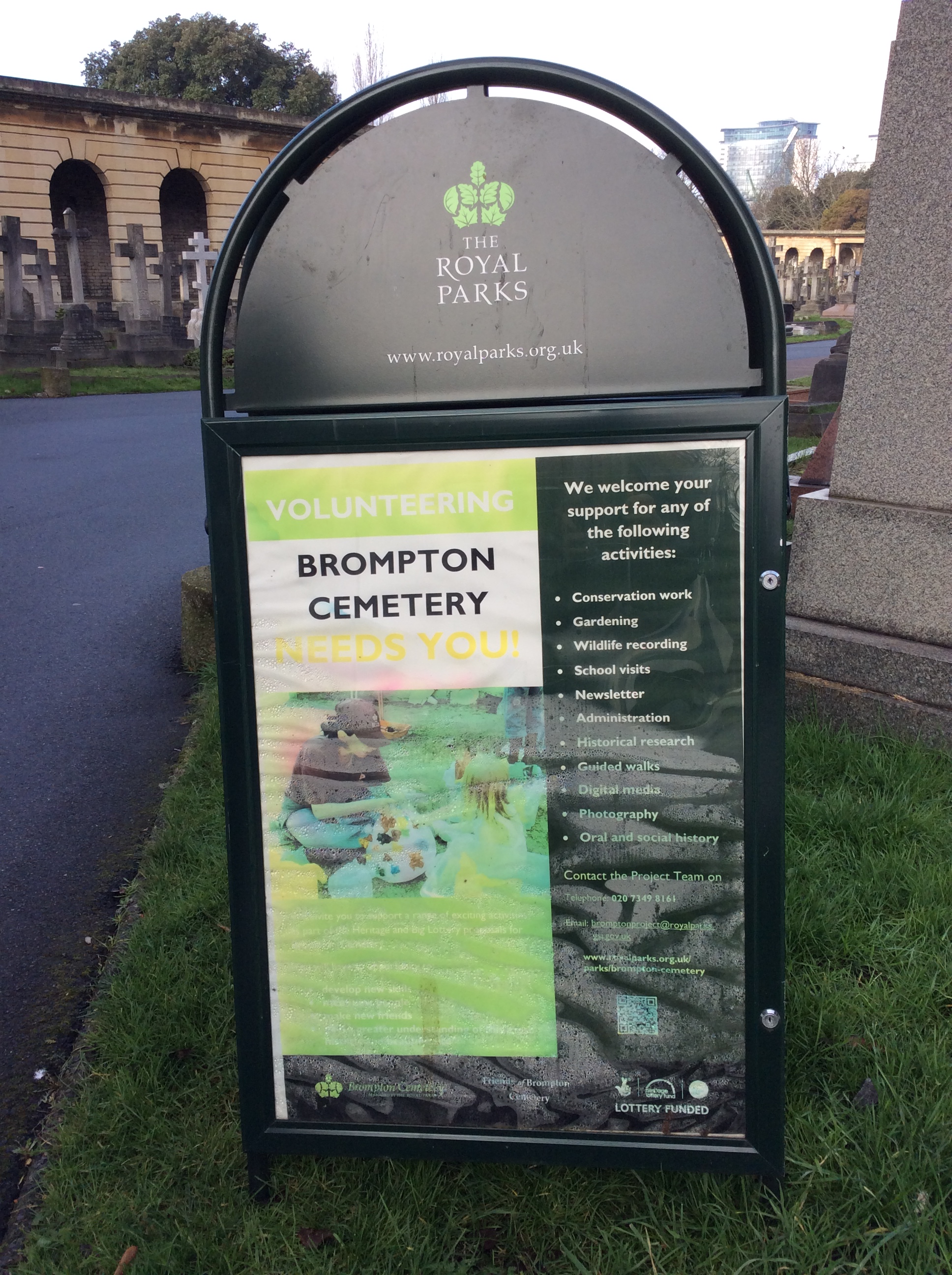
A few days ago I received an email from Jaki, one of the FOTC Friends:
“Was just in London and friend’s flat backs onto Brompton Cemetery. Walked through there. Some areas totally overgrown but they are clearing and working to restore and have an ongoing project.”
So WE ARE NOT ALONE!
Accompanying the text below are some of the photos that Jaki took.
National Federation of Cemetery Friends

All over the country there are groups working to restore local cemeteries. We have contacted the National Federation of Cemetery Friends which represents groups of volunteers interested in conserving cemeteries large and small. The Cemetery Friends give their time clearing and maintaining areas, often working with local ecology groups to maintain a balance between wildlife and heritage. Friends may also provide guided walks, open days and special events and work on projects with English Heritage and other organisations. Some groups have restored memorials and chapels.
Associate members of the National Federation include trusts, councils, organisations who manage cemeteries and burials and individual members who are not part of a Friends group but share in their values.
They have produced an excellent booklet “Saving Cemeteries, A Handbook for Cemetery Friends” which draws on experiences from a number of Friends groups across the country. It includes case studies on: Arnos Vale Cemetery, Bristol; Woodbury Park Cemetery, Tunbridge Wells; Flaybrick Cemetery, Birkenhead; Sheffield General Cemetery; Beckett Street Cemetery, Leeds; The Rosary, Norwich; Nunhead Cemetery, SE London.
Why should our cemeteries be saved?

Cemeteries are pieces of ground set aside for burials. There are around 14,000 cemeteries in the UK. Many cemeteries are closed for new burial plots, although they may be open for the interring (burying) of ashes. Many cemeteries are attached to churches, some are operated privately and many are run by Local Authorities.
However, urban burial grounds in the 19th century were originally envisaged as public open spaces, and were professionally designed to be attractive places to visit in their own right. As well as functioning as burial sites, they were also regarded as places for visiting and promenading of “a more dignified and morally uplifting kind”. The nineteenth-century legislation that provided for new burial grounds seemed to have envisaged that they would in due course become public open spaces (for which provision was made in the Open Spaces Acts 1887 and 1906).
Today, many cemeteries are neglected, with little to attract anyone apart from those visiting specific burial plots. This lack of design, planning and ambition means that the potential health and environmental benefits of cemeteries are not being realised.

There is a strong case to be made that cemeteries have especial architectural and landscape interest because they have often been trapped in a time-warp, and have not been modified, adapted, overlaid, or even destroyed, as has so much else in the historic environment.
This is an argument that is becoming increasingly heard elsewhere in Europe. There are a very large number of listed buildings in cemeteries, according to the National Monuments Record Centre, including lodges and houses, boundary walls, gates, mortuary chapels, cemetery chapels, tombs, and mausoleums.
So cemeteries are a unique mirror on our history and heritage whilst offering an opportunity for the future – a return to the original concept of “Open Space”, providing opportunities for encouraging wide community use.
The above includes extracts from the following sources:
Funeral Map ….
National Federation of Cemetery Friends ….
Cemeteries, churchyards and burial grounds ….
 Teignmouth Old Cemetery
Wonderful all of these groups should make our job easier by utilizing their hard earned knowledge , with regard to our cemetery being deemed ‘Closed’ (by a T.D.C officer ),I was told approx 15mths ago that there were still grave spaces by Mark Pain and there are a number of graves that can still be reopened for burials . A cemetery once deemed closed can with legal permission apply after clearance for reuse for a wide number of ventures , my concern is for the land directly in front of the Lodges ,very old untended graves and a large area of unmarked graves or spaces , in 2015 a large Sycamore was felled in this area , its base showed no signs of disease , was this the first signs of land clearance as it coincided with the plans put out ,to redevelop for Residential the Lodges and Chapel .?? I also questioned the young tree feller and said the tree was not diseased he agreed but after consulting a team member he approached me and said there were some unsafe branches . Why I wonder was pruning the branches back was not undertaken as felling a broad leaf tree needs Council permission and is costly ?
________________________________
LikeLike