
William Frederick Rock was a British publisher and philanthropist. Having worked with the printer and inventor Thomas de la Rue he started his own printing business with help from his brothers. They specialised in publishing topographical steel-engraved prints, one of which was the 1864 etching (No 5067) of Teignmouth Cemetery.
Thanks to local historian Viv Wilson MBE, who has kindly given us access to an old photograph from her archive, and an equivalent up-to-date picture we now have a unique comparison of almost the same cemetery scene over 150 years.
The three pictures are shown below as thumbprints. Click on any picture to get a larger view. It’s fantastic to see both chapels in a photograph, looking so similar to the original etching. All the more sad that the second of those chapels is now just a ruin.
Below the individual pictures are some close-up comparisons of all three pictures together.

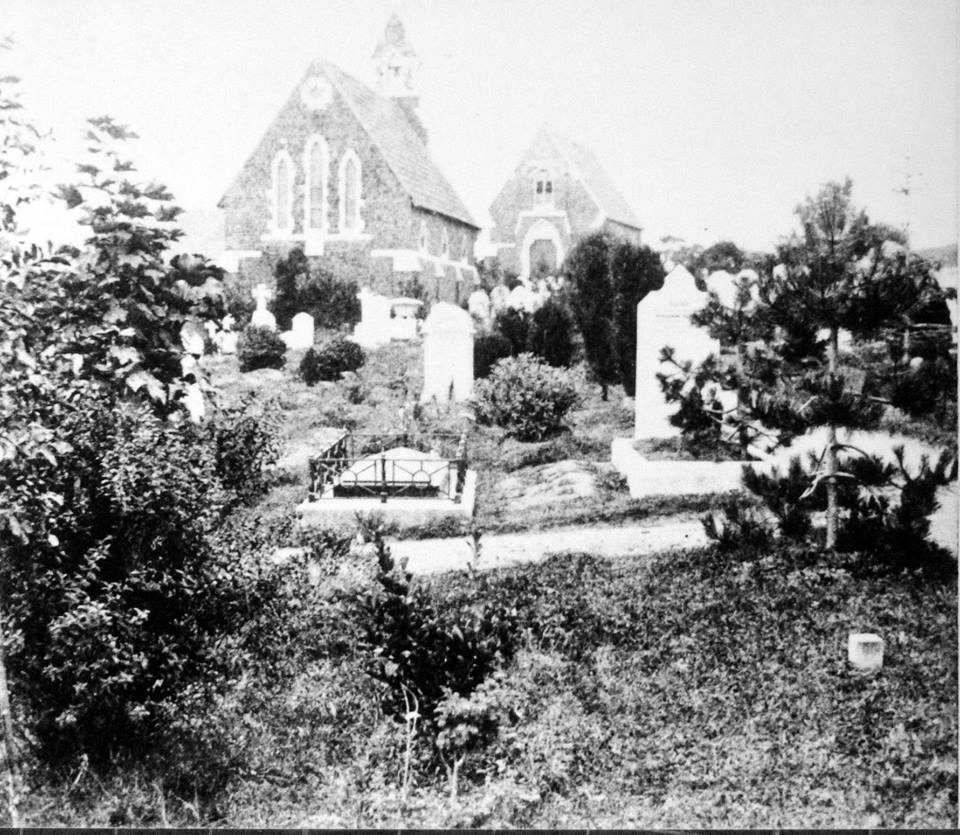
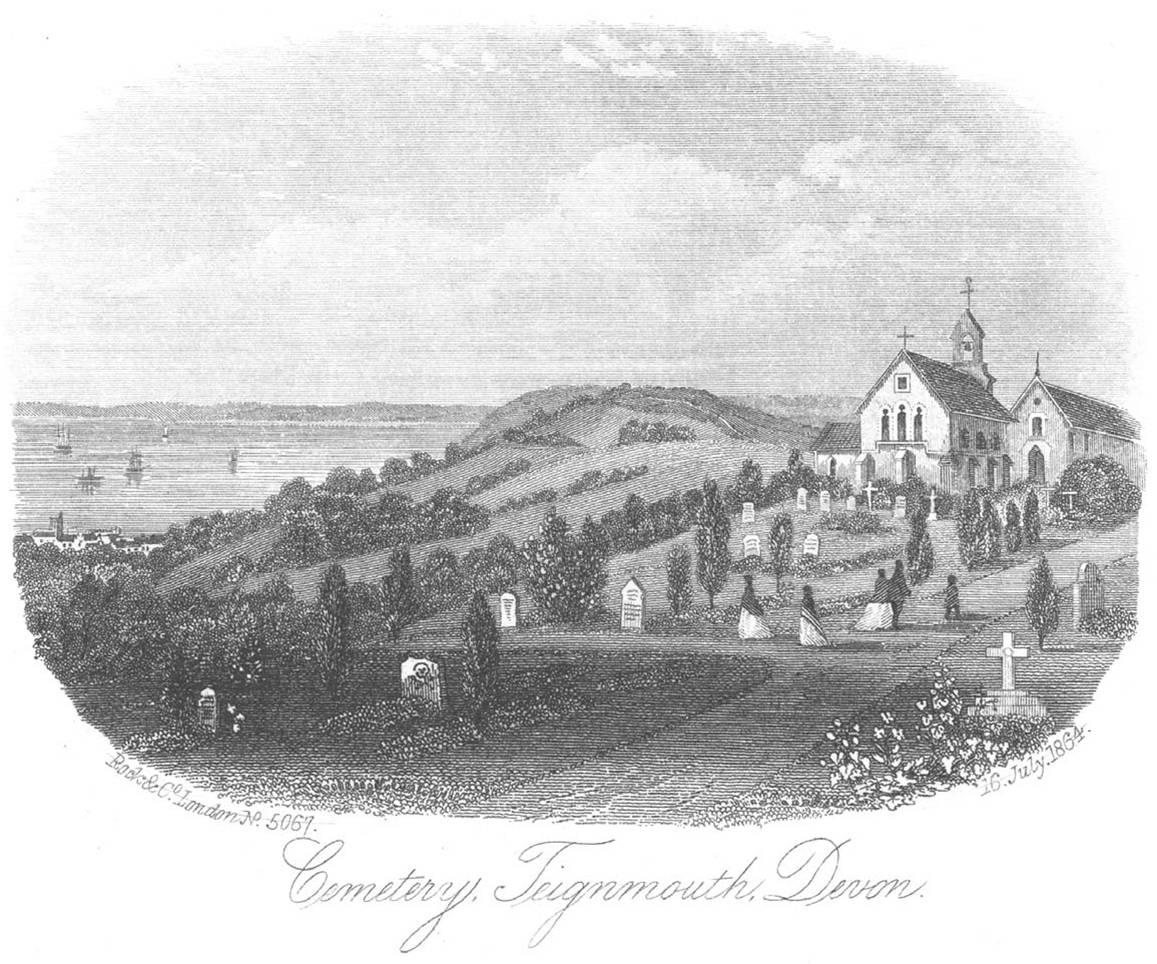
The angles and distances are obviously slightly different but cropping what appears to be roughly the same area from each picture and scaling so that the main chapel is approximately the same size in each gives the following montage:
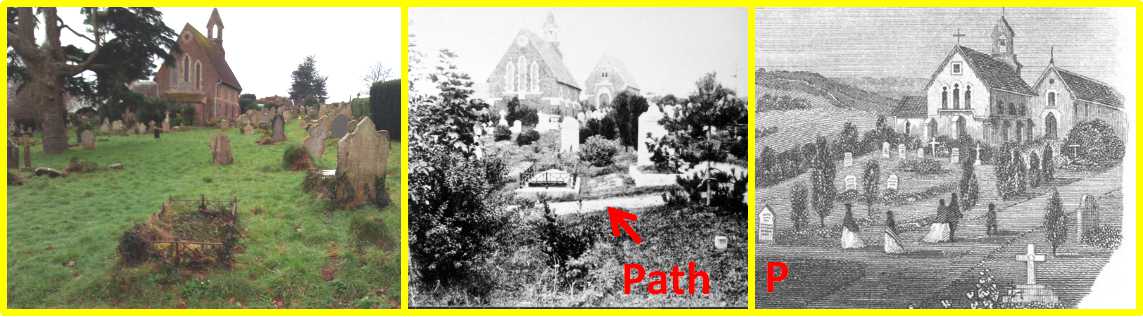
The “P” on the right-hand etching represents roughly where it would seem that the middle photograph was taken. Note the path on the etching which still appears to be a stone path in the photograph. That is now long gone. The key marker for the modern photograph is the central grave in the middle photograph which is surrounded by low iron fencing, now untidy and slightly overgrown.
There is one constant in all three pictures though – the white cross standing below the left-hand window of the main chapel:

150 years …. a long time in the life of the cemetery.
 Teignmouth Old Cemetery
Dear Sir / Madam, Do you have an explanation for the presence of two chapels? Regards, Roger Roger Griffith
LikeLike
One (the nearest) is a conformist chapel and the other non-conformist. People were originally buried on either side of the cemetery depending on their beliefs
LikeLike
I know my vision at the moment is not good and that Viv’s photo is faint but there seems to be no sight of the Lodges standing out as in the others , if so do you know how much later they were built if as it looks to me that they were not in situ in that photo , the Hook family photo shows them clearly 1918 .
Wendy
________________________________
LikeLike