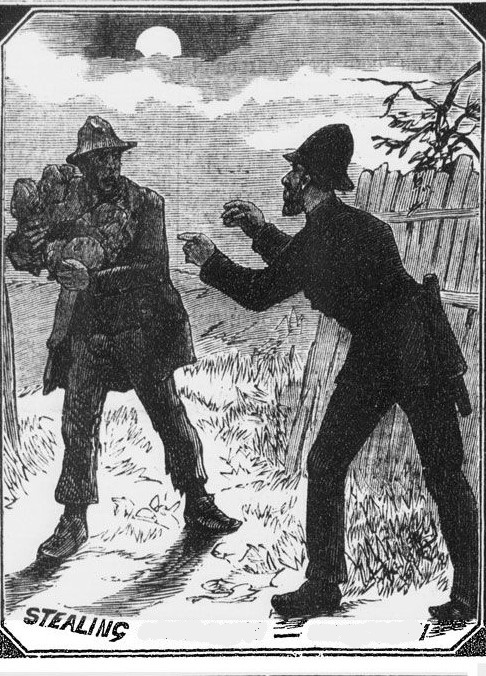
Tales from the Grave focusses mainly on stories surrounding those who are buried in the Cemetery. But the Cemetery itself has its own tales to tell. This story is a mixture of the two.
Not all crimes are as gruesome or as serious as the Babbacombe Murder which we covered in the last story. We’ve had one before – “The Curious Case of the Shifting Shrub”. Here are three little stories which come from our archive of newspaper articles. They revolve around General Frederick J Davis who was buried in the cemetery in 1901 alongside his wife, Sophia.
It All Starts with a Mangold Wurzel.

The mangold wurzel (or mangel-wurzel), of course, has traditional West country connotations. It is a versatile root vegetable which is used primarily for animal fodder but can, when young, be used for human consumption. It is also:
- the central feature of the traditional Somerset sport of “mangold hurling” which has gone international;
- the component of a potent alcoholic beverage;
- and bizarrely gave its name to mangel-wurzel disease caused by people eating too much of the vegetable during the food shortages that followed the first world war.
So who would imagine that this plain root vegetable could lie at the heart of our first crime. This is how the Western Times of 10 March 1880 described the scurrilous event:

“George Hooper, a lad, fourteen years of age, was charged with stealing mangold wurtzel, valued at a penny, from General Davis. The prosecutor had lost a large quantity of mangold lately, and he instructed the police to keep a look-out. A few days ago P.C. Stentiford met the boy coming from the direction of General Davis’s house, with mangold in his hand. On questioning him, he admitted taking them form the prosecutor’s shed. The prisoner now denied the statement, and said that another boy gave him the mangold. As the prosecutor wished the Bench to deal leniently with the lad, he was let off by paying 1s and costs.”
George Hooper, caught in flagrante with mangold in hand ….. but General Davis was soon to get his comeuppance.
Let him who is without sin …..
You might ask why General Davis was keeping mangold-wurzels in his shed. The answer probably lies in a horse which was unwittingly to be the centre of this next crime. It appeared in many papers at the time but here is one short version from the Bristol Mercury of 5 October 1881:

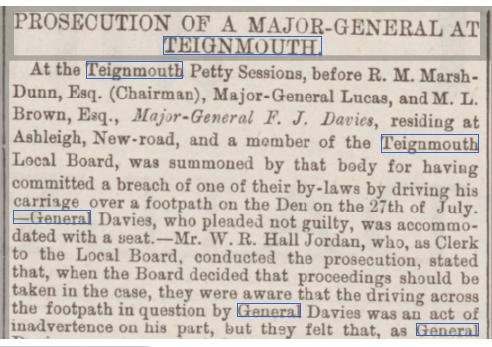
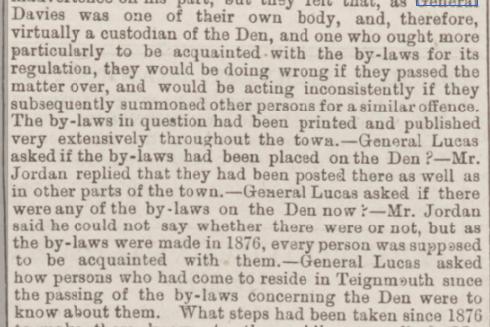
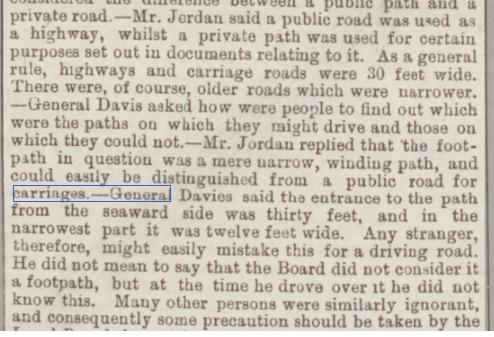
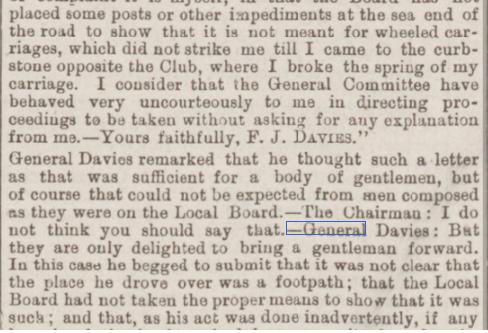
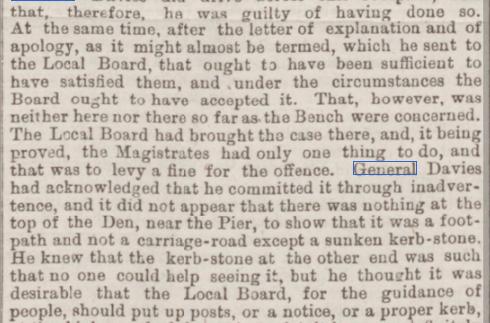
“A COMMENDABLE EXAMPLE – Major General Davis, who is a member of the Teignmouth Local Board, was on Monday brought before the magistrates at the instance of his fellow members of the board. Between the sea and the town there is a public pleasure ground styled the Den, on the preservation of which a considerable sum of public money is annually spent. The board have from time to time issued notice forbidding persons to drive across the ground, but the defendant drove his carriage and pair on the Den, and a ratepayer noticing the fact, called upon the officers of the board to take action against the general, and ‘not to make flesh of some persons, and fowl of others’. The committee of the board decided to prosecute, and in spite of the general’s explanation of inadvertence, he was fined a shilling and costs.”
The ‘Teignmouth Local Board’ is the equivalent of the Town Council. For those interested there is a much longer account at the end of this story showing clippings from the original news article. I’ll leave it up to you to decide whether the general made a genuine mistake (his defence of ‘inadvertence’) or whether he knew what he was doing and simply felt entitled by virtue of his rank and standing in local society. The magistrates – R.M. Marshall-Dunn, Esq., Major-General Lucas. And M.L. Brown, Esq. – made their decision …… guilty as charged. Major-General Davis resigned from the Teignmouth Local Board two months later.
The General Strikes Back
Six years after inveigling the local police constable to keep an eye on his mangolds the General was back with another sting. This time he persuaded another constable to hide behind a hedge and watch a nest. The Express and Echo of 26 July 1886 gives the full story:

“Teignmouth – This Day. Before Colonel Nightingale (Chairman), Mr. Whidbourne and Captain Paul.
Robert Mills, Superintendent of the Teignmouth Cemetery and Lodge-keeper, was charged with stealing two eggs, value two-pence, this morning, from General Davis. William Marsh said he was coachman, in the service of General Davis, of Ashleigh House, Teignmouth. Eggs having frequently been lost, he was told by the General to inform the police of it, which he did. On Saturday he saw P.C. Pope and showed him a nest in a hedge in a lane adjoining his master’s house. On Saturday there were two eggs in the nest. When I came on Sunday they were gone. That morning about half-past seven o’clock, the prisoner was brought to the house by P.C. Pope, and he asked the General to forgive him. He, however, gave him into custody. P.C. Pope said he went to Ashleigh, and Marsh pointed out the nest to him in the hedge. He marked two eggs, and about 6 a.m. proceeded to keep watch. About 7.40 the prisoner walked up to the nest and took out the two eggs, and went towards the Cemetery. After he had gone a little distance witness jumped over the hedge and asked him where were the two eggs he had taken out of the nest. He said ‘Here they are,’ and took them from his trouser’s pockets. Witness told him he had been watching to see who took the eggs out, and he answered ‘nonsense’. He was then taken to General Davis, who gave him into custody. The Bench considered the case proved and fined the prisoner 40s. and 13s. expenses.”
Actions have consequences. In August the Burial Board decided to dismiss Robert Mills but also gave him the opportunity to tender his resignation, which he did. He was back in court the following year for not paying maintenance to his wife. By March 1888 his wife was in the Newton Abbot workhouse and he was in court again on the same charge of not paying maintenance, and destitute himself. The Express and Echo of 26 March 1888 explained:
“He was now living at Torquay, selling a few oranges and bloaters to get a livelihood and was obliged to walk from Torquay this morning, he only having threepence in his possession.”
Two lives ruined, all for two eggs worth twopence and a General who couldn’t find it in himself to forgive Robert Mills.
It’s an interesting triplet of tales that provide an insight into how the justice system worked and how it related to your position in society. We don’t have bobbies on the beat anymore (at least not to the same extent) but I wonder how many police constables today would lurk in wait behind a hedge to watch a nest at the behest of a local General?!!
Sources and References
Extracts from contemporary newspapers are referenced directly in the text and are derived from British Newspaper Archives.
Wikipedia for general background information
Other sources, with hyperlinks as appropriate, are as follows:
Mangel-wurzel hurling – http://mangoldhurling.co.uk
Addendum – Full Story of General Davis on the Den





So the 14year old boy and the General were both fined 1s and costs ,hardly seems fair at all . but then most things are not equal .
Sent from Mail for Windows 10
LikeLike
Hi Wendy. Yes it struck me that there was some imbalance there.
LikeLike
Interesting as usual Neil!
I feel sorry for the poor man who stole the eggs.
Re police on the beta- I am reminded that in the late 1950s in Exeter…my step sister who was for ever pinning a large selection of hand washed frilly underwear out on the line had two batches stolen. The police were informed and 2 of them settled down in our garden shed overnight (!) They caught the thief red handed- one of her former boyfriends.]My – how policing has changed
Viv
________________________________
LikeLike
Wonderful anecdote Viv!!
LikeLike