Or ….. Our Wildflower Project
The Victorian Heritage
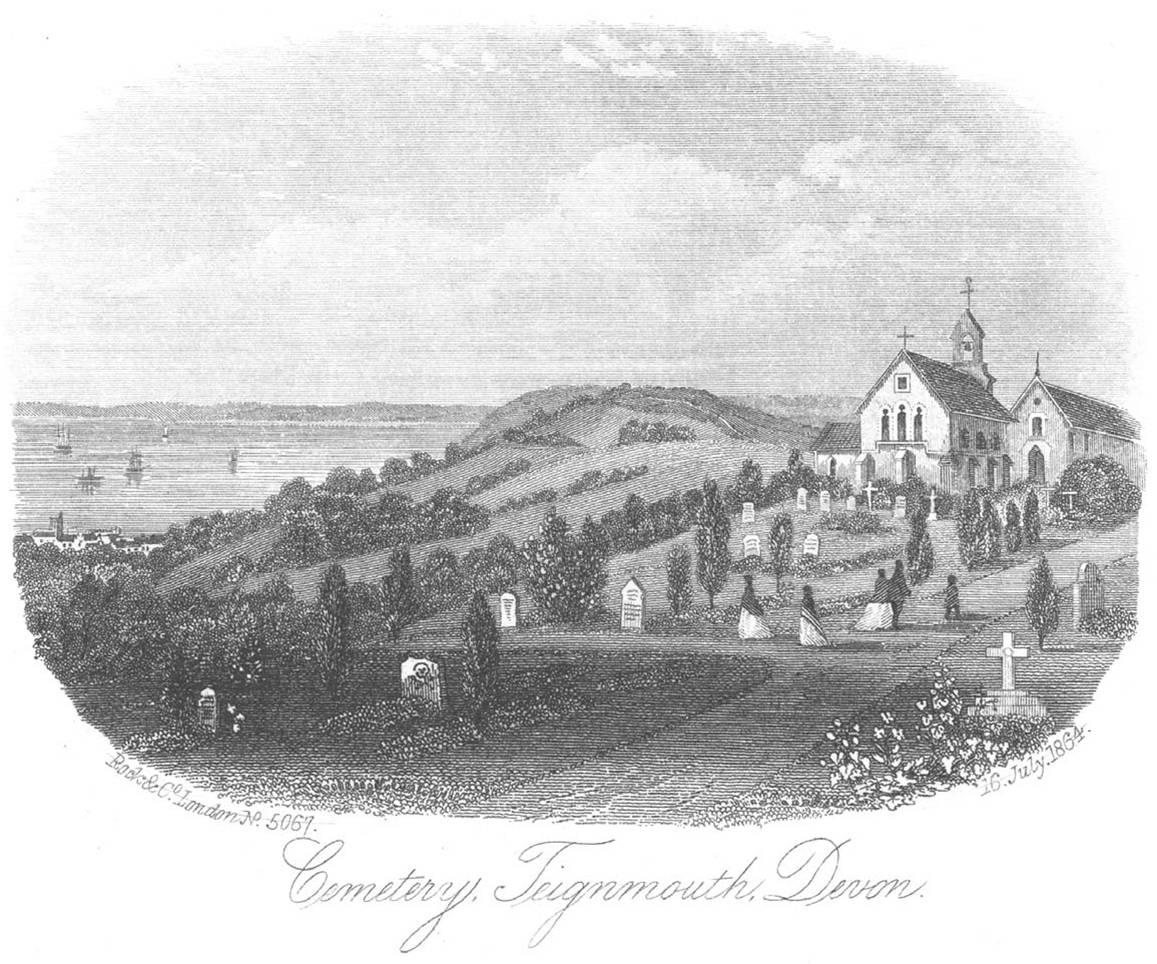
In 1856, when Teignmouth Old Cemetery was created, the Victorians had a vision of “extra-mural” cemeteries not just as burial places but also as green spaces for people to come and enjoy. They viewed them as “garden cemeteries”, oases of peace which anyone in the community could enjoy. That is reflected in this lithograph from 1864
The cemetery originally stood on its own above the town with sweeping views across the sea. You can imagine the feel of the cemetery from this quotation by the niece of the artist William Yeames who is buried here alongside his wife Anne:

“… on the cross which marks the spot where we laid him, in that beautiful hillside cemetery, within sight of the sea, changeful as life itself, on one hand, and the still purple moors on the other, my aunt had the same word inscribed which marks the tomb of Albert Durer in Nüremburg : EMIGRAVIT.”

These cemeteries though were also part of the solution to a major ecological problem of the 19th century – the increasing prevalence of water-borne diseases such as typhoid and cholera through contamination of the water-table.
Church graveyards in towns were closed and replaced by these “extra-mural” cemeteries
The Current Challenge
Moving on two centuries we are trying to restore this Victorian aethos of green space. Over the years the scene has changed as housing developments have impinged on all sides. So the idea of the cemetery as a green space is even more important now than ever with this increasing urbanisation.
But we now have our own even more critical ecological crises – climate change and the detrimental impact we as a species are having on the planet.
As we started work on restoring the cemetery we became aware of different areas that had evolved in different ways:
- The buildings and their immediate surroundings
- Marked graves which could be as large as a vault or just a simple small cross. Most though would have some form of headstone and kerbstones marking the boundary of the grave
- Large areas of open grass where people have been buried in unmarked graves
So the challenge was to restore access to marked graves whilst re-instating the Victorian idea of a community green space and modernising this concept to match the particular ecological challenges we face today, one of which is increasing biodiversity.
A Wildflower Area
There are many aspects of biodiversity but the one we are best placed to influence is the flora of the cemetery. We started four years ago with a survey of the wild flowers in the cemetery. Click HERE to go to our nature page on flowers.
As we cleared away areas of overgrowth such as brambles, ivy and self-seeded saplings we have taken care to retain wild flowers wherever possible.
We are in a position now, though, to take some more pro-active steps. With agreement from Teignbridge we have embarked on a small project to convert a self-contained area of open grass into a wildflower area.
We are doing this with assistance from the community group “Thriving Teignmouth”.
The area has been divided into two to test different approaches.

In the first area the grass will the lifted down to about 6-9 cms so the roots are removed. The remaining topsoil will then be raked to a fine tilth and wildflower seeds (native varieties) will be sown. We are using a cornfield mix including corn marigolds, cornflowers, poppies, ox-eye daisies and many more. Our hope is that we will eventually have a meadow-like area looking something like this.

The second area will be raked and scarified to expose about 50% of the soil. It will then be sown later in the year with yellow rattle to prepare it for subsequent wildflower seeding next year. The yellow rattle is a parasitic plant that lives off the grass roots and gradually overcomes them.
Next year we can make an assessment of how successful this experimental project has been and potentially extend it to other grassed areas.
The project started a couple of weeks ago with cutting the grass down to ground level. Then, after one false start because of the unusually bad May weather, we had our first working session last Saturday, 15th May 2021. That too was cut short by torrential rain and hail in the early afternoon but progress was made. One more session should complete the project. Then we just have to wait!
Here are a few photographs of the work so far:
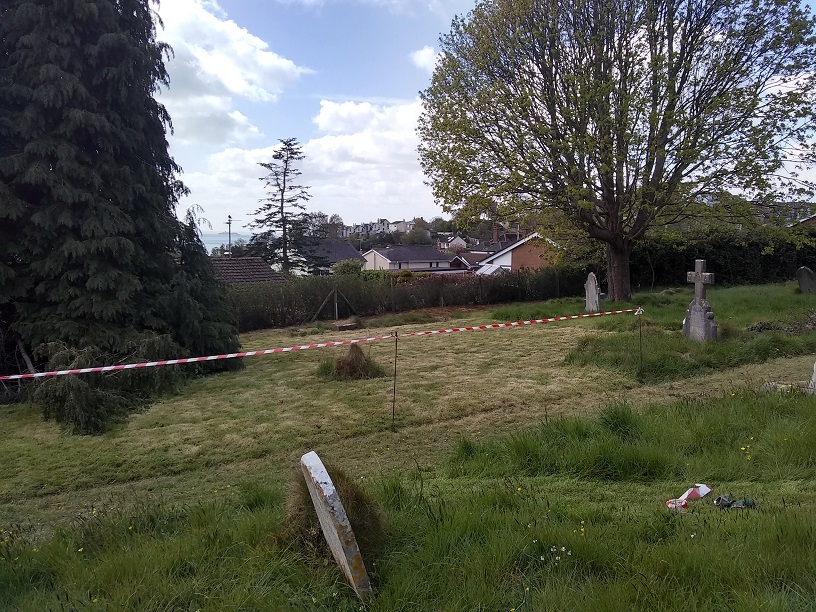
The ground prepared beforehand – grass cut down to ground level and work area cordoned off. 
Advertising the event 
Roxy and Tom were the first to arrive from Thriving Teignmouth 
Jean supervising (hi viz) and in charge of turf moving 
Ant’s eye view 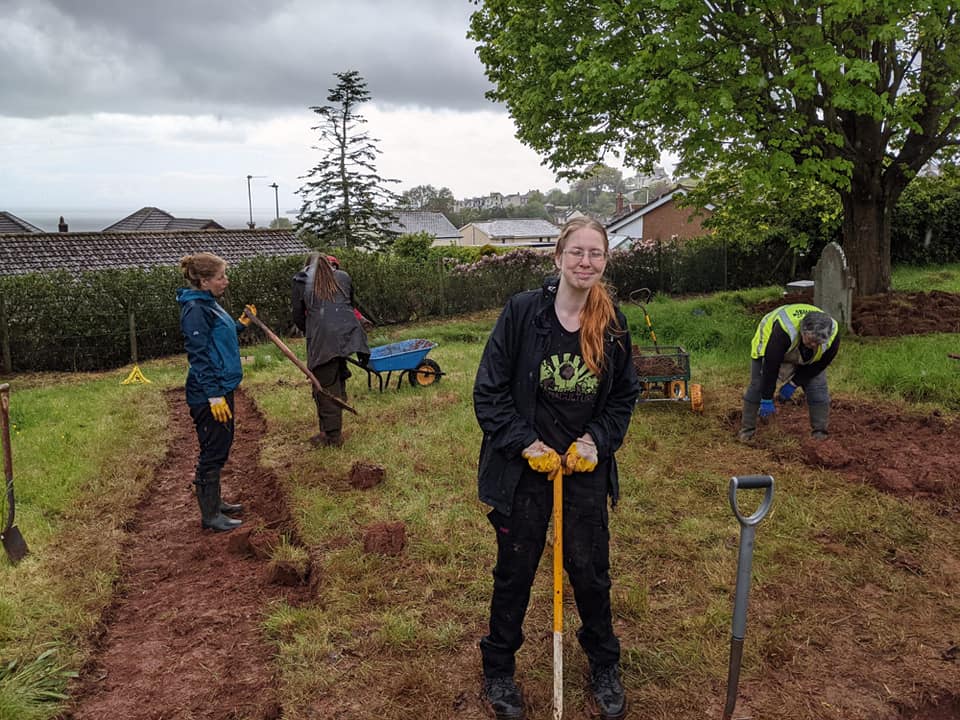
Progress but look at the dark clouds rolling in 
There had been some blue skies earlier 
Joined by a couple of FOTC volunteers who had been working higher up in the cemetery 
Flowers feed insects like this wonderful cinnabar moth
Remembering the Unmarked Graves
Although the project is focussed on biodiversity we are aware that the area we are planting is one where there are many people buried in unmarked graves. We plan to put up a plaque showing who is buried there. There are several marked graves bounding the area as well which will be cleared.
So small wildflower areas like this will provide pleasure and a reminder of those perhaps long forgotten who are buried there in unmarked graves.
If you are interested in supporting our organisations please contact:
Friends of Teignmouth Cemetery: Email fotc2017@gmail.com; Facebook www.facebook.com/fotc2018; Website: www.teignmouthcemetery.wordpress.com
Thriving Teignmouth: Email thriving.teignmouth@gmail.com Facebook www.facebook.com/ThrivingTeignmouth Instagram @thrivingteignmouth


Wonderful idea. I would love to help but I’m 75 with two dodgy knees and I can just about manage to keep my garden tidy.
LikeLike
Thanks Barbara. We’ll think of you as helping here in spirit. All the best
LikeLike