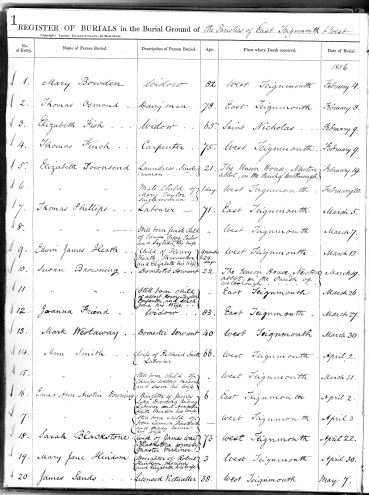
Teignmouth Old Cemetery officially opened in early 1856 and the first person to be buried there was Mary Bowden. She was buried in an unmarked, unbricked grave in what appears to be a fairly arbitrary position (plot number F51) in consecrated ground close to the Anglican (“non-dissenters”) chapel.
The event had a brief mention in the Western Times of Saturday 9th February:
“The new cemetery has been duly licensed for the burial of the dead, and received its first occupant on Monday lost. The usual burying grounds are now all closed.”
So not only was Mary Bowden buried in an unmarked grave but her name did not even warrant a mention in the reference to the event in the press.
The aethos of the Friends of Teignmouth Cemetery is to “restore, revere, remember”. We can not restore unmarked graves but we can at least start to revere and remember those who are buried there. This section takes the first step in doing that by collating whatever information we can find about the first twenty people buried in the cemetery. We have made a start on the basic genealogical information which has been expertly gathered by one of our members, Liz Davidson.
Why “twenty”? Because those are the people who appear on the first page of the first burial register, as shown below. Thanks to Sophie Sercombe of Teignbridge District Council for photographing the page for us.

From a social history point of view there are some interesting characteristics of the first twenty:
- The fact that they were buried in unmarked graves is perhaps indicative of the relative poverty in the town at that time
- Two were young women who died in the workhouse (“Union”) at Newton Abbot.
- Of the twenty, six (or just under a third) were children
- Of those six, four were stillborn
- None of the stillborn children were granted a religious funeral service
Whilst the genealogical history provides an interesting insight into each person we can also ask the more general question of what life was like at the time they died. So, for each month there is a short summary here of what was going on in Teignmouth at the time and what was happening in the world outside. The events in Teignmouth have been taken from contemporary newspapers which have been included in the references as follows:
- EPG – Exeter and Plymouth Gazette
- EFP – Exeter Flying Post
- RCG – Royal Cornwall Gazette
- WT – Western Times
As an aside, it’s fascinating to discover phrases like the “town scavenger”, “Sunday desecration”, and the “water cart” which are from a different time but has something like the “soup kitchen” simply been replaced by today’s “food banks”?
(For more details about each of the first 20 people buried in the cemetery click HERE)
February 1856
| The Burials | Teignmouth Events |
|---|---|
| Mary Bowden, buried 4th February 1856 in plot F51 Thomas Osmond, buried 8th February 1856 in plot B86 Elizabeth Fish, buried 9th February 1856 in plot F49 Thomas Finch, buried 9th February 1856 in plot F50 Elizabeth Townsend, buried 19th February 1856 in plot F48 Unnamed male child of Mary Taylor, buried 20th February 1856 in plot F117 | The Soup Kitchen – 2313 quarts of soup were distributed to the poor of this town during the past week (EFP 7 Feb) The annual soiree of the Teignmouth Useful Knowledge Society is announced ….. and on the following evening Dr. Daniel LL.D will give a lecture “On the Life and Times of Michael Angelo (sic)”. (WT 9 Feb) A meeting was held at the Assembly Rooms … for the purpose of appointing a deputation to wait on Capt. Spratt, RNCB, to invite him to a public dinner, as a testimony of the appreciation of the inhabitants of Teignmouth of his public services during the past year, while in command of HM ship Spitfire in the Baltic. (WT 9 Feb) At the Commissioners Meeting on Tuesday … Mr. Superintendent Ockford complained of the neglect of Dobbs, the town scavenger, in not removing the ashes &c, when ordered. He was cautioned to be more attentive in future. (WT 9 Feb). A petition against “Sunday desecration” has been signed by a great number of the inhabitants of this town. (WT 16 Feb). |
Meanwhile in the world outside:
1 Feb. The Crimean War ends when Russia yields to an Austrian ultimatum and agrees to preliminary peace terms at Vienna.
7 Feb Colonial Tasmanian Parliament passes the 1st piece of legislation (the Electoral Act of 1856) anywhere in the world providing for elections by way of a secret ballot
17 Feb Heinrich Heine, German poet and lyricist (Schubert, Liszt), dies at 58
March 1856
| The Burials | Teignmouth Events |
|---|---|
| Thomas Phillips, buried 5th March 1856 in plot F47 Still born female child of Edwin and Sybilla Sally Piper, buried 7th March 1856 adjoining plot F3 Edwin James Heath, buried 12th March 1856 in plot F116 Susan Browning, buried 19th March 1856 in plot F46 Stillborn child of Albert Henry & Sarah Jane Taylor, buried on 26 March 1856 next to plot A50 Joanna Friend, buried 27th March 1856 in plot F45 Mark Westaway, buried 30th March 1856 in plot F44 Stillborn child of Charles & Susan Webber, buried on 31st March 1856 in a spot adjoining plot A49. | SOUTH DEVON RAILWAY – HALF-YEARLY MEETING …. From the report of the engineer (I. K. Brunel, Esq.) ….. The damage done last winter to the sea-wall near Teignmouth had been strongly and efficiently repaired. The strengthened footing has been carried to beyond East Teignmouth tunnel and would appear to promise security against all future effects of the washing away of the beach. (EPG 1 March). COMMISSIONERS OF IMPROVEMENT. – A letter was read from Mr Mackenzie, complaining of a slaughter-house on Myrtle Hill, in the occupation of Mr Snow, butcher; and an animated discussion ensued on the propriety or otherwise of removing all slaughter houses from the town. (WT 8 March). USEFUL KNOWLEDGE SOCIETY. – Mr J. N. Hearder of Plymouth, the well-known and highly appreciated philosophical lecturer, will deliver a lecture at the Public Rooms, on “Electricity”, illustrated by numerous experiments. In the course of the lecture, cannons placed on the Den will be discharged from the lecture room by the electric field. (WT 8 March) Some of the market women who bring vegetables to market are in the habit of selling by measure. This is contrary to law, and the inspector of weights and measures would be only doing his duty by seeing that they not only sell by weight, but that the weights and measures are accurate. (WT 8 March) A medal of honour has been given to Major Sir Warwick Hele Tonkin, one of the presidents of the Societé Universelle, Paris, for his ingenious and scientific method for facilitating the study of music and harmony (RCG 21 March) |
Meanwhile in the world outside:
5 Mar – fire destroys Covent Garden Theatre in London
15 Mar –the Boat Race 1856, first of the annual series rowed between Cambridge and Oxford University Boat Clubs on the River Thames in London; Cambridge wins.
31 Mar – the Treaty of Paris is signed, ending the Crimean War
April 1856
| The Burials | Teignmouth Events |
|---|---|
| Ann Smith, buried 2nd April 1856 in plot G122 Emma Ann Austin Downing, buried on 2nd April 1856 in plot F115 Still born child of John & Mary Emma Cannon, buried on the 3rd April in a spot adjacent to plot A49 Sarah Blackstone, buried on 22nd April 1856 in plot G120 Mary Jane Hindom, daughter of Robert and Elizabeth Hindom, buried on 30th April 1856 in plot F114 James Sands, buried on 7th May 1856 in plot F43 | ACCOMMODATION FOR VISITORS – During the past week workmen have been engaged in fixing seats on the sea wall, the ‘Wanes’ and on the Bishopsteignton Road. This will prove a great accommodation to visitors and the public generally, who can now sit and admire the beautiful scenery of the surrounding neighbourhood, and inhale the exhilarating sea breezes (WT 5 April) The Royal National Life Boat Institution has forwarded to the hon. Secretary of the Teignmouth branch 10s. for each man who went off in the lifeboat with a view to render assistance and save life from the wreck of the schooner Sarah of London (EPG 5 April). Captain Hull, of Clifton, delivered an able lecture on Monday evening last, at the Zion Chapel, in which he shewed the social and moral state of the Turks before the establishment of the Christian religion in that country in 1819. (WT 5 April). Near East Teignmouth Church several coins have been found chiefly of ancient date, in the sand. One boy is reported to have found a spade ace guinea, and several small silver and copper coins (WT 12 April). IMPROVEMENT ACT – The time allowed by this act for continuing thatch on houses in the town, being about to expire on the 7th of June, the commissioners have very properly given notice that they purpose carrying the powers of the act into operation. The advantage to the town, by all who look at it rightly, will be great, although it may and will be very inconvenient to many – to the carpenters and masons it will be a great boon – the act is peremptory, and if the owners of the houses neglect to take down the thatch, the commissioners may cause the same to be taken down without being considered trespassers (WT 19 April). An unusual railway accident occurred here on Thursday morning last. A cat attempted to cross the rails as the mail train appeared in view, but before Puss could get clear the engine came down upon her and cut her in two (WT 19 April) The water cart made its first appearance for the year in public, on Saturday last, to the astonishment of the public generally, as in former years it has not made its appearance until the first of May. If the commissioners were to bring it out in the month of March, when clouds of heavy dust blow into the tradesmens’ shops and spoil their goods, they would be doing a great service. (WT 26 April). |
Meanwhile in the world outside:
3 Apr Palace of the Grand Master of the Knights of Rhodes badly damaged by gunpowder explosion, kills 4,000 on island of Rhodes
19 Apr – the iron-hulled paddle steamer RMS Persia (launched on the Clyde, 1855) sets out from Liverpool on a 9-day, 16-hour transatlantic crossing at an average 13.11 knots (24.28 km/h) to regain the Blue Riband for the Cunard Line.
6 May Sigmund Freud is Born.


Neil what and where were the usual burial grounds they mention are now closed , are they referring to church yards or ones that may have been lifted for progress ? I believe there was one probably Methodist near the DocKs that was lifted and moved . Hopefully you will soon feel well . Wendy . Sent from Mail for Windows 10
LikeLike
Hi Wendy. It doesn’t mention in the article which burial grounds but my assumption would be St James and St Michaels. I haven’t heard of a Methodist graveyard. The burial acts refer specifically to having to close burial grounds that lay within the town boundaries but I think I’ve also seen one exception – Brethrens’ graveyards. There are certainly other graveyards within the “modern” boundaries of Teignmouth which were actually established after the Old Cemetery started up – one at St Scholastica’s Abbey and another now in the grounds of Trinity School. Those would have been permitted because they were outside the then town boundaries. There must have been one as well where Mary Magdalen’s once stood (now Hazeldown School) but I don’t know what would have been done with the bodies when the school (or housing estate) was constructed. If you find out anything more about a Methodist graveyard do let me know. All the best, Neil
LikeLike