Introduction
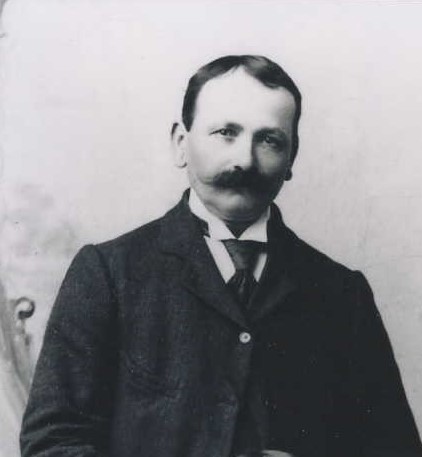
Baking in the hottest of hot July heatwaves my thoughts turned to keeping cool which inevitably led to ice cream. In turn that reminded me of a grave which I had recently re-discovered in a far corner of Teignmouth Old Cemetery. It is the grave of Angelo Antonio Antonucci.

At heart this story is simple. It is the record of an Italian family who emigrated from a poor part of Italy looking for a better life. They arrive in Teignmouth, set up a business here, the parents die and the children disperse. This simple story though is woven into an immense tapestry of social history which gives some depth to their lives and which would have inevitably coloured their story.
So this is a sort of social history interpretation which starts in Picinisco, where Angelo was born in 1860.
Picinisco and the war
Picinisco, once a small village with a castle, is now a small town which vies with other similar mountain resorts in the region of Lazio, Italy, for a share of the tourist trade. It lies sufficiently off the beaten track though to ensure that it is not overrun. Few people in this country will have heard of it.
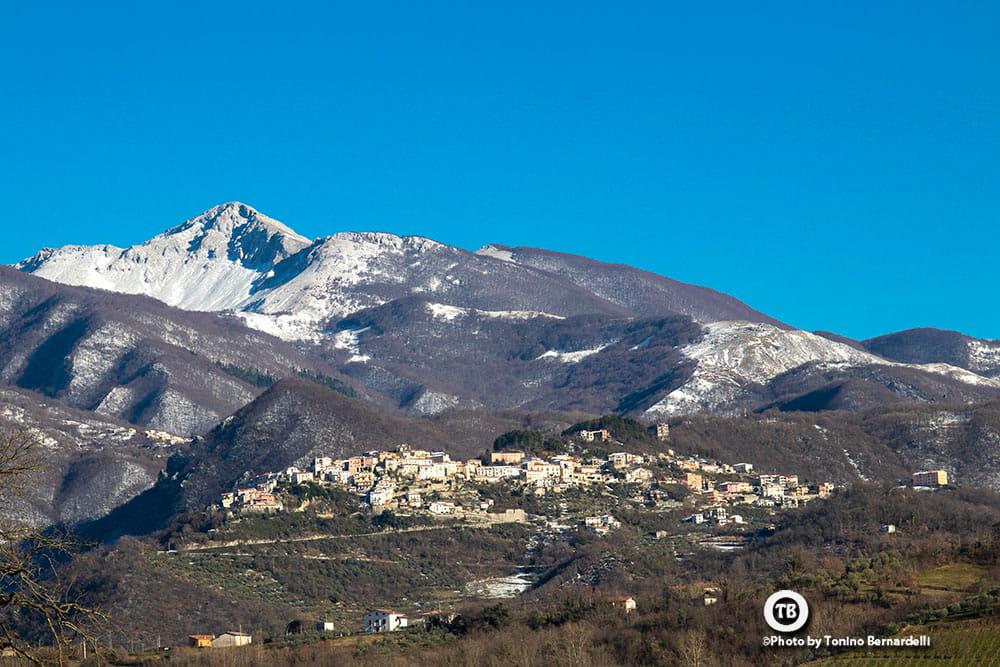
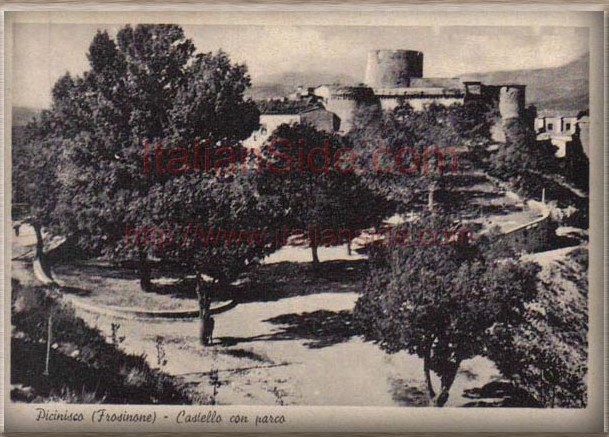
If I mention “Monte Cassino” though the picture changes. Picinisco lies 25 miles or so north from there and was on the path of the Allies advance on Rome in World War II. It was of sufficient strategic importance to be mentioned in the British press when it was captured. As the Scotsman of 31st May 1944 reported:
“The first indication that the Italian Liberation Corps is taking an active part in the battle for Rome was given yesterday in a message to Italian troops from Marshal Giovanni Messe, Chief of the Italian General Staff (says Reuter from Naples) …..
‘This new blood is generously spilled in order to redeem new Italy and give her the right to live’ …..
Troops of the Italian Corps, clearing up the wild mountain region at the western end of the Abruzzi National Park, have captured the 7000-foot high town of Picinisco, on the headwaters of the Melfa river, six miles north-east of Belmonte (adds Reuter). The Italian units taking part in this drive include Alpini, Bersaglieri and parachutists, specially trained and equipped for mountain fighting. The Corps is pressing forward from points reached during a 12 miles advance across some of the wildest mountain areas in Italy.”
Brigands
Until that time Picinisco seems to have remained a sleepy mountain village for 70-80 years but when Angelo and his two siblings, eldest sister Palma and older brother Michele Angelo Antonio, were growing up there, it was a more disturbed place. There are reports over several years of “brigand” activity there which culminated in 1870 with the capture and slaughter of one the main groups headed by the infamous Fuoco. The following graphic description appeared in the London Evening Standard of 23rd August 1870:
“Four men, captured and held in pawn by the famous brigand Fuoco, have performed a deed of heroism which deserves to be requited by some conspicuous form of public acknowledgment. Who they were and where they were seized we do not learn; but on the 16th instant they were in the custody of their captors in a well wooded retreat, about half-way up Mount Cavallo, in Terra di Lavoro.
The brigands, five in number, had plenty to eat and drink, and when they had appeased their natural cravings became very sociable, consented to loosen their prisoners’ bonds, and beguiled the evening hours with cards, varied by pitch and toss, played not with vile halfpence but with five-franc pieces and Napoleons. The flask all the while circulated without stint, and in good time the robbers dropped off to sleep, leaving one of their number, armed with a revolver, to keep watch over the prisoners.
How these men managed to concoct their plan is more than I can say. How it just happened that four such resolute fellows were thrown together on this occasion is another fact not explained; but the fact is that, at the preconcerted signal, each of them had his part cut out for him, and performed it with perfect success. When the word was given, No. 1 darted forward, and, with a small pocket-knife, obtained, we are not told how, divided the snoring Fuoco’s weasand as clean as a whistle; No. 2 made for an axe which he had kept in view all the evening, and dexterously clove the skull of a second sleeper. No. 3, armed with a wooden mallet, devoted his whole attention to another. The sentinel seems to have kept a bad look-out, for we learn that he was dispatched by a shot from a gun belonging to one of his slain companions; and, the fifth of the batch, returning to consciousness in time to see the tables turned upon him, found safety in flight, not however without receiving a broad hint to be off, in the shape of a random stroke from the axe above mentioned.
Our four heroes thus remained masters of the field, and after collecting the spoil, consisting of three rifles, a dagger, a cake of soap, and a sensational romance ” from the French” not forgetting, probably, the five-franc pieces and the Napoleons with which their captors had improved their last remaining hours here below, made the best of their way down to the village of Picinisco, where they brought the joyful but unexpected tidings that the redoubted Fuoco. earthly career was at an end.
Fuoco, after having been for years the terror of the neighbourhood, had retired to Rome upon a decent competence, but bad speculations and drink subsequently undermined his resources, and last spring he took to business again, returning to the scene of his former exploits and managing to set the law at defiance, until in an evil hour he formed the acquaintance of our clever friends, whose names the newspapers do not deign to record, although it would, I think, be difficult to find four men who have deserved better of their country. A score or two of men of this stamp would do more to clear the land of brigandage than all the regiments in his Majesty’s service.”
That must have been an unbelievably terrifying period for the villagers. As for the Antonuccis, it seems that the family gradually emigrated.
Emigration
Angelo’s sister Palma, who was born in 1852, married Giovanni Perilli in 1880. They must have left by 1884 – their first son Geraldo was born on the 6th May that year in France. They then moved on to England, their second son Michael being born in 1886 in Birmingham whilst daughter Maria Carolina was born in 1888 in Newton Abbott. By 1891 they were living in the St Andrews district of Plymouth.
Angelo’s elder brother Michele Angelo, born 1857, probably left at about the same time. The records would suggest that again this was by 1884 at the latest since he is shown as marrying Antonia Tomasso in Plymouth in April that year. He stayed in Plymouth until his death in 1919.
It looks like Angelo, being the youngest, perhaps traditionally had to stay to look after his parents. Whatever the reason, he remained, married Lucia Palombo, and together they had three children – Giuseppe, Giacomo and Elisabetta. I would surmise that when his father Luigi died (probably some time between 1894 and 1896) he too made the bold decision to up stakes and move his whole family, including his mother Domenica, to Britain.
The period from the middle of the 19th century through to the early 20th century was one of extensive migration from an impoverished Italy to lands of opportunity elsewhere. Many Italians emigrated to America but Britain and France were also popular destinations.
The immigration tended to result in Italian enclaves being established in or close to the destination ports. Although most immigrants from Picinisco apparently ended up in Scotland (perhaps because of the similar mountainous terrain?), Antonio and his family landed in Plymouth, presumably to be close to the rest of his family all of whom were also there by that time. They must have lived in Plymouth for a little while because their next child, Crestina, was born there in 1896.
Ice-Cream
They then chose to move to Teignmouth and by 1901 are showing as living at 6 Teign Street where they set up an ice-cream business. It could be that the opportunity came up to take over an existing business. The Teignmouth Post and Gazette of 6th August 1886 advertised a G.Ellis selling ice-cream at 5 Teign Street – could this have been the opportunity for Antonio?
Ice-cream was a common feature of many Italian immigrant families and there are still numerous ice-cream parlours around the country bearing the Italian names that reflect their roots. You have to wonder why. ‘Ice-cream’ of sorts (more similar to water ices like “granita”) had been around in Italy since Roman times – there is documentary evidence of it being served to Nero. But it’s not likely that someone in a small mountain village would be able to make a living there from ice-cream though perhaps Angelo’s wife, Lucia, would have routinely made it as a treat for the family? The main ingredient for ice-cream is obviously ice, which would be in plentiful supply in the winter in the snowy mountainous areas of Lazio.
So, for those Italian immigrants was it simply a case of grasping an easy market opportunity in a new country? Ice cream is easy to make, providing you can get ice; there would obviously be a demand for such a delicious product and there was probably initially little local competition.
Ice-cream made its first appearance in this country in 1671 at a royal banquet given by Charles II. Even there though it was served as a rare and special dessert only to those on the top table whilst the other diners could only suffer whilst watching!
It looks as though commercial production for public consumption was started in London in the 1840s by Carlo Gatti who had come from Ticino – the mountainous, Italian-speaking region of Switzerland.
Carlo negotiated a contract with the Regent’s Canal company to cut ice from the canal in winter which was then stored in insulated warehouses. It seems that little thought was given to the quality of water from a London canal even though there were reports of sickness after consuming the ice-cream.
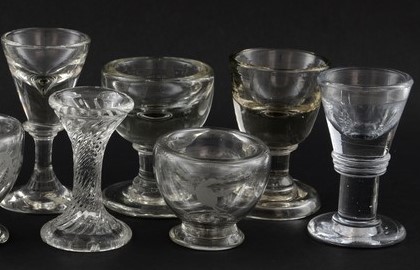
From Antique Collecting magazine
This was exacerbated by the way in which ice-cream was sold in small glasses called “penny-licks” – pay a penny, lick the ice-cream out of the glass and return the glass to the vendor. The glass would be wiped or swilled in a bowl of water ready to be filled again for the next customer. This was eventually banned (but only in 1899) when a link with the spread of TB was established.
In its early stages in London the ice-cream industry was not an easy living for Italian immigrants. The ‘History of Ice-Cream in London’ describes:
“….. the lives of the Italians living in the Saffron Hill slum in North London (think Fagin’s lair, but worse), the majority of whom made a living selling these ‘ices’. In little villainous-looking and dirty shops an enormous business is transacted in the sale of milk for the manufacture of halfpenny ices.”
Ice-cream had certainly made an appearance in Devon and Teignmouth by the 1870s but, judging from references in local papers, it still seemed to remain a more exotic dessert for banquets rather than being readily available to the general public. In a popular sea-side resort such as Teignmouth though it wasn’t long before popular demand for ice-cream resulted in a proliferation of vendors.
Ice-Cream and the Antonuccis
The problem of sanitation and ice-cream production remained through to the next century. Production was still not regulated and examples of illness caused by unsanitary conditions appeared regularly in the local papers. The vast majority of these related to London but one local example appeared in the Western Morning News of 2nd November 1900:
“DANGERS OF ICE CREAM.
FATAL PTOMAINE(Note 1) POISONING AT PLYMOUTH
Mr R. B. Johns, borough coroner, held an inquiry yesterday at Plymouth, touching the death of Christopher Kemp, aged 12, son of Thomas Kemp, of 3, Stanlake-terrace, Plymouth.
Thomas Kemp stated that on Saturday evening last, when the deceased came home, he complained of a pain in bis leg, saying that a boy had kicked him on Wednesday last. On the following day he was laid up, and died on Tuesday night. He complained on Monday of a headache. A doctor was sent for but the boy died before his arrival. His younger brother told the witness that the deceased had eaten four five ice creams on Saturday at the shop of M. Antonucci, ice cream vendor, of 49 Treville Street.
Dr. E. A. Travers-Stubbs, of Laira Villas Plymouth, said that he had made a post-mortem examination and found that death was due to ptomaine poisoning. the result of eating the ice cream. The kick was in no way attributable to his death. The Coroner remarked that this was an important case, which he should report the medical officer of health. The jury found that death was due ptomaine poisoning, caused by eating ice cream.”
M. Antonucci was, of course, Antonio’s brother. He strongly challenged the finding in the press and I can find no evidence so far that he was actually prosecuted. This is how the Western Evening Herald of 6th November 1900 recorded it:
“THE ICE-CREAM QUESTION (To the Editor of the ‘Western Evening Herald’)
Sir, – I noticed in the papers last week an account of the death of a boy who it was alleged died through the effects of eating ice-cream which was supposed to have been supplied by me. By that report it would appear that my ice-cream was impure and poisonous.
I am confident that it is perfectly pure and to show that my statement is correct I am willing to pay £5 to any person who can prove the contrary by analysing the same. I write this in common fairness to myself, as otherwise I should lose the good name which I have already earned in this town for selling pure ice-cream.
M. ANTONUCCI
Plymouth, November 5th, 1900”
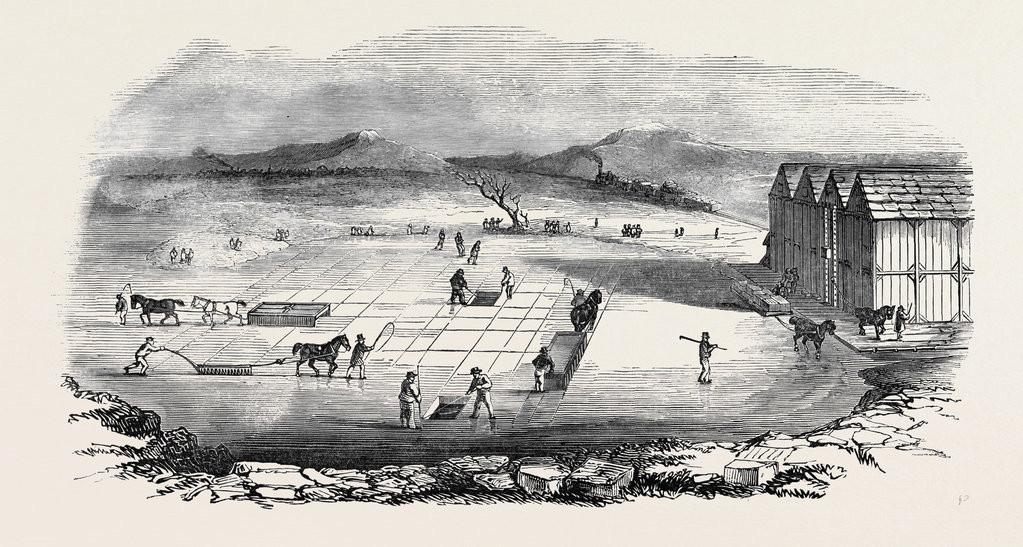
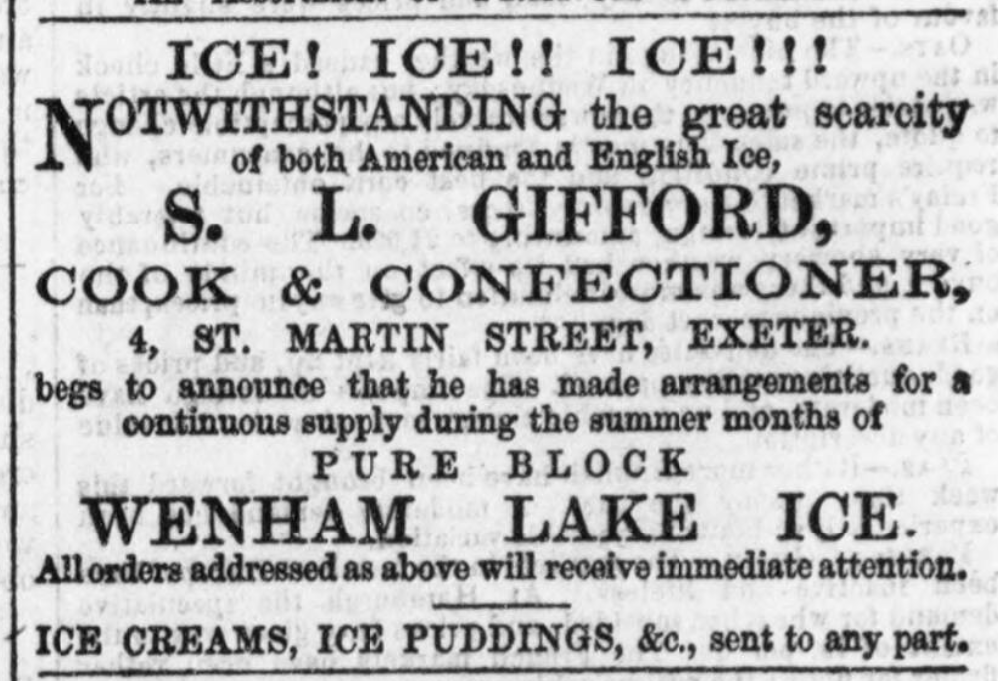
The issue of water quality in the production of ice-cream was improved through the importation of ice first from Norway and then America – in particular from Wenham Lake, Massachusetts, which was famed for the crystal clarity of its water. One of the images below shows an advertisement from the Exeter Flying Post of 20th May 1863.
But there still remained the problems of sanitation where ice-cream was being made. This point was picked up in Torquay after the above case. The Torquay Times and South Devon Advertiser of 16th November 1900 reported:
“Councillor Appleton rendered the public a useful service in calling attention at the meeting of the Town Council to the sale of ice cream in the streets of Torquay, with reference to a death at Plymouth from ptomain poisoning after eating ice cream, because it was shown that the Medical Officer of Health (Dr. Karkeek) was on the alert, and had visited the places where the compound is prepared in Torquay, in July or August last. He found that one ice cream vendor prepared his concoction in a stable, where animals were kept, that another used a stable in which no horses or other animals were kept, and that the third made his in a wash-house. We have often felt that if people could see the conditions under which these compounds are mixed, and the places where they are stored after being made, there would be far less consumption of it.”
By 1901 the government was starting to take broader action as the Western Times of 6th June 1901 described:
“The voice of the ice-cream merchant is heard on all sides in Exeter. It may be taken for granted that the raucous vendor of alleged ice-cream does not follow the reports of Parliamentary proceedings, and it may, therefore, come as a surprise that the most drastic legislation of the present session is to deal with these ‘mixtures’. A Committee has been considering the matter, and passing clauses in Bill after Bill promoted by municipal corporations all over the country, ‘regulating the manufacture and sale of ice-creams’. ‘Clause allowed in accordance with recent precedent’ is the formula adopted in the official record to the House of how the matter has been dealt with in committee; but when Tennyson talked in immortal verse of ‘freedom broadening slowly down from precedent to precedent’, he assuredly had not the ice-cream vendor in mind.”
I can find no evidence of the sanitation problem occurring in Teignmouth which might explain why Teignmouth Council had not started to think tentatively about the health problems of ice-cream until 1901, as reported in the Teignmouth Post and Gazette of 10th May 1901:
“IS THE ICE CREAM PURE?
The Rev. Anson Cartwright asked if the medical officer of health ever analysed the ice cream sold in the streets. The Medical Officer (Dr. Piggott) replied that he should only have power under the Sale of Food and Drugs Act. The inspector appointed under the Act was Mr. Drake. He anticipated no difficulty would be in the way of analysing the ice cream if the Council thought it desirable.
The Rev. Anson Cartwright: Is it your opinion that analysis is desirable?
Dr. Piggott: So far as I know anything about the conditions under which ice cream is manufactured it is only a small business and I do not think there would be any objection to taking samples”.
A second problem in selling ice-cream was the increasing competition between vendors which led to many a fight and occasionally murder. There are many reports of these in the press and Teignmouth was not immune. The Exeter and Plymouth Gazette of 26th August 1904 reported:
“A ‘hokey-pokey’(Note 2) row took place on Teignmouth Den on the occasion of the Regatta. Two Italian ice-cream vendors assaulted another of the same nationality”
The same paper from three days earlier gave a more detailed account of the rumpus:
“English v. French Fighting
There was considerable amusement at the Teignmouth Petty Sessions yesterday during the hearing of a summons for alleged assault taken out by Dominic Forte, ice-cream vendor, of Exeter, against Gusseysh Jannette and Antonio Trupper, two other Italians.
It appeared that on the day of the Teignmouth regatta some discussion took place between the parties as to the quality of the ice-cream they were supplying. It was alleged that one of the defendants struck Forte on the nose, making it bleed, while the other took up a long pole and hit him across the back.
Forte, said one of the witnesses, ‘wanted to play fighting English fashion but Trupper played fighting French way and , lowering his head, charged Forte like a bullock at a gate’. The quarrel, apparently, had begun 12 months ago, and the excuse for the use of the pole was that the defendants had been told that Forte carried a knife and a revolver in his pockets, and was seen to put his hand towards his pocket.
The Bench fined each defendant 10s inclusive.”
There is no evidence of the Antonucci family taking part in such ‘hokey-pokey’ shenanigans and the overall impression I have is that they were an honest, hard-working family keen to fit in with life in Teignmouth. Angelo’s daughters took part in various social events – musical performances etc, and there is a report of his sons, Giuseppe and Giacomo, being canopy bearers at the Feast of Corpus Christi at the Notre Dame Convent.
There is a particularly nice story about his daughter (probably Crestina, judging by the date). As the Exeter Flying Post of 25th August 1900 reported:
“HONESTY REWARDED AT TEIGNMOUTH
SIXPENCE FOR FINDING £20.
A little girl named Antonucci, daughter of Mr. Antonucci, of Teign-street, ice cream vendor, whilst on the beach near the Pier on Tuesday afternoon picked up a purse and handed it over to P.C. Butler, who was standing near. A lady came over and said the purse belonged to her. The Constable opened the purse and found it contained what the lady stated. about £20 and three return tickets to Cheltenham. The constable showed the girl to the lady, remarking that it was she who had picked it up, when the little one was rewarded with sixpence.”
A larger reward came a couple of weeks later when a local lady obviously thought sixpence was not enough. As the Teignmouth Post and Gazette of 7th September reported:
“A lady at Chudleigh Knighton, having noticed the paragraph in the papers that a little girl named Antonucci had received 6d for handing over a purse she found on Teignmouth beach, containing over £20, has sent P.S. Richards 5s to give to the girl for her honesty. The lady who lost the purse belonged to Cheltenham.”
Giuseppe and Giacomo
The Antonuccis were not immune from the law though. When it came to business Angelo’s two sons, Giuseppe and Giacomo (now anglicised to Joseph and Jack), were the eager salesmen, willing to risk pushing the boundaries of a street-vendor. On several occasions Joseph had been hauled up before the magistrates for causing an obstruction; the fine though would have probably been outweighed many times over by the profits made especially on those days with large holiday crowds in Teignmouth. As the Western Times of 12th August 1913 reported:
“At Teignmouth yesterday, Joseph Antonucci and Jack Antonucci, ice-cream vendors, were charged with causing an obstruction in Den road on Bank Holiday. P.C. Dallyn said defendants were doing a good trade, and did not seem to mind causing obstruction. P.S. Holland said they had nearly 20,000 people in the town on that day. Both defendants were fined 7s. 6d. inclusive.”


Diversifying
Once Angelo’s ice-cream business was established it seems that he diversified. Ice-cream would have been a seasonal trade so the question would be how he could maintain an income throughout the year. The answer was “chips”. Records show that by 1911 Angelo was also trading as a chip-potato vendor with an address of 48 Teign Street shown in a later directory.
Joseph’s minor flirtations with the law extended over into this business too as the Western Times of 12th April 1912 reported:
“A Teignmouth Obstructionist
At Teignmouth Sessions yesterday, before Col. Nightingale (in the chair), Col. Graeme, and Messrs. A. G. Sparrow, R. Alsopp, M. L. Brown, J. B. Bissell, and H. Conybeare, Pucci Antonucci, of Teign-street, Teignmouth. was charged with obstructing the highway with his chip-potato cart in Regent street on the 10th April.
P.C. Dalling said that he saw the defendant standing in the middle of the street for half an hour, selling hot chips. In consequence motor-cars had to swerve to the wrong side of the road, whilst great inconvenience was caused to pedestrians. He had warned defendant before that he would get into trouble if he did not refrain from causing the obstruction.
P.S. Hulland said they had had numerous complaints of the obstruction caused by chip potato carts. The Council at the beginning of the winter had complained of it, and the police had kept the carts continually moving about. The Council tried to prevent the selling of chips in the streets altogether, but found they could not do it.
The Chairman: He ought to severely punished. It is a shameful thing.
Defendant (through a friend) said he had not been warned many times.
ln fining defendant 10s inclusive, the Chairman said that if he came there again he would receive a very heavy punishment That was the first time he had been convicted.”
Last days
Angelo Antonio Antonucci died in 1913, aged only 53. His family grew during his time in Teignmouth with three more daughters – Maria, Angelina and Beatrice. The cemetery records also indicate that there was one still-born child.
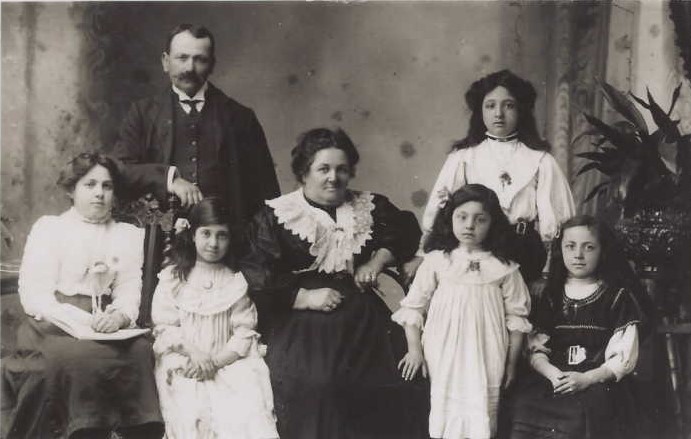
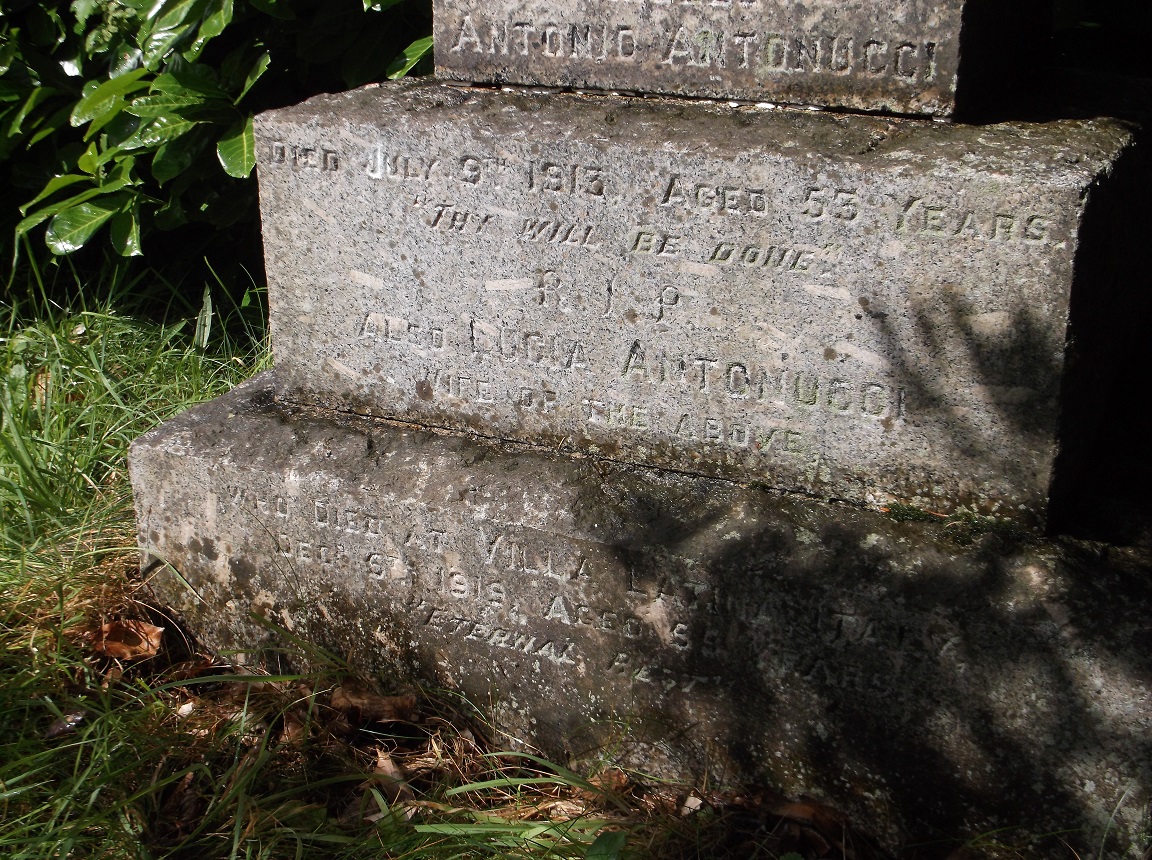
Angelo’s siblings died soon after too – his sister Palma in 1917 and his brother Michele in 1919. It is not exactly clear what happened to his wife Lucia. She is not recorded on the cemetery records but is shown on the headstone as having died in Villa Latina in 1919. Thanks to help from Italian researcher Ann Tatangelo we have established that she is not on the Villa Latina cemetery list but that her body could have been moved between 10-30 years after her interment. The only way of verifying that is by visiting the town hall to examine the original records. It seems strange that Lucia would have left her family behind in England (her youngest daughter Mary was still only 17 in 1919) unless she was simply on a short visit to Villa Latina and died there unexpectedly.
There is a mystery surrounding Angelo’s mother too. She appears on the 1901 census but with a name that appears to be ‘Fralongus’ not Domenica. Ann Tatangelo has confirmed that Fralongus means nothing in Italian so it may simply be a misinterpretation by the census enumerator at the time. There is no record of death nor of burial in Teignmouth cemetery. Did she return to Italy too prior to her death?
Angelo Antonio Antonucci is buried in plot G61 in Teignmouth Old Cemetery.

Footnotes
- Ptomaine. According to the Lancet ….. One of many new diseases revealed in the late 19th century by the new science of bacteriology. The ptomaines were alkaloids produced by the decomposition of animal substances; putrefaction, fermentation, and infection being processes associated with micro-organisms after the work of Pasteur. Sir William Osler (1906) noted that ptomaine poisoning had become synonymous in popular speech with “food poisoning”. Richard Cabot (1913) called ptomaine poisoning a fashionable diagnosis, which patients loved to brandish about. Ptomaine poisoning lost its scientific credibility by the 1950s.
- Hokey-Pokey. According to ‘The History of Ice-Cream in London’: “the streets of London echoed with ice cream sellers, shouting their wares: ‘Gelati, ecco un poco!’ (Ice cream, here’s a little bit!) or ‘O che poco!’ (Oh, how little!— as in, Oh, how cheap!), which it’s believed then led to the bastardised cry of ‘Hokey Pokey!’. The term ‘hokey-pokey’ soon came to mean poor-quality ice cream; sometimes made of questionable ingredients, under unsanitary conditions.
Acknowledgments
Thanks to Italian researcher Ann Tatangelo for help in clarifying questions about Angelo’s wife Lucia and his mother Domenica. Ann runs Angel Research & Genealogical Services and can be contacted on https://angelresearch.net
Sources & references
Extracts from contemporary newspapers are referenced directly in the text and are derived from British Newspaper Archives.
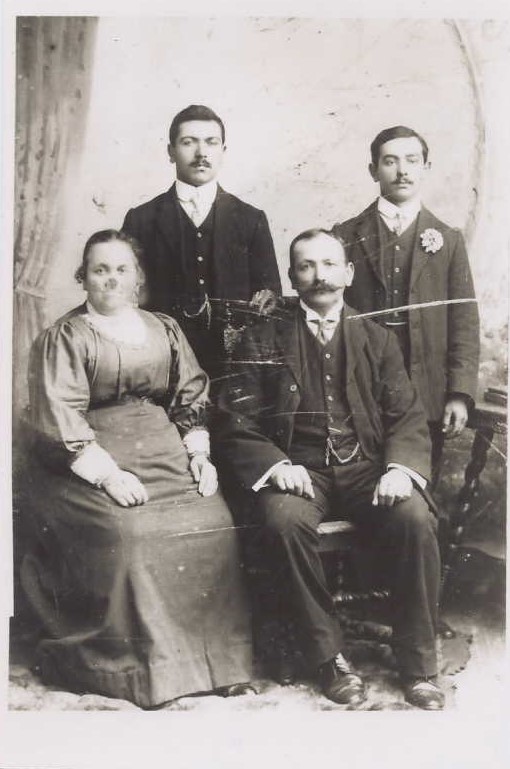
Ancestry.com for genealogy. This includes the family photographs which appear on a specific family site.
Wikipedia for general background information
Other sources, with hyperlinks as appropriate, are as follows.
- Italian migration: From ‘Our migration story’
- Italian Migration to Great Britain. Journal article by R.King: Geography Vol. 62, No. 3 (July 1977), pp. 176-186:
- Italian Migration to Nineteenth Century Britain: Why and Where: From Anglo-Italian Family History Society
- Italian Immigrants in Nineteenth Century Britain – Realties and Images. Lucio Sponza.
- Picinisco Local forum
- Brief History of Ice-Cream Big issue article by Robin Weir:
- Victorian ice-cream: English heritage article
- The History of Ice-Cream: From the Ice-Cream Alliance trade organisation
- The History of Ice-Cream in London: From London 1st
- Wenham Lake ice: From Victorian England
- Lancet : Ptomaine poisoning:
 Teignmouth Old Cemetery
The PS Richards mentioned in the report about the increased reward for the little girl Antonucci would be my great-great-grandfather Police Sergeant James Richards who actually retired before the end of 1900 and is buried in Teignmouth Cemetery. Liz Davidson
On Sun, Aug 1, 2021 at 2:11 PM Teignmouth Old Cemetery wrote:
> Everyman posted: ” Introduction Baking in the hottest of hot July > heatwaves my thoughts turned to keeping cool which inevitably led to ice > cream. In turn that reminded me of a grave which I had recently > re-discovered in a far corner of Teignmouth Old Cemetery. It is t” >
LikeLiked by 1 person
Hi Liz. That’s wonderful! I’ve found a record for a James Richards who died in February 1922 and is buried in plot W17. Would that be him? Do you have a picture of him? It would be nice to include it in the story as well.
LikeLike
Vry interetsing Thank you The two young Antonucci women had an ice cream hut on the beach beside the pier (lighthouse side I think) in the 1920s and were much admired and always known for wearing pretty dresses. They also ran fish and chips in Teign St in the 30s I believe- two branches of the same family but now warring with each other! Viv ________________________________
LikeLiked by 1 person
Hi Viv. Thanks for that useful extra information. My research stopped more or less at the point that Angelo died. I wonder if the two Antonucci women were the wives of Giuseppe and Giacomo rather than Angelo’s daughters? The only reason I suspect that is that I think all the daughters married and left but I don’t know the timing. Interesting that the chip shop was still going in the 1930s. I presume that would have been the sons. Neil
LikeLike
I believe that one of the young women selling ice-cream and wearing pretty dresses was my grandmother Ada Antonucci, who was married to Giacomo {Jack} She used to tell me that the Punch and Judy man always used to make Mr Punch say “hello Mrs Antonucci” when he saw her.
LikeLike
Hi Sue, we were out for lunch with Kath & Rob the other day and she mentioned that she was in touch with you ,so sorry to hear of your Mums passing, Our condolences to you ,so sad that generation is gone now! I have very fond memories of your Mum & Dad , my Dad was so proud to have them for a visit, always talked about Uncle Tony and Aunt Doreen! Stay well and keep in touch😘
LikeLike
Hi,
My grandmother was Angelina Antonucci. She ended up in Newport Gwent, and lived well into her 80s. Mary became a nanny to the Creighton-Stewart (of Twinings tea fame) family. She was so loved by the family that she is interred in the family resting place. Lucia did in fact pass suddenly on a visit to her homeland, and was buried there.
LikeLike
My name is Angelo Antonio Antonucci. I am the the son of Francis and Elsie Antonucci and eldest grandson of Giacomo and Ada Antonucci. I am also the namesake of Angelo Antonio Antonucci my great Grandfather. We moved from Plymouth, UK.. where I was born April 21, 1940 our family moved to London, Canada March 1949. London, Ontario Canada is our current home. My wife Sharon, nee Walker, were married May 7, 1960. We have 2 sons John, Francis, January 27,1963 and David, Michael, June 22, 1965. Our Mailing address is 18-861 Shelborne Street, London, Ontario, Canada. N5Z 5C5
LikeLike
Hi Angelo, I am Caroline, Grand-daughter of Angelina Antonucci, second youngest daughter of Angelo and Lucia. As children we were very close with our Grandmother and her siblings, mainly Beatrice and Mary. My Grandmother married Ernest Lawrence, they had three children, Mary, Bryan and Jeff (twins), Jeff was my father, sadly deceased along with Mary, however, Bryan is still very much alive, they settled in South Wales where we still live. Beatrice and Mary did not marry or have children.
My Uncle Bryan would be able to elaborate more on the whole Family. He has found an old picture of Giacomo and Ada Tucker’s wedding dated 11th November 1914, a year after Angelo died. If you email me I can send you a copy. the.parkinsons@sky.com
My Brother Tim and I are visiting Italy in two weeks, we have planned a visit to Villa Latina, where we will visit the cemetery, we have a picture of Lucia’s grave which we are hoping to find. We will be staying in Picinisco for some of our stay. I did visit Teignmouth last year with my Family and found Angelo’s grave.
I hope to hear from you.
Caroline Parkinson
LikeLike
Hello everyone,
I always knew I was part a large family but I am amazed at how large and how far travelled it is.
All this information shows my great-grandparents are named as Michele Angelo and Antonia Tomasso (who was the daughter of Gaetano Tomasso). On my copy of the family tree his name is Michelangelo Antonio Antonucci, the son of Luigi Antonucci and Domenica Fusco.
I think (but I’m not sure) they had 5 children. Their daughter Rosa Antonucci married Leonard Fletcher on 3rd Oct 1912 in Plymouth, UK. They had 6 children; Christina-1913, Leonard-1914, Francis-1916, Alfred Walter (my dad known as Walter)-1921, Marie Antonia-1923 and Gloria-1933.
LikeLike