The Discovery
Section K in the “conformist” half of the cemetery is one of the oldest sections. It is also one of the smallest with only 29 graves nestled close to the front of the Episcopal chapel. It is backed by some impressive, now rusting, iron railings which were originally constructed to separate the “dissenters” from the “conformists”; it appears that not even in death could the two come together.
The whole area was vastly overgrown and is now being slowly uncovered. This is revealing not just the graves but also a pile of half-buried stone along the line of the railings – remnants of headstones etc. which have obviously fallen and broken over time. The clearance activity is almost turning into an archaeological dig!
Amongst that debris were some footstones. At one time it would have been fashionable for graves to have a footstone, as well as a headstone, to mark the end of the grave. The footstone would have been much simpler; they were smaller in size, unembellished and contained the most basic information – the initials and year of death of each person buried in the grave. We are reuniting those footstones with their original graves where we can.
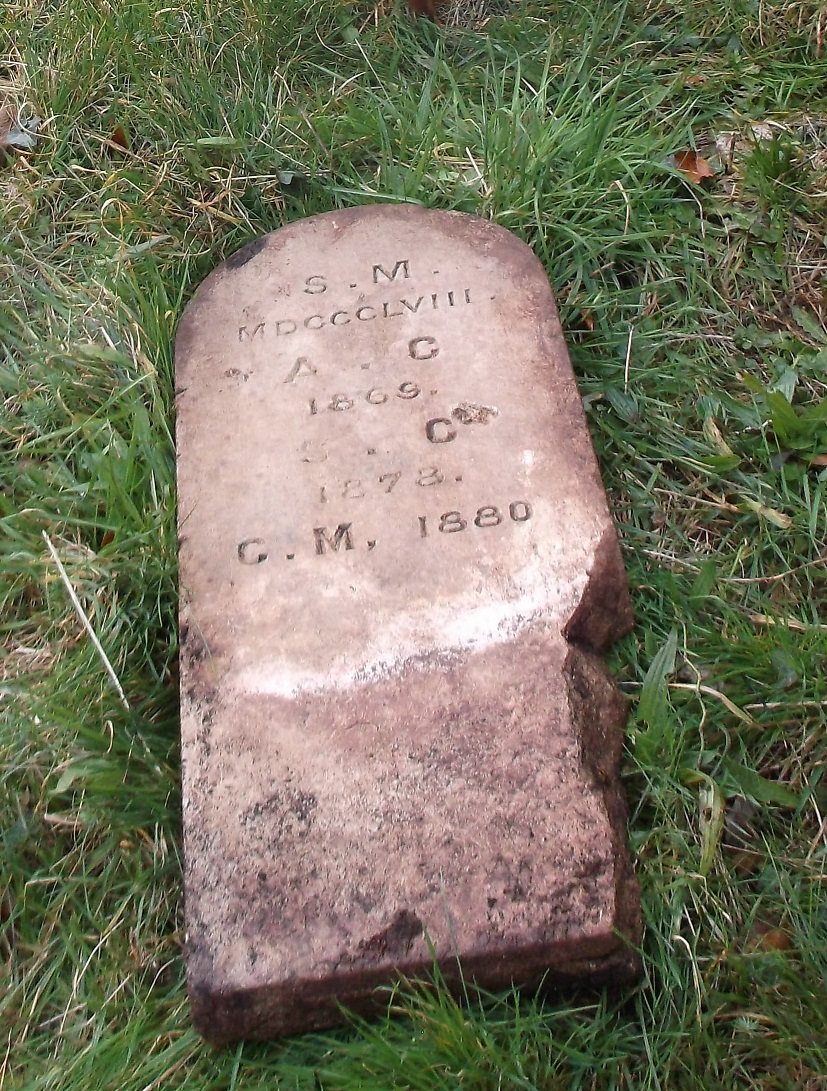
It is one of those footstones that has led to this story. The clues were basic: “S.M MDCCCLVIII A.C 1869 S.C 1878 C.M 1880”. This led to the grave of Sybella Mockler, widow of the late Rev. James Mockler, Rector of Litter in the diocese of Cloyne. Lying in the same grave are: her son-in-law, Admiral Abraham Crawford; his widow, Sophia; and Sophia’s sister, Catharine.
The discovery is fairly unique because it leads to two stories, that of Admiral Crawford and also one of his wife Sophia in her own right. It would be tempting to start with the admiral but so much of our historic research tends to focus on the men of those times. So this story is the one about Sophia ….. we’ll leave the admiral for another day.
The Family Connections
Sophia was one of eleven surviving children born to the Reverend James Mockler and his wife Sybella (nee Baker) – she had eight brothers and two sisters. They were brought up in Litter in the diocese of Cloyne, near Fermoy in County Cork. The church in Litter was built in 1812 on the site of an ancient building. It is closed and boarded up today but seems to have been quite impressive in its day. The 1840 Topographical Dictionary of Ireland said that, following its original build, “… has since been much improved from a design by G. R. Pain, of Cork, Esq; the interior is embellished with a richly groined ceiling and most of the windows are of stained glass.”


James Mockler was ‘collated’ by the Bishop to the rectory of Litter on Sept 30th 1814, two years after the church had been built. Religion ran in the family; James was the son of James Mockler, archdeacon of Cloyne, and his own son James became ‘Vicar Choral’ of Lismore. He remained until his death in 1848 at the age of 79 and was buried in Litter churchyard on 6th January. From a religious point of view the parish would have been a challenge; there was a population of around 1900 of whom only about 80 were protestant and James had difficulty in securing his tithe income from the catholics in the parish. There was also no glebe attached to Litter church so the family had to live elsewhere. They settled in Rockville, close to Fermoy, having secured a lease on a splendid residence, ‘Rockville House’, set in 37 acres of land. The house carries its own history having been subsequently owned as a summer residence by Sir Oswald Moseley.


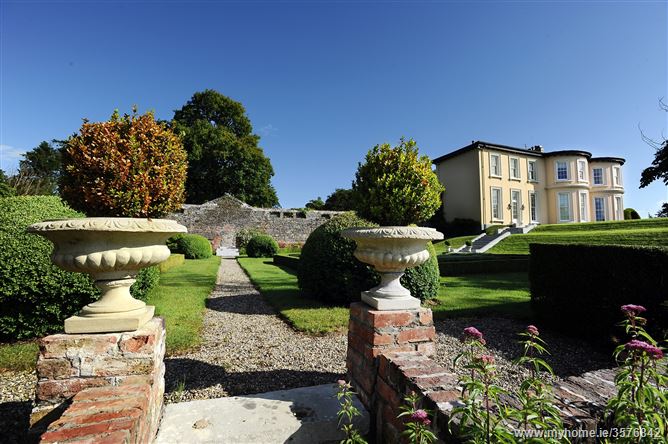
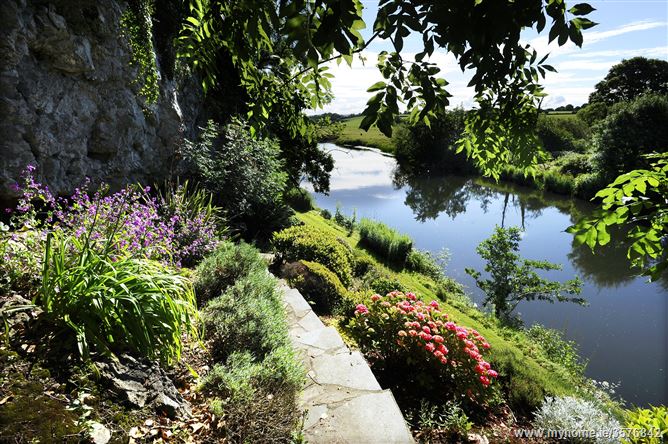
Sophia, born in 1799, would presumably have spent her formative years in Rockville House until her marriage in 1830 to Captain Abraham Crawford. It would be interesting to know how, having led such different lives, they met and subsequently married. On the one hand she was the vicar’s daughter who had presumably led a fairly sheltered, parochial life up to that time. On the other Abraham was the naval officer who had spent the previous almost 30 years virtually full-time at sea. He was invalided home in 1829 and returned to his family roots in Lismore, some 20 miles from Litter.
The next 20 years is a blank; it’s not until the 1851 census that we hear again of Sophia’s family. The census shows Sophia and Abraham living at 38 Dawlish Street in Teignmouth where they had also been joined by Sophia’s sister Catharine and by ‘Lydia’ Mockler, aged 78 and described as a clergyman’s widow. This must be Sophia’s mother Sybella. Once James Mockler had died in 1848 the lease on the family home ‘Rockville House’ passed to his son Thomas so it appears that Sybella and Catherine either chose or were obliged to leave Rockville; living with Sophia and Abraham would have been an obvious solution for them.
Whilst the story so far is interesting it isn’t distinguished. So what is it about Sophia that makes her more significant? It turns out that she was a writer.
Sophia the Author
We may never know if she had always written but her first novel was published in 1850 and she then had a relatively brief but prolific period of published works – in the next seven years she wrote five novels in 14 volumes.
Why did she start? It could have been at a whim, prompted perhaps by changes in life circumstances – her father dying, her family moving in with them, the romance of treading the streets of Teignmouth which Keats had trodden barely 30 years earlier. Perhaps there was a little friendly competition with her husband – he published the first volume of his reminisces in the same year.

Or perhaps it was motivated by the 1850 Public Libraries Act. Up until that time there had been private and circulating libraries which were run on a subscription basis and so were not readily available to much of the general public. Then, thanks to the energy of the Sheffield MP James Silk Buckingham, the Act was passed which led the way to the first public library being opened in Manchester in 1852 followed by others throughout the country and suddenly reading was freely available to all.
What was her style? Probably the best way to illustrate this is to give an example. Here is an extract from her fourth novel, ‘The Story of a Nun’, which was quoted by the Weekly Chronicle (London) of 28th April 1855 “as an illustration of the rich flow of the narrative”:
TERESA ON THE EVE OF BECOMING A NUN
A cloud rested upon her fair brow, a weight was upon her heart, as she slowly retraced her steps, and sought again her cell.
For the first time in her life, the question occurred to her if it was possible to repent taking the black veil.
Her unusual paleness when they met struck the superior and the sisterhood; but she did not feel quite well, she said—and for this and her paleness, her late nightly watchings in the chapel fully accounted.
Sister Teresa will soon get accustomed to those vigils and to other restrictions, thought the Abbess, as she looked at her with secret triumph, while the nuns prepared decorations for the morrow.
Father Ignatius, who kept a watchful eye on the novices and marked every movement, saw with pleasure, that at the hour of recreation, when the boarders and other novices sought the outward ground of the nunnery, she too turned her steps thither, with her book of hours in her hand.
She is heavenly minded, he thought.
He had no idea of the doubts that were agitating the bosom of Teresa, or of the inexplicable dread that was stealing over her.
She felt this dread, like an incubus, weighing down her spirits. She wished to be alone; and leaving her companions, took the path that led to a remote bower in the, wood, which—being seldom visited by the boarders and novices, who liked a more open space for their often childish sports—offered her a greater degree of solitude elsewhere.
Here she seated herself, and tried to read her book of hours, but this she found impossible.
The peaceful stillness, the song of the birds, the gentle waving of the branches, the perfume floating around from the sweet scented jasmine , and the thickets of odoriferous shrubs, called off her attention though they did not calm her mind.
This warbling of birds, this perfumed air, this white cistus with its green glistening leaves at her that feet, that deep blue butterfly which alighted close to her, did but bring a chill to her heart.
What! never again to sit in this sweet bower! Never again hear those birds that were uttering such thrilling notes over her head—never again help to tie up the scented jasmine —never again enter those grounds, prohibited to the nuns—those gardens which she had loved since a child—never again, never !—and she so young; only just sixteen.
Alas! if she should weep and regret, like sister Dolores, after her profession—that terrible tomorrow!—why had she not thought of this before? And she too must leave her loves, for she loved the birds and the bower, and the leaves that danced in the breeze; and those white and blue butterflies, she was afraid they would never come within the inner, gloomy garden.
Here a feeling like death stole over the novice – it seemed as if, for the first time, she had realised all she was to lose—her eyes closed, her head fell back, her senses failed, she lay motionless in a deep swoon against the trunk of one of the trees which formed the bower.
In this state she was found by the portress and lay sister, who came in search of her.
How was her writing viewed? There seem to be mixed opinions.
The Victorian Research site in its ‘At The Circulating Library’ section commented that Sophia wrote “five undistinguished novels”. However, though she may now be largely unknown she is not forgotten. Her works may not be to our taste these days but they have been digitised and are available in electronic format unlike many of her contemporaries who came, went and are forgotten. In relation to her first novel Google explains– “This work has been selected by scholars as being culturally important, and is part of the knowledge base of civilization as we know it”.
The reviews of her works in her own time are definitely more generous as we shall see. In general it appears that she was considered better than average in the genre she chose but most definitely was seen as appealing to a certain audience. Perhaps the best assessment of her works is that they were popular but not of the highest literary standards.
The Lady of the Bedchamber
Her first novel, ‘The Lady of the Bedchamber’, was published in two volumes and seemed to receive reasonable acclaim when it was released.
The ‘John Bull’ of 9th March 1850 described the plot:
The Lady of the Bedchamber, whose romantic history is recorded in these volumes, is not one bearing that office in the Royal Household of England, but lady of the Court of Louis XIV., to whose care Isabelle de Valcour was bequeathed by her father when expiring of a wound received while engaged in saving the life of his sovereign. Anxious to discharge this debt of gratitude the Grand Monargue disposed of her hand to a young nobleman of his Court, Baron de Montfort. An intrigue, however, which her husband was at that time carrying on with another lady, induced him, after going mechanically through the ceremony, to leave his bride at one of his ancestral castles, and to proceed to Constantinople. The misery of this separation is aggravated by the young Baroness’s rival, who contrives to intercept a correspondence which has commenced between her and her husband, and it is not till after he has gone through many adventures that de Montfort at last arrives, just in time to prevent Isabelle who had given him up completely, from taking the veil. Such is the main plot of a novel, which is both original in its conception, and pleasingly told.

The Morning Herald of 20th February 1850 echoes the one-line praise of the Literary gazette:
Well-devised and excites the curiosity of the reader
The Weekly Dispatch (London) of 24th February is more fulsome in its praise:
This is a very excellently-written novel, and in tone and manner is far above the ordinary standard of the fashionable fictions that are still so prodigal in their number. The title of the story does not imply the depth, the intensity, and the fine passion which it certainly embodies, because it is far more suggestive of gilded folly, of brilliant vanity and of meretricious attraction. In itself, however, it is a worthy evidence of the talents for authorship which the fair writer undoubtedly possesses. The dialogues are good, the plots excellent, and bear upon them more than the impress of probability. The descriptions are true to nature, when speaking of nature, and form, otherwise, absolute pictures in themselves, worthy the pencils of Watteau or Laneret, or any of those charming triflers which the age (and the one subsequent) of the grand monarque, produced. In Italian scenery and in Italian intrigue, there is a freshness and attraction which the reader will acknowledge with pleasure.
The Magnet (London) of 25th February is equally complimentary:
If that memorable creation of the literary taste of our ancestors, the ‘Minerva press’ were now in existence, ‘The Lady.of the Bedchamber’ would rank among its most admired productions. It is a tale extraordinarily romantic, extraordinarily exciting, and extraordinarily improbable; but our grandmothers in their light reading did not care for probabilities; being satisfied when the stimulant to imaginations was a rousing one.
(Note: the Minerva Press was the largest publisher of fiction for three decades around the turn of the 19th century. If for nothing else, Minerva Press should be celebrated for the voice it gave to women. Its owner, William Lane, published more works by women than any other publisher of his time)
The Morning Post of 4th March provides balance and is more tempered in its critique:
We wish not ….. to disparage Mrs. Crawford when we say that she does not appear to us to possess the essential qualifications for writing a novel of the highest order. The volumes before us are unquestionably superior, both in style and matter, to many which have enjoyed a very fair fame in the boudoir and the drawing room, and have outlived by several seasons that of their birth. Mrs. Crawford writes agreeably, and her descriptions of the gay Court of Louis Quatorze are graphic and faithful; but her style is too descriptive, not sufficiently dramatic. She should talk less herself, and let her characters talk more. The mere narration of fictitious incidents and the description of fictitious characters does not constitute a novel. Dramatic effect is wanting, and can only be attained by the frequent intervention of lively and appropriate dialogue. A judicious disposition of the lights and shades of character should be as much observed by the novelist as, in a painting, the arrangement of the natural lights and shades is studied by the artist, and in the characters of two sisters Mrs. Crawford has presented a well- drawn contrast; but her picture as a whole wants relief.
The Double Marriage
It was two years before Sophia’s next novel ‘The Double Marriage’ emerged. This time, as with all her remaining novels, this came in three volumes.
The Examiner of 1st January 1853 posted a number of positive reviews:
THE DOUBLE MARRIAGE
By the Author of ‘The Lady of The Bedchamber’
“A deeply interesting and exciting tale” – Observer
“A first-rate novel” – Evening Post
“Mrs Crawford tells her story well – she depicts scenes of emotion and strong feeling powerfully and without exaggeration” – Sunday Times

By now Sophia had also made it into the circulating libraries, rubbing shoulders with the likes of Charles Dickens and William Thackeray. Here is one example of an announcement in the Hampshire Chronicle of 6th November 1852:
T. PROUTEN begs respectfully to state, that he has ….. added to the CIRCULATING LIBRARY the following NEW WORKS:-
The Double Marriage. By Mrs. Crawford
Uncle Walter. By Mrs. Trollope
Esmond: a Story of Queen Anne’s reign. By W. M. Thackery, Esq.
The Goldbeater. By the author of Blacksmith’s Daughter
Uncle Tom’s Cabin. Large illustrated edition
Alton Locke, Tailor and Poet
Gabriella Witherington. By Mrs. Martin Lucas
The Dodd Family Abroad. By C. Leaver, Esq.
Stokers and Pokers
Pilgrim of Lore. By Sue
Bleak House. By Dickens
White Slave Quarterly and Edinburgh Reviews and all other periodicals
There are some strange titles there: “Stokers and Pokers”, ….”White Slave Quarterly” ??!!
Lismore
The following year, 1853, saw the publication of ‘Lismore’. This, of course, was the place where her husband had grown up and returned to during his breaks from service. So she must have had a fount of local knowledge to draw from.
The Morning Post of 21st February 1854 commented:
Just what a woman’s novel ought to be – elegant in diction, pure in sentiment, and absorbing in the interest of the tale.
Inevitably the publication was picked up by the local press in Ireland. The Waterford Mail of 8th February 1854 shared a review which was a little ambivalent about how their beloved Lismore was presented:
A new novel has just appeared, the scene of which is laid in this beautiful locality—the name given to it, LISMORE. The following notice of it appears in The Press:
Lismore, by Mrs. A. Crawford, Author of ‘The Lady of the Bedchamber.’ London Newby.

‘Lismore’ is a historical tale, in which the action revolves round the beautiful castle of that name on the Blackwater, in the south of Ireland. The Boyles, and other historical characters of the seventeenth century, are made to appear before us, but the story wants the colour of the time, and ‘Lismore’ is more true in its topography than in its portraiture of manners. Mrs Crawford’s extensive reading qualifies her for the part of an essayist, and there are other departments of literature in which her pen might be distinguished.
Sophia was slowly gaining a reputation though. ‘Lismore’ featured in the ‘New Quarterly Review and Digest of Current Literature for 1854’. As well as giving a synopsis of the plot it too was ambivalent about the quality of the work, almost damning with praise:
This is a very good novel, or rather, romance, for the regular devourers of that class of article, but for no others. Not that the present work is bad, any more than it is good. It is of the female ‘James’ school. Quid multa? …..
It is an Irish story of the seventeenth century. There is a certain Lady Alice, who is abducted by a red-haired villain who is lord of a castle and makes war on his neighbours. She is duly married according to the most approved style by one Visconti, who is an Italian nobleman, doing a little propagandist business for a certain Cardinal E ……
….. there are all the usual properties of an Irish novel. Item a loquacious fisherman, item a faithful domestic, item an old harper, item a rascally vulgar attorney, item an aged nurse, with an Irish proverb or two in real Irish …..
….. Visconti being in Ireland of course falls in love with Lady Alice. He had previously loved another, a certain marchesa who is married for money to a marquis. Then there is a Mrs FitzThomas, jealous of her husband. A wicked attorney … one O’Halloran, pretending to be in love with her, practises on her jealousy, and carries her off from her husband. This he does to get possession of her property. She goes to France, and breaks a bloodvessel, and dies, and the attorney disappears, but not in a blaze of blue fire, as he should. Finally, Lady Alice goes to Italy, where she enters a convent as a novice. Visconti, her guardian, is in love with her, and she with him; but neither of them knows that the other loves, a position whereof the difficulties are enhanced by the machinations of the marchesa who comes to a friend’s house where they all meet. The marchesa is, however, just found out in time … and goes off in a travelling-carriage and a great rage, without wishing anybody a polite ‘addio’. So, the Italian count marries the Irish heiress …..
For the rest, the language and sentiments of the work are about up to the mark, which is the half-ebb mark of the great ocean of mediocrity.
However, it will do very well. Where one better romance is made and offered for sale there are at least ten worse; and many people will prefer it to the fiction immediately preceding it.
Enough people must have liked it for it to find its way into a public library. The Hampshire Chronicle of 14th January 1854 advertised it as one of the new works arriving at Prouten’s Winchester Library in a list which included ‘The Whale’ by Herman Melville.
The Story of a Nun
Saunders’s News Letter of 23rd March 1855 quoted the Guardian when the new novel ‘The Story of a Nun’ was published: “It is by far the most interesting novel that Mrs. Crawford has written. It will be exceedingly popular.”
This too was written in three volumes and we have an interesting explanation from the Weekly Chronicle (London) of 28th April 1855 of why this format was popular at the time:
The circulating library exists, and the novelist writes on. The only essential is that your novel should be in three volumes, in order that the circulating library keeper may charge the circulating library reading public one penny per day. If you can give a taking title to your novel, so much the better; and if the story itself be well written, of course the public reaps the benefit—but that is not essential. “A book ‘s a book although there’s nothing in it,” and a novel in three volumes is a novel, in spite of what ill-natured critics may say to the contrary. Bear in mind the essential requisite of a novel is that it be in three volumes—the plot, the story, the manner of telling it, the genius or the want of genius on the part of the writer, are all of minor consideration.
The Chronicle then links that observation specifically to Sophia’s latest novel:
Viewed from this stand point, we must award the palm to Mrs. A. Crawford, author of “The Lady of the Bedchamber,” “The Double Marriage,” Etc., for she has given us three volumes with a very attractive title—one that will be sure to catch the Protestant eye of Mr. Spooner. We should not be surprised if he gives the outline as a case from real life in his next speech against the grant to Maynooth.
This is followed by a one-sentence synopsis of the plot:
A Teresa Clifford, who escapes from her confinement, becomes a governess in the family of a gentleman who fell in love with her in Lisbon, and whom she marries after he has lost the wife whom he had previously married in the meantime.
And here is an interesting extract from the book – did it inspire, I wonder, the famous scene in The Thomas Crown Affair of Steve McQueen and Faye Dunaway playing chess (!):
MAKE LOVE AT CHESS
Thus a few weeks went on, and still that feeling of diffidence which real love always inspires prevented Frederick Ratcliff from confessing the passion his fair mistress had raised in his bosom, and Helen herself assisted in protracting this disclosure, by denying him with girlish coquettishness an opportunity of speaking to her in private. Nevertheless, her evident pleasure in receiving his attentions at last emboldened the timid lover, and when, one evening, at a game of chess, on which he was vainly trying to fix his thoughts, Helen said to him, playfully, after sweeping away his best pieces one after the other –
“See, Mr. Ratcliff, I have taken your two knights and one castle, and if you do not play better, I shall take all your other pieces too.”
He could not resist any longer, but seizing the little white hand which hovered temptingly over the board, and pressing her delicate rosy-tipped fingers, exclaimed –
“Take everything, dear Miss Vivian; but take me too with them—say—speak—do not keep me in this cruel suspense. Shall it be so?” murmured he, eagerly, while Helen, covered with blushes, overturned all the men on the board, and rose hastily.
There was music going on at the other end of the room. Nobody was attending to them, nobody heard him whisperingly press his suit, or marked her downcast eyes. However, it was all settled.
Early Struggles
Her final publication, ‘Early Struggles’, emerged in October 1857. It starts intriguingly, drawing the reader in:
It was on a dark, foggy day in the month of November 18 that the wife of a poor lieutenant in the army took her way through one of the long, narrow, dirty streets in the ancient town of —-.
She had a baby on one arm, for her husband was too ill to take care of it during her absence, and the other hand held a small parcel neatly tied up, containing a gentleman’s vest which she had just finished embroidering for the large warehouse of Messieurs Simpkins & Co. This shop, though presenting on the outside a poor appearance in a dingy street spread in its interior into large and handsome ware-rooms, filled with every variety of expensive drapery. It was one of those old-fashioned establishments without any display, which the superior attractions of plate-glass windows, and a superb front, in a more fashionable part of the town vainly try to displace.
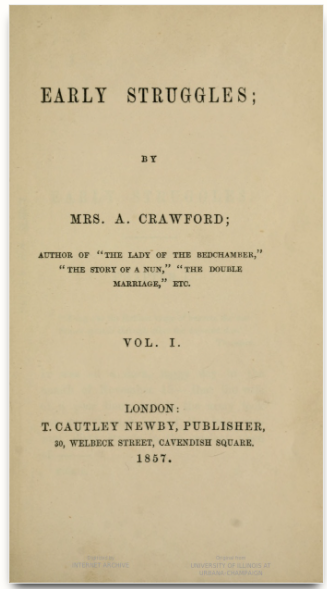
The book made it into Winchester Library too, this time rubbing shoulders on the ‘new’ list with ‘Tom Brown’s Schooldays’. The Morning Herald (London) of 1st December 1857 published an interesting review which reflected the change in the style of writing over the previous 30 years:
To those who recollect the fashionable three volume novels of 30 years ago a great improvement must be perceptible in the style and tendency of works of the same class of the present day. Instead of the imaginative sketches of the higher ranks of society, and the records of their insipidities and follies, by authors who had little or no experience of the subject they treated or the characters they attempted to portray, we have now pictures of real life, as we in England know it, by our own firesides. The incidents and the passions most affecting human action in the 19th century are the sources whence our present novel writers weave their webs of innocent fiction. We have lost the thrilling tales of mystery and horror, the dreams of morbid sentimentality, the pointless delineations of unreal character, which were formerly the chief stock of our seaside libraries. But we have in their place the actual observations of the ordinary workings of society, carefully recorded and embodied in scenes and personages, whose creation lends a lifelike interest to the lessons of experience they are intended to convey.
This is the great charm of Mrs. Crawford’s “Early Struggles.” In the actors and the scenes she has introduced few readers will fail to recognise the results of their own observation and experience in regard to general traits of character and the ordinary episodes of the life of the present day. To those who know society as it exists in the quiet country districts which she selects as the locality of her story, her truthfulness of representation will appear striking. How many, whose recollections of happy hours and days spent in some one of those delightful nooks with which South Wales abounds are still a source of enjoyment, will dwell with regretful pleasure on her charming description of the village of Llanyudd, with its neat cottages, its exquisite little valleys and woodlands, its streams tumbling from rock to rock, and rushing through quaint old bridges —with its hardy race of yeomen, and its maidens still clad in linsey-wolsey petticoats, jacket, and hat. The reality of such sketches as that of the Apjohn family and of Miss Winny Toms, the village schoolmistress, must come home to all. The hopes and disappointments of Hubert Vaughan’s literary career—the patient gentleness of Emily Hume —the stern and rugged old Indian, are carefully drawn. On the whole the interest of the book is very well sustained throughout, and the scene of the forced marriage at the death-bed of the uncle is startling and impressive. The plot is neither new nor striking, but it furnishes matter for some very pleasant reading; and it has this merit, that the youngest and purest minds may peruse it, not only without fear of offence, but with every prospect of benefit.
Life after Publishing
‘Early Struggles’ was the last book written by Sophia Crawford. It seems that she decided to abandon writing as abruptly as she had first taken up the pen some seven years earlier. She had started shortly after her father had died so perhaps the death of her mother in 1857 had a reverse effect on her. We will probably never know.
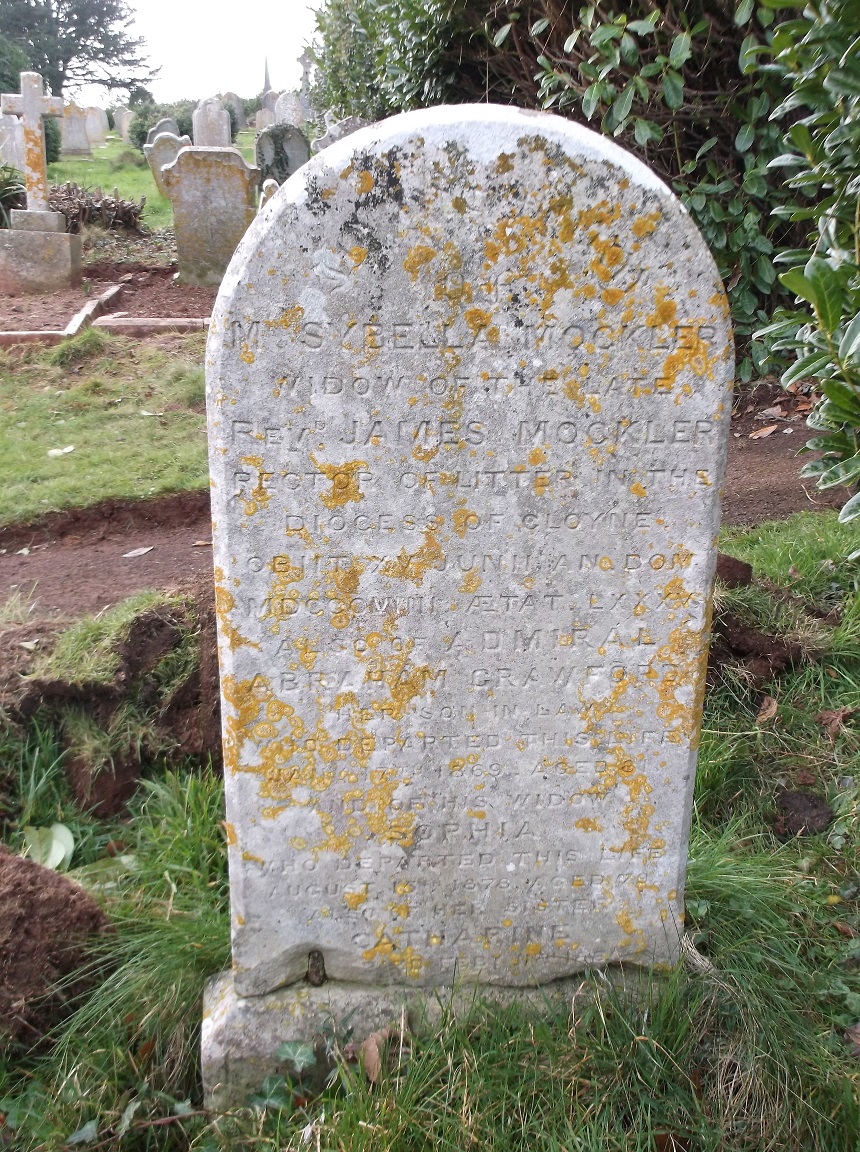
After her last book there is very little reference to Sophia again. We know her husband Abraham died in 1868. In 1871 she and her sister, Catharine, were living at 115 Teign Street and had moved to 21 Northumberland Place by 1878 (the house next to Keats’ House), the year of her death. She is buried in plot J26 together with her mother, husband and sister.
In her own words from The Story of a Nun ….. “It was all settled”.
Acknowledgements
Thanks to Niall C.E.J. O’Brien for some impressive research into the Mockler family and providing some snippets about James. The story of the Mocklers: an Irish Clerical family can be found on: https://niallbrn.wordpress.com/2022/02/02/mockler-an-irish-clerical-family/
Thanks also to Derek & Sandy Gardiner and Yvonne Russell for comments and photographs of the Castlehyde cemetery.
Sources and References
Extracts from contemporary newspapers are referenced directly in the text and are derived from British Newspaper Archives.
Ancestry.com for genealogy
Wikipedia for general background information
Other sources, with hyperlinks as appropriate, are as follows.
1878 White’s History, Gazetteer and Directory
A Celebration of Women Writers, edited by Mary Mark Ockerbloom
The Double Marriage: a novel, by Mrs A. Crawford – Hathitrust archives
Early Struggles, by Mrs. A. Crawford – Hathitrust archives
The Lady of the Bedchamber, a novel, by Mrs. A. Crawford – Hathitrust archives
A database of Victorian fiction – At the Circulating Library – Victorian Research site
The New Quarterly Review Digest of Current literature British, American, French and German for the Year 1854, published by Hookham and Sons, 15 Old Bond Street
Information on public libraries – Historic England
Image of Manchester Public Library 1860s – Spartacus Education
Anniversary of first public library – BBC
Image of Rockville House – from Irish Waterways
Clerical and Parochial Records of Cork, Cloyne and Ross, W. Maziere Brady DD, Dublin 1863
Background to Litter – Lewis’s Topographical Dictionary of Ireland
National Gazetteer of Great Britain and Ireland 1868
 Teignmouth Old Cemetery
Great research again Neil ???? ________________________________
LikeLike