Introduction
Most stories about people buried in the cemetery originate because we have found their graves and there is something significant about the grave suggesting that some further research would be worthwhile. For instance:
- The person could have a significant rank – see, for example, ADMIRAL Thomas Abel Brimage Spratt
- The person could have an intriguing epitaph – see, for example, Georgiana Caroline Mainwaring
- The grave could look special – see, for example, Robert Arthington
- The person could be (relatively) well-known – see, for example, Harry Welchman
This story however came in from the cold, a product of modern technology.
It started with a post on a local Facebook site which showed a restored picture of the two chapels in the cemetery. We already had a copy of the original (see “Then and Now”) but the new piece of information was the possible name of the photographer – Samuel Poole. It turns out he is buried in the cemetery and ran a photography business in Teignmouth for the best part of forty years. Records suggest that the Poole family lived in Teignmouth for almost 100 years.
This was the time when photography was taking off and its potential as a new recording medium of history was being recognised.
Samuel Poole Family Background
We are fortunate in having a virtually complete census record for Samuel Poole which gives a good insight into the changing family circumstances. Let’s start with this and then focus on Samuel Poole the photographer.
Samuel was born in 1824 in Taunton to parents John and Anne Poole. His father was a labourer and in 1841 the family was living in King Street, Taunton. Samuel was the eldest child and by that time had four younger siblings: Frederick, 13; Edmund, 12; Thomas, 7; and Anne, 4.
By 1851 Samuel had his own home in Park Street, Taunton. In the census he gave his profession as “house-builder”. He had married Mary Ann Orchard Goodman in 1848 and by 1851 they had two children: Helen Jane, 2; and Samuel James, 5 months. Mary’s younger brother Edwin Goodman, a scholar aged 5, was also with them. They were also obviously doing well enough to have a servant, Charlotte Harclode.
By 1861 Samuel and his family had gone through some major life changes. It would be interesting to know what brought those about. By then the family had grown with four extra children: William, 8; Eveline, 7; Arthur, 5; and Emily, 3. They had also moved and were now living at 43 Teign Street Teignmouth. It looks as though the move took place some time in 1858/59 since Emily was born in Taunton. Most significantly though Samuel had changed profession – he was now described as a “photographic artist”. With a large family to support you would think that this was a high-risk move. What prompted it? Photography was still in its infancy. Maybe Samuel had taken it up as an amateur hobby and could see a real business opportunity, especially in a relatively prosperous place such as Teignmouth which also had a burgeoning tourist trade.
By 1871 the family had grown once more with three more children: Rosa, 8; Lillian, 6; and Reginald 2. They had moved again to 34 Somerset Place and his two eldest sons, Samuel James and William were now also working as photographic artists in his business. His eldest daughter, Helen Jane, had married Edward Roberts in December 1869 and was now shown as being in the house at the time with her one-year old daughter Helen but without her husband.
The photography business was obviously flourishing but it seems that Samuel had also decided to diversify. An entry in the Devonshire Trades Directory of 1878 shows him listed as a dealer of music and musical instruments at 4 Somerset Place; the Teignmouth section of the directory quotes him as “music seller, photographer and joint overseer 4 Somerset Place”.
By the time of the 1881 census the composition of the family was starting to change. They are now recorded as living at 2 Somerset Place. Samuel James, William, Helen and Eveline are no longer listed but there is now a grand-daughter, Lilian Florence Poole, aged 7 who was born in Exeter. Emily is shown as being a music-teacher which might tie in with Samuel’s diversification into the music business. Arthur is shown too as a photographic artist, presumably helping Samuel with the business now his brothers Samuel and William have left. The grand-daughter, Lilian, is intriguing. She was born in Exeter and, in the absence of other information and given that her surname was shown as Poole, there are two possible scenarios: she was either Eveline’s daughter born out of wedlock or William’s daughter (with no wife shown).
The next ten years brought four tragedies to the family.
It would appear that Eveline died, probably giving birth, in 1883. The grave next to Samuel’s in the cemetery, but in the same plot, carries a headstone in remembrance of Evaline but with the rest of the inscription now barely legible. The cemetery records show that this was Evaline Jeffery for whom there is a record of death for May 17th. Birth records show a Frederick Jeffery being born at around the same time though he sadly died too within a year.
Then Emily died in 1888, barely 30 years old. She is commemorated on the other headstone in the plot.
Finally, Samuel’s wife Mary Ann died in 1890, aged 63.
By 1891 it could be imagined that Samuel was struggling to run his business which may have comprised two establishments by then – an 1890 trade directory refers to a second address at 19 Wellington Street. His remaining sons had left – Arthur had now established his own business and Reginald was working as an ironmonger’s assistant in Honiton (it’s likely this is where he met his future wife Alice Slater who was working there as a draper’s assistant and whom he married in 1898). So various responsibilities fell to Samuel’s daughters. Rosa was now a “photographer’s assistant”, Lilian was a “music seller”, and Helen had returned as “housekeeper” with her youngest son Walter, aged 13.
There is some thought that Reginald took over the business in 1893 but kept it on only as a music shop. There is certainly a reference to him being the owner of the “Pianoforte Warehouse” in 1902 and the “Music Warehouse, Somerset Place” in 1906 (Exeter and Plymouth Gazette, Friday 14 December 1906) but no further references to a photographic business.
In late 1895 Samuel re-married Sarah Rossiter, some 20 years his junior, and by 1901 he was shown as having retired and living with Sarah and her daughter Elizabeth Alice, aged 15, at 6 Gloucester Road. Sarah had been widowed some seven years earlier – she had been the wife of Ebenezer Rossiter, a jeweller in the Den and is buried with him in the Old Cemetery (Plot I82).
Samuel died on 2nd August 1906 and is buried with his wife and daughter Emily in Teignmouth Old Cemetery (plot H98). Little is known in the newspaper archives about Samuel outside his photography business. We do know that he was secretary of the “Useful Knowledge Society” (an organisation perhaps equivalent to U3A today but which also seems to have led on to the roots of a public library in Teignmouth). But it is not until his obituary that we discover his active involvement with the Baptist church, for which he was a deacon, trustee and treasurer (Exeter and Plymouth Gazette 6th August 1906).
The Teignmouth Post and Gazette of 10 August 1906 describes the funeral:
FUNERAL OF MR. S. POOLE
Last Thursday, at the ripe age of 83 years, Mr. Samuel Poole, a well-known and esteemed townsman passed away. A native of Taunton where be had numerous friends, and where his brother, a solicitor, still resides, Mr. Poole many years ago came to Teignmouth, and founded in Somerset Place the successful business, which his son, Mr. Frank Poole continues. As organist, the deceased gentleman rendered excellent service to several churches and was senior deacon, and for many years treasurer of the local Baptist Church.
The funeral took place on Saturday afternoon at Teignmouth Cemetery. The widow, son, brother, son-in-law, with many others followed the loved remains. A memorial wreath was plated on the grave as “A small tribute in loving remembrance of Samuel Poole, our oldest member and Senior Deacon, from the members and congregation of the Baptist Church.”
On Sunday morning the Pastor (S. John Thorpe) preaching before a large congregation, referred to the Church’s bereavement, and spoke of the departed, as a “lover of good men” strong in his convictions, faithful in discharge of Church work, regular in attendance at public worship, a ready helper in all good work, and he desired to pass on to his hearers the words with which Mr. Poole had years ago, welcomed him into the pastorate, as the best legacy of their friend. “Be thou faithful unto death, and I will give thee a crown of life.”
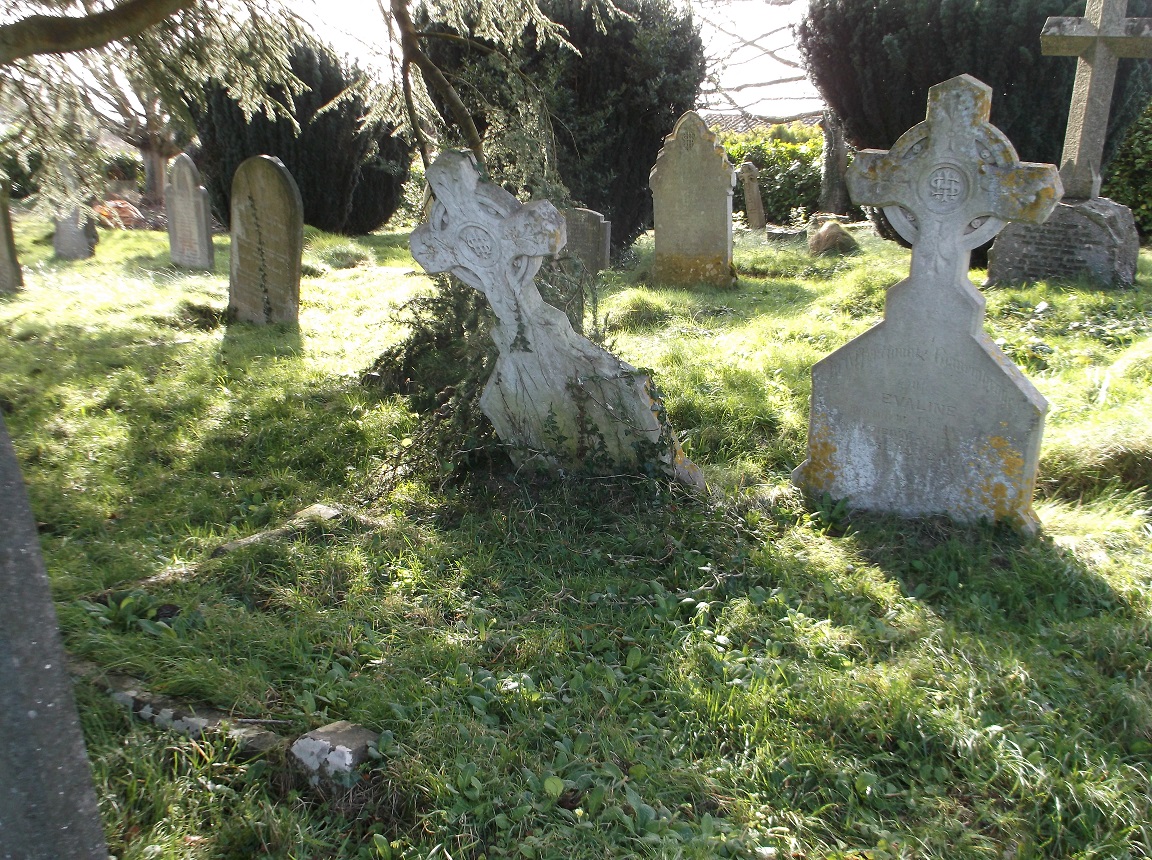
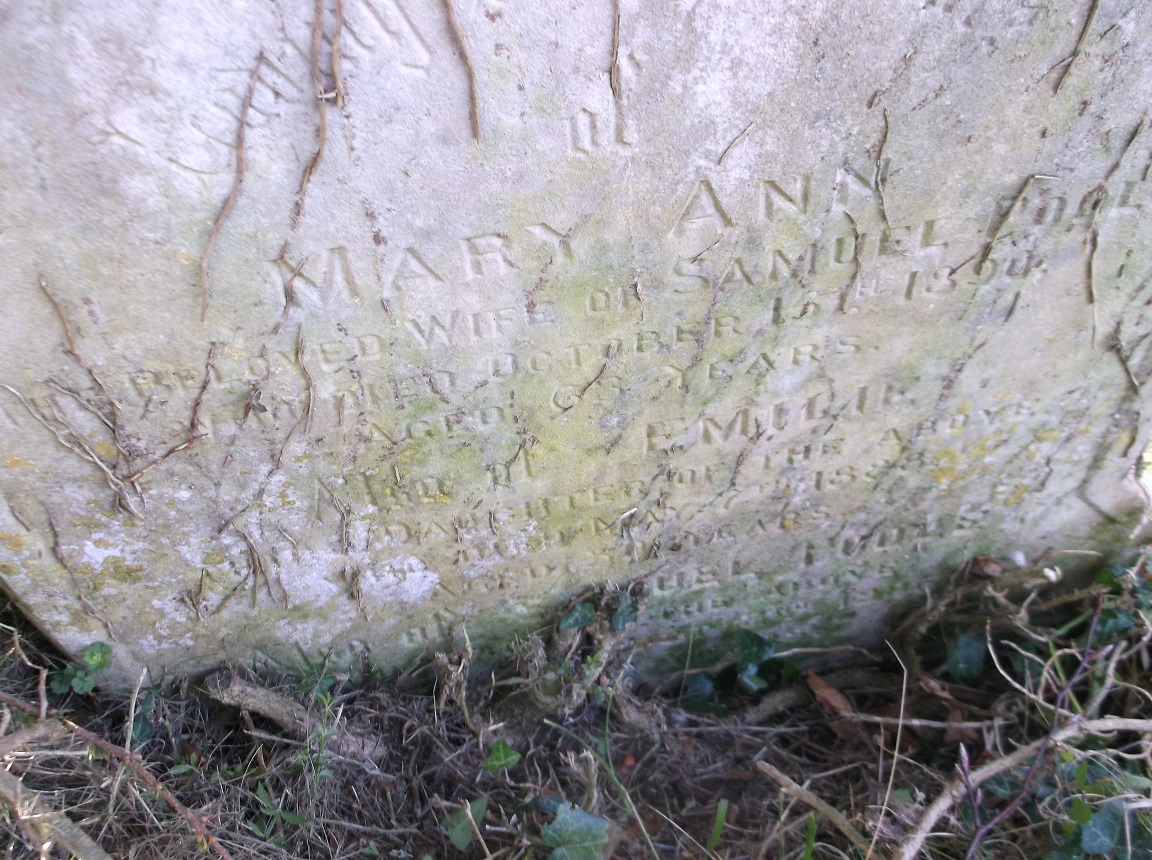
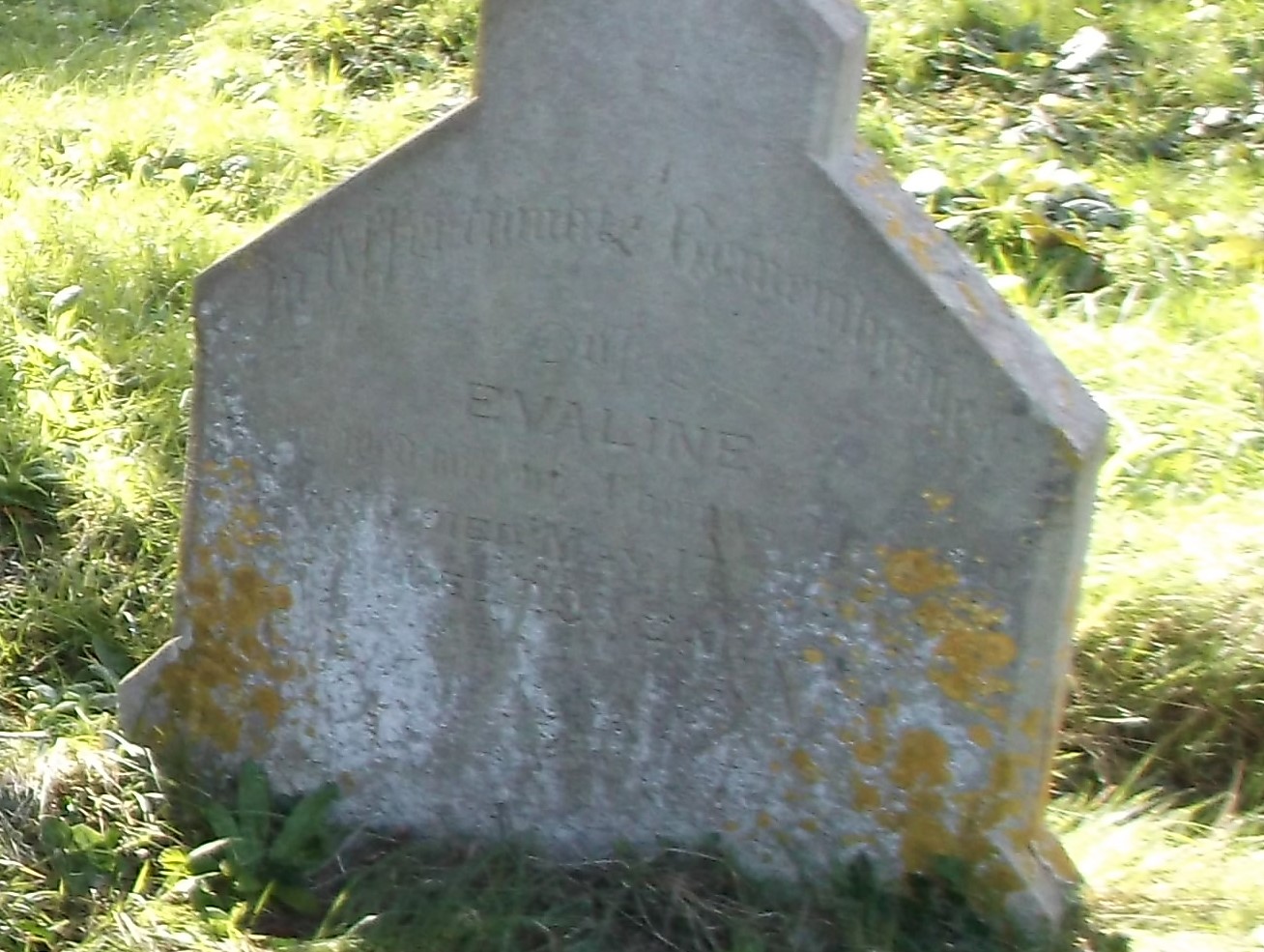
The left-hand picture shows the family plot with the two identical headstones. Top right is the inscription for the left-hand grave showing Mary, Emily and Samuel. Bottom right is the inscription for Evaline on the right-hand grave.
Samuel Poole and Photography
Setting the Scene
When Samuel Poole arrived in Teignmouth to set up his photography business in around 1858/59 commercial photography was still in its infancy.
19 years earlier, on the 19th August 1839 Louis Daguerre had made the first public announcement of his commercial process for the production of photographs. This was announced in the Academy of Sciences, Paris and the Globe of 23rd August 1839 reported:
The DAGUERREOTYPE
It having been announced that the process employed by M. Daguerre, for fixing images of objects by the camera obscura, would be revealed on Monday at the sitting of the Academy of Sciences, every part of the space reserved for visitors was filled as early as one o’clock, although it was known that the description of the process would not take place until three. Upwards of two hundred persons who could not obtain admittance remained in the courtyard of the Palace of the Institute.
From that first announcement photography progressed rapidly. By 1841 the Daguerreotype had arrived in Plymouth, as reported on the front page of the Exeter and Plymouth Gazette of 11 September 1841:

Exeter followed soon after. An advertisement appeared in the Exeter and Plymouth Gazette of 28 July 1842:

This was followed a couple of days later in the same paper by the following announcement:
A suite of rooms, for the photographic process, was opened under Northernhay this morning, by Mr Gill. The invention is a most surprising one, ensuring, as it necessarily does, fidelity and almost instant operation.
Meanwhile the fantasy, wonder and novelty of photography was reaching the public eye.
The Wonder of Photography

Such was its novelty that the Exeter and Plymouth gazette of 2 July 1842 felt it had to announce that “Sir William Follett lately sat for a photographic portrait, which will we hope be lithographed for his admirers”.
Sir William was the Solicitor-General and MP for Exeter. Perhaps this picture in the National Portrait Gallery is that portrait – it is described as a mid-19th century mixed-medium engraving by an unknown artist.
An imaginative role for photography as a complementary medium was described in the Bristol Mercury of 4 December 1841 when a local artist F. Riddle was embracing the opportunity it offered:
PORTRAIT PAINTING
F. RIDDLE begs to announce to the Public in general, and to his friends in particular, that he has adopted a new style of PAINTING PORTRAITS, which requires only two Sittings, combining the correct Drawing of the Photographic likeness, with the improvement of expression and colour given by a few but most essential touches of the pencil.
This method being expeditious and certain, the charge is lessened in proportion. F. R. flatters himself that he shall obtain an increased share of patronage, and his utmost endeavours shall be used to give satisfaction.
Specimens will be exhibited in a few days at his PAINTING ROOM, No. 2, ST. AUGUSTINE’S PARADE, where attendance is given, from Half-past Nine till Half-past Four, daily.
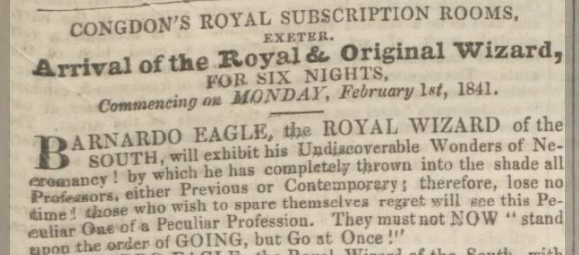
And, as a final example of the inroads that photography was making, who would have thought that it would feature in the programme of the Royal Wizard. It was the Western Times of 30 January 1841 that boldly announced the arrival of the “Royal and Original Wizard” in Exeter:

Photography in Teignmouth
This was the world that Samuel Poole was entering. Photographic businesses seemed to be gradually emerging elsewhere such as Exeter and Plymouth but in Teignmouth there was a definite gap in that market. There had been someone earlier – a Mr Sharp who lived at Woodbine Cottage, Brunswick Place but it seems that he left around 1848, briefly turned up in Exeter before moving on once more. He also seems to have made some extraordinary claims of a new apparatus he had patented for the production of colour photographs but there doesn’t appear to be evidence that his invention ever took off.
So it would be reasonable to claim that Samuel Poole was indeed the pioneer of commercial photography in Teignmouth. Inevitably he was joined by others. For the next 40 years through to the start of the 20th century the following photographers came and went in Teignmouth – Henry Thomas, George Denney, David Robert Everest (9 Somerset Place), Valentine and Sons (Rembrandt Studio, 18 Bank Street). Of these the business of J U Valentine seems to be the closest in nature to Samuel Poole’s – it was a family business which survived after Samuel Poole and whose founder and family are also buried in Teignmouth Old Cemetery.
After Samuel’s death his business was taken on by William Marsden Harrison.

He may well have been a medal-winning photographer but he had a chequered past. He was made a bankrupt in the first business he started, he was involved in court in a “love-triangle” case with two of his employees, he was charged in court for assault on his wife and at the time of taking on Samuel Poole’s business he was going through bankruptcy proceedings once again. There is no evidence that he lasted in Teignmouth. This was a rather sad ending to the efforts that Samuel had made over the previous fifty years.
Samuel Poole the Photographer
We have seen that Samuel started business in Teignmouth around 1858/59 and moved his studios there several times, presumably in response to business requirements. Once he had established himself in business in Teignmouth though he quickly started to expand his presence elsewhere as well. Notably in 1860 he entered into a joint venture with a Cornwall photographer, Robert Preston, forming Preston and Poole based at No 1 South Terrace, Penzance. They advertised themselves in the Cornish Telegraph’s edition of 13th February 1861:

The partnership appears to have lasted formally until 1870 (there are no more newspaper archive references after that) although maybe a split occurred earlier since Robert Preston moved premises and announced that under his own name.
Two years later in 1872 Samuel also set up a studio in Exeter (at 5 Southernhay); this was a bold move given the amount of competition there would have been in Exeter at the time.
During his lifetime Samuel would have produced tens of thousands of photographs. Sadly though most of these have either disappeared or are simply not available through the normal research channels. Some are still in circulation for sale on sites such as Ebay and there is a small but growing collection of studio portraits on Brett Payne’s site (see link at end).
Here are a few with some specific comments or stories, followed by a gallery of others which have been discovered.
Eyes Fixed on the Past
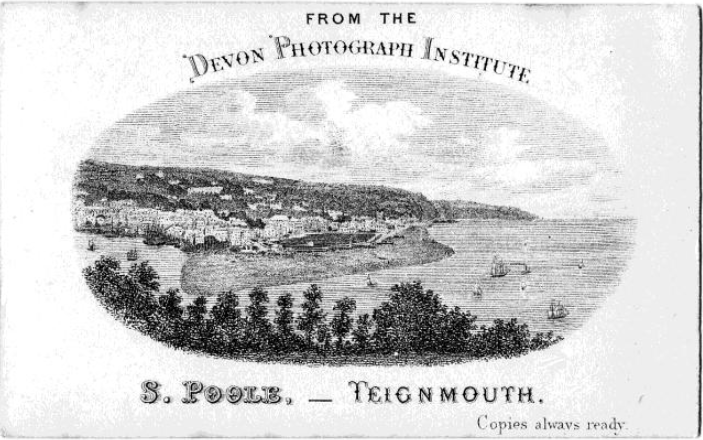
The first of these is a picture of Teignmouth taken from the Ness. It appears to be a lithographic reproduction from an original photograph. It is undated but there doesn’t appear to be an obvious pier on the beach which would suggest the image is pre-1865 when the pier was constructed.
There is a heading for the enigmatic “Devon Photograph Institute” – enigmatic because I can find no official reference to the existence of such a splendid sounding body. There was a “Devon and Exeter Photographic Society” founded in 1857 but later re-named the “Devon and Exeter Graphic Society” in 1858. It is more likely that the title was simply a marketing ploy to lend a certain air of grandeur to the business; there are similar references to the “Photographic Institution”, the “West of England Photographic Institution” and the “Museum Photographic Organisation” all of which were commercial photography businesses in Exeter. Samuel may simply have copied this mechanism.
There are only a couple of references in the newspaper archives to the “Devon Photograph Institute”. The first made the national news and is the subject of the next section. The second is local, appearing in the Western Times of 1st December 1860:
“Mr. Samuel Poole of the Devon Photographic Institute, has just published a series of Moonlight Stereoscopic Views of this neighbourhood. They are exceedingly pretty. They may be procured either of the artist, or of Messrs. Carpenter and Son, Fore-street.”
This copy of the photograph has been taken from “Eyes Fixed on the Past”, the PhD thesis of Margaret O’Brien-Moran. The thesis itself is about Samuel’s son, Arthur, who carved out his own niche in photographic history and is sub-titled “The Poole hidden archive: a case study of the materiality of the Photographic prints, and the research implications for working with historical photographs.”

Railway Destruction
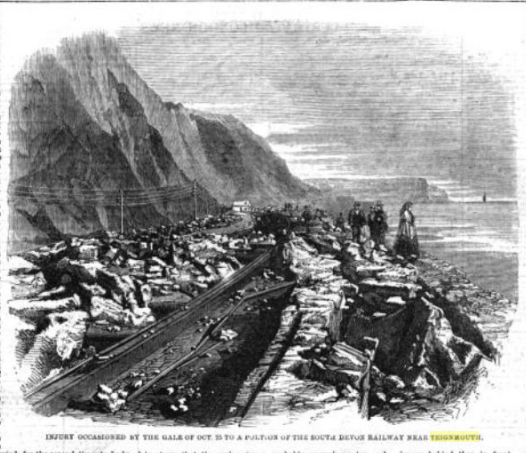
The Illustrated London News of 3rd December 1859 carried this story together with a lithographic reproduction of a photograph by Samuel Poole of the scene of the destruction:
DESTRUCTION OF A PART OF THE SOUTH DEVON RAILWAY.
Among the many disasters occasioned by the gale of the 25th of October last may be counted the destruction of portion of the seawall and permanent way of that part of the South Devon Railway which lies between Dawlish and Teignmouth. From the station of Starcross westward this rail is on the seashore, being for a distance of two miles adjacent to the scene of accident seaward of the abrupt conglomerate cliffs which here bound the coast.
To render available such a course it became necessary, in the construction of the railway, to erect a mass of masonry, consisting of two parallel walls, the interval being filled with sand and shingle, the top ‘pitched’, or paved. Between the double wall and the cliffs also rubble was placed to support the permanent way, and to give additional solidity to the whole. It appears, however, that the engineer to the company (the late lamented Mr. Brunel) had much under-calculated the effect of the waves during spring tides, augmented by strong easterly winds.
Such was the terrific force of the impelled water during the late storm that the coping-stones, probably averaging a ton each, were tossed about like corks, and huge fragments of the disjointed wall were rolled upon the metals. The breaking-up of the structure is described as having been appalling, surf, foam, and fragments of the debris rising in the air with a terrific roar. Through a tunnel which opens into the town the sea-water rushed impetuously, flooding the houses and damaging property to a considerable extent. This and the retreating waves, removing the ballast from the sleepers of the rail, allowed the ponderous stones from the wall to bend and twist the metals in various directions. Of course traffic was for a while suspended, although an inner line of rails (comparatively uninjured), used occasionally for shunting, &c., was utilised by the authorities, and communication was speedily resumed. Our Engraving is from a photograph taken by Samuel Poole, of the Devon Photographic Institute, Teignmouth.
A Royal Visit
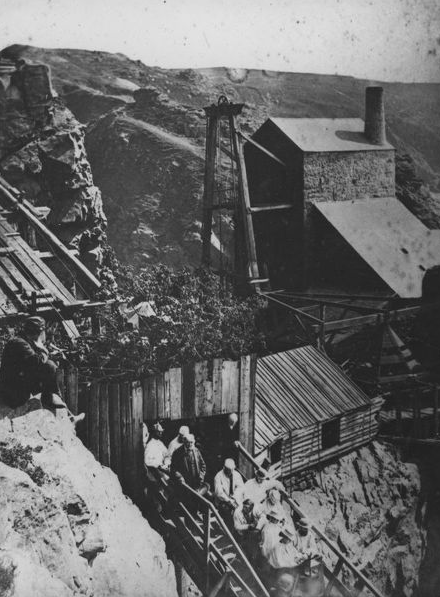
In 1865 the Prince and Princess of Wales (later to be King Edward VII and Queen Alexandra) did a grand tour of the West Country. Part of that tour was a visit to the Botallack tin mine in Cornwall, including a descent into the new section of the mine which extended about a third of a mile under the sea. The tour was extensively covered in the local and national press; and the company of Preston and Poole took photographs.
This was how the Illustrated London News of 5th August 1865 described the visit:
The Prince and Princess, with Mr. St. Aubyn and Lady Elizabeth St. Aubyn, arrived there in a carriage-and-four, about noon, followed by the Duke and Duchess of Sutherland, the Earl of Mount-Edgcumbe, Lord Vivian, the Lord Lieutenant of Cornwall, Lady Vivian, Lady DeGrey, and others of their party. They were received by Mr. Stephen Harvey James, the purser, and the other officers of the mine.
All the ladies and gentlemen, including the Princess herself, then attired themselves in loose dresses of white flannel to go down into the mine. The Princess and Lady Elizabeth St. Aubyn rode in donkey-chaise along the narrow path from the counting-house to the mouth of the shaft, while the Prince and the others walked behind. By the side of this path, and on the heights above, were hundreds of people, the spectators of a curious scene.
On each hand were high, jagged, weather-beaten rocks, with here and there a rude construction of planks and beams to aid in the working of the mine. Halfway below was the head of the shaft, the gaunt upper works and wooden platforms hanging over deep chasms, and at the base of the high rugged cliffs the water surging itself into foam against the black, seaweed-covered rocks.
As the Royal party passed slowly along the path, a long line of volunteers, comprising representatives from each of the corps of the western battalion of the Duke of Cornwall Artillery Volunteers, under command of Colonel Gilbert, saluted the Prince and Princess by presenting arms, and the band played the National Anthem. On arriving at the mouth of the shaft, the Princess, wearing the sort of wrapper just mentioned, and having on a coarse straw hat trimmed with blue, took her place with Mr. St. Aubyn, upon the lower seat, the Prince and a brakesman sat on the next seat behind them, and the rest of the party followed. Mr. John Rowe, the captain of the mine, directed the car, which had been fitted up, under his superintendence, by Mr. Bennett, of Penzance, for the special use of the Prince and Princess.
The car descended gently down a steep inclined plane, and in a moment or two the Royal party had passed downwards from the light into the dark shaft, the depth of which is about 200 fathoms. The bottom-level of the mine extends horizontally about half a mile beneath the sea; the dark narrow passages being traversed by the help of a candle, which each person must hold in his hand as he gropes his way along. A part of this mine belongs to the Prince of Wales.
After an absence of rather more than an hour, the Prince and Princess, Mr. St. Aubyn, and a lady, were drawn to the surface, and as they appeared again above ground they were greeted with the heartiest cheering. The Princess and Lady B. St. Aubyn walked to the donkey carriage, and were drawn up the path along which they had previously descended. The Princess looked rather heated, but smiled charmingly in response to the cheers on her behalf. The band played “God Save the Queen,” God bless the Prince of Wales,” and cheers were given for the Princess, the Prince, for the Queen, and not less heartily for Denmark. The volunteers again saluted as the Royal party passed.
The Western Morning News of 19th August 1865 carried Preston and Poole’s announcement of their photographs:

Previously the Cornish Telegraph of 16th August 1865 had commented on the merits of the photographs:
PHOTOGRAPHIC VIEWS OF
THE PRINCE AND PRINCESS OF WALES
AT BOTALLACK
Messrs Preston and Poole, of Penzance, have produced three photographs of the interesting scenes at Botallack on the 24th of July – scenes, in artistic merit and fidelity, far, very far, beyond what we ourselves had contemplated, eyewitnesses as we were of the careful bustle and loyal excitement of those on the platform leading to the diagonal shaft at Botallack, and fearful as we have been that this stir would tell against even the proved skill of our local photographers. Three phases of the day’s proceedings have been successfully reproduced, and will form most interesting memorials of the event for all Cornishmen.
The scenery is the same in all three photographs :—a foreground of bold projecting rock, of woodwork leading to the shaft’s mouth, and of perpendicular cliff on which stands the Crown engine-house; a distance of cliffs, headlands, and sea. These serve admirably to delineate one part of the mine and one stage of the royal visitors’ progress. It is almost needless to say that the scenery, from account-house to shaft, would not be exhausted by a dozen pictures. The part of the mine is the platform down which the Prince and Princess cast rather an anxious glance: the progress is the point at which they are about to descend.
Three separate parties are shewn in the skip, with Capt. John Rowe and the young brakesman, Eddy; while the Purser, Mr. S. H. James, the Clerk, Mr. S. H. James, jun., and others who looked on, will be recognised – the purser and his son being unmistakable.
Although, to those who saw and noted their royal highnesses and suite, every face in these pictures is discernible and easy of recognition, no doubt most of our townsmen and townswomen will appreciate some fuller portraiture of Prince and Princess. These also, we hear, Messrs. Preston and Poole will soon be in a position to supply, so that their lenses will have preserved for us scenery with which their royal highnesses will be pleasantly associated; and their countenances as we saw them, the Princess a little thin and fragile-looking but not the less interesting for that, and so serve to keep in remembrance one of the happiest days of Penzance.
It is not clear exactly which photographs were taken by Samuel Poole or Robert Preston although, according to the Royal Cornwall Museum, Preston was the designated photographer. The company’s commission and subsequent work though did enable Samuel to announce himself as photographer to their Royal Highnesses the Prince and Princess of Wales. Also, the reproduction in the Illustrated London News (left-hand side) is not credited but is shown here as well for completeness.


Cartes de Visite
Whilst the above photographs are interesting period historical records the bread and butter work of photographers of this time would have been studio portraiture, in particular the production of what were known as “cartes de visite”. Samuel Poole and his family business would have produced thousands of these.
The Carte de Visite (CdV) is French for a visiting card. In 1854 a French photographer, André Adolphe Eugène Disdéri patented a method for creating multiple negatives on a single plate. This resulted in the production of cards about 2½ by 4 inches which replaced the traditional calling card in use at the time. The cards opened up photography to the masses and became really popular after 1859 when Disdéri published Napoleon III’s photograph in this format. The trend for CdVs continued through to the 70s when it started declining as CdVs were replaced by larger “cabinet cards”.
Here are a few examples of CdVs by Samuel Poole which illustrate some of the features of the medium. The backs of the cards are shown as well because that is where the photographers had the opportunity to advertise themselves with a little flourish.
Lady with Braided Hair
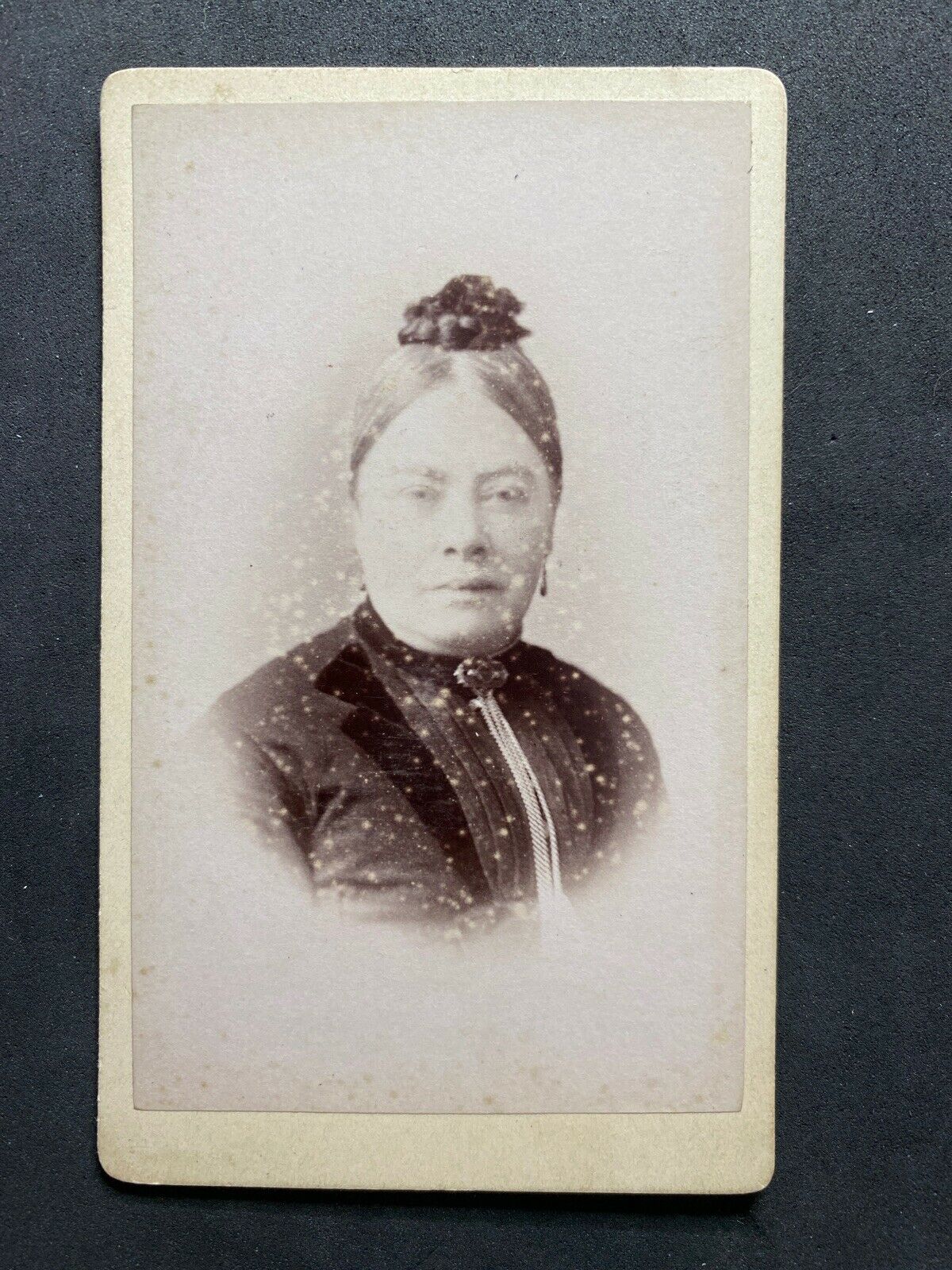

As with so many CdVs we may never know who the subject of the portrait is. Occasionally there may be a name handwritten on the reverse side, or the provenance may be known if the CdV has come from a family collection. In general though the CdV is described by a specific feature of the portrait, in this case the braided hair. The reverse shows quite an impressive advert for Samuel Poole with a studio in Wellington Street and the main business residence of Somerset Place, suggesting it was one of Samuel Poole’s later photographs..
Young Girl


The reverse of this rather spooky photograph shows Samuel Poole this time as part of the partnership Preston and Poole and also indicates that they were photographers to the Prince and Princess of Wales. This suggests the photograph was taken some time between 1865 (the royal visit) and 1870 (probable ending of partnership).
Elegant Lady with Parasol

This shows Samuel in his own right as photographer to their Royal Highnesses.
Bessie Harper
And here is one taken in Samuel’s studio in Exeter where we actually know the name of the subject in the picture.


Samuel Poole – The Legacy
Other photographs from Samuel Poole do exist but are hard to come by. Here are a few more, taken from various internet sites where CdVs are bought and sold. There is also a growing collection on Brett Payne’s web-site – see link at end. Can you spot Princess Alexandra?


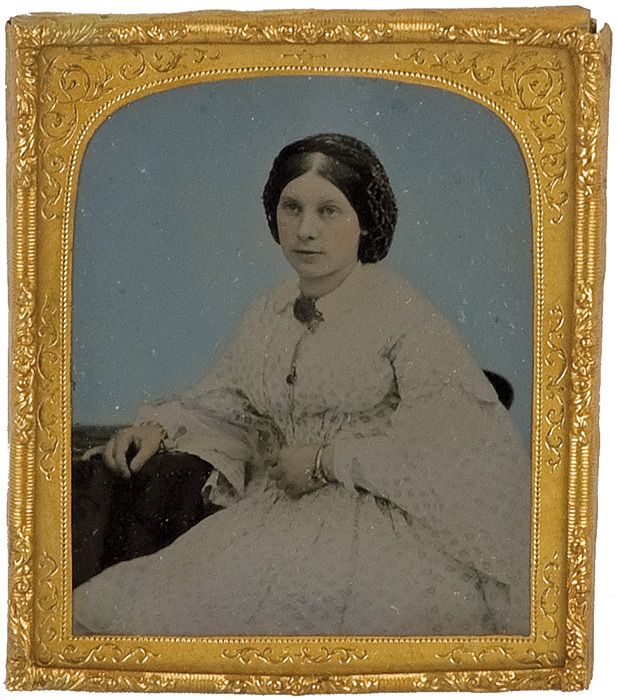

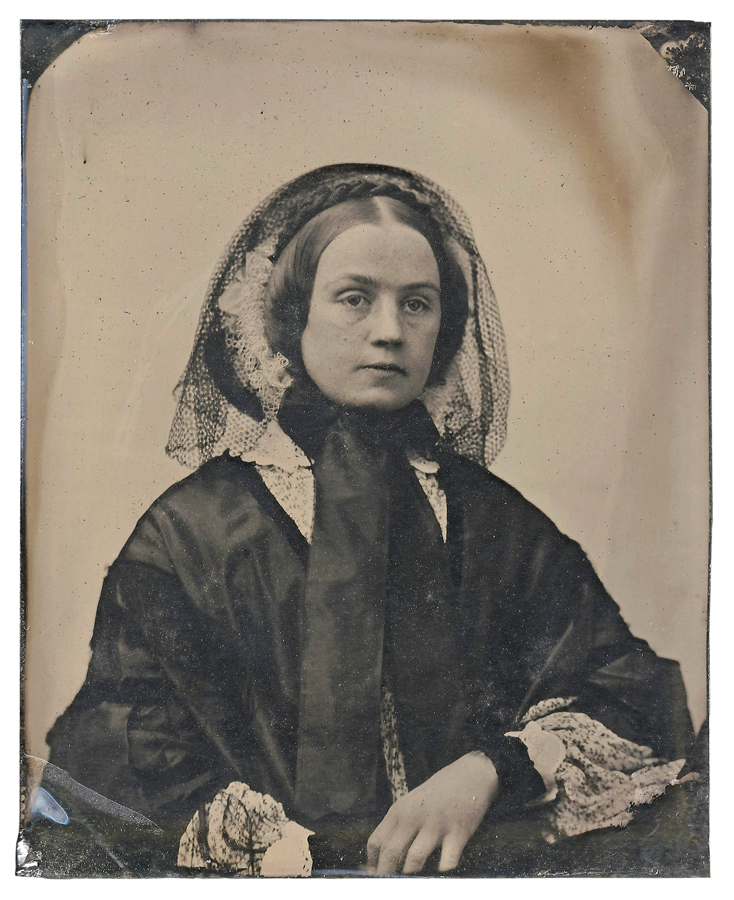


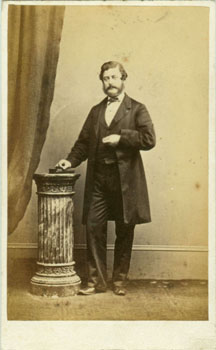
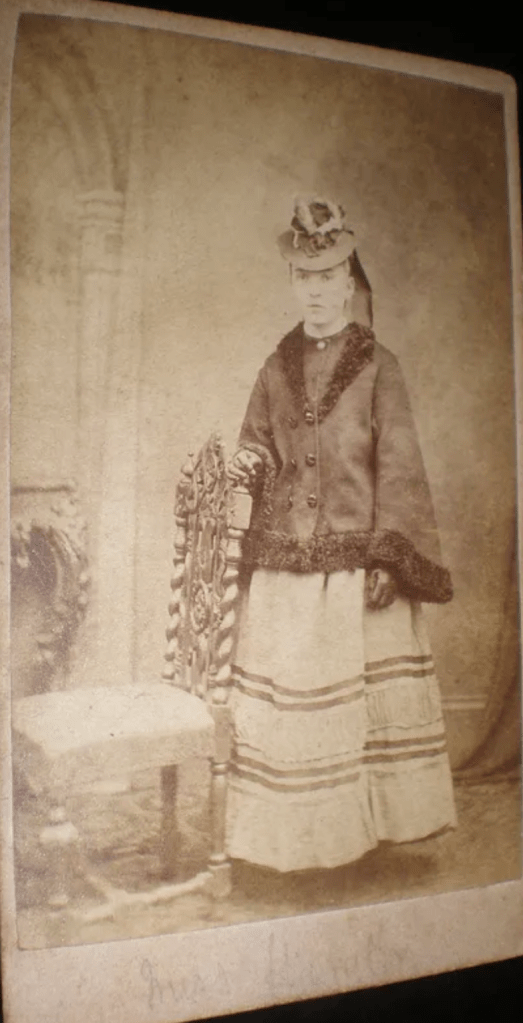

The other legacy which Samuel left was the continuation of photography through his family. His son Samuel James Poole established a photographic business first in Torquay and then moved to London where he continued with studios in Putney.
However, it was his son Arthur H Poole who probably made the most lasting contribution. He moved to Ireland and established his business in Waterford. The Poole photographic collection, comprising some 70,000 plates, has been described as “affording to posterity a window into the essence of Waterford in the late 19th and first half of the 20th centuries”. It is housed in the National Photographic Archives in Dublin, part of the National Library of Ireland. The collection is unique because it also includes Arthur Poole’s daybooks which are a record of every photograph taken.
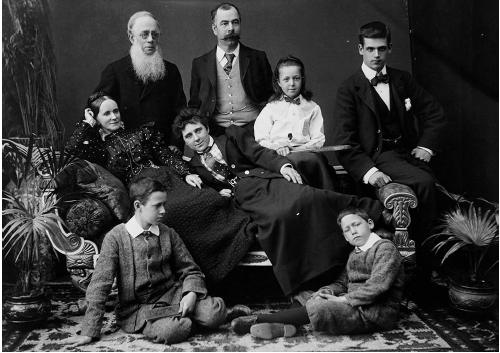
One of the photographs is entitled “Mr and Mrs Poole of Teignmouth” but it is described as also including “A.H. Poole, back row centre and his wife Lily Poole, middle row centre and their three children, Bertram, Violet and Vivian”. This suggests that perhaps the elderly man on the left of the picture is Samuel Poole with his wife Mary seated below him.
And finally a salutary tale on the dangers of having your photograph taken, from the Exeter and Plymouth Gazette of 7th August 1874:

Acknowledgements
A plea went out for any information about Samuel Poole and his photographs which elicited a number of replies. So, many thanks to: Gwynneth Chubb and Bob Kethro from the Teignmouth and Dawlish Camera Club; Monica Lang; Lin Watson from Teign Heritage Centre; Exeter camera Club; Royal Albert Memorial Museum; Rosemary Rodliffe of Rodliffe Genealogy; Margaret Morgan of the Royal Cornwall Museum. Also various people on the following Facebook sites: Devon in Old Postcards and Photographs (Liz Barrett), Dawlish History, Teignmouth & District U3A, Remembering Teignmouth Area, History of Teignmouth. Apologies to anyone I have inadvertently forgotten.
Sources and References
Extracts from contemporary newspapers are referenced directly in the text and are derived from British Newspaper Archives.
Ancestry.com and Freebmd for genealogy
Wikipedia for general background information
Other sources, with hyperlinks as appropriate, are as follows.
Eyes Fixed on the Past – PhD thesis of Margaret O’Brien-Moran, BA, MA. Copyright rests with the author
Victorian and Edwardian Portrait Photo Collection – Brett Payne
University of Tasmania – image of Charlotte Gibson
National Library of Ireland – Poole Photographic Collection – APA Citation. A. H. Poole Studio, p. (1884). The Poole Photographic Collection
Carters Price Guide to Antiques – Portrait of a Woman, 1860 daguerrotype
Antique dog photographs – Portrait of woman with pug
Maartje de Nie photography – Ambrotype of woman
Royal Photography Society – general
Waterford Treasures – Arthur Poole details
Collectors Weekly – Cartes de Visite
Royal Cornwall Museum – details of Botallack mine and royal visit
Views and Likenesses by Charles Thomas (1988) published by the Royal Institution of Cornwall
 Teignmouth Old Cemetery
More great ,interesting research connected to graves in our cemetery ..many thanks to Neil 👍🏻
LikeLike