The Death of James Bond
We saw the death of the fictional James Bond recently in the film “No Time to Die”, but did you know that a real James Bond died 160 years ago in Teignmouth and is buried in our cemetery? He was buried with military honours and reportedly over 3000 people attended his interment.
Who was James Bond?
James was born in 1842 in West Teignmouth and at the time of the 1861 census, shortly before his death, he was still living with his parents, William and Mary Bond, at No. 3 Bickford Lane. This was designated as “West Teignmouth” simply because it lay to the west of the river Tame which flowed into the Teign roughly where Northumberland Place is now located. James was a shipwright so he shared an affinity with the sea with his fictional doppelganger. Did he also share an aspiration to become a Commander RN? We will never know because his life was cut untimely short.
The events leading to his death were documented in the Press over a period of about 18 months but have never been connected together in a single story; so this is that story of events that conspired inexorably to lead to the death of James Bond.
The Ship at the Heart of the Story
At the heart of this story is an American ship called the Caroline which was based out of Charleston, South Carolina. ‘Caroline’ was a popular name for ships of that time so it’s hardly surprising that, given that Charleston was the largest slave port in America, an earlier incarnation of Caroline was as a slave trader. By the time of our story though slave trading had ended and our Caroline was pursuing the more conventional business of import/export across the Atlantic. There are manifest records of cotton being shipped to Liverpool and salt being shipped to Charleston. Having crossed the Atlantic it is likely she would then have done short-haul trades around Europe to make the overall voyage more profitable.
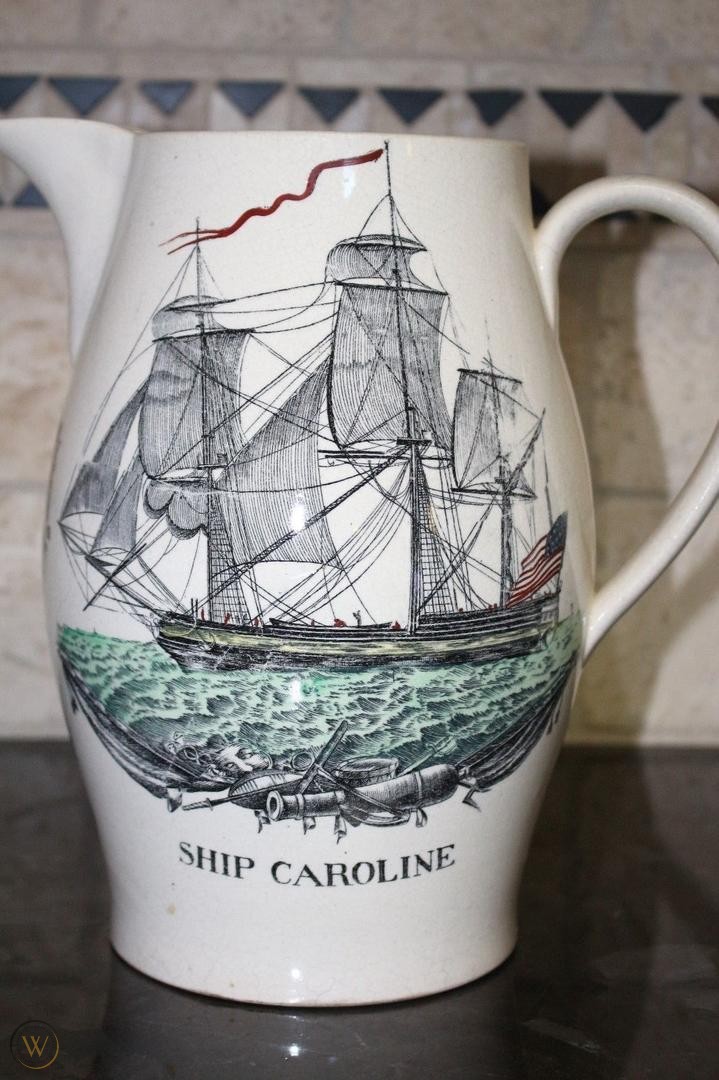
Although we don’t have a picture of the Caroline we do know that she was “full-rigged”, so at least a three-master, ocean-going vessel. We also know that one of the significant products imported to Charleston from Liverpool in the first half of the nineteenth century was “creamware” or “pearlware” – ceramic pottery from factories in Liverpool and Staffordshire. Towards the end of the 19th century James Leech of Staffordshire produced some reproductions of this earlier work. One common motif he used was the “Ship Caroline”, with American flag. So our full-rigged Caroline may well have looked like this transparency image on a James Leech pitcher:
It all started in 1860 …..
Our story starts on 14th March 1860 when the Western Morning News reported:
…..

WRECK OF AN AMERICAN SHIP NEAR TORQUAY
We have to report the wreck of an American ship, which took place about 12 o’clock, on Sunday night, at a spot called Petit Tor, about three miles from Torquay, and not far from Babbicombe. The ship in question is full-rigged, about 600 tons burden, and is called the Caroline, of Charleston. She was bound from Havre to Cardiff, and was in ballast. It appears that on Sunday night the wind was blowing from the south-east, and having missed stays, the vessel went on shore. Two boat crews, consisting of a number of sturdy fishermen, headed by Mr Gasking and Mr Thomas, went off early in the morning to render assistance, and as the tide was favourable, they felt certain that with very little difficulty the ship could be got off. The master of the vessel, however, refused to accept the proffered assistance, and sent off for the Industry, steam-tug, of Teignmouth. When this vessel arrived, the disabled ship had settled well down, with a large hole in her bottom, and all the efforts of the little tug to remove her on Monday, were unavailing. In that exposed part of the coast it is very probable that the wreck will speedily break up, especially if there is any wind.
Over the next few weeks a controversy raged about the exact details of the event. The captain insisted that weather conditions had been bad with thick fog and low visibility. He also claimed that as soon as his ship grounded he was surrounded by fishing boats whose crews tried to board his vessel to claim salvage. The locals’ version was that weather conditions were fine, that advice and assistance had been offered (not boarding) and that the captain’s version was a “Kentucky tale”!
The Salvage
In the event, the Caroline was salvaged by John Bartlett Mansfield, “eminent shipbuilder” of Teignmouth, whose crew were commended for working “with a zeal and energy rarely shewn, and still more rarely surpassed”. Negotiating the Point with the Caroline in tow was no easy task. Mansfield decided to do it in two stages: first grounding her on the bar where she stayed overnight; then, the following day, when wind and tide conditions were optimum she was eventually beached in Teignmouth. There she was speedily stripped of everything that could be sold, as the Exeter and Plymouth Gazette of 16th March 1860 described:
NOTICE IS HEREBY GIVEN that an AUCTION will be held by Mr. W. Cotton, on the Den, Teignmouth, on TUESDAY, the 20th of March 1860, at Two o’clock in the afternoon, for SALE of the whole of the masts, spars, sails, rigging, warps, chain cables, anchors, stores, sheathing, furniture, and fittings, saved from the wreck of the American ship Caroline of 730 tons register. The whole will be laid out and sold in covenant lots on the Den, and may be viewed the morning of sale.
The salvagers after deducting their costs, made a respectable £165 from this sale (although it doesn’t sound much in today’s terms – about £23,000).
The hull was sold separately for £250 on 18th March by public auction at the Devon Arms. She was apparently bought by a “party of gentlemen of Teignmouth” although an article in the Western Times the following year (28th September) states that it was Mr Mansfield himself who had purchased the ship. The Western Times of 31st March 1860 suggested that this was quite a snip and that a value of £3000 was more realistic. It looks like Mr. Mansfield got a bargain! Presumably the damage was deemed to be less significant than first thought from the nature of the wreck. This is how it was described:
About 25 feet of the after piece of keel completely gone, the heel of the stern post broken off, a portion of the after deadwood broken off, the rudder unshipped and broken, the garboard streak on each side, together with several planks of the run torn off, and the heels of the pitcher timbers exposed on each side; several planks of the port bulge very much chafed, and in many places the frame is exposed and the garboard streak in the port flat is cut through.
Significantly though, which may have counted for the revised valuation …..
The hull above the bulges does not appear the least strained or injured, and apparently requires but little attention or outlay. She will shortly be placed in a convenient spot, and her repairs commenced.
That convenient spot was the shipyard of John Bartlett Mansfield (later to become the famous Morgan Giles shipyard). Little more is heard about the Caroline until the following year when the Western Times of 20th April reported that the repairs on the ship were “progressing” towards completion. By September, after £1800 worth of repairs, she was ready for public exhibition for the benefit of the Teignmouth, Newton, and Dawlish Dispensary. The Caroline had by now been renamed the Superb and, according to the Western Morning News of 23rd September “she has been repaired and fitted up for the East India trade, in the most splendid style”. She was now sailing under a British flag and also John Mansfield had acquired some new joint owners – Messrs. James Jackson and Co. of Liverpool.
Celebrating the Rebuild
The exhibition and celebrations for the new ship lasted for over two weeks. As the Western Times of 28th September 1861 reported:
For the past fortnight this splendid vessel – superb in appearance as well as name – has been exhibited to the public at a charge of threepence each, the object being to raise a donation for the Teignmouth and Dawlish Infirmary ….. On Tuesday last the Teignmouth Subscription Band kindly volunteered their services, and a great number of persons visited the ship that day. In the evening a dance took place, which was continued with spirit until 10 o’clock, when the company, numbering over 200, broke up, having thoroughly enjoyed themselves.
A Shadow Cast
Two incidents though cast a shadow over these celebrations. The first occurred the day after the evening dance and was relatively minor, as reported by the Western Times of 28th September:
ROBBERY. – On the night of Wednesday last some bottles were stolen from the ship Superb. The wine was the property of Mr Banbury, confectioner, of this town, and had been left in the cabin for safety, the doors leading to it having been locked, but entrance was effected by means of a trap door communicating with the steerage. The thief remains undiscovered, although Mr. Mansfield has offered a reward for information that will lead to the detection of the offender.
The second, more serious and tragic, occurred two days later, as reported first by the Exeter Flying Post of 2nd October:
A fatal accident occurred on board the Superb on Friday. A shipwright’s assistant named James Bond, twenty years of age, son of a fisherman, and in the employ of Mr. Mansfield, shipbuilder, of this town, whilst employed on board the vessel with George Lee and Thomas Tucker, happened accidentally to step backwards to avoid a blow from a piece of ropeyarn which he seems to have thought was about to be aimed at him by one of his fellow workmen, and fell down the hatchway, a distance of fifteen feet, receiving injuries, from the effects of which he died a few hours afterwards in the infirmary.
In those days inquests happened very quickly and this was no exception. The inquest was held on the body at the Railway Inn on Saturday by F. B. Cuming, deputy coroner. The report from that gave a fuller account of the incident as described here by the Exeter and Plymouth Gazette of 4th October:
About noon on that day the deceased and another workman were engaged fixing some ‘hatches’ between decks on board the Superb. Whilst so engaged, the deceased threw a piece of rope, by way of larking, at a fellow workman named Tucker, and in stepping backwards out of Tucker’s reach, he accidentally fell down the hatchway some fifteen feet, pitching on his head. In the bottom of the vessel where the deceased fell there was a quantity of water. Tucker and several other workmen immediately went to his assistance and took him on shore.
In the meantime Mr. Sullock, surgeon, was sent for, and upon seeing the poor fellow he ordered him to be taken to the Infirmary. There Mr. Sullock again examined him, but he was extremely violent, and made use of several oaths. There was only a slight abrasion on the back part of his head. Mr. Sullock thought he was tipsy, especially as Mr. Mansfield had informed him that a quantity of wine and spirits had been taken from the ship on the night previously. He, therefore, desired that the man’s clothes, which were wet, should be changed, and that he should be put to bed. Mr. Sullock then left him in charge of Mr. Harris, the house surgeon, but on his returning about half-past four o’clock he found him dying.
He had since reason to believe that the deceased was not in liquor at all at the time, but that he was suffering from injuries received on the head …… (At the inquest) ….. when the above facts, together with evidence that the deceased had not been drinking, were adduced, and the jury returned a verdict of ‘Accidental Death’. As the deceased, who was a member of the Teignmouth Artillery, was much respected, the jury presented his friends with their fees.
The Funeral
Whilst the accidental death of a young shipwright in Teignmouth would have been a sad event for his friends and immediate family it would soon have faded away into the day-to-day life of the town. The death of James Bond would have been no different from the deaths of other young working men of the time. However, for some reason it struck a chord which resulted in an extraordinary funeral which deserves remembrance as an historic event in Teignmouth. Here’s a full report from the Western Times of 12th October:
Funeral Of A Volunteer Artilleryman – The funeral of the young man, James Bond, whose death – the result of injuries received through falling into the hold of the ship Superb – we recorded in our last impression, took place on Thursday, the 3rd inst. The deceased was a gunner in the 3rd, or Teignmouth, Company Volunteer Artillery, and he was interred with military honours. The Teignmouth Company of Volunteer Rifles, a section of the Teignmouth troop of Yeomanry Cavalry, and few members of the Torquay Artillery were present on the occasion. In addition to these the whole of the apprentices and workmen in the employ of Mr. Mansfield, shipbuilder, and the members of the Teignmouth Branch of the Rational Sick and Burial Association, (of which the deceased was member), attended the funeral.
At half-past three o’clock the whole of the volunteers assembled on the Den, from whence they marched to the late residence of the deceased, and were there drawn up in line, the ranks taking open order and facing inwards. On the approach of the corpse, the firing party presented arms, and when it had been carried past they reversed arms and headed the procession, which proceeded through the town, and to the Cemetery, in the following order – the coffin was covered with a Union Jack, and the cap and sword of the deceased lay on the top:
Firing Party,
Consisting of Corporals Benney and Binnin ; Bombardiers Stafford
and E. Pratt; Gunners Wills, Syms, G. Hooper, I. Hooper,
Windeatt, Prowse, Youlden, anil Saunders; under
the command of Sergeant Whidborne,
Band of the 3rd D.V.A. playing the Dead March in Saul
| PALL BEARERS Gunner T. Tratt Gunner W. Higgings | The coffin borne by six apprentice shipwrights | PALL BEARERS Gunner W. Jones Gunner J. Mann |
Relatives and friends of the deceased.
The 3rd Devon Volunteer Artillery.
A section of the Torquay Volunteer Artillery.
A section of the Teignmouth Troop Yeomanry Cavalry.
The Teignmouth Company lst Volunteer Rifles,
Drill Instructors
Lieut. Kingdon, 3rd D.V.A., Dr. Sullock, 3rd D.V.A.,
Capt. Floyd, 3rd D.V.A., Capt. Clarke, 1st V.R.,
Lieut.-Col. Sir W. H. Tonkin, D.V.A.
The workmen and apprentices in the employ of Mr. Mansfield,
shipbuilder.
The Teignmouth Branch of the Rational Sick and Burial
Association
On arrival at the Cemetery, the firing party halted, faced inwards, and rested on their arms reversed, whilst the corpse and the whole of the procession passed through to the chapel; they then took up their position at the grave, and the burial service having been read by the Rev. T. B- Simpson, and the coffin lowered into the narrow tomb, three volleys were fired in the air, the band playing at intervals.
The volunteers and the mourners then separated, the latter pursued their homeward journey, whilst the former marched to their rendezvous and were dismissed.
The peculiar spectacle of a military funeral attracted hundreds of spectators. The streets were packed, and every window commanding view of the street along the line of route was thronged. At the cemetery it is estimated that not less than 3,000 persons had congregated awaiting the arrival of the cortege, yet the greatest order prevailed. During the passing of the funeral through the crowded streets all sounds were hushed except the measured tread of the volunteers and the solemn notes of the Dead March which produced feelings of great awe and solemnity shared by the whole of the spectators, many of whom were moved to tears.
I wonder if such a funeral has ever been seen in Teignmouth since then. Despite the pomp and ceremony though James Bond was buried in an unmarked grave, plot H81, and therefore lost to history until now. This is one of the areas of the cemetery yet to be cleared; the photos show the approximate location.

Life goes on
Two days later, as reported by the Exeter and Plymouth Gazette of 11th October:
THE SUPERB – This splendid ship was on Saturday evening successfully floated from the beach, where she has undergone repair and been refitted by Mr. Mansfield, and she now lies moored to one of the buoys in the river. She will take in 500 tons of clay for ballast and proceed to Liverpool, whence she will sail to the East Indies.
The funeral may have been a memorable occasion but life goes on.
Sources and References
Extracts from contemporary newspapers are referenced directly in the text and are derived from British Newspaper Archives.
Ancestry.com for genealogy
Other sources, with hyperlinks as appropriate, are as follows.
The Abbeville Banner Jan 12th 1860 – Caroline manifest
United States Economist 23rd October 1852 – Caroline manifest
Article “Creamware and Pearlware Exports to the USA” by Terence Lockett
Torquay Geological Field Guide, Ian West – contemporary picture of Petit Tor
 Teignmouth Old Cemetery
Interestingly, there’s another James Bond buried in the churchyard at Dawlish.
LikeLike
I love reading these historical tales. Very interesting.
LikeLike
Oh, I’ve not seen No Time To Die, now it’s spoiled knowing James Bond dies
LikeLike
Sorry!
LikeLike