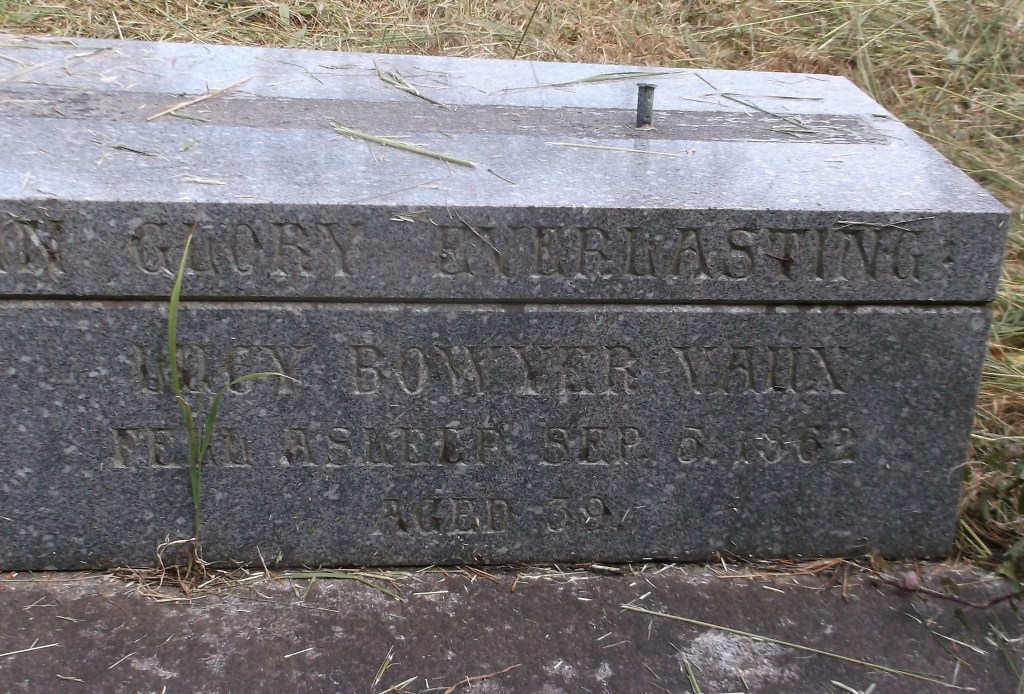
In the last post on the death of James Bond there was a photograph showing the approximate location of his unmarked grave. The reference point for this was the grave in the foreground of the picture. The eagle-eyed amongst you might have noticed the unusual name on that grave. For those not so eagle-eyed, here it is in close-up:

Bowyer Vaux seemed an unusual name worthy of investigation. However, a quick search showed that it wasn’t as uncommon as you might have thought at that time. Also there seemed to be very little about our own Bowyer Vaux. What there was gives one interesting insight into the medical profession at the time. It also provides a serendipitous link into the story for the next post provided by Teignmouth resident Mike Brokenshaw.
Genealogy
Bowyer Vaux was born in Birmingham on the 9th September 1781 into a Quaker family – father Jeremiah and mother Susanna. The Quakers were excellent at keeping their own records so we have this wonderful birth certificate for Bowyer:

Interestingly though he seems to have later left his Quaker roots behind because there is a baptism record for him in 1844.
Bowyer married Hannah Browne on 26th April 1810 and they had five children: Bowyer (b. 1811); Hannah (b. 1816); Susan (b.1821); Lucy (b. 1826); and James (b. 1828).
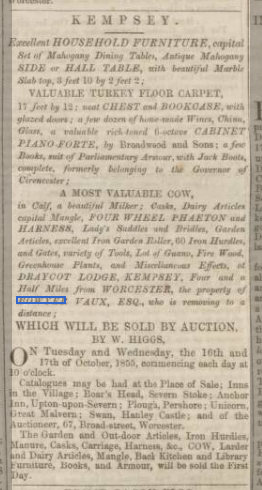
For the whole of his working life the family lived in the Birmingham area, moving to Draycot Lodge, Kempsey after Bowyer retired. In 1855 an advertisement in the Worcestershire Chronicle of 10th October for the sale by auction of house contents suggests that that was the year that Bowyer, his wife and youngest daughter moved to Teignmouth.
The Surgeon
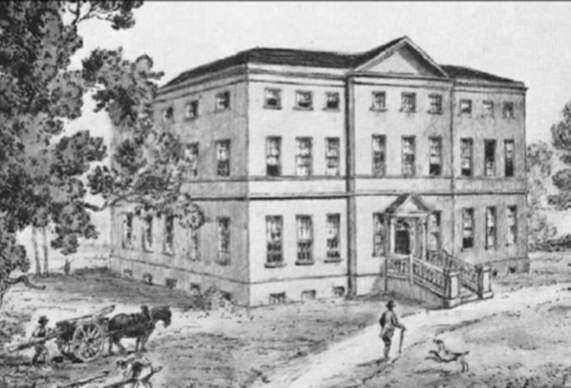
Bowyer Vaux was a surgeon who had worked all his life at the General Hospital, Birmingham, before retiring from there in 1843 at the age of 60. He had succeeded his father, Jeremiah Vaux, who was one of the four original surgeons at the founding of the hospital in 1779. He was one of the original members of the Royal College of Surgeons which had been established by royal charter in 1800 and, at the time of his death in 1872, he was the Senior Fellow at the college.
Judging by the apparent lack of papers in his name it would appear that Bowyer was more of a practising surgeon with little aspiration to the academic side of the profession. I wonder if he might have been amused therefore by his mention in despatches after his death in a brief analysis of longevity in the medical profession.
This was the circulating story which appeared in the Express and Echo of 1st January 1873:
LONGEVITY OF MEDICAL MEN. The obituary of The Times and the medical journals have recorded some remarkable illustrations of prolonged existence in members of the medical and surgical professions, who have died in the year which has just closed. It will be seen in the subjoined list that only those who had reached four score years and upwards are published, as Hugh Andrew, M.D., and Peter Miller, M.D., each 94 years of age; Bowyer Vaux, F.R.C.S., 91; ……. The united ages of these 14 gentlemen amount to 1,200 years, giving an average of more than 85 years to each.
This sounds impressive but then the article proceeds to debunk the presumed general conclusion of long life in the medical profession:
Dr. Casper, of Berlin, in his work on the duration of human life, has placed medical men as representing a medium longevity of 56. Artists are represented at 57; lawyers 59; military men 59; farmers and clerks 61; merchants 62; and clergymen 65.
It concludes with advice on living longer:
To prolong life the same authority adds that good temper and hilarity are necessary; violent passions, the inward gnawings of offended vanity and pride, tending to corrode every viscus, and to lay the seeds of future and bodily sufferings. Apathy and insensibility being, unfortunately the best sources of peace of mind, and, as Fontenelle observed, “a good stomach and a bad heart are essential to happiness,” perhaps the best maxim to prolong our days and render them as tolerable as possible is the “Bene vivere et laetari” (Live well and be happy).
On his death the Birmingham Daily Post of 10th May 1872 published a rather strange obituary. Normally you would expect an obituary to focus on the contributions that the person had made in their professional field. Perhaps because of the lack of publications by Bowyer Vaux the paper instead chose to rake up stories from the past that reflected the ‘cut-throat’ business of becoming an elected surgeon and the shenanigans of election-rigging that seemed to be common practice.
THE LATE MR. BOWYER VAUX.
Two lines in our obituary on Wednesday announced the death of a professional man once holding a foremost position In Birmingham; but long since forgotten, and to the present generation unknown, even by name. This was Mr. Bowyer Vaux, formerly one of the surgeons to the General Hospital, and in his day an eminent practitioner, not unworthy to rank with Freer, Dickenson, Wood, and others who honourably distinguish the roll of the surgical staff of the General Hospital.
Mr. Vaux carries us back a long long way in the history of the institution. His father, Mr. Jeremiah Vaux, was one of the Hospital surgeons, being elected to that office in 1779, and vacating it by resignation in 1807, when his son, Mr. Bowyer Vaux – then a young man of twenty-five – was nominated as his successor. Mr. Dickenson was also nominated for the vacancy, and a remarkably vigorous contest ensued.
Mr. Vaux had the support of the Soclety of Friends, and especially of the Galton family – then powerful in the Hospital and the town. His friends endeavoured to secure the election by “making” governors; that is, subscribing in the names of persons who might be safely reckoned upon to “vote as they were told.” So far was this device carried, that some persons named Brickwell, living in London, enjoyed the distinction of finding themselves governors of the hospital, to the great advantage of its funds.
When the day of election arrived, it was found that Mr. Dickenson’s friends had availed themselves of the same device, but on a more liberal scale. A series of ready-made governors – Brown, Jones, and Robinson- from the nelghbouring smithies, governors almost without their knowledge, marched up to the poll, and turned the scale In Mr. Dickenson’s favour. The defeated party was greatly disgusted, and an angry controversy ensued; but the case of the Brlckwell family oozed out, and Mr. Dickenson had the laugh as well as the election.
One good thing, however, came of this not too creditable episode in hospital contests. A law was passed enacting that no governor should have the right of voting unless he had subscribed for twelve months before the poll. In 1808 there was another vacancy, on the death of Mr. Tomlinson. Two candidates entered the field – Mr. Bowyer Vaux and Mr. Richard Wood – and a stout contest began. In the midst of the canvassing, however, Mr. Kennedy resigned, and so there were two vacancies. But then another candidate appeared, in the person of Mr. Lardner; and so the fight went on – for in those days Hospital appointments carried with them indisputable pre-eminence, both In professional status and social position, and were consequently fought for as vigorously as if they had been seats for the county. Ultimately, the contest was decided in favour of Mr. Vaux and Mr. Wood, who were elected by a majority of ninety votes.
Mr. Vaux held the appointment for thirty-five years, and resigned it in 1843, just after he had completed the sixtieth year of his age. Soon afterwards he ceased to practise, and for some years past he has been living in quiet retirement at Teignmouth, in South Devon, where he died on the 5th inst., in his ninetieth year.
Bowyer Vaux in Teignmouth
You might have thought that as a retired surgeon, fellow of the RCS, Bowyer might have taken a philanthropic interest in the health issues in Teignmouth – the Infirmary, the Dipensary, public health etc. But, as in his career, there is a remarkable lack of information about what he was involved with in Teignmouth. You get the impression he just wanted to lead a quiet life. His daughter, Lucy, had accompanied them to Teignmouth. She sadly died, aged just 39, in 1862 but there is no word of her death or funeral either in the local press, only in Aris’s Birmingham Gazette.
The only scrap of information is from 1857 when he seemed to be involved in the creation of local parochial schools, as reported by the Western Times of 26th December:
PAROCHIAL SCHOOLS
On Thursday, Dec 17, a meeting called by the committee appointed on the 26th June last, for the erection of schools on the government plan for the joint parishes of East and West Teignmouth, was held at the Assembly Rooms, for the purpose of receiving the committee’s report, and to decide what steps shall be taken – it having been determined to establish separate schools for the parish of East Teignmouth.
There were present the Rev. T.B. Limpson (incumbent of East Teignmouth), in the chair, C.K. Clarke, Esq., T. Harris, Esq., R.R. Moir, Esq., Bowyer Vaux, Esq., Lieut. Brokensha, R.N., Rev. W. Cresswell, Mr. R. Willcocks, Mr. Nicholson, Mr. Bradbeer, and Mr. B.L. Burnett.
The Grave
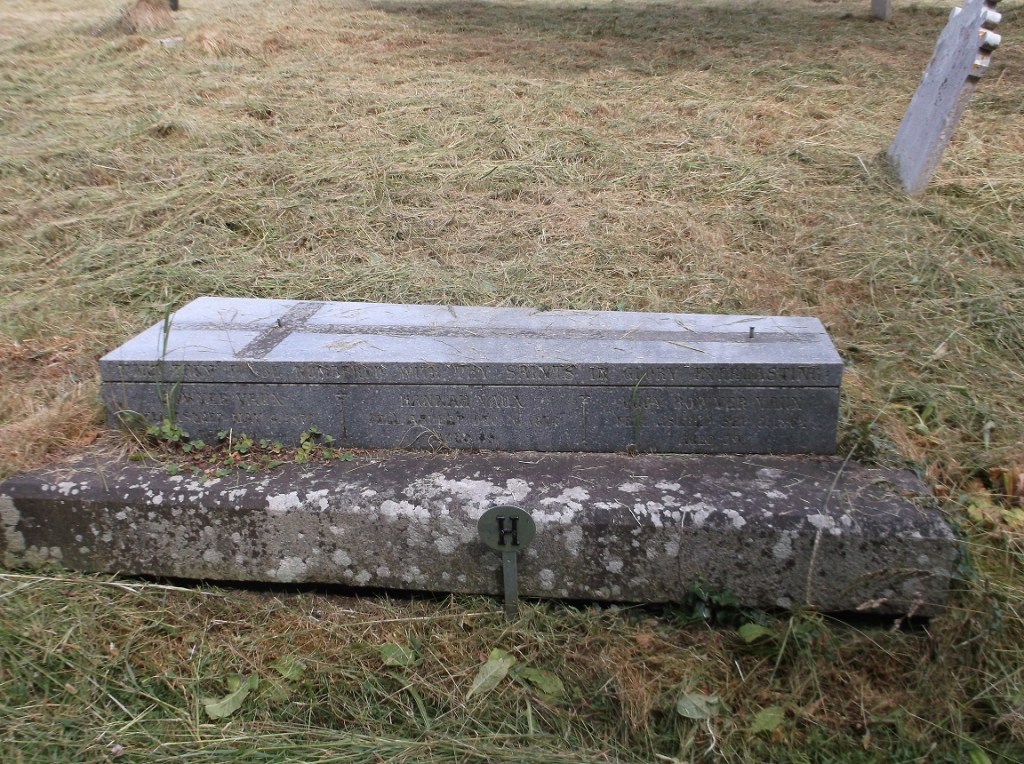
Bowyer Vaux died on May 4th 1872, ten years after his daughter Lucy and two years before his wife, Hannah (16th December 1874, aged 90). All three are buried in the same plot, H65, one of the oldest sections of the cemetery. Their grave can be used as a marker to locate the unmarked grave of James Bond, subject of the previous post.


Sources and References
Extracts from contemporary newspapers are referenced directly in the text and are derived from British Newspaper Archives.
Genealogy from Ancestry.Com
Other sources, with hyperlinks as appropriate, are as follows.
 Teignmouth Old Cemetery
thanks Neil very interesting as always Viv ________________________________
LikeLike