“Watch therefore, for ye know neither the day nor the hour wherein the Son of man cometh.” Matthew 25-13
Docks can be a dangerous place and deaths there can happen unexpectedly. Teignmouth was no exception. We already have one example of that in the death of James Bond in 1861. This is a second such story some 30 years later, this time the death of Thomas Watt Linklater.
Thomas was born 23rd October 1829 at Sedgwick in the Orkneys[1]. The fourth of six siblings to Thomas Linklater and Jean Slater he became a seaman by trade. At the time of his death 65 years later, he was the bosun on board a cargo-ship called the Comorin.
The Comorin
By way of background the Comorin was a schooner-rigged screw-steamer built in 1863 on the Clyde by William Simmons and Co[2]. At just under 300 tons she was a small ship with a crew of sixteen hands and carrying upto about 580 tons of general cargo[3]. She had an auspicious start, joining the fleet of the British India Steam Navigation Company. The National Maritime Museum, Greenwich, holds a fine picture of her on her voyage home from India in 1871 via the Suez canal[4]. That same year though she grounded on the French coast, was salvaged and subsequently sold to J & P. Hutchison, Glasgow[5]. After repair she continued as a general cargo ship.
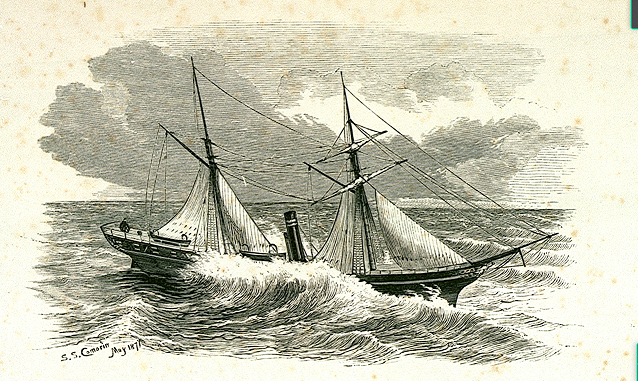
Fast forward to 1894. The Comorin set sail from “Tail-of-the Bank”, the name given to the anchorage in the upper Firth of Clyde immediately North of Greenock, registered as bound for Bordeaux [6]. She reached Teignmouth on Christmas Day and ran ashore off the Ness where she remained until floating off on the high tide[7]. She sailed into harbour on Boxing day to load up with an additional cargo of clay bound for Seville[8]. That was when the accident happened.
The Accident
There were several accounts published of what happened that day. The fullest was in the Teignmouth Post and Gazette of 28th December:
SAD ACCIDENT AT THE OLD QUAY
“On Wednesday morning a sad accident occurred at the Quay Extension by which Thomas Linklater, boatswain, of the steamer Comorin, of Glasgow, lost his life. The steamer came into the harbour in the morning and was berthed at the wharf to load clay from trucks. Two gangs of men were at work loading the steamer, one party at the main hatchway and another at the hatchway the aft side of the main mast. As the trucks were unloaded they were removed and the loaded ones run down in their places. Two horses were drawing the trucks and it was at the moment of shunting that the deceased stepped off the deck of the steamer, with the intention, no doubt, of crossing the line of rails. There was a space of a few feet between the trucks at the spot where the unfortunate man got on the wharf, and it is supposed he was passing between the trucks at the time another loaded one was being pulled down the line, as he was caught between the buffers and squeezed badly. Notwithstanding the dreadful injuries he received he got over the rail of the steamer and walked towards the cabin, and was able to state that he had heard his bones smash. Medical aid was procured and Drs. Little and Stevenson were soon in attendance and ordered his removal to the Infirmary, where he died within a few minutes of his admission.”
An inquest was held the following afternoon by Mr Sidney Hacker with Mr J W Finch as the foreman of the jury. The jury found that Thomas Linklater’s death was accidental but that there were factors which contributed which should be reported to the appropriate authorities to determine whether action could be taken to improve safety on the quay.
The report of the inquest fleshed out the details of the accident through the eyes of witnesses, as described in the same newspaper article:
THE INQUEST.
“The first witness called was George Andersen. of Glasgow, deposed that he was master mariner of the steamship Comorin. The vessel had come from Glasgow with a part cargo of coals. The deceased was boatswain of the steamer, and his name was Thomas Linklater, a native of the Orkney Islands, and lived at Glasgow. He was sixty-five years of age, and a widower. Deceased had been sailing under witness for six years. Witness was standing on the Old Quay, at which wharf the steamer was lying, but did not see deceased until the accident occurred. Witness was standing opposite the after end of the ship, when a man tapped him on the shoulder and said “Captain, one of your men is hurt.” The deceased walked on board after the accident, and went down to the cabin. He said he was in pain and he heard his bones crack when he was squeezed between the buffers of the truck. Deceased was not deaf and he had good eyesight.
The Foreman: If there was room between the trucks and the edge of the Quay would a man stand a chance of getting out of the way of the trucks? (witness replied) Certainly he would. The rails are close to the edge of the wharf.
Witness had given over the wages and effects to the Mercantile Marine Office.
A Juror: Was the deceased sober at the time? (witness replied) Perfectly; he was a man of sober habits.
John McGilvery, first mate of the Comorin, stated that about 11.30 he was standing on the deck, and saw the deceased get on to the Quay and stand with his back to the rails, and he was looking at the ship. Witness happened to turn around to speak to the chief engineer, and he heard the buffers of the trucks come together. He turned around and saw that the deceased had been caught between the buffers, and the trucks went back, which allowed deceased to get clear. He got over the rail himself and sat down near the funnel, and then went down the cabin. Deceased said he was very bad, and that he heard his bones smash. The lumpers on shore were shunting the trucks with horses, and deceased knew this. As the trucks were unloaded they were pulled away and the loaded ones brought up. The horses were working on the other side of the trucks to that which the deceased was standing. The man in charge of the horses would not see anyone standing on the Quay at the spot where deceased stood. In other places where trucks are unloaded there was more space, and in witness’s opinion the accident was attributable to the narrow space between the trucks and the edge of the Quay. No warning was given at the time the trucks were being shunted, neither was there anyone near the spot with a flag.
Samuel McKay, chief engineer of the ship, corroborated the evidence given by the previous witness, adding that he heard deceased shout when the trucks came together. It was not more than a minute from the time that witness spoke to deceased before the accident occurred.
At this stage of the proceedings one of the jurors was putting leading questions to the witness, and the Coroner said he could not allow it. The jury must form their own opinion from the evidence given, and not help witnesses in their evidence.
William Dymes Stevenson, surgeon practising at Teignmouth, stated that he was called about quarter to 12 to go to the Quay. He found deceased in the cabin in a sitting position. He was in a state of collapse and speechless. His stomach was swollen and hard, and he had the appearance of losing blood internally. There were no external marks or injury to the flesh. Witness ordered his removal to the Infirmary, where he died in a few minutes after he was brought in. Witness concluded there had been a rupture of the liver and probably the diaphragm had been injured. The buffer would inflict injuries over a large surface.
Richard Medland stated that he was in the employ of the Old Quay Company, and drove the horses in shunting the trucks. On Wednesday morning witness and his mate, Hamley, were shifting the empty waggons and bringing up the loaded ones. There were three loaded trucks standing on the line a few yards from the empty trucks. Hamley was the hind chain man and witness was at the horses’ heads. He called out “Look out” before he started the horses, which he always did before he moved trucks. He could not see on the offside of the trucks and did not know deceased was standing on the wharf. It was only a few yards distance to pull the trucks and would only take about a minute.
The Foreman: Between the buffers of the trucks would be about six feet. (witness replied) He never saw anyone standing in the six feet opening.
By Mr. Wills (juror): (witness confirmed) He had been employed for 30 years in the same kind of work.
Charles Hamley stated that be hooked the chain to the trucks. There were close on 50 people standing about. He and the previous witness shouted to the people to “Look out” before the trucks were started.
Charles Brewer, stevedore, in the Quay Company’s employ, stated that he had charge of the work of loading the steamer. He heard Medland call out ” Look out.” Medland could not have seen anyone standing on the line at the spot where he was hooking the horses to the trucks. Deceased was caught between the empty trucks at the moment the loaded one came against them.
William Skinner Wills, secretary to the Old Quay Company deposed that he was on the Quay talking to the Captain when the accident happened. He did not see the deceased neither could he hear anyone call out, the noise of loading and moving the trucks prevented his hearing Medland call out. All the rails were laid under the supervision of Mr. Inglis, chief engineer of the Great Western Railway and to have a system of signalling would be a farce. The Board of Trade regulations did not come into force where horse traffic was used. Medland and Hawley were two most trustworthy men and knew their work well.
The Foreman: Were not the rails laid so close to the wharf to save a turn-table?
Witness: I cannot pass judgment on Mr. Inglis’s plans.
The Coroner reviewed the evidence and pointed out that as long as people had access to the Quay so must proper precautions be taken. It was just a question whether the cause of death came within the category of accidents or not. If there was culpable negligence on the part of anyone, it then became a serious affair, if on the other hand any suggestion from the jury would prevent future accidents, it would be their duty to say so and pass a rider to that effect.
The jury then discussed their verdict in private, and came to the conclusion that the accident was purely accidental, and added a rider to the effect that the railway metals were too close to the edge of the wharf, thereby not allowing sufficient space for a person to stand between the trucks and the edge of the Quay. The Coroner accepted the rider and said he would forward it to the proper authorities.
Following Events
The Comorin left port on the same day after the inquest. Apparently it was despatched pretty smartly by Messrs G.P. Ward, the brokers.

Thomas was buried in Teignmouth Old Cemetery in plot M89 on 31st December.
His epitaph is the quotation from Matthew which was quoted at the start of this story:
“Watch therefore, for ye know neither the day nor the hour wherein the Son of man cometh.”
A haunting reminder.
Sources and References
Extracts from contemporary newspapers are derived from British Newspaper Archives.
Wikipedia for general background information
Other sources, with hyperlinks as appropriate, are as follows:
[1] Genealogy from: www.raymillar.co.uk
[2] Ship’s build register from: https://www.clydeships.co.uk/
[3] Ship’s details from: https://www.wrecksite.eu/wreck.aspx?302188
[4] National Maritime Museum – https://www.rmg.co.uk/collections/objects/rmgc-object-110921
Attribution: License:: Public Domain. Free for editorial, educational, commercial, and/or personal projects
[5] British India Steam Navigation Company: https://www.theshipslist.com/ships/lines/bisn.shtml
[6] Departure of Comorin: 1894-12-24 Greenock Telegraph and Clyde Shipping Gazette – Monday 24th December 1894
[7] Grounding of Comorin: Sunderland Daily Echo and Shipping Gazette – Wednesday 26th December 1894
[8] Setting sail: Teignmouth Post and Gazette – Friday 28th December 1894

