The Railway Poet

Beneath the Weeping Lime

The Weeping Lime in Autumn

The weeping lime in Teignmouth Old Cemetery hides many secrets.  Stretching low across sections T and U in the older part of the cemetery its canopy covers graves which lie invisible for a large part of the year.  When autumn approaches though and the leaves burnish and fall, the secrets are revealed.

Thomas Henry Aggett

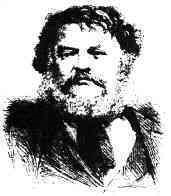
One of those secrets is Autolycus, the son of the god Hermes and Chione in Greek mythology.  He inherited the arts of theft and trickery from his father, and he could not be caught by anyone while stealing.  It was also the pseudonym adopted by Thomas Henry Aggett, the ‘Railway Poet of the West,’ when publishing his books of verse.

Early Years

Royal Albert Bridge, from Plymouth Herald

Thomas Henry Aggett was born in July 1863 at Saltash in Cornwall where his father had been working under Brunel on the construction of the famous Royal Albert Bridge.  The bridge had been formally opened in 1859 but presumably the work continued beyond then and on completion of that work the family moved to Torquay.

There Thomas, at the age of ten, started work as a farmer’s boy.  This seems a somewhat inauspicious start but it appears that Thomas had some aspirations because in 1880 he moved to the Isle of Wight where he served as a footman for two years in the household of an invalid widow lady.  There was a fine library in the house which Thomas apparently used to the full and kept himself in a regular supply of literature.  He had to be a little surreptitious though since the house-keeper did not approve of this activity.  It was then that he first became acquainted with the works of Burns and Byron who became his favourite authors.  He would read them again and again until he knew nearly the whole of their poems by heart.

The Railway Years

Whilst Thomas was working there his father died (1881) at the young age of 52 and In October 1882 Thomas joined the Great Western Railway (GWR) at Tovil in Kent.  He moved with them the following month to Teignmouth where he worked as a porter, although living at that time in Torquay.  He spent the rest of his working life with GWR, retiring early in 1901 on the grounds of ill-health.  By then he was a foreman porter.  An interesting aspect of social history can be found in his railway record which showed his wages rising from 15s (or 75p in modern terms) a week to the princely sum of 22s a week 18 years later.  According to the Victorian Web this would have been on a par with farm hands and sailors.  By comparison the Governor of the Bank of England was then earning around £8 a week.

Thomas Aggett GWR Work Record

In 1885, at the age of 22, he married Emily Lavis, the daughter of a tailor in Newton Abbot.  They went on to have five children.  Mabel Jane, was born on 23 January 1886 whilst they were still living in Torquay.  By 1887 the family had finally moved to Teignmouth and Robert William was born there on 14 April.  He was followed on 15 September 1890 by Herbert Edmund, when they were living at 4 Parson Place.  Their next son, Thomas Henry, arrived two years later on 24 May 1893 and it was another seven years before the birth of their final child, Ernest Harry, in 1900.  By that time the family had moved to 5 Gardener Farm in Frogmarsh Street – this would have been off Lower Brook Street somewhere in the area below the railway station which had once been the marshland through which the river Tame flowed as it meandered down through Teignmouth to emerge into the Teign by what is now Somerset Place.

So we have a picture of Thomas living a “normal” family life in a steady job but that job could bring its own trauma.  Here is a story from the Teignmouth Post and Gazette of 15th April 1898:

“THE CASE OF ATTEMPTED SUICIDE AT THE RAILWAY STATION
NO FOOD. NO HOME. NO MONEY”

“At the Town Hall on Tuesday, before Col. Nightingale (Chairman) and Mr F. Slocombe, Charles Pratt, a middle-aged man, of no fixed address, was charged with ‘throwing himself in front of a train with intent to murder himself’.

The prosecution was in the hands of the police. Prisoner who was pale, had his left arm in bandages. He had every appearance of having undergone a great shock to his system, and was allowed to sit during the hearing.

William Henry Pellow, goods checker at Teignmouth railway station, stated that on Saturday evening, the 19th of March, he was on the platform awaiting the arrival of the 6.40 from Exeter and due at Teignmouth at 7.0 o’clock. When the train was coming in and the engine nearing the bookstall, he heard someone shout. Witness could not tell the exact words, but it was like ‘Here goes’, or something to that effect. Witness saw a man (the prisoner) run towards the edge of the platform and jump off. He pitched on his feet in the centre of the permanent way. Seeing the man was in danger, witness turned his handlamp to red and waved it to attract the attention of the driver, who saw the signal and applied the vacuum brake and the train was pulled up. The man was the length of the engine ahead of the train. Witness at once reported the matter to the station master, and then went to where the man lay under the carriage. The engine and a coach and a half had passed over him. Witness had seen prisoner in the station yard before six o’clock on the same evening. He had no reason to believe that the man had been drinking.

William Kibbey, of Lower Brook Street, said he was standing on the down platform on the night in question at about ten minutes to seven. Witness noticed prisoner there and when the engine was just opposite the bookstall he ran towards the line and jumped off, about ten yards in front of the train that was running in. He pitched on his feet and turned around and faced the engine. Witness shouted to him to clear off the line; he took no notice of the warning, but threw himself forward towards the engine and fell flat on his face. He was not struck by the front of the engine; his injuries must have been received as the engine passed over him.

Thomas Henry Aggett, porter in the employ of the Great Western Railway, stated that on the Saturday evening in question, he had just locked the door where the tickets are collected as the 7.0 o’clock train was running in. He heard someone shout that a man was under the train. Parcels-porter George Honywill ran around the front of the engine and witness went down between the carriages and crawled underneath. Prisoner was lying under the second coach from the engine; on his back, and was bleeding from a cut on his head. Whilst they were examining his legs, before moving him, prisoner said ‘Let me get up. I can’t breathe.’ When they had moved him a bit, he asked for some whiskey and water. He was shifted from his position and a doctor was sent for, and the house-surgeon at the hospital came with a stretcher.

Mr. J. Shera, house-surgeon at the hospital said he was called and informed that an accident had occurred at the railway station. When he got there, he found a man (the prisoner) lying in the six-foot way, and bleeding profusely from the head. He was removed to the hospital, and on further examination witness found two large incised wounds on the scalp; a fracture of the skull; and a comminuted fracture of the clavicle-or left collarbone. Prisoner was sober, but the shock had affected his mind. So far as witness could judge, he should consider the man was accountable for his actions.

W. Pellow recalled: There would be barely room under the class of engine running that train for a person to escape. The road being level the bogie plate would strike the man first.

Constable Martin deposed that he was outside the station gates and was informed of what had happened. When prisoner was removed from beneath the train, witness helped to carry him to the hospital. Ever since the 19th March, a constable had been watching him night and day. When searched he had neither money or railway ticket. Before witness charged prisoner with attempting to take his life, he cautioned him in the usual way. Prisoner said “Well, I was very hard up; I could not beg, and I was never before a magistrate in my life.” Sergeant Richards said they had been in communication with a sister of prisoner residing at Dawlish, and she said she had not seen her brother but twice in twenty years, and positively declined to be responsible for him in any way. From what witness could learn, prisoner was a smith and had worked for a railway company somewhere near London. He had other relatives who refused to take charge of him. Prisoner had informed him (Sergeant Richards) that he was married but where his wife was he did not know.

Prisoner having been asked if he had any defence stated that he was out of work and had been as far as Dartmouth to get something to do and could not get a job. He had not had anything to eat for three days and only a drink of water on the road. He had no money or place to go to, and it was so many years since he saw his sister at Dawlish he had forgotten her address. It was the first time he had ever been before a bench of magistrates in his life until now. The Chairman said it was clearly a case to go to the Assizes. Prisoner would be granted bail in a surety of £3, failing to get that, he would have to go prison to await his trial. Prisoner said he did not know of anyone who would become surety for him.”

Apart from incidents such as this, life as a railway porter would inevitably been one of routine.  How many of them would have broken that routine with outside interests?  The Totnes Weekly Times of 25th January 1890 explored that very issue:

“RAILWAY POETS AND ARTISTS
Teignmouth Railway Station has, says a contemporary, its poet in Mr Thomas Henry Aggett, author of ‘The Demon Hunter,’ and Moretonhampstead Station can boast of having in two of its porters, Messrs W. J. Barnicott and George Koodes, amateur artists of much ability ……. Considering their long hours of labour, these railway servants deserve the greatest praise for devoting their very little leisure to such intellectual pursuits.”

One wonders what Thomas might have achieved if he had been born in different social circumstances, had received a formal education instead of working as a farm-hand from age 10 and had been given the opportunity that would have afforded.  His love of poetry has already been mentioned but he appears to have been well-read and knowledgeable outside that arena too as evidenced by a letter he wrote to the Western Morning News of 25th November 1892:

THE COMET IN ANDROMEDA

Sir, – ln your issue of 23rd inst. I notice that Miss Macnamara makes some startling statements with regard to Holmes’ comet. She says that she has found by calculation that it is Biela’s comet which was discovered 1826. This, according to Sir Robert Ball, is not the case, and I would direct her attention to an article on the subject in the Daily Graphic of the 23rd inst. by that eminent astronomer. She goes on to say that Biela appeared in 1846 under the form of two comets of unequal size. This, I believe, is generally accepted as true; but then she proceeds with her most remarkable statement – “Now what has become of the smaller one? It, undoubtedly, was captured by Jupiter about three years ago in crossing its orbit, and now appears in the form of its fifth nearest and smallest moon.” Surely she does not consider that in the amazing short space of three years Jupiter has pulled one part of Biela from following a very elongated ellipse to that followed by Jupiter’s inner satellite- Let us hear what Professor Barnard says, who discovered the satellite in question: – “The latitude measures of the satellite shew that its orbit lies in the plane of Jupiter’s equator, and consequently the satellite is a very old member of Jupiter’s family.” Lastly, it appears she is going to dispute with Professor Barnard the honour of discovering the satellite. Professor Barnard discovered it on the night of September 9th last, and Miss Macnamara says her family saw it on September 4th, but I understand that it cannot be seen with an instrument under 26in, of aperture, and then only under first-class conditions; and I doubt very much if Miss Macnamara possesses a telescope of this size. But perhaps she will enlighten us this point. – Yours Truly, Thomas Henry Aggett, 4 Parsons Place, Teignmouth.”

Biela Comet 1852 sketch by Angelo Secchi

This was cutting-edge science at the time.  The appearance of the comet was much reported and people in Teignmouth were reported as waiting up to view it, also in expectation that it could enter the earth’s atmosphere and provide a spectacular pyrotechnic display.

The fifth moon of Jupiter was named Amalthea and was the only moon, other than the first four observed by Galileo, to have been discovered by direct visual observation.

Aggett The Poet

One of the perks of being a railway employee appears to have been access to free rail travel, which brings us back neatly to Thomas’s major interest – poetry.  He has recorded that in October 1883:

“I paid a visit to the ‘Land o’Burns’ having a week’s leave, with a free pass to Manchester and back.  I started on my pilgrimage as devoutly as every good Mussulman started for the shrine of Mohammed at Mecca, and never have I so thoroughly enjoyed myself as I did that week in visiting the places of interest connected with Scotland’s national bard.”

Thomas seems to have had an affinity for poetry from an early age because he remembers that, when very young, he used to hum over his favourite tunes adding words of his own that would suit his particular fancy of the moment.  In this respect he has actually been compared to Alexander Pope as someone who “lisped in numbers”, which seems to mean having a natural inclination to think and/or express oneself in a metrical rhythm.  Pope revealed this in his letter to Dr. Arbuthnot:

“Why did I write? What sin to me unknown
Dipt me in ink – my parents’ or my own?
As yet a child, nor yet a fool to fame,
I lisped in numbers, for the numbers came.”

Thomas’s love for poetry led him to publish his own works.  In 1889 he issued a brochure entitled the ‘Demon Hunter, a Legend of Torquay’ (publisher Ebenezer Baylis) which included pieces such as the title-poem – the ‘Demon Hunter’ – ‘The Parson and the Clerk,’ ‘The Mayor of Bodmin,’ and others dealing exclusively with local legends.  This was followed in 1894 by a little volume entitled ‘Vagabond Verses, Through the Coombes and Vales of Delectable Devon’.

What was he like as a poet?

There’s an interesting comment about his poetic style in the book ‘West Country Poets’ of 1896:

“It may be readily understood that a man employed at a busy railway-station can have but little leisure for the cultivation of the Muses, and this fact must condone many imperfections in the published works of our railway poet.”

This may sound a little disparaging or patronising but the local reviews of his works were much more upbeat at the time.  There are many to choose from.  Here is an example from the Western Morning News of 17 March 1905:

“The poems printed here ….. display considerable poetic feeling and power of expression ….. The author writes with commendable smoothness and finish, and displays a turn of humour which renders many of his verses very entertaining reading”

Thomas Aggett himself was honest enough to recognise his limitations. In the preface to his first volume he wrote:

“I do not aspire to genius, neither do I pretend to have written anything exceptionally good, and if the reader derives the same amount of pleasure in reading as I have in writing the poems, I shall consider it sufficient recompense, and feel justified in having printed them; if, on the other hand, they are found incapable of affording any pleasure, I can only excuse myself, by saying they never would have been printed had it not been for the hope of benefiting the Widows and Orphans’ Fund of the Great Western Railway”.

Returning to that short clip from the Western Morning News it’s worth looking at the article in full which reveals more about Thomas, the man:

“VAGABOND VERSES: THROUGH THE COOMBES AND VALES OF DELECTABLE DEVON.

By Autolycus. (Hartnell, Teignmouth, 1s) – Prefixed to this modest little volume of verse is a note on the author by Mr. W. H. K. Wright, of Plymouth, to which is added a statement by Mr W. G. Hole, stationmaster at Teignmouth, where the author is employed as a foreman railway porter, that his ill health prevents his attending to his duties for any length of time, and that he will shortly have to retire. This volume is now published in the hope of recouping by its sale the expense he has incurred by three or four years illness. Mr. Wright’s note gives a brief sketch of the life of ‘Autolycus’, who in everyday life is Thomas Henry Aggett. A native of Saltash, he worked as a farmer’s boy. and then became a footman in a household where he was able to spend much of his time in a fine library, by means of which he was able to cultivate his natural taste for letters.  In 1882 he became a railway porter, and has remained one ever since. The poems here printed, though largely imitative in style, display considerable poetic feeling and power of expression, and coming from such a source are not a little remarkable. The author writes with commendable smoothness and finish, and displays a turn of humour which renders many of his verses very entertaining reading. His subjects are largely, indeed chiefly, drawn from his adopted county Devon, by whose leading residents, as the subscription list at the end of the volume shows, the book has been largely bought. Apart from the worthy object of helping a deserving Westcountryman, the poems are worthy of a wide circulation for their intrinsic merit.”

Although never a mainstream poet his life history is fascinating and, as suggested by the above article, he uses poetry to capture anecdotes of his time, snippets perhaps of social history.  Here are some examples:

Eulogy to Dr Robert Hamilton Ramsay
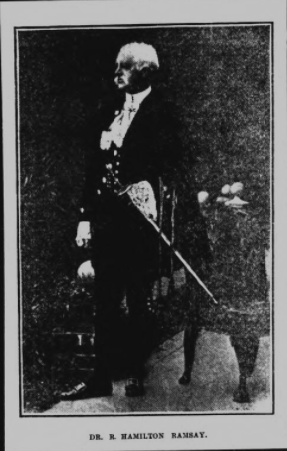
This is a long poem which was also later reproduced in full in the Torquay Times and South Devon Advertiser of 10 May 1907.  The article refers to “Mr Thomas Henry Aggett, ‘The Railway Poet’, who, during a long illness, had much reason to be grateful to the late Dr Ramsay.”  Only the first verse is reproduced here to give a feel for the style and tenor of the poem:

Since thou art mindful of the needy poor,
Whose welfare in this world so few consider;
In honour of thy worth the Muse would soar;
Worth is our standard and we never did err,
Or like the mercenary bards of yore,
Sell panegyrics to the highest bidder;
Worth is alone rewarded with an ode
Or song from our Parnassian abode.

The Great Western Railway Record Run, May 9th, 1904

It is only fitting to include something that Thomas would definitely have been proud of – the longest and fastest Non-stop Railway Run, London Paddington to Plymouth (245⅝ miles) in 3 hours 53⅟₂ minutes.

GWR engine at Plymouth (1905)

Speed! From the West!
Steam in the service of man!
Great Western, you hold of records the best.
‘Twas work well done in a stiff contest,
Of brawny arms of a brainy clan –
A credit to every man.

Through our County of cider and cream,
Flying soft and as swift as a bat,
It shows us the triumph of steam,
And the triumph of brains over that.

More problems for us to unravel,
Dame Nature still holds in her greed,
Then where is the limit of travel,
And what is the limit of speed?

Bridget of Brimley

Brimley now is a developed residential area of Teignmouth but in Aggett’s time would have been largely farmland, with Brimley brook formerly being a feeder for the River Tame which once flowed into the centre of Teignmouth where it formed a marshy confluence with the Teign.  This poem is an interesting example of customs of the time which might otherwise have disappeared from memory if they hadn’t been recorded in rhyme, whether that be poetry or song.  It is also of a similar ilk to Keats’s “Devon Maid” – perhaps that was part of the inspiration.
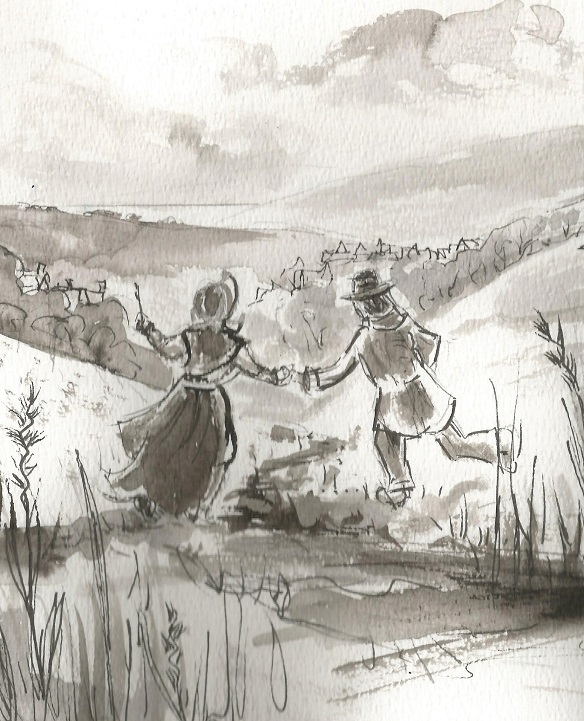
Sketch by Maureen Fayle

Now Sweetheart be good,
And don’t be contrary,
Pray put on your hood
And lock up the dairy,
Together we’ll roam,
Ay, trip it so trimly
Through the meadows and home,
Come, Bridget of Brimley.

Here’s a grass, tell our lot,
You witch, read it steadily;
“We love” – “we love not” –
“We love” – ay so readily.
But throw now I pray
Light where I see dimly
The hour and the day
Bright Bridget of Brimley.

The book ‘Vagabond Verses’ explains:

“The kind of grass here alluded to is the perennial rye-grass, locally known as ‘Eaver’ which Devonshire maidens are wont to pluck to ascertain of what trade their future husbands will be. Starting from the top ear they chant the following:- ‘Tinker, Tailor, Soldier, Sailor, Richman, Poorman, Beggarman, Thief’ – repeating (if necessary) until the last ear is touched wherein resides the oracle. Children in play in the meadows have a similar custom; when in doubt as to the passage of time they take a grass and say – ‘Does my mother want me? Yes – no – yes – no’ and so on.”

Eaver by Maureen Fayle

Address of Teignmouth to her Local Board

As a final example of Aggett’s poems here is one scathing commentary which, some might say, reflects the unchangeable nature of local politics and decision-making:

With lamentations loud and deep
Great cause have I, alas! to weep,
My Council members seem asleep,
I’m so dejected
For I whom they profess to keep
Am quite neglected.

By Nature clad in beauty’s dress,
Ye members surely must confess
What great attractions I possess,
Which you abuse,
When you could much improve I guess
Me if you choose.

But no, a dilatory curse
Seems settled on you, quite averse
To all improvements, worse and worse.
Your attitude
And money from the public purse
Does me no good.

I cannot now enumerate
Your foolish actions, neither state
Your time-waste in so-called debate;
With grief I see
Less water for more water-rate;
But list to me –

Just cease your foolish altercation,
My visitors want recreation,
Give this your best consideration,
You must agree
If you desire not condemnation,
Attractive be.

And to the public weal attend
In future better, and amend
The foolish way in which you spend
The public pence,
And pray that Providence will send
You better sense.

The feeling behind this poem might well have been a driver for their third son (also Thomas Henry) entering local politics.

In Memoriam

So, in summary, Thomas Aggett was a man of humble origins, self-educated, with an eye to social justice and with a love of poetry.  Like his father he died young.  In his later years Thomas went through a long illness, had to retire early and was only 43 when he died on 14th October 1906.  As befits a poet he had written his own short epitaph:

“Scorn not this humble grave, turn not away,
Ashamed to shed a sympathetic tear;
With reverence to this shrine thy homage pay,
A poet’s sacred dust reposes here”

There were several obituaries of Thomas published in the local press.  Here is an extract from the Western Times of 16th October 1906:

The Railway Porter Poet Dead.

Mr. Thomas Aggett, well-known in the West of England as the ‘railway poet’ is dead.  He was formerly foreman porter at Teignmouth railway station, but failing health necessitated his taking rest, and his recovery being doubtful he was unable to return to his duties on the platform.  A short time since he was granted the privilege by the G W Railway of being a town porter at Teignmouth.  On Saturday he had been to Plymouth to see his brother, and on Sunday morning he passed away.  He occupied much of his time in writing poetry, and published three books, one entitled ‘Vagabond Verses’, and another with the title of the ‘Demon Hunter, a legend of Torquay’; the proceeds of the sale were given to the Widows and Orphans’ Fund of the G.W. Railway.  He was a modest and unassuming working man.  He suffered from an affliction of the heart …..

The remainder of the obituary contains the extracts included earlier on his view of his own poetry and the epitaph he wrote.

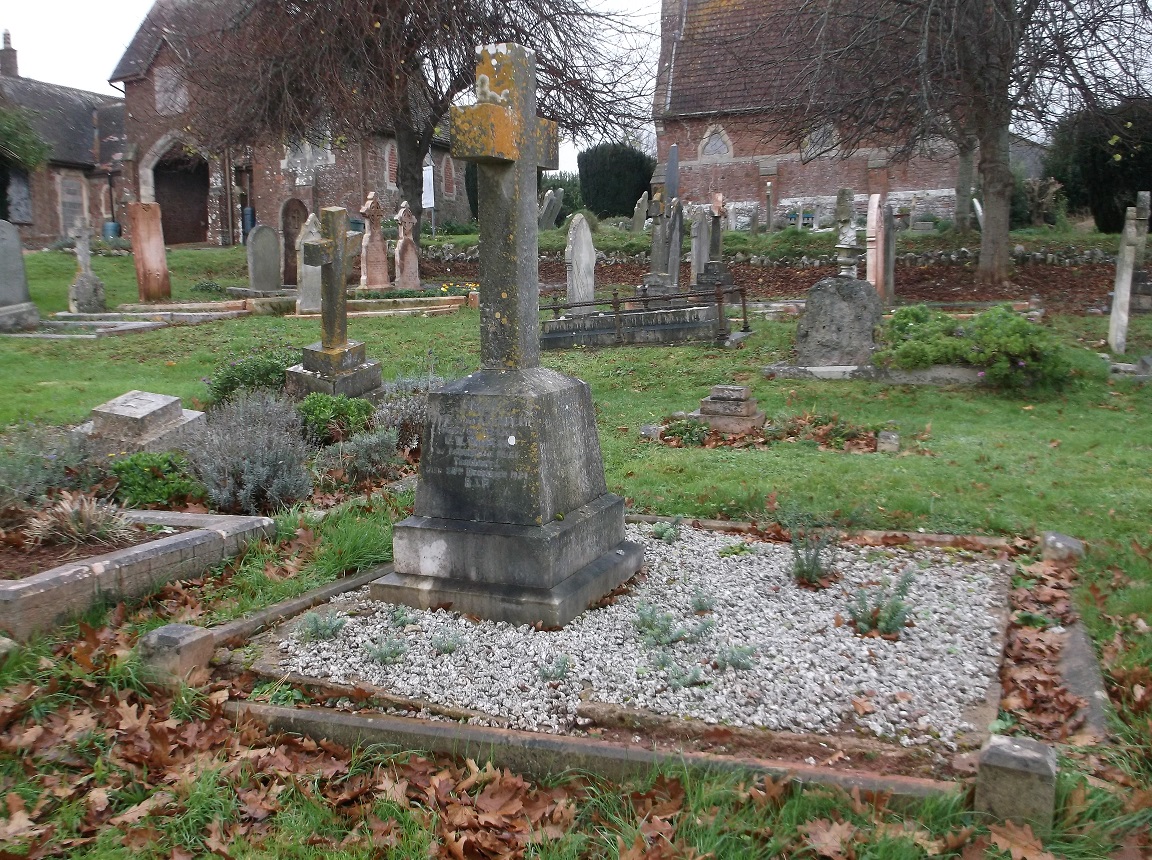
Thomas Henry Aggett is buried along with his wife Emily, who died in 1925, in plot T156 beneath the weeping lime.  Their daughter, Mabel Jane, and sons Robert William and Thomas Henry are also buried in the cemetery.  Herbert Edmund also joined GWR, married and died in Tolworth, Surrey.  Ernest Harry became an engineer with the GPO and died in Honiton in 1957.

Sources and References

Extracts from contemporary newspapers are referenced directly in the text and are derived from British Newspaper Archives.

Ancestry.com for genealogy

Wikipedia for general background information

Other sources, with hyperlinks as appropriate, are as follows.

‘West-Country Poets: Their Lives and Works’ by Wright, W.H.K., (1896)  On-line version:  West Country Poets

https://www.greekmythology.com/Myths/Mortals/Autolycus/autolycus.html – background to Autolycus

https://www.academia.edu/23444877/A_Catalogue_of_British_and_Irish_Labouring_class_and_Self_taught_Poets_c_1700_1900

https://www.britannica.com/place/Amalthea – Jupiter moon

Bilea comet – By Secchi / Guillemin – World of Comets, A. Guillemin, 1877 (U.S. edition), Public Domain, https://commons.wikimedia.org/w/index.php?curid=47581940

https://www.bartleby.com/library/poem/4124.html – Alexander Pope poem

https://www.bartleby.com/209/693.html -Henry Craik, ed. English Prose. 1916.
Vol. III. Seventeenth Century

Porter, Dale H. The Thames Embankment: Environment, Technology, and Society in Victorian London.  See for example http://victorian-era.org/the-victorian-era-wages-salary-earnings.html

For more examples of Thomas Aggett’s poetry search the catalogue in “Teignmouth in Verse” (https://keatsghost.wordpress.com/).  Alternatively track down “The Demon Hunter: a Legend of Torquay”, published by Ebenezer Baylis, 1st January 1889; and “Vagabond Verses… Through the Coombes and Vales of Delectable Devon”, 1904.
Of War, Brigands, Ice-cream and the Antonuccis

Introduction

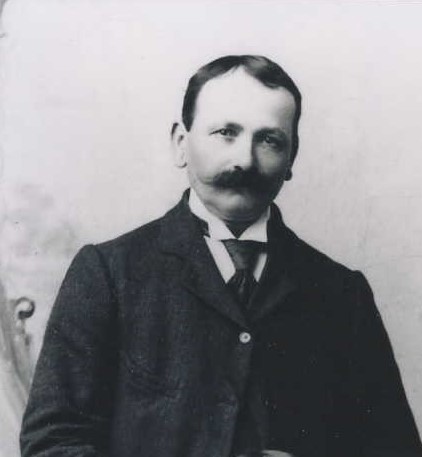
Baking in the hottest of hot July heatwaves my thoughts turned to keeping cool which inevitably led to ice cream.  In turn that reminded me of a grave which I had recently re-discovered in a far corner of Teignmouth Old Cemetery.  It is the grave of Angelo Antonio Antonucci.

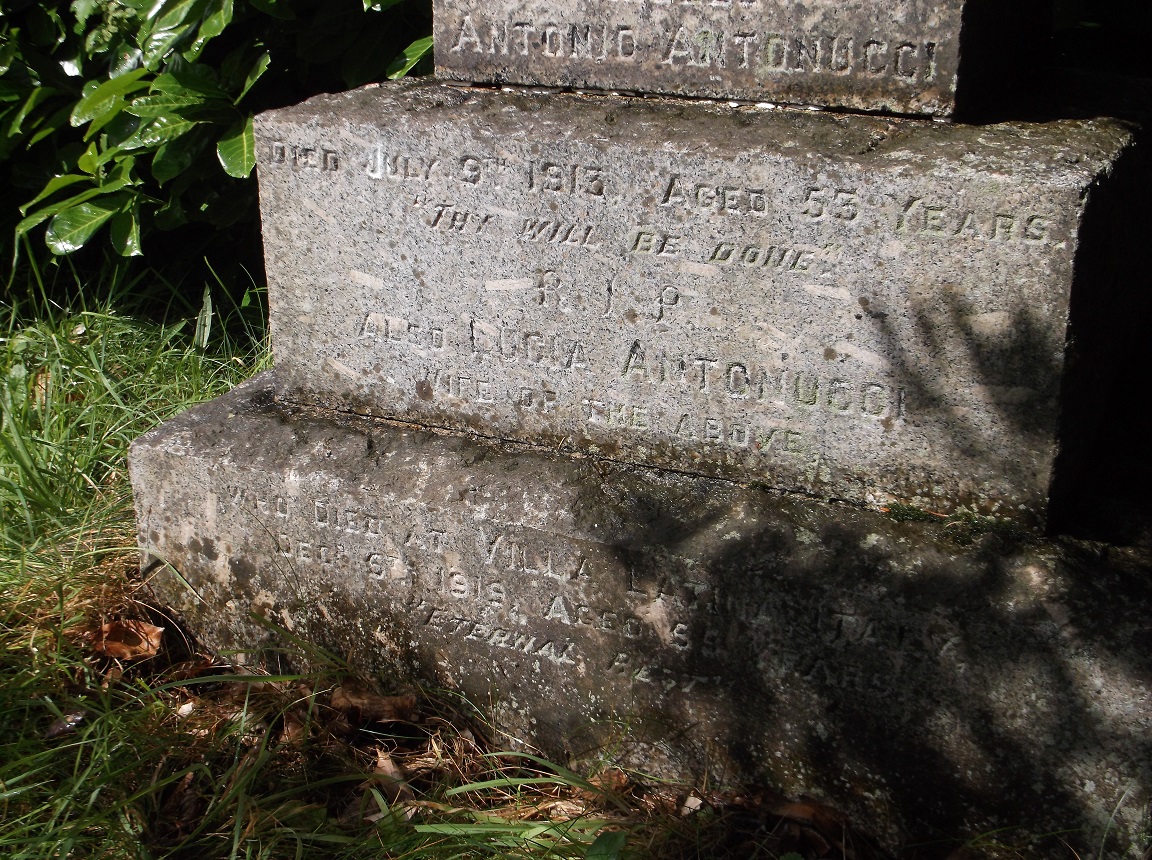
Grave of Angelo Antonio Antonucci

At heart this story is simple.  It is the record of an Italian family who emigrated from a poor part of Italy looking for a better life.  They arrive in Teignmouth, set up a business here, the parents die and the children disperse.  This simple story though is woven into an immense tapestry of social history which gives some depth to their lives and which would have inevitably coloured their story.

So this is a sort of social history interpretation which starts in Picinisco, where Angelo was born in 1860.

Picinisco and the war

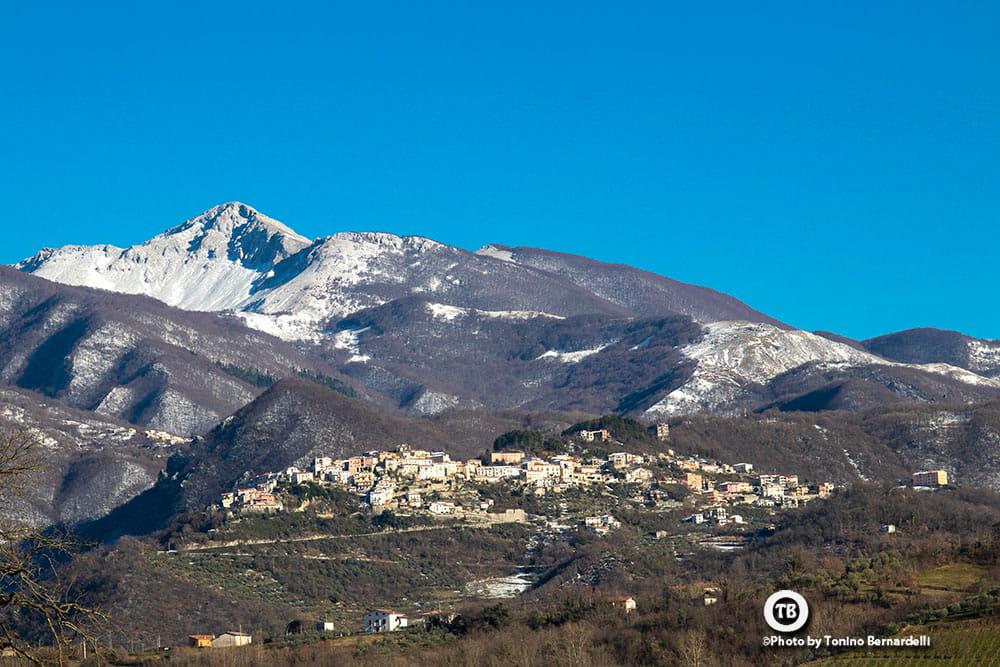
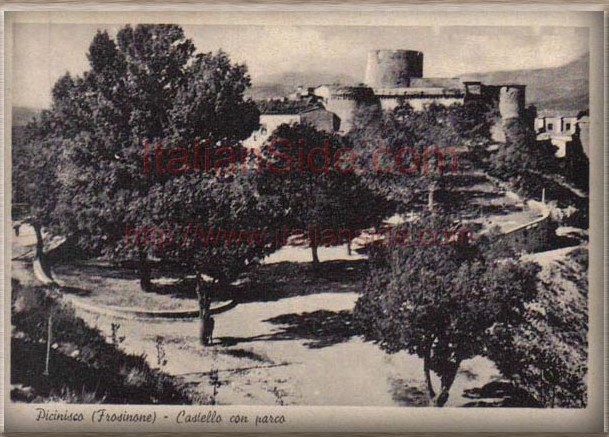
Picinisco, once a small village with a castle, is now a small town which vies with other similar mountain resorts in the region of Lazio, Italy, for a share of the tourist trade.  It lies sufficiently off the beaten track though to ensure that it is not overrun.  Few people in this country will have heard of it.

If I mention “Monte Cassino” though the picture changes.  Picinisco lies 25 miles or so north from there and was on the path of the Allies advance on Rome in World War II.  It was of sufficient strategic importance to be mentioned in the British press when it was captured.  As the Scotsman of 31st May 1944 reported:

“The first indication that the Italian Liberation Corps is taking an active part in the battle for Rome was given yesterday in a message to Italian troops from Marshal Giovanni Messe, Chief of the Italian General Staff (says Reuter from Naples) …..

‘This new blood is generously spilled in order to redeem new Italy and give her the right to live’ …..


Troops of the Italian Corps, clearing up the wild mountain region at the western end of the Abruzzi National Park, have captured the 7000-foot high town of Picinisco, on the headwaters of the Melfa river, six miles north-east of Belmonte (adds Reuter).  The Italian units taking part in this drive include Alpini, Bersaglieri and parachutists, specially trained and equipped for mountain fighting.  The Corps is pressing forward from points reached during a 12 miles advance across some of the wildest mountain areas in Italy.”

Brigands

Until that time Picinisco seems to have remained a sleepy mountain village for 70-80 years but when Angelo and his two siblings, eldest sister Palma and older brother Michele Angelo Antonio, were growing up there, it was a more disturbed place.  There are reports over several years of “brigand” activity there which culminated in 1870 with the capture and slaughter of one the main groups headed by the infamous Fuoco.  The following graphic description appeared in the London Evening Standard of 23rd August 1870:

“Four men, captured and held in pawn by the famous brigand Fuoco, have performed a deed of heroism which deserves to be requited by some conspicuous form of public acknowledgment. Who they were and where they were seized we do not learn; but on the 16th instant they were in the custody of their captors in a well wooded retreat, about half-way up Mount Cavallo, in Terra di Lavoro.

The brigands, five in number, had plenty to eat and drink, and when they had appeased their natural cravings became very sociable, consented to loosen their prisoners’ bonds, and beguiled the evening hours with cards, varied by pitch and toss, played not with vile halfpence but with five-franc pieces and Napoleons. The flask all the while circulated without stint, and in good time the robbers dropped off to sleep, leaving one of their number, armed with a revolver, to keep watch over the prisoners.

How these men managed to concoct their plan is more than I can say. How it just happened that four such resolute fellows were thrown together on this occasion is another fact not explained; but the fact is that, at the preconcerted signal, each of them had his part cut out for him, and performed it with perfect success. When the word was given, No. 1 darted forward, and, with a small pocket-knife, obtained, we are not told how, divided the snoring Fuoco’s weasand as clean as a whistle; No. 2 made for an axe which he had kept in view all the evening, and dexterously clove the skull of a second sleeper. No. 3, armed with a wooden mallet, devoted his whole attention to another. The sentinel seems to have kept a bad look-out, for we learn that he was dispatched by a shot from a gun belonging to one of his slain companions; and, the fifth of the batch, returning to consciousness in time to see the tables turned upon him, found safety in flight, not however without receiving a broad hint to be off, in the shape of a random stroke from the axe above mentioned.

Our four heroes thus remained masters of the field, and after collecting the spoil, consisting of three rifles, a dagger, a cake of soap, and a sensational romance ” from the French” not forgetting, probably, the five-franc pieces and the Napoleons with which their captors had improved their last remaining hours here below, made the best of their way down to the village of Picinisco, where they brought the joyful but unexpected tidings that the redoubted Fuoco. earthly career was at an end.

Fuoco, after having been for years the terror of the neighbourhood, had retired to Rome upon a decent competence, but bad speculations and drink subsequently undermined his resources, and last spring he took to business again, returning to the scene of his former exploits and managing to set the law at defiance, until in an evil hour he formed the acquaintance of our clever friends, whose names the newspapers do not deign to record, although it would, I think, be difficult to find four men who have deserved better of their country. A score or two of men of this stamp would do more to clear the land of brigandage than all the regiments in his Majesty’s service.”

That must have been an unbelievably terrifying period for the villagers.  As for the Antonuccis, it seems that the family gradually emigrated.

Emigration

Angelo’s sister Palma, who was born in 1852, married Giovanni Perilli in 1880.  They must have left by 1884 – their first son Geraldo was born on the 6th May that year in France.  They then moved on to England, their second son Michael being born in 1886 in Birmingham whilst daughter Maria Carolina was born in 1888 in Newton Abbott.  By 1891 they were living in the St Andrews district of Plymouth.

Angelo’s elder brother Michele Angelo, born 1857, probably left at about the same time.  The records would suggest that again this was by 1884 at the latest since he is shown as marrying Antonia Tomasso in Plymouth in April that year. He stayed in Plymouth until his death in 1919.

Angelo Antonio Antonucci

It looks like Angelo, being the youngest, perhaps traditionally had to stay to look after his parents. Whatever the reason, he remained, married Lucia Palombo, and together they had three children – Giuseppe, Giacomo and Elisabetta.  I would surmise that when his father Luigi died (probably some time between 1894 and 1896) he too made the bold decision to up stakes and move his whole family, including his mother Domenica, to Britain.

The period from the middle of the 19th century through to the early 20th century was one of extensive migration from an impoverished Italy to lands of opportunity elsewhere.  Many Italians emigrated to America but Britain and France were also popular destinations.

The immigration tended to result in Italian enclaves being established in or close to the destination ports.  Although most immigrants from Picinisco apparently ended up in Scotland (perhaps because of the similar mountainous terrain?), Antonio and his family landed in Plymouth, presumably to be close to the rest of his family all of whom were also there by that time.  They must have lived in Plymouth for a little while because their next child, Crestina, was born there in 1896.

Ice-Cream

They then chose to move to Teignmouth and by 1901 are showing as living at 6 Teign Street where they set up an ice-cream business.  It could be that the opportunity came up to take over an existing business. The Teignmouth Post and Gazette of 6th August 1886 advertised a G.Ellis selling ice-cream at 5 Teign Street – could this have been the opportunity for Antonio?

Ice-cream was a common feature of many Italian immigrant families and there are still numerous ice-cream parlours around the country bearing the Italian names that reflect their roots.  You have to wonder why.  ‘Ice-cream’ of sorts (more similar to water ices like “granita”) had been around in Italy since Roman times – there is documentary evidence of it being served to Nero.  But it’s not likely that someone in a small mountain village would be able to make a living there from ice-cream though perhaps Angelo’s wife, Lucia, would have routinely made it as a treat for the family?  The main ingredient for ice-cream is obviously ice, which would be in plentiful supply in the winter in the snowy mountainous areas of Lazio.

So, for those Italian immigrants was it simply a case of grasping an easy market opportunity in a new country?  Ice cream is easy to make, providing you can get ice; there would obviously be a demand for such a delicious product and there was probably initially little local competition.

Ice-cream made its first appearance in this country in 1671 at a royal banquet given by Charles II.  Even there though it was served as a rare and special dessert only to those on the top table whilst the other diners could only suffer whilst watching!

Carlo Gatti

It looks as though commercial production for public consumption was started in London in the 1840s by Carlo Gatti who had come from Ticino – the mountainous, Italian-speaking region of Switzerland. 

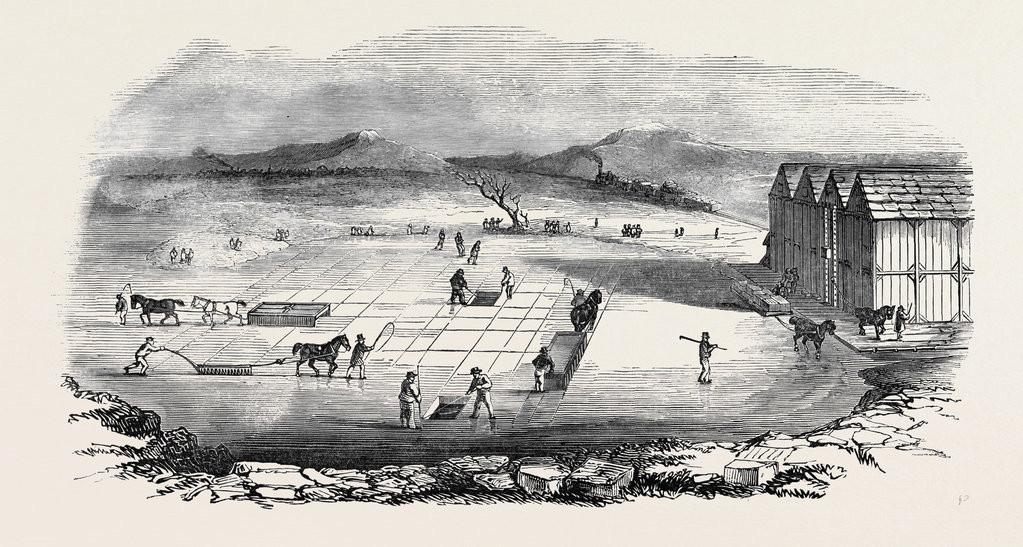
Carlo negotiated a contract with the Regent’s Canal company to cut ice from the canal in winter which was then stored in insulated warehouses.  It seems that little thought was given to the quality of water from a London canal even though there were reports of sickness after consuming the ice-cream. 

The notorious penny-lick glasses.
From Antique Collecting magazine

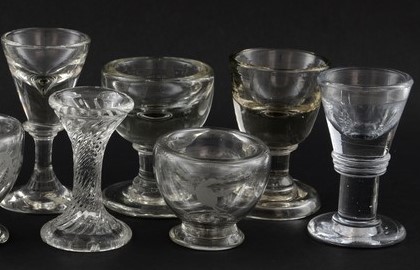
This was exacerbated by the way in which ice-cream was sold in small glasses called “penny-licks” – pay a penny, lick the ice-cream out of the glass and return the glass to the vendor. The glass would be wiped or swilled in a bowl of water ready to be filled again for the next customer.  This was eventually banned (but only in 1899) when a link with the spread of TB was established.

In its early stages in London the ice-cream industry was not an easy living for Italian immigrants.  The ‘History of Ice-Cream in London’ describes:

“….. the lives of the Italians living in the Saffron Hill slum in North London (think Fagin’s lair, but worse), the majority of whom made a living selling these ‘ices’. In little villainous-looking and dirty shops an enormous business is transacted in the sale of milk for the manufacture of halfpenny ices.”

Ice-cream had certainly made an appearance in Devon and Teignmouth by the 1870s but, judging from references in local papers, it still seemed to remain a more exotic dessert for banquets rather than being readily available to the general public.  In a popular sea-side resort such as Teignmouth though it wasn’t long before popular demand for ice-cream resulted in a proliferation of vendors.

Ice-Cream and the Antonuccis

The problem of sanitation and ice-cream production remained through to the next century.  Production was still not regulated and examples of illness caused by unsanitary conditions appeared regularly in the local papers.  The vast majority of these related to London but one local example appeared in the Western Morning News of 2nd November 1900:

DANGERS OF ICE CREAM.
FATAL PTOMAINE(Note 1) POISONING AT PLYMOUTH


Mr R. B. Johns, borough coroner, held an inquiry yesterday at Plymouth, touching the death of Christopher Kemp, aged 12, son of Thomas Kemp, of 3, Stanlake-terrace, Plymouth.

Thomas Kemp stated that on Saturday evening last, when the deceased came home, he complained of a pain in bis leg, saying that a boy had kicked him on Wednesday last. On the following day he was laid up, and died on Tuesday night. He complained on Monday of a headache. A doctor was sent for but the boy died before his arrival. His younger brother told the witness that the deceased had eaten four five ice creams on Saturday at the shop of M. Antonucci, ice cream vendor, of 49 Treville Street.

Dr. E. A. Travers-Stubbs, of Laira Villas Plymouth, said that he had made a post-mortem examination and found that death was due to ptomaine poisoning. the result of eating the ice cream.  The kick was in no way attributable to his death.  The Coroner remarked that this was an important case, which he should report the medical officer of health.  The jury found that death was due ptomaine poisoning, caused by eating ice cream.”

M. Antonucci was, of course, Antonio’s brother.  He strongly challenged the finding in the press and I can find no evidence so far that he was actually prosecuted.  This is how the Western Evening Herald of 6th November 1900 recorded it:

THE ICE-CREAM QUESTION (To the Editor of the ‘Western Evening Herald’)

Sir, – I noticed in the papers last week an account of the death of a boy who it was alleged died through the effects of eating ice-cream which was supposed to have been supplied by me.  By that report it would appear that my ice-cream was impure and poisonous.

I am confident that it is perfectly pure and to show that my statement is correct I am willing to pay £5 to any person who can prove the contrary by analysing the same.  I write this in common fairness to myself, as otherwise I should lose the good name which I have already earned in this town for selling pure ice-cream.

M. ANTONUCCI
Plymouth, November 5th, 1900”

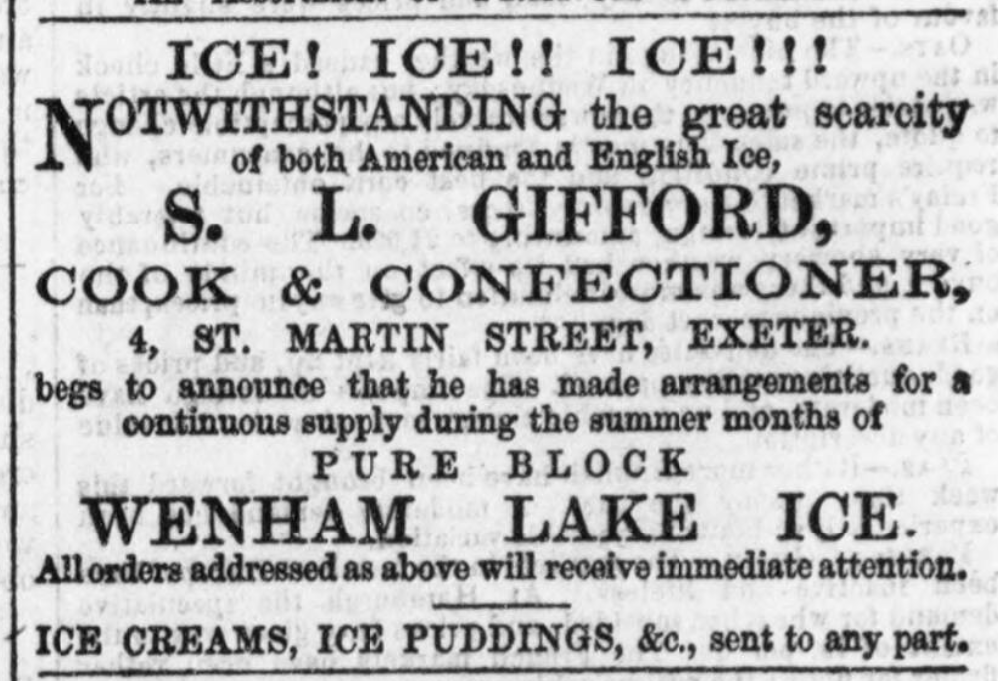
The issue of water quality in the production of ice-cream was improved through the importation of ice first from Norway and then America – in particular from Wenham Lake, Massachusetts, which was famed for the crystal clarity of its water. One of the images below shows an advertisement from the Exeter Flying Post of 20th May 1863.

But there still remained the problems of sanitation where ice-cream was being made.  This point was picked up in Torquay after the above case.  The Torquay Times and South Devon Advertiser of 16th November 1900 reported:

“Councillor Appleton rendered the public a useful service in calling attention at the meeting of the Town Council to the sale of ice cream in the streets of Torquay, with reference to a death at Plymouth from ptomain poisoning after eating ice cream, because it was shown that the Medical Officer of Health (Dr. Karkeek) was on the alert, and had visited the places where the compound is prepared in Torquay, in July or August last.  He found that one ice cream vendor prepared his concoction in a stable, where animals were kept, that another used a stable in which no horses or other animals were kept, and that the third made his in a wash-house.  We have often felt that if people could see the conditions under which these compounds are mixed, and the places where they are stored after being made, there would be far less consumption of it.”

By 1901 the government was starting to take broader action as the Western Times of 6th June 1901 described:

“The voice of the ice-cream merchant is heard on all sides in Exeter.  It may be taken for granted that the raucous vendor of alleged ice-cream does not follow the reports of Parliamentary proceedings, and it may, therefore, come as a surprise that the most drastic legislation of the present session is to deal with these ‘mixtures’.  A Committee has been considering the matter, and passing clauses in Bill after Bill promoted by municipal corporations all over the country, ‘regulating the manufacture and sale of ice-creams’.  ‘Clause allowed in accordance with recent precedent’ is the formula adopted in the official record to the House of how the matter has been dealt with in committee; but when Tennyson talked in immortal verse of ‘freedom broadening slowly down from precedent to precedent’, he assuredly had not the ice-cream vendor in mind.”

I can find no evidence of the sanitation problem occurring in Teignmouth which might explain why Teignmouth Council had not started to think tentatively about the health problems of ice-cream until 1901, as reported in the Teignmouth Post and Gazette of 10th May 1901:

IS THE ICE CREAM PURE?

The Rev. Anson Cartwright asked if the medical officer of health ever analysed the ice cream sold in the streets.  The Medical Officer (Dr. Piggott) replied that he should only have power under the Sale of Food and Drugs Act.  The inspector appointed under the Act was Mr. Drake. He anticipated no difficulty would be in the way of analysing the ice cream if the Council thought it desirable.

The Rev. Anson Cartwright: Is it your opinion that analysis is desirable?

Dr. Piggott: So far as I know anything about the conditions under which ice cream is manufactured it is only a small business and I do not think there would be any objection to taking samples”.

A second problem in selling ice-cream was the increasing competition between vendors which led to many a fight and occasionally murder.  There are many reports of these in the press and Teignmouth was not immune.  The Exeter and Plymouth Gazette of 26th August 1904 reported:

“A ‘hokey-pokey’(Note 2) row took place on Teignmouth Den on the occasion of the Regatta.  Two Italian ice-cream vendors assaulted another of the same nationality”

The same paper from three days earlier gave a more detailed account of the rumpus:

English v. French Fighting

There was considerable amusement at the Teignmouth Petty Sessions yesterday during the hearing of a summons for alleged assault taken out by Dominic Forte, ice-cream vendor, of Exeter, against Gusseysh Jannette and Antonio Trupper, two other Italians.

It appeared that on the day of the Teignmouth regatta some discussion took place between the parties as to the quality of the ice-cream they were supplying.  It was alleged that one of the defendants struck Forte on the nose, making it bleed, while the other took up a long pole and hit him across the back.

Forte, said one of the witnesses, ‘wanted to play fighting English fashion but Trupper played fighting French way and , lowering his head, charged Forte like a bullock at a gate’.  The quarrel, apparently, had begun 12 months ago, and the excuse for the use of the pole was that the defendants had been told that Forte carried a knife and a revolver in his pockets, and was seen to put his hand towards his pocket.

The Bench fined each defendant 10s inclusive.”

There is no evidence of the Antonucci family taking part in such ‘hokey-pokey’ shenanigans and the overall impression I have is that they were an honest, hard-working family keen to fit in with life in Teignmouth.  Angelo’s daughters took part in various social events – musical performances etc, and there is a report of his sons, Giuseppe and Giacomo, being canopy bearers at the Feast of Corpus Christi at the Notre Dame Convent.

There is a particularly nice story about his daughter (probably Crestina, judging by the date).  As the Exeter Flying Post of 25th August 1900 reported:

HONESTY REWARDED AT TEIGNMOUTH
SIXPENCE FOR FINDING £20
.

A little girl named Antonucci, daughter of Mr. Antonucci, of Teign-street, ice cream vendor, whilst on the beach near the Pier on Tuesday afternoon picked up a purse and handed it over to P.C. Butler, who was standing near. A lady came over and said the purse belonged to her. The Constable opened the purse and found it contained what the lady stated. about £20 and three return tickets to Cheltenham. The constable showed the girl to the lady, remarking that it was she who had picked it up, when the little one was rewarded with sixpence.”

A larger reward came a couple of weeks later when a local lady obviously thought sixpence was not enough.  As the Teignmouth Post and Gazette of 7th September reported:

“A lady at Chudleigh Knighton, having noticed the paragraph in the papers that a little girl named Antonucci had received 6d for handing over a purse she found on Teignmouth beach, containing over £20, has sent P.S. Richards 5s to give to the girl for her honesty.  The lady who lost the purse belonged to Cheltenham.”

Angelo, Lucia and sons
Giuseppe and Giacomo

The Antonuccis were not immune from the law though.  When it came to business Angelo’s two sons, Giuseppe and Giacomo (now anglicised to Joseph and Jack), were the eager salesmen, willing to risk pushing the boundaries of a street-vendor.  On several occasions Joseph had been hauled up before the magistrates for causing an obstruction; the fine though would have probably been outweighed many times over by the profits made especially on those days with large holiday crowds in Teignmouth.  As the Western Times of 12th August 1913 reported:

“At Teignmouth yesterday, Joseph Antonucci and Jack Antonucci, ice-cream vendors, were charged with causing an obstruction in Den road on Bank Holiday.  P.C. Dallyn said defendants were doing a good trade, and did not seem to mind causing obstruction.  P.S. Holland said they had nearly 20,000 people in the town on that day.  Both defendants were fined 7s. 6d. inclusive.”

Diversifying

Once Angelo’s ice-cream business was established it seems that he diversified.  Ice-cream would have been a seasonal trade so the question would be how he could maintain an income throughout the year.  The answer was “chips”.  Records show that by 1911 Angelo was also trading as a chip-potato vendor with an address of 48 Teign Street shown in a later directory.

Joseph’s minor flirtations with the law extended over into this business too as the Western Times of 12th April 1912 reported:

A Teignmouth Obstructionist

At Teignmouth Sessions yesterday, before Col. Nightingale (in the chair), Col. Graeme, and Messrs. A. G. Sparrow, R. Alsopp, M. L. Brown, J. B. Bissell, and H. Conybeare, Pucci Antonucci, of Teign-street, Teignmouth. was charged with obstructing the highway with his chip-potato cart in Regent street on the 10th April.

P.C. Dalling said that he saw the defendant standing in the middle of the street for half an hour, selling hot chips. In consequence motor-cars had to swerve to the wrong side of the road, whilst great inconvenience was caused to pedestrians. He had warned defendant before that he would get into trouble if he did not refrain from causing the obstruction.

P.S. Hulland said they had had numerous complaints of the obstruction caused by chip potato carts. The Council at the beginning of the winter had complained of it, and the police had kept the carts continually moving about. The Council tried to prevent the selling of chips in the streets altogether, but found they could not do it.

The Chairman: He ought to severely punished.  It is a shameful thing.

Defendant (through a friend) said he had not been warned many times.

ln fining defendant 10s inclusive, the Chairman said that if he came there again he would receive a very heavy punishment That was the first time he had been convicted.”

Last days

Angelo Antonio Antonucci died in 1913, aged only 53.  His family grew during his time in Teignmouth with three more daughters – Maria, Angelina and Beatrice.  The cemetery records also indicate that there was one still-born child.

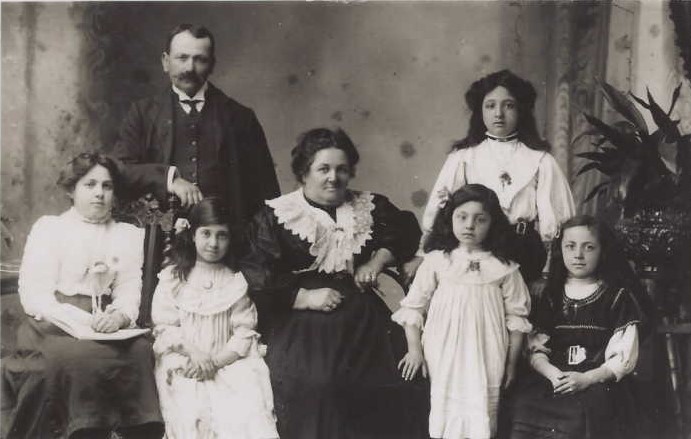
Angelo, Lucia and their 5 daughters, the 3 youngest at the front being born in Teignmouth

Angelo’s siblings died soon after too – his sister Palma in 1917 and his brother Michele in 1919.  It is not exactly clear what happened to his wife Lucia.  She is not recorded on the cemetery records but is shown on the headstone as having died in Villa Latina in 1919.  Thanks to help from Italian researcher Ann Tatangelo we have established that she is not on the Villa Latina cemetery list but that her body could have been moved between 10-30 years after her interment.  The only way of verifying that is by visiting the town hall to examine the original records.  It seems strange that Lucia would have left her family behind in England (her youngest daughter Mary was still only 17 in 1919) unless she was simply on a short visit to Villa Latina and died there unexpectedly.

There is a mystery surrounding Angelo’s mother too.  She appears on the 1901 census but with a name that appears to be ‘Fralongus’ not Domenica.  Ann Tatangelo has confirmed that Fralongus means nothing in Italian so it may simply be a misinterpretation by the census enumerator at the time.  There is no record of death nor of burial in Teignmouth cemetery.  Did she return to Italy too prior to her death?

Angelo Antonio Antonucci is buried in plot G61 in Teignmouth Old Cemetery.

Footnotes

  1. Ptomaine. According to the Lancet ….. One of many new diseases revealed in the late 19th century by the new science of bacteriology.  The ptomaines were alkaloids produced by the decomposition of animal substances; putrefaction, fermentation, and infection being processes associated with micro-organisms after the work of Pasteur.  Sir William Osler (1906) noted that ptomaine poisoning had become synonymous in popular speech with “food poisoning”.  Richard Cabot (1913) called ptomaine poisoning a fashionable diagnosis, which patients loved to brandish about.  Ptomaine poisoning lost its scientific credibility by the 1950s.
  2. Hokey-Pokey.  According to ‘The History of Ice-Cream in London’:  “the streets of London echoed with ice cream sellers, shouting their wares: ‘Gelati, ecco un poco!’ (Ice cream, here’s a little bit!) or ‘O che poco!’ (Oh, how little!— as in, Oh, how cheap!), which it’s believed then led to the bastardised cry of ‘Hokey Pokey!’.  The term ‘hokey-pokey’ soon came to mean poor-quality ice cream; sometimes made of questionable ingredients, under unsanitary conditions.

Acknowledgments

Thanks to Italian researcher Ann Tatangelo for help in clarifying questions about Angelo’s wife Lucia and his mother Domenica.  Ann runs Angel Research & Genealogical Services and can be contacted on https://angelresearch.net

Sources & references

Extracts from contemporary newspapers are referenced directly in the text and are derived from British Newspaper Archives.

Ancestry.com for genealogy. This includes the family photographs which appear on a specific family site.

Wikipedia for general background information

Other sources, with hyperlinks as appropriate, are as follows.

  1. Italian migration: From ‘Our migration story’
  2. Italian Migration to Great Britain.  Journal article by R.King: Geography Vol. 62, No. 3 (July 1977), pp. 176-186: 
  3. Italian Migration to Nineteenth Century Britain: Why and Where: From Anglo-Italian Family History Society
  4. Italian Immigrants in Nineteenth Century Britain – Realties and Images.  Lucio Sponza.
  5. Picinisco Local forum
  6. Brief History of Ice-Cream Big issue article by Robin Weir: 
  7. Victorian ice-cream:  English heritage article
  8. The History of Ice-Cream:  From the Ice-Cream Alliance trade organisation
  9. The History of Ice-Cream in London:  From London 1st
  10. Wenham Lake ice:  From Victorian England
  11. Lancet : Ptomaine poisoning:

The First Twenty

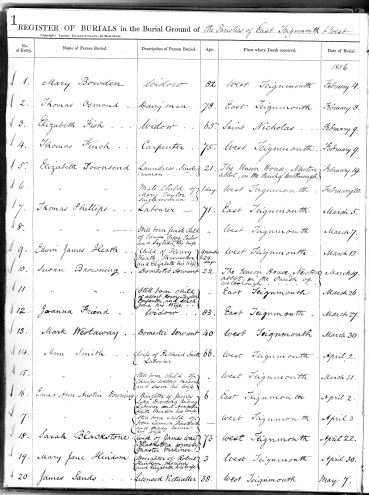
Teignmouth Old Cemetery officially opened in early 1856 and the first person to be buried there was Mary Bowden.  She was buried in an unmarked, unbricked grave in what appears to be a fairly arbitrary position (plot number F51) in consecrated ground close to the Anglican (“non-dissenters”) chapel.

The event had a brief mention in the Western Times of Saturday 9th February:

“The new cemetery has been duly licensed for the burial of the dead, and received its first occupant on Monday lost.  The usual burying grounds are now all closed.”

So not only was Mary Bowden buried in an unmarked grave but her name did not even warrant a mention in the reference to the event in the press.

The aethos of the Friends of Teignmouth Cemetery is to “restore, revere, remember”. We can not restore unmarked graves but we can at least start to revere and remember those who are buried there.  This section takes the first step in doing that by collating whatever information we can find about the first twenty people buried in the cemetery.  We have made a start on the basic genealogical information which has been expertly gathered by one of our members, Liz Davidson.

Why “twenty”?  Because those are the people who appear on the first page of the first burial register, as shown below. Thanks to Sophie Sercombe of Teignbridge District Council for photographing the page for us.

From a social history point of view there are some interesting characteristics of the first twenty:

  • The fact that they were buried in unmarked graves is perhaps indicative of the relative poverty in the town at that time
  • Two were young women who died in the workhouse (“Union”) at Newton Abbot.
  • Of the twenty, six (or just under a third) were children
  • Of those six, four were stillborn
  • None of the stillborn children were granted a religious funeral service

Whilst the genealogical history provides an interesting insight into each person we can also ask the more general question of what life was like at the time they died. So, for each month there is a short summary here of what was going on in Teignmouth at the time and what was happening in the world outside. The events in Teignmouth have been taken from contemporary newspapers which have been included in the references as follows:

  • EPG – Exeter and Plymouth Gazette
  • EFP – Exeter Flying Post
  • RCG – Royal Cornwall Gazette
  • WT – Western Times

As an aside, it’s fascinating to discover phrases like the “town scavenger”, “Sunday desecration”, and the “water cart” which are from a different time but has something like the “soup kitchen” simply been replaced by today’s “food banks”?

(For more details about each of the first 20 people buried in the cemetery click HERE)

February 1856

The Burials Teignmouth Events
Mary Bowden, buried 4th February 1856 in plot F51

Thomas Osmond, buried 8th February 1856 in plot B86

Elizabeth Fish,
buried 9th February 1856 in plot F49

Thomas Finch, buried 9th February 1856 in plot F50

Elizabeth Townsend, buried 19th February 1856 in plot F48

Unnamed male child of Mary Taylor,
buried 20th February 1856 in plot F117


The Soup Kitchen – 2313 quarts of soup were distributed to the poor of this town during the past week (EFP 7 Feb)

The annual soiree of the Teignmouth Useful Knowledge Society is announced ….. and on the following evening Dr. Daniel LL.D will give a lecture “On the Life and Times of Michael Angelo (sic)”. (WT 9 Feb)

A meeting was held at the Assembly Rooms … for the purpose of appointing a deputation to wait on Capt. Spratt, RNCB, to invite him to a public dinner, as a testimony of the appreciation of the inhabitants of Teignmouth of his public services during the past year, while in command of HM ship Spitfire in the Baltic. (WT 9 Feb)

At the Commissioners Meeting on Tuesday … Mr. Superintendent Ockford complained of the neglect of Dobbs, the town scavenger, in not removing the ashes &c, when ordered.  He was cautioned to be more attentive in future. (WT 9 Feb).

A petition against “Sunday desecration” has been signed by a great number of the inhabitants of this town. (WT 16 Feb). 

Meanwhile in the world outside:

1 Feb. The Crimean War ends when Russia yields to an Austrian ultimatum and agrees to preliminary peace terms at Vienna.

7 Feb Colonial Tasmanian Parliament passes the 1st piece of legislation (the Electoral Act of 1856) anywhere in the world providing for elections by way of a secret ballot

17 Feb Heinrich Heine, German poet and lyricist (Schubert, Liszt), dies at 58

March 1856

The BurialsTeignmouth Events
Thomas Phillips, buried 5th March 1856 in plot F47

Still born female child of Edwin and Sybilla Sally Piper, buried 7th March 1856 adjoining plot F3

Edwin James Heath, buried 12th March 1856 in plot F116

Susan Browning, buried 19th March 1856 in plot F46

Stillborn child of Albert Henry & Sarah Jane Taylor, buried on 26 March 1856 next to plot A50

Joanna Friend, buried 27th March 1856 in plot F45

Mark Westaway, buried 30th March 1856 in plot F44

Stillborn child of Charles & Susan Webber, buried on 31st March 1856 in a spot adjoining plot A49.  


SOUTH DEVON RAILWAY – HALF-YEARLY MEETING …. From the report of the engineer (I. K. Brunel, Esq.) ….. The damage done last winter to the sea-wall near Teignmouth had been strongly and efficiently repaired.  The strengthened footing has been carried to beyond East Teignmouth tunnel and would appear to promise security against all future effects of the washing away of the beach. (EPG 1 March).

COMMISSIONERS OF IMPROVEMENT. – A letter was read from Mr Mackenzie, complaining of a slaughter-house on Myrtle Hill, in the occupation of Mr Snow, butcher; and an animated discussion ensued on the propriety or otherwise of removing all slaughter houses from the town. (WT 8 March).

USEFUL KNOWLEDGE SOCIETY. – Mr J. N. Hearder of Plymouth, the well-known and highly appreciated philosophical lecturer, will deliver a lecture at the Public Rooms, on “Electricity”, illustrated by numerous experiments.  In the course of the lecture, cannons placed on the Den will be discharged from the lecture room by the electric field. (WT 8 March)

Some of the market women who bring vegetables to market are in the habit of selling by measure.  This is contrary to law, and the inspector of weights and measures would be only doing his duty by seeing that they not only sell by weight, but that the weights and measures are accurate. (WT 8 March)

A medal of honour has been given to Major Sir Warwick Hele Tonkin, one of the presidents of the Societé Universelle, Paris, for his ingenious and scientific method for facilitating the study of music and harmony (RCG 21 March)

Meanwhile in the world outside:

5 Mar – fire destroys Covent Garden Theatre in London

15 Mar –the Boat Race 1856, first of the annual series rowed between Cambridge and Oxford University Boat Clubs on the River Thames in London; Cambridge wins.

31 Mar – the Treaty of Paris is signed, ending the Crimean War

April 1856

The BurialsTeignmouth Events
Ann Smith, buried 2nd April 1856 in plot G122

Emma Ann Austin Downing, buried on 2nd April 1856 in  plot F115

Still born child of John & Mary Emma Cannon, buried on the 3rd April in a spot adjacent to plot A49

Sarah Blackstone, buried on 22nd April 1856 in plot G120

Mary Jane Hindom, daughter of Robert and Elizabeth Hindom, buried on 30th April 1856 in plot F114

James Sands, buried on 7th May 1856 in plot F43 


ACCOMMODATION FOR VISITORS – During the past week workmen have been engaged in fixing seats on the sea wall, the ‘Wanes’ and on the Bishopsteignton Road.  This will prove a great accommodation to visitors and the public generally, who can now sit and admire the beautiful scenery of the surrounding neighbourhood, and inhale the exhilarating sea breezes (WT 5 April)

The Royal National Life Boat Institution has forwarded to the hon. Secretary of the Teignmouth branch 10s. for each man who went off in the lifeboat with a view to render assistance and save life from the wreck of the schooner Sarah of London (EPG 5 April).

Captain Hull, of Clifton, delivered an able lecture on Monday evening last, at the Zion Chapel, in which he shewed the social and moral state of the Turks before the establishment of the Christian religion in that country in 1819. (WT 5 April).

Near East Teignmouth Church several coins have been found chiefly of ancient date, in the sand. One boy is reported to have found a spade ace guinea, and several small silver and copper coins (WT 12 April).

IMPROVEMENT ACT – The time allowed by this act for continuing thatch on houses in the town, being about to expire on the 7th of June, the commissioners have very properly given notice that they purpose carrying the powers of the act into operation.  The advantage to the town, by all who look at it rightly, will be great, although it may and will be very inconvenient to many – to the carpenters and masons it will be a great boon – the act is peremptory, and if the owners of the houses neglect to take down the thatch, the commissioners may cause the same to be taken down without being considered trespassers (WT 19 April).

An unusual railway accident occurred here on Thursday morning last.  A cat attempted to cross the rails as the mail train appeared in view, but before Puss could get clear the engine came down upon her and cut her in two (WT 19 April)

The water cart made its first appearance for the year in public, on Saturday last, to the astonishment of the public generally, as in former years it has not made its appearance until the first of May.  If the commissioners were to bring it out in the month of March, when clouds of heavy dust blow into the tradesmens’ shops and spoil their goods, they would be doing a great service. (WT 26 April).

Meanwhile in the world outside:

3 Apr Palace of the Grand Master of the Knights of Rhodes badly damaged by gunpowder explosion, kills 4,000 on island of Rhodes

19 Apr – the iron-hulled paddle steamer RMS Persia (launched on the Clyde, 1855) sets out from Liverpool on a 9-day, 16-hour transatlantic crossing at an average 13.11 knots (24.28 km/h) to regain the Blue Riband for the Cunard Line.

6 May Sigmund Freud is Born.

If this has whetted your interest then to see the details about the first 20 people buried in the cemetery click HERE

A Walk on The Wild Side

Or ….. Our Wildflower Project

The Victorian Heritage

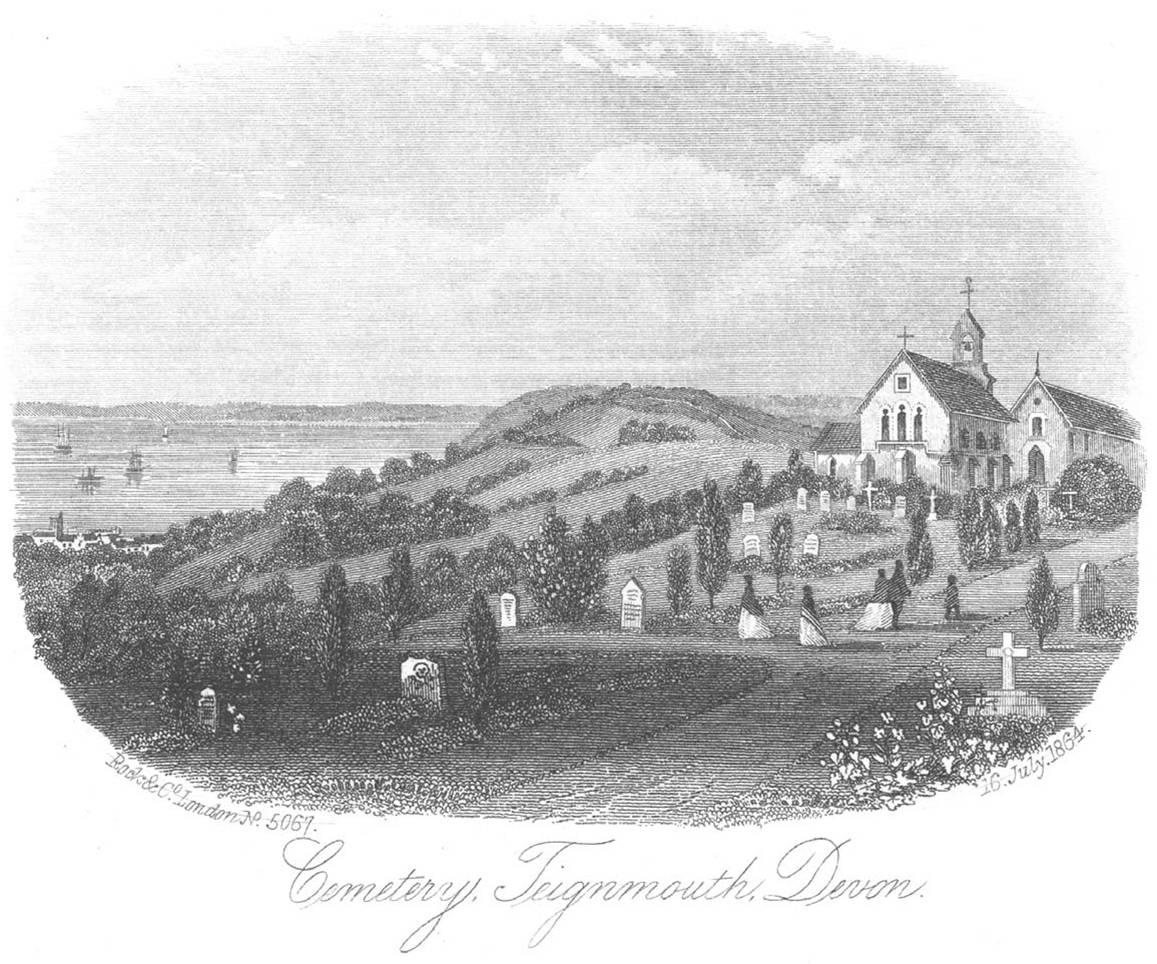
Teignmouth Cemetery 1864

In 1856, when Teignmouth Old Cemetery was created, the Victorians had a vision of “extra-mural” cemeteries not just as burial places but also as green spaces for people to come and enjoy.  They viewed them as “garden cemeteries”, oases of peace which anyone in the community could enjoy. That is reflected in this lithograph from 1864

The cemetery originally stood on its own above the town with sweeping views across the sea.  You can imagine the feel of the cemetery from this quotation by the niece of the artist William Yeames who is buried here alongside his wife Anne:

Grave of William Yeames and his wife Anne

“… on the cross which marks the spot where we laid him, in that beautiful hillside cemetery, within sight of the sea, changeful as life itself, on one hand, and the still purple moors on the other, my aunt had the same word inscribed which marks the tomb of Albert Durer in Nüremburg : EMIGRAVIT.”


Water Contamination

These cemeteries though were also part of the solution to a major ecological problem of the 19th century – the increasing prevalence of water-borne diseases such as typhoid and cholera through contamination of the water-table.

Church graveyards in towns were closed and replaced by these “extra-mural” cemeteries

The Current Challenge

Moving on two centuries we are trying to restore this Victorian aethos of green space.  Over the years the scene has changed as housing developments have impinged on all sides.  So the idea of the cemetery as a green space is even more important now than ever with this increasing urbanisation.

But we now have our own even more critical ecological crises – climate change and the detrimental impact we as a species are having on the planet.

As we started work on restoring the cemetery we became aware of different areas that had evolved in different ways:

  • The buildings and their immediate surroundings
  • Marked graves which could be as large as a vault or just a simple small cross.  Most though would have some form of headstone and kerbstones marking the boundary of the grave
  • Large areas of open grass where people have been buried in unmarked graves

So the challenge was to restore access to marked graves whilst re-instating the Victorian idea of a community green space and modernising this concept to match the particular ecological challenges we face today, one of which is increasing biodiversity.

A Wildflower Area

There are many aspects of biodiversity but the one we are best placed to influence is the flora of the cemetery.  We started four years ago with a survey of the wild flowers in the cemetery.  Click HERE to go to our nature page on flowers.

As we cleared away areas of overgrowth such as brambles, ivy and self-seeded saplings we have taken care to retain wild flowers wherever possible.

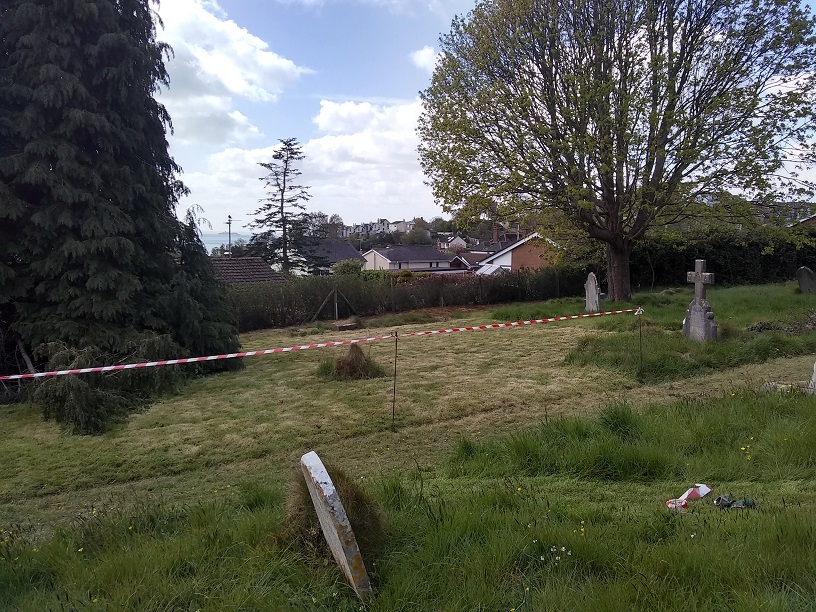
We are in a position now, though, to take some more pro-active steps.  With agreement from Teignbridge we have embarked on a small project to convert a self-contained area of open grass into a wildflower area.

We are doing this with assistance from the community group “Thriving Teignmouth”.

The area has been divided into two to test different approaches.

Cornfield Mix

In the first area the grass will the lifted down to about 6-9 cms so the roots are removed.  The remaining topsoil will then be raked to a fine tilth and wildflower seeds (native varieties) will be sown.  We are using a cornfield mix including corn marigolds, cornflowers, poppies, ox-eye daisies and many more. Our hope is that we will eventually have a meadow-like area looking something like this.


Yellow Rattle

The second area will be raked and scarified to expose about 50% of the soil.  It will then be sown later in the year with yellow rattle to prepare it for subsequent wildflower seeding next year.  The yellow rattle is a parasitic plant that lives off the grass roots and gradually overcomes them.

Next year we can make an assessment of how successful this experimental project has been and potentially extend it to other grassed areas.

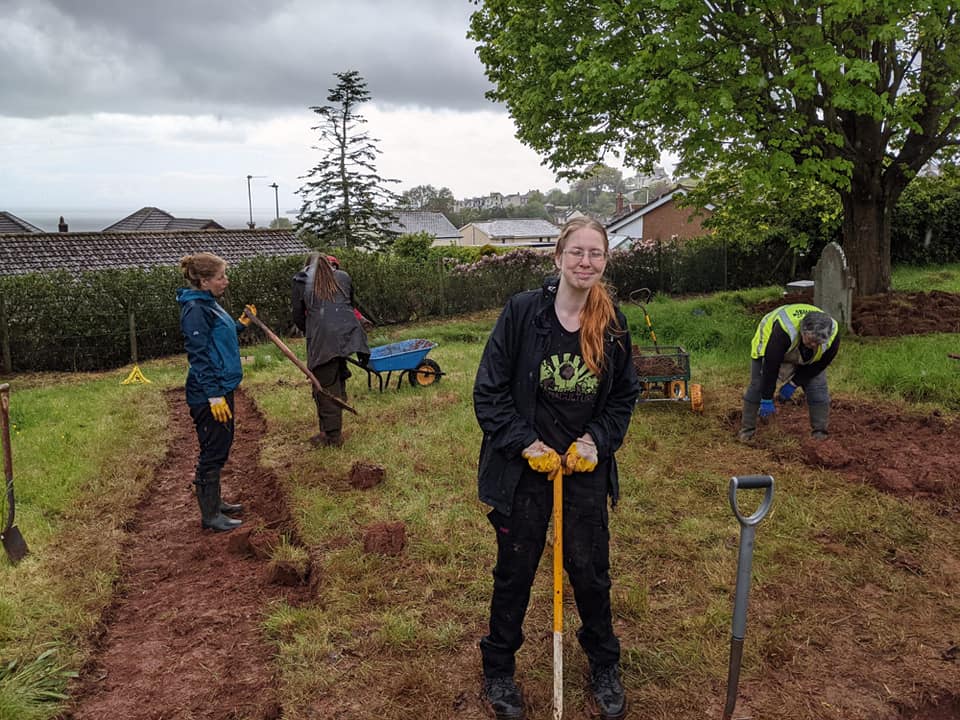
The project started a couple of weeks ago with cutting the grass down to ground level.  Then, after one false start because of the unusually bad May weather, we had our first working session last Saturday, 15th May 2021.  That too was cut short by torrential rain and hail in the early afternoon but progress was made.  One more session should complete the project.  Then we just have to wait!

Here are a few photographs of the work so far:

Remembering the Unmarked Graves

Although the project is focussed on biodiversity we are aware that the area we are planting is one where there are many people buried in unmarked graves.  We plan to put up a plaque showing who is buried there.  There are several marked graves bounding the area as well which will be cleared.

So small wildflower areas like this will provide pleasure and a reminder of those perhaps long forgotten who are buried there in unmarked graves.

If you are interested in supporting our organisations please contact:

Friends of Teignmouth Cemetery: Email fotc2017@gmail.com;  Facebook www.facebook.com/fotc2018; Website: www.teignmouthcemetery.wordpress.com

Thriving Teignmouth: Email thriving.teignmouth@gmail.com  Facebook www.facebook.com/ThrivingTeignmouth  Instagram @thrivingteignmouth

Of Mining, Military, Migration and the Steer Family Grave

From Victoria, Australia

A couple of months ago we were privileged to receive from across the Atlantic the wonderful, adventurous story of Herbert Douglas Langston.  We can now add to our international connections following a contact from Sandra Fuller of Victoria, Australia who was searching for the family grave of Ann and Philip Steer who were buried in section C, together with two of their children Thomas and Agnes.

Sandra explained the link:

“Ann Steer’s maiden name was Barkell and she was born in 1819 in Mary Tavy where her father was a miner.  In 1857, one of her brothers and his wife and 3 sons migrated to South Australia.  One of my maternal great grandfathers was Samuel, the youngest of those sons.  Eventually, Samuel and his family moved to Victoria, where I live.

Regarding the Steer family, Philip was born in 1817 in Ashburton and joined the navy when he was 19.  An ancestor of his lives in Tasmania and we found each other via Ancestry.

Thank you again so much. You’ve really made my day!  It took me a long time to find where Ann went after she left her family in the Tavistock area, so I’m particularly pleased that you’ve gone to the trouble to locate the grave for me.”

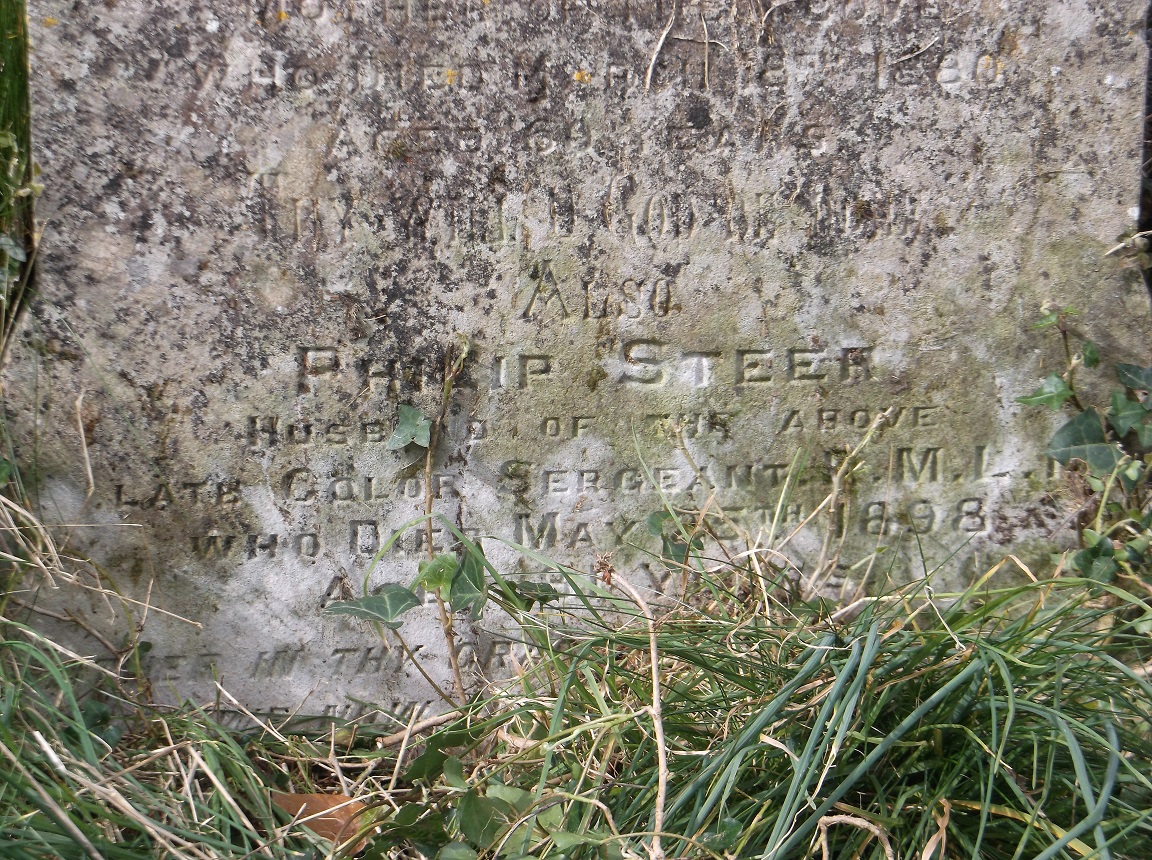
We were not hopeful of finding the grave because it was in a section which had not yet been cleared and in one of the oldest parts of the cemetery where there are few standing headstones and, we presume, a lot of unmarked graves.  So it was a wonderful surprise to actually find the headstone, partially covered by ivy, standing in isolation in this area.

Sandra further explained:

The Barkell and Steer families have been researched from Australia where there are still family connections.  Two of Ann Barkell’s brothers, Edward and Richard, migrated to Australia in the 1850s.  Both were miners, like their father, and spent time in Victoria, most likely looking for gold in the Ballarat area, before settling in South Australia.  One of Philip Steer’s grandsons, William Thomas Steer, son of Edward Philip, absconded from the Royal Navy ship ‘Royal Arthur’ in Sydney, New South Wales in 1899 and eventually settled in Tasmania.

Sandra has kindly put together a potted history of Ann and Philip which we reproduce verbatim below with some images and notes added for historical context.

First though, a brief description of the family roots in Mary Tavy.

An Upbringing in Mary Tavy

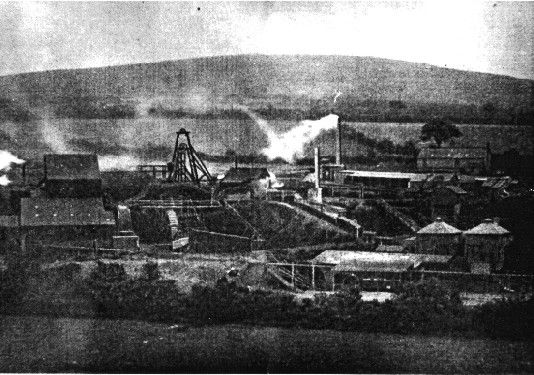
Ann’s father Thomas was a miner which was not surprising given that Mary Tavy, where he was born and raised, was a significant mining community on the edge of Dartmoor whose mining activities continued through to well into the 20th century. The attached image from an Ordnance Survey map of 1883 gives the impression of mine after mine with village houses in the centre of this industrialisation.

There is an excellent historical summary by Mary Warne on the Mary Tavy Parish Council website.  Here is an extract:

“Years ago mining was the main industry and the whole area around the Coronation Hall and much further afield was a hive of activity, with many deep shafts and seventeen huge water wheels working the heavy machinery to process the ore and to pump the water from underground.  Many hundreds of men and women were employed.  The women were called Bal Maidens and their job was to break up the mundic with hammers for which they were paid one shillling a day. (Mundic is also known as pyrite or iron pyrites and was sometimes found in tin and copper mines.  A waste product used as aggregate in concrete, when the desired mineral was tin, copper, silver or lead but once mined out of the more valuable ores, mundic, also known as arsenical pyrites, was the source of another valuable mineral. – ed.)  Bal is the old word for mine and we still have a Bal Lane in Mary Tavy.

The Largest Mine in the World.  Wheal Friendship was at one time the largest copper mine in the world.  Later on arsenic was processed and you can still see the flues and calciners on the hillside to the East outside the Coronation Hall.

There was a huge market for the arsenic in the Southern States of America to kill the Bol Weavil in the cotton fields.  They say that there is enough arsenic clinging to the inside of the flues to kill millions of people.  (A recent report tells that the crops being grown on these fields in the USA now contain traces of that arsenic, a progressive poison that once ingested does not get removed as waste matter. The build up over years of eating contaminated food has been sited a possible cause for many illnesses – Ed)

In earlier times the copper and tin ore was taken by pack horse through Peter Tavy and out on the old road to Tavistock that comes out by Mount Tavy on the Princetown Road.  Then on through tracks to Morwellham where it was shipped to all parts of the world.  John Taylor, when he was manager of Wheal Friendship, built the Tavistock canal to make transport easier.  That was completed in 1817.”

Mining in Mary Tavy – from Parish Council

Where did Thomas Barkell work?  The likelihood is that it would have been in the Wheal Friendship which was transformed by John Taylor who modernised the techniques for extracting and transporting ore from the mine.  An alternative would have been Wheal Betsy which had been in decline until also taken on by John Taylor who brought it back into profitable operation.  Was Ann Steer a “Bal Maiden”, or would that have been her destiny if she hadn’t married and moved away from Mary Tavy?

The Family’s History

Ann did marry, though, and move away, which brings us back to Sandra’s research:

“Ann Steer (née Barkell) was born in Creason and baptised Nancy Bartle on July 25th, 1819 at St Mary’s parish church, Mary Tavy.  Her parents were Thomas, a miner from Mary Tavy, and Agnes (née Alford) from nearby Sourton.

When Ann was a child, her family, including three brothers, moved to the mining area of Mold in Wales and two more siblings were born there in Gwernaffield.

RMLI Private

By 1841, when Ann was about twenty-two, she was back in Tavistock with her widowed mother and three of her brothers.  Her eldest brother had married and was living nearby with Ann’s paternal grandparents.

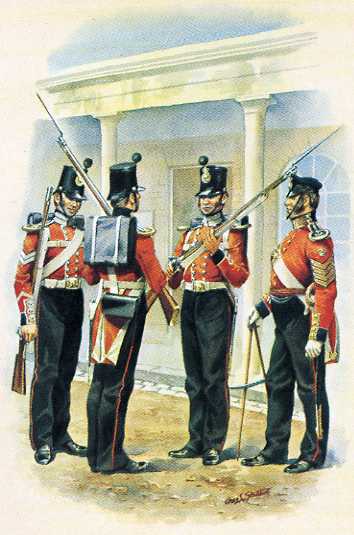
On September 7th, 1843, Ann Barkell married Philip Steer at the parish church in East Stonehouse.  Ann was 24 and Philip was 26.  Philip, a private in the Royal Marines (1), was born in Ashburton and baptised in Buckland in the Moor on June 22nd, 1817.  His parents were William and Maria (née Tothill) from Ashcombe.  Philip had joined the Royal Navy in 1836, aged 19.


Ann and Philip’s first child, Emma Jane, was born at East Stonehouse in July 1844, but died in 1849, aged 5, just months before the birth of a son called Charles, born in Woolwich, who would later follow in his father’s footsteps and become a seaman in the Royal Navy.

Two years later, according to the 1851 Census, the family lived at the Royal Marine Infirmary in Woolwich (3) where Philip was a hospital sergeant.

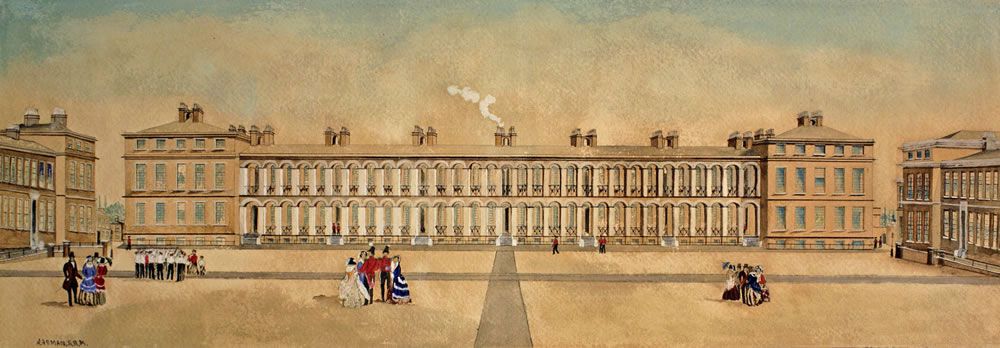
Royal Marine Barracks, Woolwich

Four more children were born to Ann and Philip in Woolwich – Edward Philip, Thomas Arthur (named after Ann’s father and known as Arthur), William Frederick, who died in infancy aged 2 years and 7 months and Agnes Emma (named after Ann’s mother and known as Emma).

After 21 years of service, Philip Steer, Colour Sergeant (2), was discharged from the Royal Marines in 1857 and, by 1861, the family had moved to West Teignmouth where two more children, Annie and Ernest Richard, were born.

By 1871, their son Edward Philip was a shipwright, eventually working at H.M. Dockyard in Portsmouth, and Thomas Arthur worked as a butcher.

Sadly, Thomas Arthur died in West Teignmouth in late 1871, aged 17, and was buried in a family plot in Old Teignmouth Cemetery.  Another child, Agnes Emma, died six years later in 1877, aged 19, and was buried in the same grave.  Ann and Philip, now a Royal Marine pensioner, had lost 4 of their 8 children!

In March,1880, just three years later, Ann Steer died, aged 61, and was buried with Thomas and Agnes.

Philip Steer continued to live in West Teignmouth and eventually married Mary Ann Bice in July 1884, but tragically, another of his children, Ernest Richard, a pupil teacher according to the 1881 census, died in the Barnstaple area later that year, aged 21.  Five of Philip Steer’s eight children had now predeceased him!

Philip and his new wife Mary Ann had a daughter, Margaret Emma, in Newton Abbot in April 1885.

Philip Steer lived in Newton Abbot until his death on May 25th, 1898, aged 81. He was buried with his first wife Ann and two of his children, Thomas and Agnes, in Old Teignmouth Cemetery.”

Some Additional Notes

Philip Steer’s death was marked by a short local obituary as reported in the East and South Devon Advertiser of May 28th 1898:

“Mr Philip Steer, who died at Manor Cottages on Wednesday at the advanced age of 80, was an old Crimean veteran and retired Colour-Sergeant of the Royal Marines.  Deceased was an ardent politician and could recite off-hand the members of the Cabinet and the posts they held.  For some years he acted as gate-keeper to South Devon Cricket Club.  The funeral takes place at Teignmouth this afternoon.”

The family seems to have moved several times in Teignmouth.  The 1881 census shows them living at 66 Bitton Street whilst in 1871 they are simply shown as being in “Coombe” and the 1861 census gives an illegible address – can anyone decipher?

Which street in West Teignmouth is this in 1861?

Historical Notes

1 – The Royal Marine Light Infantry (RMLI).  

For most of their history, British Marines had been organised as fusiliers and had served in many landings especially in the First and Second Opium Wars (1839–1842 and 1856–1860) against the Chinese.

The marine Infantry forces of the Royal Navy were renamed the Royal Marines Light Infantry (RMLI) in 1855 which was probably a more fitting title given that the Royal Navy only saw limited active service at sea after 1850 until the start of the first world war.  The concept of ‘Naval Brigades’ was developed in which the Royal Marines would land first and act as skirmishers ahead of sailors trained as conventional infantry and artillery. This skirmishing was the traditional function of light infantry.  During the Crimean War in 1854 and 1855, three Royal Marines earned the Victoria Cross.

2 – Colour Sergeant.  

Colour sergeant (CSgt or C/Sgt) is a non-commissioned title in the Royal Marines and infantry regiments of the British Army, ranking above sergeant and below warrant officer class 2. It is equivalent to the rank of staff sergeant in other branches of the Army.

RMLI Colour Sergeant on right?

The rank was introduced into British Army infantry regiments in 1813 during the Napoleonic Wars to reward long-serving sergeants; a single colour sergeant was appointed to each company as the senior NCO.

Historically, colour sergeants of British line regiments protected ensigns, the most junior officers who were responsible for carrying their battalions’ colours to rally troops in battles.  For this reason, to reach the rank of colour sergeant was considered a prestigious attainment, granted normally to those sergeants who had displayed courage on the field of battle. This tradition continues today as colour sergeants form part of a colour party in military parades.

3 – Woolwich Barracks.  

The Woolwich Division of the Royal Marines was established, as part of the response to the threat created by the Napoleonic Wars, in 1805.  New barracks for marines, who provided a military presence in the Dockyard, were established east of Frances Street in 1808.  These were re-built between 1842 and 1848 to a enlightened design developed by Captain William Denison which provided even the lowest-ranked inhabitants with sufficient light, space and fresh air.

Alongside the barracks stood the red-brick Royal Marine Infirmary designed by William Scamp and built between 1858 and 1860.  Situated on a hill, it was ‘the most conspicuous and striking feature of the town of Woolwich’.  Along with Blackburn Infirmary it was one of the first two pavilion-plan hospitals to be erected in England in the wake of the Crimean War.

Sources and References

Extracts from contemporary newspapers are referenced directly in the text and are derived from British Newspaper Archives.

Ancestry.com for genealogy

Wikipedia for general background information

Other sources, with hyperlinks as appropriate, are as follows.

Mary Tavy history – www.marytavyparishcouncil.co.uk

Royal marines militaria – www.gmic.co.uk/topic/37275-the-royal-marines/

Wheal Friendship – the Mine that made John Taylor – navsbooks.wordpress.com/2016/03/21/wheat-friendship-the-mine-that-made-john-taylor/

Wheal Friendship photos – http://www.aditnow.co.uk/Photos/Mine/Wheal-Friendship-Mary-Tavy-Copper-Mine_8582/

Wheal Betsy artwork – http://www.anitareynolds.com/wheal-betsy-tin-mines

Wheal Betsy History – https://www.solosophie.com/wheal-betsy/

Tunbridge to Texas to Teignmouth

It’s not often that you get a story straight from the horse’s mouth, so to speak, so it’s a great pleasure to be able to share this one.

We were contacted by Wallace (Randy) Langston after the discovery of his great-grandfather’s grave in the cemetery and he has subsequently sent this amazing story about his great-grandfather’s journey through life.

Herbert William Douglas Langston

Born – January 17, 1843 – Channel Island of Jersey
Died — January 12, 1920 – Teignmouth, Devon

By

Wallace R. Langston, Jr.
Great Grandson of Herbert Langston

Herbert William Douglas Langston

The Langston family can accurately trace its origins in England back to the late 16th or early 17th century. Herbert enters this story in 1843, born in St. Helier, Jersey, the son of an Anglican vicar, Stephen Hurt Langston and Maria Rotch, the daughter of Benjamin Rotch, a wealthy whale oil merchant. Herbert’s father settled in Tunbridge Wells (Now Royal Tunbridge Wells) as vicar of St. Peter’s Church. This background sets the stage for a multi-continent story.

Herbert matriculated at Oxford, but apparently did not graduate. I suspect he had a wandering soul as his mother, who still had strong relationships in the shipping industry,decided around 1862 that he needed to receive a more worldly education. She shipped him to Sydney, Australia with a letter of introduction and funds to support an apprenticeship with an old family friend who happened to be the Lord Mayor of Sydney. When Herbert boarded that ship he was not yet twenty years old.

The four month voyage was not without excitement. During the trip the crew mutinied and since Herbert had sided with the Captain, the mutineers put him in chains until they reached Sydney. Upon arrival he was released but discovered that his only contact had recently died. Being the indomitable spirit that he was, he found work raising sheep and horses and continued his education.

Sometime around 1864 he found passage to the United States and landed in Galveston, Texas. Upon landing he managed to meet George Wilkins Kendall who happened to own a large ranch called “Post Oak” (Now a wealthy suburb of Houston, Texas). The Post Oak ranch had lost all its shepherds in a gun fight and Herbert convinced Mr. Kendall that he could assist him in managing his ranch and sheep until a new crew could be hired. It seems apparent that Herbert had become a very resourceful young man, and before 1868 he had already purchased 1700 acres of land, near San Antonio, Texas for 1700 gold dollars.

When Herbert arrived in San Antonio he was a polished, well-spoken, and landed young man. It was said that he saw “the prettiest girl in San Antonio” and decided to win her hand. That young woman was Margarita Navarro, the grand daughter of Jose Antonio Navarro, an original signer of the Texas Declaration of Independence. The Navarro family was near royalty and at the peak of the San Antonio high society. Herbert again let nothing stop him and in 1871 he married Margarita. He significantly increased the size of his ranch, became a local Justice of the Peace, and had seven children, five of whom lived into their nineties.

I was lucky enough to know all five of these children, as one was my Grandfather. The tales of this family growing up on the Texas frontier in the late 1800’s is complete with stories of gunfights, Indians and everlasting friendships. Regretfully, in 1895, when my Grandfather was only five years old, Margarita died, leaving Herbert with five children under the age of seventeen. Sometime after 1900 he sold his ranch and moved his family, by wagon train, to Galveston and started over.

Herbert arrived in Galveston after the great hurricane which struck on August 27th 1900 and is still recognized as the worst natural disaster to ever occur in the United States; an estimated 12,000 people died and the city was totally destroyed. Herbert met the Manageress of his hotel and she became his second wife. Together they took advantage of the rebuilding of the city. They became managers of the Seaside Hotel. In 1908 they also became managers of the brand new Boulevard Hotel. At one time he was running three First Class hotels and Galveston was booming again. Herbert was on top again when tragedy struck and his wife died in 1910.

He was terribly despondent and after a year alone he was beguiled by a younger woman who turned out to be nothing but a lazy gold digger. The marriage lasted less than two months and at the end Herbert sold everything, again, and purchased a one way ticket on the R.M.S. Oceanic to Southampton.

From there he reconnected with his sister, Gertrude, in Wimbledon. In one of his letters, written to his oldest daughter Mary, he described his happiness at returning to England after forty four years:

“All England seems to fill me with a sense of rest and peace. There is no strenuous life here, everyone seems to take it easy and have plenty of time.”

Gertrude was the beneficiary of the Langston family wealth that Herbert had left behind. Texas must have seemed like another world as he was waited on by butlers and other servants. Never the less he went to visit a widowed half-sister who lived at the Leamington Spa. He ended up staying with her for two years; after which she moved with him into a very nice local hotel. It was here, in 1913, that Herbert met and married his fourth wife, Lavinia Phillips, known as Vinny; who was the manageress of the hotel.

Northam, 43 Higher Brimley

They lived a happy life but in 1916 his sister Mary died and left him with an inheritance which allowed him and Vinny to retire from the hotel business. They looked for a quiet place in the country and magically ended up in a nice home on Higher Brimley in Teignmouth. On January 12, 1920, Herbert passed away just short of his seventy seventh birthday and was buried in the Teignmouth Cemetery.

During his life he had crossed the Atlantic and Pacific oceans, been on three continents, worked as a cowboy, a sheep herder, a judge and hotel manager. He married the granddaughter of a Texas icon, and raised five children. His progeny were all strong and wonderful people, with great stories to tell of the old west, each an example of the strength and fortitude given to them by Herbert William Douglas Langston.

POSTSCRIPTS

The SS ‘Ibex, Photo Credit: Jersey Heritage

It turns out that in the year before his death Herbert and Lavinia paid a nostalgic trip to his birthplace, Jersey. According to the Jersey passenger lists they arrived on 5th June 1919 aboard the SS Ibex and left just over three weeks later.

Here’s his birth registration in the parish of St Saviour, showing his father as the minister of St James Church (click on the picture for a clearer view of the registration) .

And finally, Herbert’s wife Lavinia is also buried in Teignmouth Cemetery but not in the same location (MM32). She is across the other side of the cemetery in an area yet to be fully uncovered (OO71). However, someone else is buried in Herbert’s plot – Ethel Mabel Hutchings, who died in 1917.

The Vagabond Husband

There are many ‘child graves’ in Teignmouth old cemetery. This is the story behind one of those.

I choose the phrase ‘behind one of those’ carefully because it is rare that a child’s lifetime would be of historical significance. But the events leading up to a child’s birth and death are a different matter, and that’s part of the sadness.

(Photo by Rolls Press/Popperfoto via Getty Images/Getty Images)

One of the challenges of presenting an historical story is finding pictures to enhance the words and bring them more to life. These days of course we are flooded with visual images – the smartphone is the weapon of choice on social media. But 150 years ago the sabre may have been a weapon of choice when it came to winning a maiden’s heart. That’s the image I want to convey at the start of this story, especially when that sabre is in the hands of a dashing hussar whose intentions may not be that honourable.  Picture Terence Stamp exquisitely playing the role of Sergeant Troy in the film version of Thomas Hardy’s “Far from the Madding Crowd” and you won’t be far from the mark.

I started researching this almost four years ago when I found the grave and then was spurred on by some background information given to me by Tacy Rickard and Tim Whiteaway.  The discovery of the child’s grave was a trigger to a story of family circumstances played out through snippets in the press between 1852 and his death.

A Child’s Grave.

The earliest picture we have of the cemetery is a lithograph from 1864, eight years after the cemetery was opened. There is obviously some artistic licence in these pictures but you have to believe that the artist was trying to be as true to life as possible. One grave stood out to me and I wondered whether it had survived intact to the present day. So I went in search.  The grave was marked by a white cross atop a base of three square white stones laid in a pyramid fashion. I found it. The ‘pyramid’ was intact but the cross had broken and was lying to one side.

This was the grave of William Carl Edward Bodnar who died age 8.

Although the Gothic script of the headstone appears to show him as “William” Bodnar, he is named on his birth register entry as “Wilhelm” Carl Edward Bodnar, born 2nd May and baptised 19th July 1854.  His parents were Maria Louisa and Charles Bodnar, married on June 15th 1853.
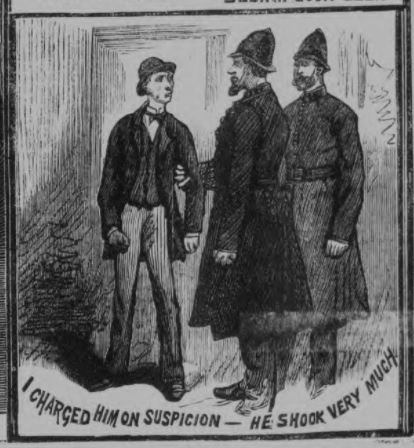
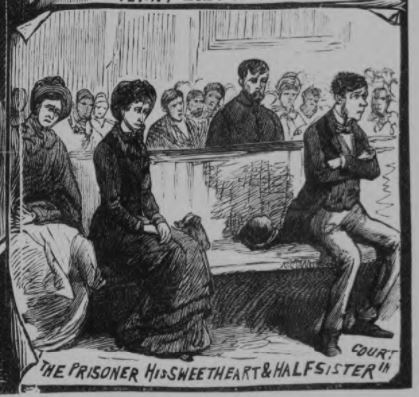
Maria Louisa Croydon was the youngest daughter of Edward Croydon, part of a well-established family in Teignmouth who ran a printing/ publishing/ book-selling business as well as the Royal Library which had been established shortly before John Keats arrival in Teignmouth in 1818.

Enter the Hussar

The story starts a few years before the child’s birth.

The European continent was a cauldron of power struggles during mid-Victorian times, leading ultimately of course to the First World War.  One of those struggles was the Hungarian revolution of 1848/49 against what was seen as the oppression of the Austrian empire.  Those who fought in the revolution were called ‘honved’ or ‘defenders of the homeland’.  The revolution was defeated but the name was taken on within the Austro-Hungarian empire by the force named the ‘honved hussars’.  Following the Austro-Hungarian compromise of 1867 the name was recognised in its full glory as the “Royal Hungarian Honved”.

So what does that have to do with our story?  The link of course is Charles Bodnar.

The first we learn of him is from a short notice in the Royal Cornwall Gazette of 27th February 1852:

Honved Hussar

“Baron Charles A. Bodnar, late Captain of the Honved Hussars, under General Dembinsky, during the whole of the Hungarian war, was landed here (Falmouth) on Monday, he having come passenger by the Royal William, from Constantinople.”

So, an Hungarian Baron with perhaps a romantic military record comes to Falmouth.  We know very little about Charles Bodnar.  The name has probably been anglicised and would have been ‘Carolus’ in his original language.  No records can be found of a Baron Carolus Bodnar; and the closest genealogical records which match some of the details in his marriage record suggest that he was baptised 21st June 1821 in the village of Hernádkércs in N.E. Hungary.  His parents would have been Andreas Bodnar and Maria Ujfelussy.

Exit the Hussar, Enter the Professor of Music

Once he had landed in England he did not seem to make much of his aristocratic and military background judging from the absence of any reference to him in the newspapers of the time.  In fact the next we hear of him is some fourteen months later with a musical background as evidenced by this short reference in the Exeter and Plymouth Gazette of 16th April 1853:

“It will be perceived from an advertisement in another part of our paper, that Mr C. Bodnar has commenced giving lessons in Music, &c, in this city and neighbourhood.  This gentleman who is an Hungarian, and honorary member of the Academy of Music at Vienna, is the author of several popular works.”

The advertisement referred to is interesting for its quaintness and the revelation that he was now living in Exeter:

Very soon he was composing music and linking it to local events and people as can be seen from the following item in the Western Times of 28 May 1853:

“NEW MUSIC,
By C. BODNAR,
Honorary Member of the Royal Academy of Music at Vienna

THE FLOWER OF DEVON QUADRILLES, 4S.  These Quadrilles, which have an Exquisite Floral Title, Painted by Paul Jerrard, are Dedicated by Special permission to Lady Buller Yarde Buller.

The most beautiful and perfect set of Quadrilles that has been published for many a day, which no Pianist should be without, possessing great brilliancy for the executionist, and for the learner is a perfect study.

THE IRRESISTABLE POLKA, 2s.

A truly elegant and melodious Polka of more than ordinary interest, very aptly named and of moderate difficulty.

THE LAUNCH OF THE ST. JEAN D’ACRE, 2s.

A Song, — Dedicated by Special Permission to Miss Ommanney.

These beautiful words, which were written on the occasion of the Launch of the St. Jean D’Acre, have been set to a very striking melody by Mr Bodnar, and will, undoubtedly, become a great favourite.

Teignmouth: E. Croydon, Royal Library,
London: Addison and Hollier, Regent Street,
Exeter: Messrs. Smith; Mr. Ashe, or Mr. Vinnicombe.

This was followed five weeks later by another announcement in the Exeter and Plymouth Gazette of 2nd July:

Just Published,
’THE TABLE-MOVING POLKA,’
By C. BODNAR,
Dedicated by Special Permission to Mrs. Carey, Tor Abbey.

ALSO, by the same Composer, ‘THE FLOWER OF DEVON QUADRILLES,’ dedicated by permission to Lady Yarde Buller. ‘THE IRRESISTIBLE POLKA;’ ‘THE LAUNCH OF THE ST. JEAN D’ACRE,’ dedicated by permission to Miss Ommanney, and now in the Press.  ‘THE DEVON ARCHERY WALTZ,’ dedicated by Permission to the Lady Patronesses of the Second Grand Annual Archery Meeting; and the Ballad ‘IF I WERE A VOICE,’ the poetry by Dr Mackay, dedicated by permission to C. Langton Massingberd, Esq.; and ‘THE FLOWERS OF HOME,’ dedicated by permission to Lady Sophia Wyndham.

Teignmouth: Croydon’s Royal Library.  Torquay: G. Croydon, Jun., Royal Library, and all book and music sellers.

There are a couple of interesting observations on these articles.

The first is the dedications – Lady Buller Yarde Buller, Miss Ommanney (who was the daughter of Commander-in-Chief Admiral Ommanney KCB), Mrs Carey of Tor Abbey, Lady Sophia Wyndham and the more general ‘lady patronesses of the second grand annual archery meeting’.  Does this suggest perhaps that Charles Bodnar was a bit of a ladies’ man well-versed in engaging flattery?

The second is that this is the first reference of a connection between Charles Bodnar and the Croydon family, suggesting that these musical publications came about through his relationship with Maria.

Three weeks later came a further affirmation of Charles Bodnar’s apparent musical prowess when the Exeter and Plymouth Gazette of 23rd July reported:

“We perceive that Mr. C. Bodnar, the eminent pianist and composer, now residing at Teignmouth, has been honoured with the appointment of musical preceptor to the family of Her Imperial Highness the Grand Duchess Marie of Leuchtenberg, during her sojourn at Torquay.  This appointment fully confirms the high musical reputation of this talented artist.”

The comings and goings of the Grand Duchess and her royal entourage remained in the news until late in the year.  Their presence would no doubt have been the subject of much social gossip of the time.  Here is the description of their arrival from the Western Courier of 13th July 1853:

Grand Duchess Maria

“Two Russian ladies of the highest rank are about to visit this country.  The Grand Duchess Maria, eldest daughter of the Emperor Nicholas, and widow of the late Duke de Leuchtenberg, accompanied by her six children, will arrive immediately, and take up their residence at Torquay, for the benefit of her health. Her Majesty’s ship Vivid left Dover on Friday for Antwerp, to convey the Grand Duchess to Dover.  Having done so, the Vivid will return at once to Ostend, to convey the Grand Duchess Catherine, daughter of the Grand Duke Michael, and niece to the Emperor of Russia, who will be accompanied by her husband, Duke George of Mecklenberg-Strelitz.”

Meanwhile, in the middle of these musical items of news it was also announced that on the 15th June Charles Bodnar Esq married Maria Louisa, youngest daughter of Mr (Edward) Croydon of Teignmouth.  The service was held at St David’s, Exeter, by Rev C C Bartholomew.

The marriage entry information is interesting because:

  1. Charles Bodnar is shown as living in West Teignmouth whilst Maria Louisa’s residence is given as St Davids – the area of Exeter where Charles Bodnar used to live – which would explain why the marriage was held there and not in Teignmouth;
  2. Charles’ father was also shown as Charles Bodnar, which seems odd given that he would have been Hungarian and would surely be shown with his correct Hungarian name (Carolus?);
  3. His father was shown as a “Gentleman” which again seems odd given that Charles had been described as a Baron; and Charles himself does not use his title of Baron.

The Unravelling of a Past

There is no more news of the musician and the next we hear of Charles Bodnar is in a small curious notice published in the Western Times of 17th December 1853:

“£100 Reward

Whoever will give information to C. BODNAR Esq, of Hope Cottage, Teignmouth, which will lead to the discovery of the person who spread First, Certain False Reports, injurious to his reputation, will receive the above mentioned Reward.”

By this time Maria Louisa was also about five months pregnant.

Time to pause and speculate on what this strange reward means.  £100 was a significant amount worth about £13,000 today.  What were the “false reports injurious to his reputation”?

Could it be that Charles Bodnar was not what he at first appeared.  He claimed to be an Hungarian baron yet I can find no references to ‘Bodnar’ in the lists of European aristocracy of that time and, as we saw, he didn’t himself attribute a title to himself or his father on the marriage register.  He also claimed to have been a captain in the Honved Hussars.  The wars going on in central Europe at the time were well reported in the press, local and national, as were the exploits of General Dembinsky yet I can find no evidence to substantiate Charles Bodnar’s claim to being a captain in the Honved Hussars.  You would also expect, given his title and rank, that on landing in Britain he would have rapidly become part of the social scene yet I can find no mention of him in the attendance lists of the many balls that took place during the season in the Plymouth/ Torquay/ Teignmouth area.  In fact between his arrival in Falmouth and the announcement of him being a music teacher in Exeter he seems to have disappeared off the radar.

His emergence as a piano teacher, composer and honorary member of the Academy of Music in Vienna is interesting because, despite that musical accolade, he is now not referred to as an Hungarian baron but simply an Hungarian.  He composes and publishes quite a few pieces in a short period of time and is obviously helped by the Croydon family’s contacts in the publishing business – Paul Jerrard, for example, who illustrated the ‘Flowers of Devon’ was a well-known London-based illustrator, lithographer and publisher.

His dedications also reflect contact with the local social elite.  Miss Ommanney, for example, to whom he dedicated the song ‘The Launch of the St. Jean D’Acre’ was the daughter of Commander-in-Chief, Admiral Sir John Ommanney and she actually launched the warship in Plymouth. Somehow he also seemed to have secured that appointment with the Grand Duchess of Leuchtenberg, the eldest daughter of the Emperor of Russia.

It seems likely that he produced some original work (e.g. ‘The Devon Archery Waltz’, ‘The Launch of the St Jean D’Acre’) but I wonder whether he also plagiarised some other works and that might have been the source of the alleged “false reports” about him.  I have been unable to find any other reference to sheet music of compositions by Charles Bodnar but there are plenty of references to other contemporaneous works with the same titles e.g. “The Irresistible Polka” and “Flowers of Home”.  The latter, for example, was the name of a ballad written by J E Carpenter and set to music by John Blockley, described as “one of the most prolific and in his time most popular of Victorian ballad composers”.

Whatever happened it is clear that after perhaps a couple of months of fairly prolific composition and advertising of his works there is no further reference that I can find to any new compositions.  Charles Bodnar seems to disappear off the radar of the local press until the next twist in the story starts to unravel in public in 1860.

The Reveal

A legal Notice appeared in the Morning Post of 10 May 1860:

“TO CHARLES BODNAR, of Teignmouth, in the County of Devon.  TAKE NOTICE, That a CITATION, bearing the date the 1st day of December, 1859, has issued under Seal of her Majesty’s Court for Divorce and Matrimonial Causes, at the instance of MARIA LOUISA BODNAR, of Teignmouth, in the county of Devon aforesaid, wife of you, the said Charles Bodnar, citing you to appear in the said Court withing eight days of the service thereof, then and there to answer her Petition, filed in the said Court, praying for a dissolution of her marriage with you; and such Citation contains an intimation that in default of your so doing the Judges of the said court will proceed to hear the said Petition proved in due course of law, and pronounce sentence therein, your absence notwithstanding.  Dated the 8th day of May, 1860.

H L Strong, Registrar
Cobbold and Patteson, 3 Bedford Row
Solicitors for the Petitioner”

So by 1860 Maria Louisa had reached the final stage of being able to divorce Charles Bodnar, a process that was by no means easy for women in Victorian times.  But it was through this divorce that the final part of the story emerged.

In summary, Charles Bodnar:

  • deserted Maria and their child,
  • tried to borrow a substantial sum from a local man,
  • fled to Portsmouth to join the navy, enlisting on the St. George, a 120 gun vessel which was part of the Baltic Fleet
  • Returned to London where he seems to have run off with someone’s money and a reward had been posted for his whereabouts
  • Changed his name to Charles Wales and joined the British Italian Legion based in Susa, where he became a Sergeant-Major quartermaster
  • Bigamously married an inn-keeper’s daughter, Carlota Ozelli

For those interested in the details of how this panned out in court there were many reports in the press at the time but the one from the Western Times of 23rd March 1861 gives the fullest story under the title “A Vagabond Husband”.  (If you want to skip the full detail click here to go to the end).

The Vagabond Husband

“A VAGABOND HUSBAND. (SPECIAL REPORT)

In the Court of Divorce and Matrimonial Cause, on Tuesday, before the Judge Ordinary, the following case was heard:

BODNAR v. BODNAR.  Dr. Dene, Q.C., and Mr. Patterson were Counsel for the petitioner, Maria Louisa Bodnar, who prayed for a dissolution of her marriage with Charles Bodnar on the grounds of adultery, bigamy, and desertion.  Respondent did not appear.

Dr. Dene stated that the parties were married at St. David’s, Exeter, on the 5th of June, 1853, and lived together at Teignmouth, where her father kept a bookseller and stationer’s shop, and they had issue of the marriage one child. In 1854 the respondent left his wife and entered on board H.M. ship St. George.  He had never since returned to his wife, but had lived a a vagabond and roving life, passing under various assumed names, and occasionally writing to her from various parts of the world. In May 1857, her attention was attracted to an advertisement offering a reward for the apprehension of a person answering to his description.  She made enquiries, she found that it did relate to him, and in consequence of the facts that then came to her knowledge, she presented this petition.

The following evidence was then given:

The Rev. Chris. Bartholomew, Incumbent of St. David’s Exeter, produced the marriage register.  The petitioner was stated to have been 30, and the respondent 21 years of age at the time of the marriage.

Mrs Maria Louisa Bodnar:  My maiden name was Croydon.  After my marriage I lived with my husband at Teignmouth for about 6 months.  After that he left me and came to London.  He sent me a letter, which he requested me to take to Mr. Hoare.  I did not take it.

The letter was read.  We give the following extracts:

‘Two years since I arrived in England, coming from Constantinople quite a stranger, and without any means; an exile from my country, for whose freedom and welfare I sacrificed all I possessed, namely standing, friends, relatives.  I have been received by the English nation with its own noble benevolence which is granted to everyone who deserves protection. I worked day and night, and you know very well that I have obtained, through my own labour and talents, supported by the patronage of the English, a respectable standing as a teacher of music, and realised a sufficient income to maintain myself and my wife respectably.

I married a girl without any fortune, the youngest daughter of Mr. Croydon, the bookseller, in Teignmouth, and, God bless her, she made me the best wife a man could wish for, but also for all her love and compassion, she is but rewarded by sorrow and grief, caused by the misfortunes which, coming over me, must be naturally deeply felt by herself. God may pardon me, I have been innocent. Sir, during the last summer I had an extensive teaching at Torquay, and among others was honoured to be engaged as teacher of music to the daughter of the Emperor of Russia, the Grand Duchess Maria of Leuchtenberg spending the summer months at Torquay.

I had a large profit to expect, and was also to buy two pianos for her Imperial Highness, according to her order. I did fulfil the duties of professor conscientiously. I bought the pianos and sent them to Peterborough, and obtained the high approbation of Her Imperial Highness, but just before her departure she was informed that I was an Hungarian captain in the war against Russia and Austria, and suddenly I was looked at as a spy and a traitor, and the laws of England would not have been any shelter.’

The letter concluded with a request for the loan of £400.

HMS St George & Arethusa 1860, Edward Snell

After that letter my husband came back to me at Teignmouth for about three days.  He then returned to London and from London he went to Portsmouth There he went on board the St. George (Note: The St. George was a 120gun vessel of the Baltic fleet).  I saw him in November, 1854, at Exeter; but he was only with me a few hours; and I have never seen him since.  He left no money with me; but he said that if I went to Plymouth, where the St.George was then lying, I should receive his pay.  I went there, but I found he had drawn it all himself. I have never received any assistance from him from that time to this.

There is a child by the marriage. I have received nothing from him for that child.  I have since lived with my father. I received a letter from my husband in the spring of 1856.  He had lost his occupation as teacher before he left Teignmouth, in consequence of his neglect.  Whilst he was away he wrote to me that he was trying to get employment on board the fleet; and I told him that I should be glad if he could get employment anywhere.  A letter on the 1st of January was the first in which he told me that he had anything to do. When I saw him in November he was to have returned to the St.George, and I was to have seen him at Plymouth.  I went there but I did not see him.  He was not there. I have not seen him since.

The next time he communicated to me was on the 24th of December, by letter, which I have not got now.. He told me in that letter that when I received it he should have sailed for Australia. I heard no more of him till the spring of 1856.  I received a letter from him informing me that he was living prosperously in the South of Italy, and asking me if I would come out to him.  He told me to write to him through his mother at Vienna, and promised to send me money to take me out.  I answered the letter in the way he pointed out, but I received no answer.  I heard from the British Consul at Vienna that the respondent’s mother was dead.

The next thing that called my attention to him was an advertisement offering a reward of £10 for his apprehension for felony.  In consequence of that advertisement I wrote to the police office, and was referred to Mr.Watts, in Gillingham-street. I then employed Mr. Barry.

By the Judge – When the respondent left me the first time he went off without my knowing where he was gone. He said that he had bought the pianos, but everybody said he had not. I know of nothing else that could have caused him to go, but for the disagreeableness of the affair.  He afterwards told me that he went to see the pianos shipped. He had lost his pupils at Teignmouth, but it was through his own neglect.

Mr. Barry, solicitor to the petitioner, produced a letter which the respondent had written to Captain Watts, offering to join the legion going to the Argentine Republic.  It was dated from Susa on the 1st December 1856. In it he said that he wished to leave the country, because he could not agree with his wife’s father. ‘With Charlote,’ he added, ‘I am extremely satisfied and happy; she proves the best wife a man can wish for; and, in fact, she herself discovered to me the mischievous plans of her deceitful father, and warned me from the worse.’

Witness also produced a letter to another Captain, dated from Turin, 18th January 1857.  It asked for assistance to enable him to return to England with his ‘dear little wife,’ and to thus leave ‘that wretched country in which a man of his abilities could not get a living.’

Miss Croydon, sister to the petitioner, proved the hand-writing of letters which had already been read, and of some other letters of a similar character. She also identified a photograph.

Mr Collis, of Haverstock Hill, London – In June, 1853, I was employed at the Photographic Establishment in Bond street.  I remember a lady and gentleman coming and giving me an order. The photograph produced was sent to Teignmouth, in pursuance of that order. The person who gave me the order was the man whose portrait was taken.

Miss Croydon (re-called) recollected the photograph coming down to Teignmouth, and saw the parcel opened. It was a likeness of Mr. And Mrs. Bodnar.

Captain George Shepherd – In 1856 I was a captain in the 4th regiment of the British Italian Legion. We were then quartered at Susa. There was a Quarter-Master’s Serjeant-Major in the regiment, passing under the name of Charles Wales. He was a single man; but was married at Susa by permission of Col. Crawford, the commanding officer of the regiment. I was not present at the marriage but I saw the couple at the petitioner’s. Afterwards I saw them at the bride’s father, whose name was Ozelli. Her Christian name was Carlotta. They certainly passed as man and wife. They lived at an inn. The photograph produced is a portrait of the Serjeant-Major. The letters produced are in his handwriting, and so is the signature in the marriage register.

By the Judge – I have been in Sergeant Major Wales’ appartments at the hotel. He had only a bed room in Quarter Master Watts’ appartments. This was before his marriage. I cannot tell what appartments he had afterwards.

Mr Bodham Castle – In 1856 I was Lieut. In the 4th regiment of the Italian Legion. I was present at the marriage of Sergeant Major Wales. I afterwards saw him and his wife at the hotel, kept by the bride’s father. I remember the respondent opening a door, and say that was the appartments in which they lived.

The Court said that the learned counsel had at last successfully traced their man.  There could be no doubt as to the fact of the desertion. In the first instance, indeed, when the respondent left Teignmouth, it was, as he said, through the injustice of other people, not as the wicked world said, in consequence of his own fraud.  His wife agreed to his departure in search of employment, that he afterwards agreed to meet her at Plymouth, and never came after which she heard nothing from him till she received that mock invitation from Italy.  The question came to this, had he cohabited with somebody else? It had been established that he went through some ceremony of marriage, and afterwards lived with the woman as her husband, at the house of the latter. There was no actual proof that he had actually occupied the same bed with her, but taking the fact of the marriage ceremony – the residence at the house of the woman’s father – her reception as Mrs. Wales by persons connected with the Legion, and the admission in his letters; it would not be prudent to affect any doubt about the matter. As to the photograph, he (Sir C. Cresswell) always greatly mistrusted that sort of evidence; though if there had been any difficulty in the case it would have assisted the other testimony, but after the identity of the respondent’s hand writing, there was no necessity to resort to the portrait.

Decree nisi, with costs.”

Conclusion

So that’s the story behind the child’s grave.

William Carl Edward Bodnar was born on May 2nd 1854, as notified in the Western Times of May 6th..  He died some eight years later on 4th December 1862, barely one year after Maria secured her decree nisi.  His grave is in the cemetery but he is also commemorated in St Michael’s Church, Teignmouth.

It seems that Maria never remarried and returned to live with her brother and two sisters.  They eventually moved to Heathfield, Torquay, where she died on 24th April 1891.  She is buried close to her son in what appears to be an unmarked grave.

No more was ever heard of the baron/ hussar/ professor/ rating/ sergeant-major Charles Bodnar, or Charles Wales, or whatever other name he may have assumed.

Acknowledgements

Thanks to Tacy Rickard and Tim Whiteaway for contributing to some of the original research

Sources and References

Extracts from contemporary newspapers are referenced directly in the text and are derived from British Newspaper Archives.

Ancestry.com for genealogy

Wikipedia for general background information

Other sources, with hyperlinks as appropriate, are as follows.

Hungarian 1848 Revolution – details of Honved Hussars
Hungarian history site – details of Honved hussars and general history
Art collection of Russian royalty etc – picture of Grand Duchess of Leuchtenberg

The Curious Case of Mangolds, the General and the Eggs

Tales from the Grave focusses mainly on stories surrounding those who are buried in the Cemetery.  But the Cemetery itself has its own tales to tell.  This story is a mixture of the two.

Not all crimes are as gruesome or as serious as the Babbacombe Murder which we covered in the last story. We’ve had one before – “The Curious Case of the Shifting Shrub”.  Here are three little stories which come from our archive of newspaper articles.  They revolve around General Frederick J Davis who was buried in the cemetery in 1901 alongside his wife, Sophia.

It All Starts with a Mangold Wurzel.

The mangold wurzel (or mangel-wurzel), of course, has traditional West country connotations.  It is a versatile root vegetable which is used primarily for animal fodder but can, when young, be used for human consumption.  It is also:

  • the central feature of the traditional Somerset sport of “mangold hurling” which has gone international;
  • the component of a potent alcoholic beverage;
  • and bizarrely gave its name to mangel-wurzel disease caused by people eating too much of the vegetable during the food shortages that followed the first world war.

So who would imagine that this plain root vegetable could lie at the heart of our first crime.  This is how the Western Times of 10 March 1880 described the scurrilous event:

“George Hooper, a lad, fourteen years of age, was charged with stealing mangold wurtzel, valued at a penny, from General Davis.  The prosecutor had lost a large quantity of mangold lately, and he instructed the police to keep a look-out.  A few days ago P.C. Stentiford met the boy coming from the direction of General Davis’s house, with mangold in his hand.  On questioning him, he admitted taking them form the prosecutor’s shed.  The prisoner now denied the statement, and said that another boy gave him the mangold.  As the prosecutor wished the Bench to deal leniently with the lad, he was let off by paying 1s and costs.”

George Hooper, caught in flagrante with mangold in hand ….. but General Davis was soon to get his comeuppance.

Let him who is without sin …..

You might ask why General Davis was keeping mangold-wurzels in his shed.  The answer probably lies in a horse which was unwittingly to be the centre of this next crime.  It appeared in many papers at the time but here is one short version from the Bristol Mercury of 5 October 1881:

The Den

“A COMMENDABLE EXAMPLE – Major General Davis, who is a member of the Teignmouth Local Board, was on Monday brought before the magistrates at the instance of his fellow members of the board.  Between the sea and the town there is a public pleasure ground styled the Den, on the preservation of which a considerable sum of public money is annually spent.  The board have from time to time issued notice forbidding persons to drive across the ground, but the defendant drove his carriage and pair on the Den, and a ratepayer noticing the fact, called upon the officers of the board to take action against the general, and ‘not to make flesh of some persons, and fowl of others’.  The committee of the board decided to prosecute, and in spite of the general’s explanation of inadvertence, he was fined a shilling and costs.”

The ‘Teignmouth Local Board’ is the equivalent of the Town Council.  For those interested there is a much longer account at the end of this story showing clippings from the original news article.  I’ll leave it up to you to decide whether the general made a genuine mistake (his defence of ‘inadvertence’) or whether he knew what he was doing and simply felt entitled by virtue of his rank and standing in local society.  The magistrates – R.M. Marshall-Dunn, Esq., Major-General Lucas. And M.L. Brown, Esq. – made their decision …… guilty as charged.  Major-General Davis resigned from the Teignmouth Local Board two months later.

The General Strikes Back

Six years after inveigling the local police constable to keep an eye on his mangolds the General was back with another sting.  This time he persuaded another constable to hide behind a hedge and watch a nest.  The Express and Echo of 26 July 1886 gives the full story:

A fair cop

Teignmouth – This Day.  Before Colonel Nightingale (Chairman), Mr. Whidbourne and Captain Paul.

Robert Mills, Superintendent of the Teignmouth Cemetery and Lodge-keeper, was charged with stealing two eggs, value two-pence, this morning, from General Davis.  William Marsh said he was coachman, in the service of General Davis, of Ashleigh House, Teignmouth.  Eggs having frequently been lost, he was told by the General to inform the police of it, which he did.  On Saturday he saw P.C. Pope and showed him a nest in a hedge in a lane adjoining his master’s house.  On Saturday there were two eggs in the nest.  When I came on Sunday they were gone.  That morning about half-past seven o’clock, the prisoner was brought to the house by P.C. Pope, and he asked the General to forgive him.  He, however, gave him into custody.  P.C. Pope said he went to Ashleigh, and Marsh pointed out the nest to him in the hedge.  He marked two eggs, and about 6 a.m. proceeded to keep watch.  About 7.40 the prisoner walked up to the nest and took out the two eggs, and went towards the Cemetery.  After he had gone a little distance witness jumped over the hedge and asked him where were the two eggs he had taken out of the nest.  He said ‘Here they are,’ and took them from his trouser’s pockets.  Witness told him he had been watching to see who took the eggs out, and he answered ‘nonsense’. He was then taken to General Davis, who gave him into custody.  The Bench considered the case proved and fined the prisoner 40s. and 13s. expenses.”

Actions have consequences.  In August the Burial Board decided to dismiss Robert Mills but also gave him the opportunity to tender his resignation, which he did.  He was back in court the following year for not paying maintenance to his wife.  By March 1888 his wife was in the Newton Abbot workhouse and he was in court again on the same charge of not paying maintenance, and destitute himself.  The Express and Echo of 26 March 1888 explained:

“He was now living at Torquay, selling a few oranges and bloaters to get a livelihood and was obliged to walk from Torquay this morning, he only having threepence in his possession.”

Two lives ruined, all for two eggs worth twopence and a General who couldn’t find it in himself to forgive Robert Mills.

It’s an interesting triplet of tales that provide an insight into how the justice system worked and how it related to your position in society.  We don’t have bobbies on the beat anymore (at least not to the same extent) but I wonder how many police constables today would lurk in wait behind a hedge to watch a nest at the behest of a local General?!!

Sources and References

Extracts from contemporary newspapers are referenced directly in the text and are derived from British Newspaper Archives.

Wikipedia for general background information

Other sources, with hyperlinks as appropriate, are as follows:

Mangel-wurzel hurling – http://mangoldhurling.co.uk

Addendum – Full Story of General Davis on the Den

A Big Thanks

As we start the new year we would like to thank everyone who has contributed in one way or another to the research behind the various historical stories which have appeared on this site in the last year.  It’s wonderful that not only do we have a cadre of support locally but that there are also people in other organisations around the country who give up a little of their time to respond to requests coming out of the blue.  Hopefully the name of Teignmouth Old Cemetery is writ a little larger on the history map of the country.

MANY THANKS TO …..

  • Alison Vainlo, who put together and maintains the Arksey Village History site, and threw herself into the research on the Cookes
  • Andrew Templer, administrator of the Templer Family history
  • Bob Lawrence, Bristol & Avon Family History Society
  • Bradford Historical Society
  • Carol Smith, inspiring the story of Sir Henry and Lady Emmelina Wilkins and contributing family photographs
  • Carole Laverick, Prior Park College for photographs and information.
  • Devon Archives and all its volunteers for tracking down records from their archives
  • Frances Billinge B.Sc., M.Sc., Ph.D. Honorary Associate Research Fellow University of Exeter. Local Historian of Bovey Tracey
  • Jean Gitsham, for continuous snippets of information and help in tracking down the location of “Beulah”
  • June Snell, local historian who helped in tracking down the location of “Beulah”.
  • Lin Watson, archivist at Teign Heritage Centre for helping with every enquiry I’ve thrown at her.
  • Margaret Boustead, Head of Archives & Records Management at North Yorkshire County Record Office
  • Revd Fr Paul Jones, who kindly sent us a pamphlet describing the life of Father John Hewett and prompted the story on his life.
  • Stuart Drabble, local historian and secretary of the Stover Trust.
  • Tacy Rickard (now sadly deceased) for information on East Cliffe she had shared with me several years ago
  • Tate Gallery, for permission to use copies of some of their paintings
  • Viv Wilson, MBE, local historian and guru of all things Teignmouth – in other words a font of all knowledge who handles my sometimes bizarre queries with great equanimity
  • William Morris Society

AND FINALLY REMEMBER THOSE WHO MADE THE HISTORY:

Click on the photo to read the story

Lady Blanche Juanita Cooke and
her daughter Ruby Blanche Juanita Cooke

Sir Henry John Arthur Wilkins, his wife Emmelina and daughter Mabel

Countess Isabella Jane English

Rev. John Hewett, M.A.

Peter Paul Marshall

Reginald Gwynne Templer

Murder Most Foul

Or …..

The Curious Case Of A Teignmouth Solicitor And Babbacombe Lee

A waning crescent moon augured a dark night in Babbacombe Bay.  The Cary Arms had disgorged its last customers and extinguished its lights.  The “Glen”, a ‘pleasant marine villa’ long accustomed to receiving royal visitors from their yachts anchored in the bay, was tightly locked up.  It’s owner Emma Keyse and her four servants were inside.  It was a night fitting for murder most foul and a Victorian whodunnit …..

Teignmouth Old Cemetery has already yielded some of its secrets, proving to be an historian’s paradise.  We have had tales of wealth, philanthropy, religious commitment, artistic prowess, literature, theatre and film, sea-faring exploits ….. the list goes on.  But this is something new – our first crime.  Not just any crime but a murder so gruesome that it shocked the nation at the time.  It was reported throughout the country and has since been the subject of books, a film, an exhibit in Madame Tussauds, TV documentaries, internet blogs as suspicions grew amongst historians and criminologists that all was not what it seemed.

Because of the vast amount of documentation available about the case this story will not go into all the detail but will focus on one twist in the tale which I have dubbed “the curious case of a Teignmouth solicitor and Babbacombe Lee”.

The solicitor in question is Reginald Gwynne Templer who is buried in a family plot (N47/48) alongside his father, mother, step-mother and aunt.  Babbacombe Lee is the nickname given by the press to John Lee the man accused of the murder, tried, found guilty and sentenced to death.  He also became known as the “man who wouldn’t hang”.

Let’s start with the crime.

The Crime

On that dark night of Saturday 15 November 1884 the first indications that something terrible was happening were the shouts.  Elizabeth Harris, the cook, had woken up to the smell of smoke some time between 3 and 4am.  She got out of bed and opened her bedroom door to find clouds of smoke outside in the passage and on the stairs.  The house was on fire.  Her shouts awoke the other two servants on the first floor – Eliza and Jane Neck – and also John Lee the butler/ footman/ gardener who slept downstairs in the pantry.

In the bedroom

Jane and Eliza went into their mistress’s bedroom calling out to warn and rouse her only to find the bedroom ablaze too but with no sign of Emma Keyse.  Whilst Elizabeth and Jane attempted to extinguish the fire in the bedroom Eliza groped her way downstairs in search of her mistress.  The smoke was so thick that she could hear but not see John Lee down there in the hallway.  She did see another fire though blazing in the dining room.  John went upstairs to help up there and, it seems, to bring people down through the smoke.  Eliza went to the pantry to fetch a bucket of water and had just thrown it onto the blaze in the dining room when John returned with her sister Jane and, as the flames died down, the three of them witnessed the grisly scene.

Finding the Body

There, on the dining room floor, lay the body of Emma Keyse.  Her head was smashed in, her throat slit from ear to ear so that her head was almost severed from her body and her body had been set alight.  Her clothing had largely burnt away so that she lay there naked.

Charging John Lee

Over the next few hours others arrived on the scene to help, including the local Constabulary.  Sergeant Nott seems to have made a very quick assessment that not only had a murder been committed but that John Lee was responsible.  He duly arrested John Lee on Saturday morning with the words “I charge you on suspicion on having committed murder of Miss Keyse”. Lee was then taken into custody at Torquay police station.

The crime immediately received immense press coverage.  Here is one example from the East & South Devon Advertiser, Saturday 22 November 1884:

“The small village of Babbacombe, about one-and-a-half miles from Torquay, was thrown into a state of excitement on Saturday, last week, by a report that an aged and well-known lady of the place had been cruelly and foully done to death.  At first the rumours were believed to be exaggerated, but as the morning wore on and more details came to light, the conviction gained ground that a terrible deed had been committed mysteriously, silently, and with a fiendish disregard of other lives in the house and of the premises and their handsome contents – for all appearance point to the conclusion that the hand which did the murder, if murder it be, set fire to the house, with the intention, undoubtedly, of hiding all traces of the ghastly act”

The Judgment of John Lee

The Justice system moved swiftly.  A coroner’s inquest opened in St Marychurch on Monday 17th November and completed by the end of the week with the judgment that Emma Keyes was unlawfully killed and that there was sufficient evidence to prosecute John Lee for the murder.

Accordingly the case moved on immediately to the Magistrates court in Torquay where the judge upheld this judgment and ordered that John Lee should be remanded in custody to be held for trial at the next Exeter Assizes in February 1885.  There he would be tried for the wilful murder of Emma Keyse and the attempted burning of the Glen to cover up the crime and, in so doing, endangering the lives of others in the house.

There is a sense of inevitability here.  John Lee was found guilty and sentenced to death by hanging, the date being set for 23rd February 1885.

On the Scaffold

Then comes the first twist in this grim tale.  On the night before his execution Lee claims to have had a dream that he would be led to the scaffold but that it would not work.  The following day his dream came true.  Three attempts were made to hang John Lee and each attempt failed, despite the fact that the hangman had thoroughly tested the scaffold mechanism beforehand and had made adjustments between each attempt.  John Lee now became known as the “man who wouldn’t hang”.

The Home Secretary commuted Lee’s sentence to life imprisonment, a decision helped no doubt by a petition for clemency previously submitted by Rev. Vesey Hine, the vicar of Abbotskerswell.  Interestingly Lee was released in December 1907 after serving only 23 years.

Throughout this whole process, including during his imprisonment, Lee protested his innocence.  He maintained an air of calm during the trials which was inevitably interpreted in the press as at best indifference and at worst callousness.  However, it seems that, in his eyes, his calmness was because of his faith as expressed to the judge at his sentencing:

“The reason my Lord, why I am so calm and collected is because I trust in my Lord, and he knows that I am innocent.” (The Secret of the Babbacombe Murder, Mike Holgate)

The Validity of the Judgment

It may be that all is not what it seems.

With the benefit of hindsight and people’s re-examination of the evidence it appears that there is sufficient doubt that John Lee was correctly sentenced.  The evidence was largely circumstantial, witnesses changed their statements and there was definitely a lack of proper forensic evidence which, of course, wouldn’t have been available at that time.

It also seems that there was prejudice against him, he was badly defended (more later) and didn’t have the same financial capacity to sustain a defence as did the prosecution to resource what would have been an extremely high-profile case for the time.

The East and South Devon Advertiser of 21st February, 1885 expressed these very concerns:

“From the first there has scarcely been but one opinion entertained by the public, viz., that John Lee was the brutal murderer.  So strong was the opinion even before the prisoner’s committal that there were not a few of the public who would have ignored the English mode of administrating justice, and would have inflicted lynch law upon him – in other words would have taken his life much after the same way poor Miss Keyse came to her tragic end.

Hence perhaps it was the prisoner was conveyed to the county prison from Torquay, in a carriage and pair early one morning after his committal by the magistrates instead of being taken by train.  Most of the public pre-judged the man; they were impregnable to any theory that might be advanced in his defence.  Even one of the jurymen at the inquest figured among the number, for he did not hesitate to make it known that if he could have his way he would hang the prisoner without affording him a trial at the Assize, and notwithstanding at the time the prisoner, acting under the advice of his solicitor, had reserved his defence.

Between the time of his committal and his trial, even in the absence of the nature of his defence, public opinion even further ripened into a belief that he was the wicked murderer, and the most wild and incorrect reports, all more or less prejudicial to the prisoner’s position, were circulated.  In saying this much we do not in any way wish to exonerate the man ….. Still, whilst we believe this, we are bound in common justice to say there is room for some doubt  And we do not hesitate to assert that doubt might have been greatly strengthened in our minds, as well as in that of others, if the prisoner in the outset could have commanded money in like manner as the prosecution did in netting around him strong evidence of guilt.

Very rightly the prosecution spared no expense, not a stone was left unturned in fact, to produce even the most trifling bit of evidence against him.  The prisoner, on the other hand, had no such facilities.  Shut up in the cells at Torquay he was debarred even an interview with his father, and though he was afterwards defended by a solicitor, that gentleman falling ill, and remaining so up to the time of the trial, he was unable to render the counsel (Mr St. Aubyn) who represented the prisoner at the Assizes but comparatively little assistance.  The loss sustained in this respect must have been all the more severely felt, when two eminent counsel were engaged for the prosecution.  Not only was the evidence against the prisoner very strong, but it was systematically linked together, in the absence of any material cross-examination to snap or weaken any of these links, that the jury had no other alternative but to return the verdict which they did.”

So with this background it’s worth scrutinising John Lee’s defence.  Let’s start with some background to his lawyer, Reginald Gwynne Templer.

Reginald Gwynne Templer

Reginald Gwynne Templer

Reginald was born in Teignmouth in the last quarter of 1857, the eldest of seven children of Reginald William Templer of Teignmouth, and his wife Emily Laurentia (neé Gwynne).  His father was the nephew of George Templer who was, until 1829, the owner of the Stover estate near Newton Abbot.  The family lived at The Hill, Teignmouth, a substantial property on the corner of Woodway and New Road.

Following his education at Blundell’s School, Tiverton, he pursued his own father’s profession into the Law. The Liverpool Mercury of 25 Feb 1880 marked his entry:

“THE INCORPORATED LAW SOCIETY – At the examination for honours of candidates for admission on the roll of solicitors of the supreme court, the examination committee recommended the following gentlemen, under the age of 26, as being entitled to honorary distinction: ……… Second Class ….. Reginald Gwynne Templer.”

The 1881 Census shows him as a Solicitor’s Managing Clerk and by 1884, at the age of 28, he was a Solicitor, practising in Newton Abbot and living at Bridge Street.  He was also an agent in Newton Abbot for the Sun Fire insurance company.  So, an apparently flourishing career, coupled with his membership of the distinguished, local Templer family should have made him an eligible bachelor.  But he never married, despite the evidence in the press that he moved in the social circles of the day.  Here are a few examples of events he routinely attended over time:

The Second Ladies Day for the season took place at Teignbridge on Thursday, and was attended with brilliantly fine weather …… As usual dinner was partaken of in the Pavilion between five and six o’clock, and at a later hour, after promenading on the level and well-kept ground in the cool of the evening, dancing was enjoyed for several hours to the music of Fly’s Quadrille Band, from Plymouth.  There was a large and fashionable attendance (followed by long list of ladies)”

The Exeter and Plymouth Gazette Daily Telegrams, Saturday 20 July 1878


FANCY DRESS BALL AT THORNLEY – A children’s fancy dress ball took place on the evening of Boxing day at the residence of J Dawson Esq …. The lawn and conservatory was brilliantly illuminated by means of hundreds of Japanese lanterns and coloured lights, supplied by Mr Hartnell, pyrotechnist, and the place presented a very fairy-like scene.”

Western Times, Tuesday 31 December 1878


BISHOPSTEIGNTON. IRISH RELIEF FUND – On Tuesday two entertainments consisting of readings and singing, were given in the large Billiard-room at Huntley, in aid of Duchess of Marlborough’s Fund for the relief of the Irish.”

Western Times, Saturday 20 March 1880


TORBAY HOSPITAL BALL. On Wednesday night at the Torquay Winter Garden the annual ball on behalf of the funds of the Torbay Hospital took place on a scale of unusual magnificence ….. Everything went with a swing, and the ball altogether was highly successful, breaking up at about four …..”

Torquay Times and South Devon Advertiser, Friday 20 January 1882


TEIGN BOATING CLUB.  An entertainment, comprising a grand evening concert by lady and gentlemen amateurs, and an exhibition of prestidigitation by the well-known amateur, Dr Stradling, was given at the Assembly Rooms last evening, under the direction of the Captain and Officers of the Teign Boating Club ….. The principal performers were ….. Mr R G Templer”

Express and Echo, Thursday 2 March 1882


Professionally, his career was developing and there are plenty of examples in the press of cases he litigated both in a prosecutorial role and in defence.  Here are just a couple of examples of more serious cases which should have prepared him for the more challenging Babbacombe murder:

THE ALLEGED ATTEMPTED MURDER AT SHALDON.  At the Teignmouth Petty Sessions, yesterday, before Colonel Lucas (Chairman), Lewis Brown, Esq., and H.B.T. Wrey, Esq., Mary Ann Wickett was charged on remand with attempting to do grievous bodily harm to her husband, landlord of the Clifford Arms, Shaldon, by cutting his throat.  Mr. May, of Newton, prosecuted, and Mr R G Templer, jun, defended.

Exeter and Plymouth Gazette Daily Telegrams, Tuesday 20 July 1880


THE NEWTON ABBOT CHILD MURDER.  Rebecca Loveridge (39) was indicted for murdering Jessie Loveridge, her infant daughter, at Kingsteignton, on the 11th January ….. Mr Frazer McLeod (instructed by Mr R Gwynn Templer) were retained for the defence ….. The jury …. returned …. with the following verdict: ‘We find the prisoner guilty of causing the death of her child by drowning it while attempting to take her own life, during temporary insanity.’  His Lordship: Then the prisoner will be detained in the gaol here until her Majesty’s pleasure is known.”

Totnes Weekly Times, Saturday 2 February 1884


So we have a picture of Reginald Gwynne Templer as a bit of a socialite, at the start of his legal career and with at least a couple of cases related to murder under his belt already by the time of the Babbacombe murder. You would think that his career and life would have prospered but it was not to be.  Half way through the case, between the Magistrates court session and the Assizes, Reginald was taken ill, removed from the scene and sent to Holloway Sanatorium near Windsor. He did return from there and attempted to resume his career but was forced back and eventually died there on 18 December 1886.

His decline and subsequent demise was commented on by the Express and Echo of Wednesday 22 December 1886:

“.…. Mr. R. Gwynne Templer, the promising young Teignmouth solicitor, who for a time acted on behalf of the notorious John Lee, has died after a long illness, before he had reached the age of 30.  I well remember Mr. Templer’s appearances on behalf of the callous criminal at the inquest on Miss Keyse in St Mary Church Town Hall, and subsequently at the formal hearing of the case before the Torquay magistrates.  By that time I believe that everybody who had had to do with the awful affair were becoming thoroughly sickened of it, and I have reason to know that amongst those who shared that feeling, and whose nervous system was by no means improved by constant attention to the dreadful details for several weeks, was the late Mr. Templer.

Whether this had anything to do with the unfortunate solicitor’s illness I cannot of course say, but it is nevertheless a fact that soon after he, in common with other persons professionally concerned in the case, had expressed his relief at the commital of Lee for trial, his health gave way, and when the case came on for hearing at the Assizes at Exeter – now nearly two years ago – Mr. R. G. Templer was unable to attend, and his place as solicitor to instruct the counsel for the defence (Mr. St. Aubyn) had to be taken by his brother, Mr. Charles Templer, who very efficiently carried out the duties which thus devolved upon him.

After being laid aside for several months, Mr. R. G. Templer had so far recovered as to be able to partially resume practice.  Those who knew him, however, soon noticed that he was in anything but a satisfactory state of health.  Still, with the pluck and courage characteristic of the Templers, he held on and did his best for his clients until one day, at Newton Police Court, serious illness again attacked him, and he was obliged to give up.  It was hoped that another long rest might have the effect of restoring Mr. Templer to health.  But it was not to be.  He gradually grew worse, and on Saturday he breathed his last in London, to the regret of a large circle of friends.”

Holloway Sanatorium was in fact a specialised establishment for treating the mental illness of the middle-classes.  Officially Reginald died of “general paralysis (or peresis) of the insane”.  This was the euphemistic Victorian description of tertiary syphilis  Although now this can be readily treated with penicillin that treatment was obviously unavailable in Victorian times and death inevitably followed usually within three years.  Patients would show symptoms such as: sudden personality change, radical alteration of previous ethical and moral standards, development of extravagant and grandiose behaviour, progressive dementia.

So in reality perhaps Reginald Gwynne Templer was viewed as a bit of a black sheep of the family.

The Defence

Reginald Gwynne Templer was engaged to represent John Lee only after the start of the inquest, and judging from the transcripts of proceedings in the press he did not do a good job.  He was not always present at the hearings which meant that John Lee was obliged to defend himself.  He did not provide an effective challenge to the prosecutor’s evidence and he also seemed to antagonise the Chairman of the court unnecessarily with irrelevant questioning.  He failed to provide a counter defence – in fact he was not even present on the final day of the magistrates court and told John Lee to say that he was going to reserve his defence (i.e. not present further information) until the Assizes.

Mr Molesworth-St. Aubyn, MP

The final nail in the coffin of the defence though was possibly when Templer withdrew from the case on the grounds of ill health as described above.  This meant that Mr Molesworth-St. Aubyn MP, John Lee’s counsel at the Assizes, had no-one to rely on who had intimate knowledge of what had happened previously and the finding by the court of John Lee’s guilt was almost inevitable.  He was also defending a number of other cases at the same time and was under such time pressure that he even requested a delay in the case as the Western Times of Monday 2 February reported:

“The Counsel engaged in this case pleaded for a later opening of the Court, as the witnesses from Torquay would have to leave at half-past seven in order to be here in time, and Mr. St. Aubyn, who defends the prisoner, had not had time to inspect the premises, and it seemed to be thought that the learned gentleman …. would have to go there on Sunday – at the peril of being prosecuted under the Statute, for following his usual occupation on the Lord’s day.”

There was a suggestion that a line of defence of insanity on the part of John Lee should have been used.  In fact this was the main contention in the petition sent to the Home Secretary by Rev. Vesey Hine:

“His parents, who are respectable people living at Abbotskerswell, in the county of Devon, consider that he is suffering from a deranged state of mind, he having from his youth upwards shewn at times symptoms of temporary insanity.”

According to the East & South Devon Advertiser of Saturday 21 February 1885:

“It is perhaps to be regretted speaking in behalf of the prisoner, that another kind of defence had not been set up, viz., that of insanity.  We believe that if that course had been pursued the issue might have been very different.  This is not merely our views but those of others who are far better able to form an opinion of the prisoner’s state of mind than we are.

.… owing to a variety of incidents coming to light, and the eccentricities the prisoner was known to indulge in from time to time, many people consider that his right state of mind is very questionable.  His parents assert most positively that from his youth upward he acted at times ‘as though he was not right’, but that they never divulged their suspicions lest it should affect him in getting his living.

….We should further mention that a few days since we saw the foreman of the jury who convicted the prisoner of murder.  He stated that he felt most confident that the prisoner was not of sound mind, and in that opinion, he said, he was joined by several other jurymen.”

A potential second line of defence emerged during the closing speech of John Lee’s defence Counsel, Mr Molesworth-St. Aubyn, although it would appear that he had not actually pursued this during the trial.  This was how it was reported by the Cardiff Times of 7 February 1885:

“The long looked for speech for the defence was then commenced and listened to with eager interest.  Mr. St. Aubyn spoke as though fully impressed with the responsibility and difficulties of his position, but put his case in a practical way and without much attempt at enlisting the sympathies of the jury.  The theory which he advanced that the crime was committed by the lover of the prisoner’s half-sister seemed to produce little or no impression, and it was subsequently felt that it had been pithily described by Mr Justice Manisty as a ‘far-fetched idea’.  The facts adduced by the prosecution were virtually allowed to go unchallenged, and Mr. St. Aubyn did not dwell so minutely as was expected on those portions of the testimony which were admittedly weak or at variance.  He solemnly cautioned the jury as to the responsibility which rested upon them in dealing with purely circumstantial evidence, and held out to them the example of Habron, wrongly convicted of a crime committed by the notorious murderer Peace, as showing the occasional unreliability of such testimony.  Finally, he appealed to the jury to give the prisoner the benefit of any doubt they might entertain, and sat down after an address of half an hour.”

John Lee’s half-sister was Elizabeth Harris, the cook in Emma Keyse’s house who had been the first to discover the fire.  She was approximately two months pregnant at the time (her daughter Beatrice was born 24th May 1885 in the Union Workhouse, Newton Abbot) and the argument behind St. Aubyn’s theory was that the unknown father was in fact some local person of note – possibly his identity had been discovered by Emma Keyse who may have threatened to disclose it and provided the motive for murder.  That idea, coupled with John Lee’s continuing protestation of innocence whilst in prison, has been at the nub of the mystery surrounding the murder ever since.  It was the first inkling of another revelation some fifty years later.

The Final Twist in the Tale ….. perhaps

In 1936 the Torquay Herald Express published an article by the journalist Reg CowilI.  Convinced by information he had recently received he re-opened the debate on the Babbacombe murder:.

“About the year 1890 there stood at the side of an open grave, in a South Devon town, a well-known and local resident and his two sons. The man who had been buried was a public man of the town who had been very well-known, highly respected and very popular throughout South Devon. The young men were, also, in their turn, to become public men in the area. As they were moving away from the grave and the mourners were disbursing their father turned to them and said ‘we have buried this afternoon the secret of the Babbacombe murder’.

The man concerned, and who was declared by Lee to be the murderer of Miss Keyse, was known, says our informant, to have been critically ill for a long time after the murder, though nobody knew at that time, or ever, associated him with the crime.  As a matter of fact, he never really recovered, and gradually became demented.  He died in a mentally unbalanced condition ….. When in his madness, he shouted things which the doctors put down to his state of mind, there were one or two people – our informant’s father was one – who knew what he was referring to, and what had driven him insane.”

The implication from the article was that the murderer was Reginald Gwynne Templer.  There is still no concrete evidence of that.  It is hearsay but there is also reportedly circumstantial (and unverified) evidence that Emma Keyes was connected to the Templer family and that Reginald Gwynne Templer was a regular visitor to her house.

So there is no definitive answer and many loose ends that would need to be tidied up to get to an answer.  I suspect that will never happen because the real knowledge of what occurred was buried long ago in the graves of the characters in the story.

One Loose End

One aspect which has always intrigued me though was that John Lee (who, from his past, didn’t seem to be religiously inclined) appeared to exhibit a trust in God and believed that right would prevail because God knew that he was innocent and didn’t commit the murder.  That was his response to the observation that he remained so calm during all the proceedings.  Could “God” have been simply his translation of a local religious person knowing the facts of the case?

There was, of course, the Reverend Vesey Hine, the vicar from John Lee’s original parish of Abbotskerswell, who raised the petition to the Home Secretary.  But I have also found a snippet of information about someone else which may be of relevance.  It’s from the Exeter and Plymouth Gazette of Tuesday 2nd December 1884:

Fr. John Hewitt

“The Chief Constable (Gerald de Courcy Hamilton, Esq.) and Superintendent Barbor were present to watch the proceedings on behalf of the police authorities; and Mr. R.G. Templer appeared for the accused, John Lee, who, as on the previous similar occasion, was not brought into Court.  Among those who occupied the reserved seats was the Rev. J. Hewitt, Vicar of Babbacombe.

Normally this would have passed me by but Rev John Hewitt is buried too in our cemetery and I wrote up his story recently (click here) .

It struck me as odd that he should have been interested in attending the inquest unless he had some involvement.  It is also odd that the paper picked him out from everyone else who had reserved seats.  It could have been that he simply knew Miss Keyse but it could also have been because of the cook, Elizabeth Harris.  Why?  If you read his story you’ll see that coincidentally his own wife had died earlier that year and he was closely involved with organisations supporting young women (the Sisters of Mercy at Bovey and the House of Rest in Babbacombe).  The fact that Elizabeth Harris was pregnant and single might suggest that he was aware of her and perhaps knew who the father was and that exposure of the father could have been a motive behind the murder.  We may never know.

Acknowledgments

I am grateful for help I have received from Stuart Drabble (local historian and secretary of the Stover Trust) with aspects of the Templer family.  A book of his on the “Stover Park History & Connections” is due for publication soon and should make fascinating reading.

Sources and References

Extracts from contemporary newspapers are referenced directly in the text and are derived from British Newspaper Archives.

Ancestry.com for genealogy

Wikipedia for general background information

Other sources, with hyperlinks as appropriate, are as follows:

The Secret of the Babbacombe Murder, book by Mike Holgate, Peninsula Press, 1995,2001

Templer Family Genealogy

Murder Research website, Ian Waugh, comprehensive write-up of all aspects of the Babbacombe murder,

Pictures – the Illustrated Police News and the Penny Illustrated Paper were invaluable sources

Histories of Things to Come, website carrying Babbacombe murder story – “Strange Tales from a Seaside Town”

Institutionalizing the Insane in Nineteenth-Century England, Anna Shepherd
Studies for the Society for the Social History of Medicine 20, Pickering & Chatto, 2014 – history of Holloway Sanatorium

Notes on Templer Burials in Teignmouth Cemetery, Stuart Drabble