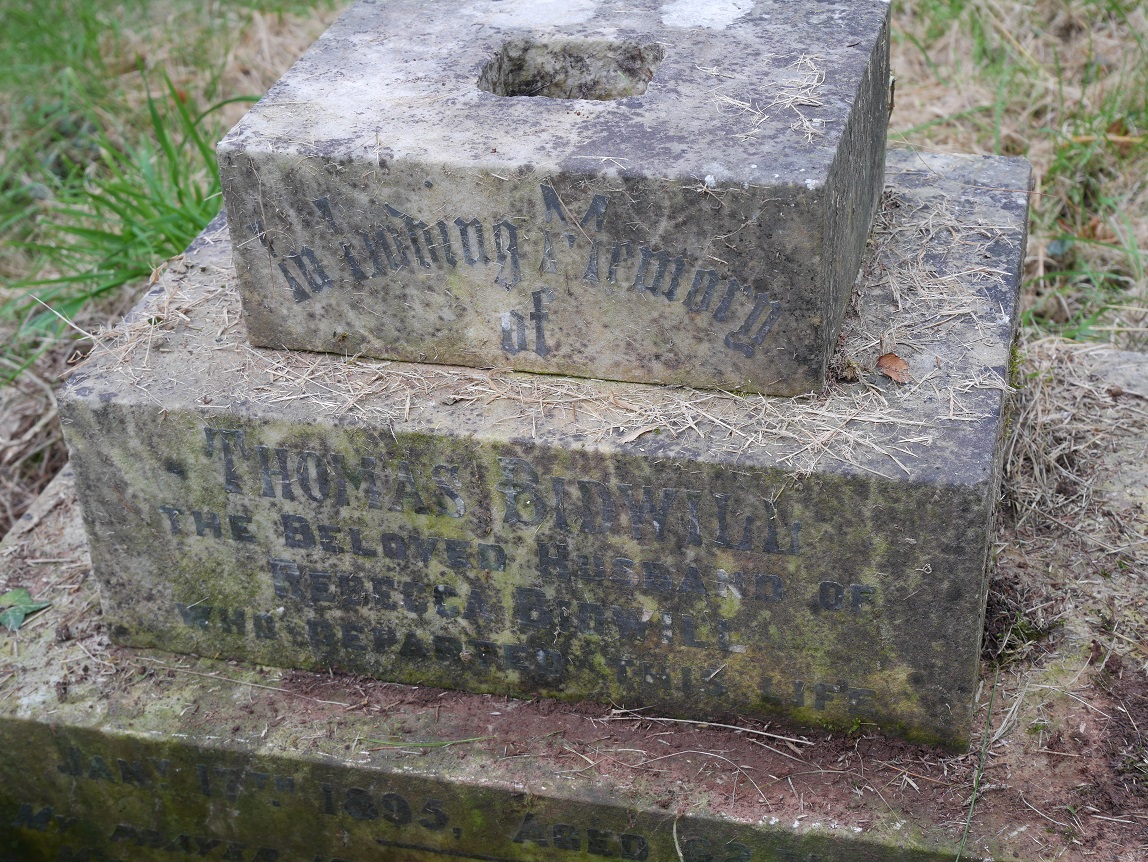
A few days ago we had a visit from Don Cockman who lives in Torquay and who first contacted us about 18 months ago. Don owns a decorated terracotta plate painted by “T. Bidwill” who, he believed, was buried in Teignmouth Cemetery. So we did some research and with the help of the Teignbridge Cemetery Office managed to locate the grave of Thomas Bidwill.
I had promised Don that if he were able to come over to the cemetery I would show him the grave and the clearance work that we were undertaking. So that’s what happened last week when Don arrived, bringing with him the plate and we were able to capture the moment of Don, the plate and Thomas Bidwill’s grave.
Thomas Bidwill, epitaphThomas Bidwill, headstoneStill life decorated plate, Thomas Bidwill
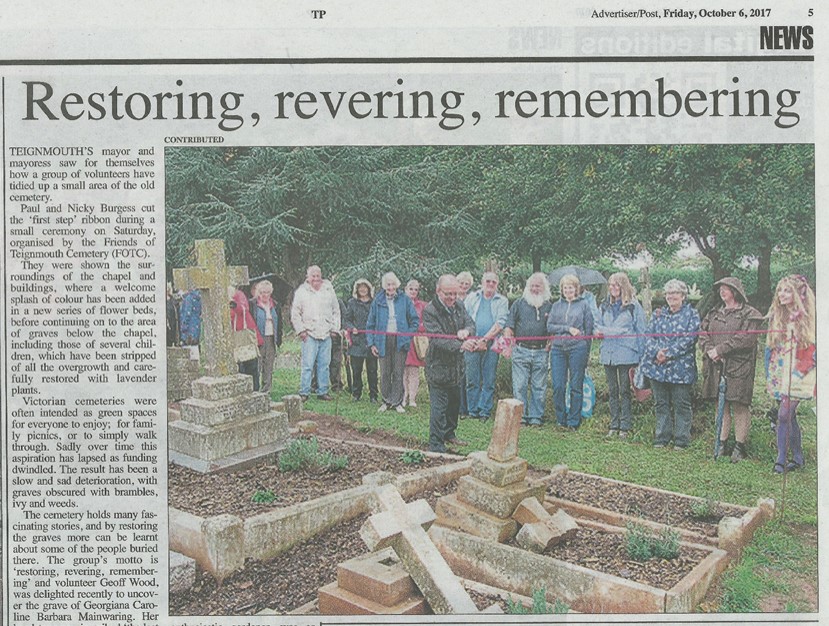
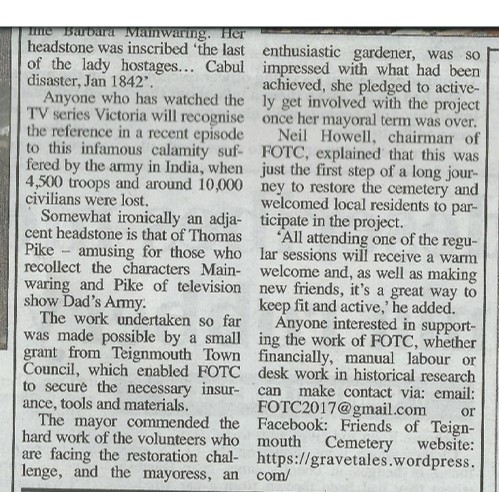
Here’s some press coverage about the “First Step Ceremony” we held at the cemetery on Saturday 30th September – Teignmouth Mayor Paul Burgess cut the ribbon to mark the first area in the cemetery where we had been clearing graves. (Full text shown below)
As we collect information about some of the people buried in the cemetery we post their stories on this blog. But those stories are mixed in with assorted other posts so there is now a new page “The Stories” which is essentially an index through to the various people we have written about. Try it out!
On 6 January 1842, 16,000 members of the British Kabul force, the `Army of the Indus’, fled from Kabul under a “shameful capitulation and the illusion of safe-conduct” promised by the eastern Afghan tribes. One week later, on 13 January, Surgeon William Brydon rode alone into Jellalabad, apparently the only British survivor. It has been described as the worst British military disaster until the fall of Singapore a century later and upto that time the greatest defeat ever inflicted on the British by an Asian enemy.
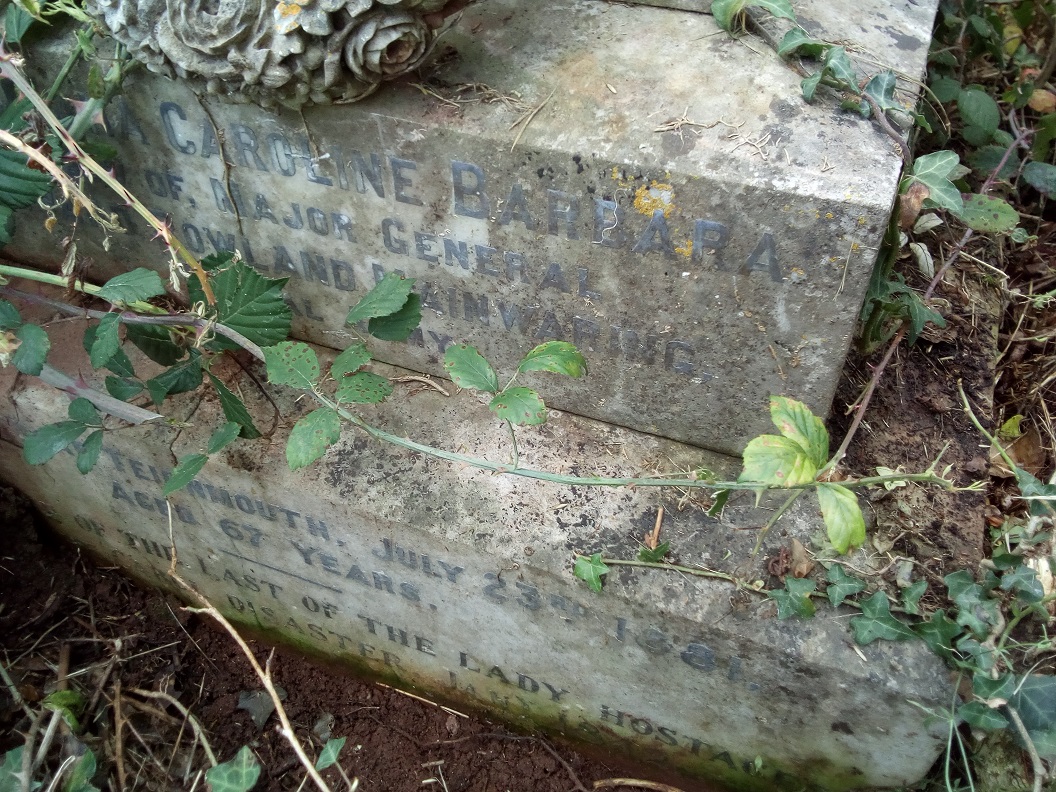
Grave of Georgiana Caroline Barbara Mainwaring
On 15th August 2017 A member of the Friends of Teignmouth Cemetery, discovered the overgrown grave of Georgiana Caroline Barbara Mainwaring. She was the wife of Major-General Edward Rowland Mainwaring of the Bengal Army. On her headstone she is decribed as “the last of the lady hostages …. Cabul disaster, Jan 1842”.
The Military Connection
Georgiana had a long association with the military.
She was the youngest daughter of colonel Johan Frederick Meiselbach, born in the Netherlands in 1775 but who subsequently moved to India as a colonel in the Bengal Horse Artillery in the service of the Rajah Mimamet Bahadur of Bundelkhand.
As noted in the Calcutta Magazine and monthly register of 1832 she married Lieut. George Byron of the 48th Regt N.I. (Native Infantry) in Calcutta on November 16th 1831. He died on 23rd May 1834, aged 28. They had one son, George Rochfort Byron, born 9th November 1832.
Georgiana remarried in 1838; as noted in the Calcutta Monthly Journal of September that year:
“At Saint John’s Church, Delhi, by the Reverend R Everest, M.A. Edward Rowland Mainwaring Esq., 16th regiment N.I. to Georgiana Caroline, widow, of the late Lieutenant George Byron”
When they married he was a captain but gained his next promotion four years later as announced in the London Gazette of Tuesday 4th October 1842:
“To be Majors in the Army in the East Indies only. Captain Edward Rowland Mainwaring, of the 16th Bengal Native Infantry”
He was eventually promoted to Major-General on 28th March 1865 but died in Madras three years later in 1868. As noted in the Times of Thursday May 14th 1868:
“On 9th April at the house of his younger brother, Madras, on his way to the Neilghberries for the benefit of his health, after 44yrs service during which he had received five medals, two clasps and a bronze star; Maj Gen Edward Rowland MAINWARING aged 60yrs of the Bengal Army, e/s of the late Thomas Mainwaring Esq, Bengal Civil Service.”
The following obituary appeared in the Illustrated London News in 1868:
“MAJOR-GENERAL E.R. MAINWARING Major-General Edward Rowland Mainwaring, who died at Madras, on April 8, was the eldest son of the late Thomas Mainwaring, Esq., of the Bengal Civil Service, by Sophia Walker, his wife, and was nephew of the late distinguished Admiral Rowland Mainwaring, of Whitmore Hall, in the county of Stafford, the representative of the very ancient and honourable family of Mainwaring, which traces back to the time of the Conquest. He was born Nov. 20, 1807, and entered the Bengal Army when only sixteen years of age. He served throughout the whole of the Affghan campaign from 1839 to 1842, including the assault and capture of Ghurnee. He was engaged at the night attack at Babookoorgch, and the destruction of Khoodawah. He was one of the garrison of Jellalabad; and, in the general action and defeat of Akbar Khan, and the subsequent operations leading to the reoccupation of Cabul, he was attached to the left wing of the army of Gwalior, and was present on the staff at the battle of Punniar. He was with the army on the Sutlej, including the battle of Sobraon, and was engaged with the army of the Punjaub and at the actions of Ramnugger, Sadoolpore, Chillianwallab, and Goojerat. His decorations were five medals, two clasps, and a bronze star. The General married Georgiana, widow of the late George Byron, Esq., and leaves two sons and a daughter. He was interred with military honours, at Madras, April 9, last.”
The military life continued through their children. Their elder son, Edward Philipson Mainwaring born 1841, appeared to have had a distinguished career in the Bengal Infantry, retiring as a colonel in 1893. Interestingly his medals were auctioned in 2004 as part of the Brian Ritchie collection.
His younger brother Francis George Lawrence Mainwaring, born in 1851, also joined the army, retiring as a Lieutenant-Colonel at the end of 1899.
Finally, Georgiana and Edward also had a daughter, Emily Sophia Isabella born in 1844, who in 1862 married Major Osmond Barnes of the Bombay Staff Corps. As the tallest man in the Indian Army at the time he was selected to proclaim Queen Victoria the Empress of India.
So we have a picture of Georgiana steeped in military tradition, but what of her involvement in the Kabul disaster?
The Kabul Debacle
So much has been written about the Afghan wars, the Kabul disaster and the subsequent recapture of Kabul that it’s impossible here to go into detail. Here’s an attempt at a summary and the link with Georgiana Mainwaring.
The 1842 Kabul Retreat took place during the First Anglo-Afghan War and was also known as the “Massacre of Elphinstone’s Army”. Following an uprising in Kabul, Major-General Sir William Elphinstone, apparently an ineffectual commander, negotiated an agreement with Wazir Akbar Khan, one of the sons of the Afghan Emir Dost Mohammad BarakzaiContinue reading “Georgiana Caroline Barbara Mainwaring”
Although the work we are doing at the cemetery is about clearing the overgrowth from graves we are also very conscious of the wild-life that is present there. The cemetery as an open space is an oasis of nature in the midst of the surrounding housing developments. Whilst paying attention to the graves we would also like to preserve as far as possible the nature of the place as well.
We decided that a survey of the flowers and wild-life in the cemetery would be a good start. We approached John Whetman from Devon Wildlife Trust to come along and do that initial survey for us. The idea would be to repeat this next Spring for comparative purpose and to pick up any other species which would be more prevalent at that time of year.
The results of this initial survey are contained in a spreadsheet which can be accessed through the following link:
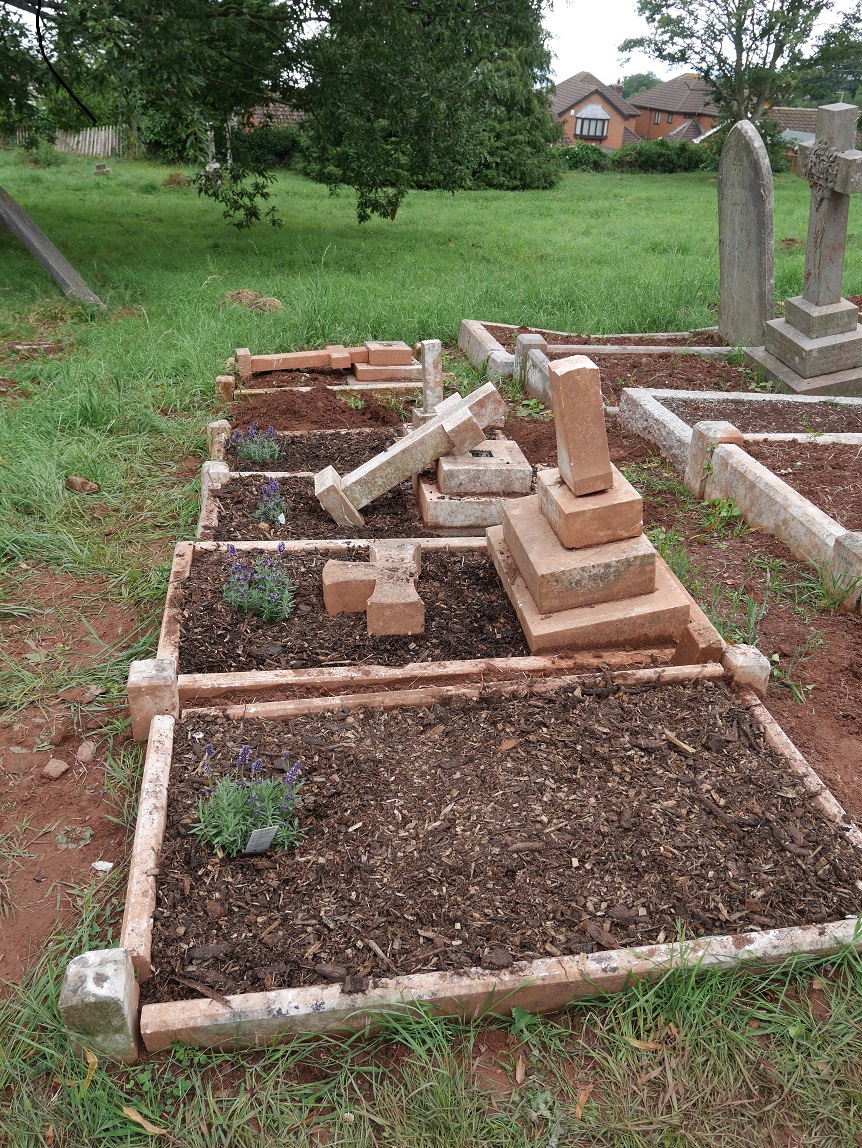
The area of the cemetery that we decided to clear first brought an unexpected finding – a row of children’s graves. We believe there are six, although only five have kerbstones which suggests that the sixth is an unmarked grave.
Most of the hard clearance work in this area has now been done which begs the question of “what next?” here. It has always been the plan to gradually plant up the graves and surroundings but we feel that that could be a waste of time at this stage because of the high likelihood of remaining roots and weed seeds in the graves.
So we are trying out an intermediate strategy – to cover the graves with weed-membrane and mulch and mark each grave with a small plant buried in its own pot for ease of lifting next year. We have started this with four of the children’s graves, each of which now has its own pot of lavender. The following photos show the steps:
First grave, re-weeded, raked over and with pot buried ready for plantingFirst grave with membrane
First grave completed and planted with lavender4 graves completed and planted up
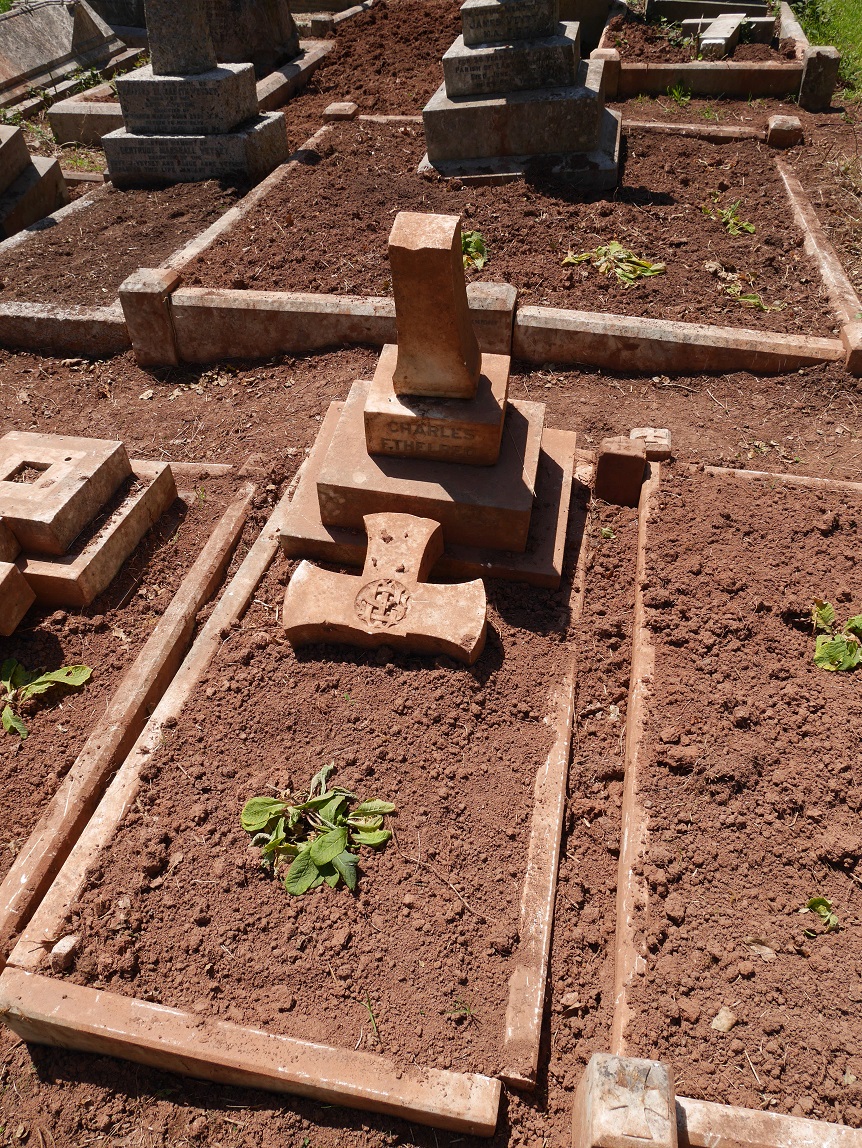
Charles Ethelred, first born son of Rev Charles A and Sarah V Sladen taken home 4th February 1895 aged 13 months
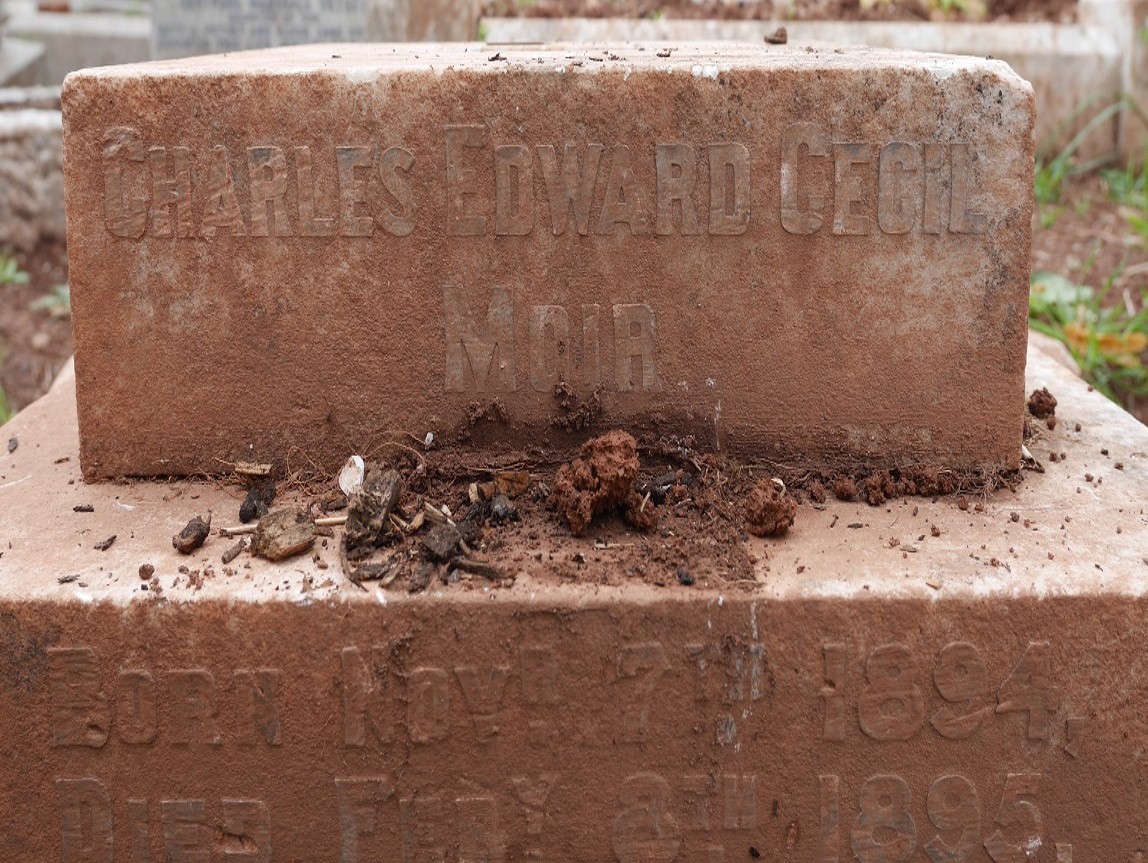
Charles Edward Cecil Moir born November 7th 1894, died Feb 8th 1895
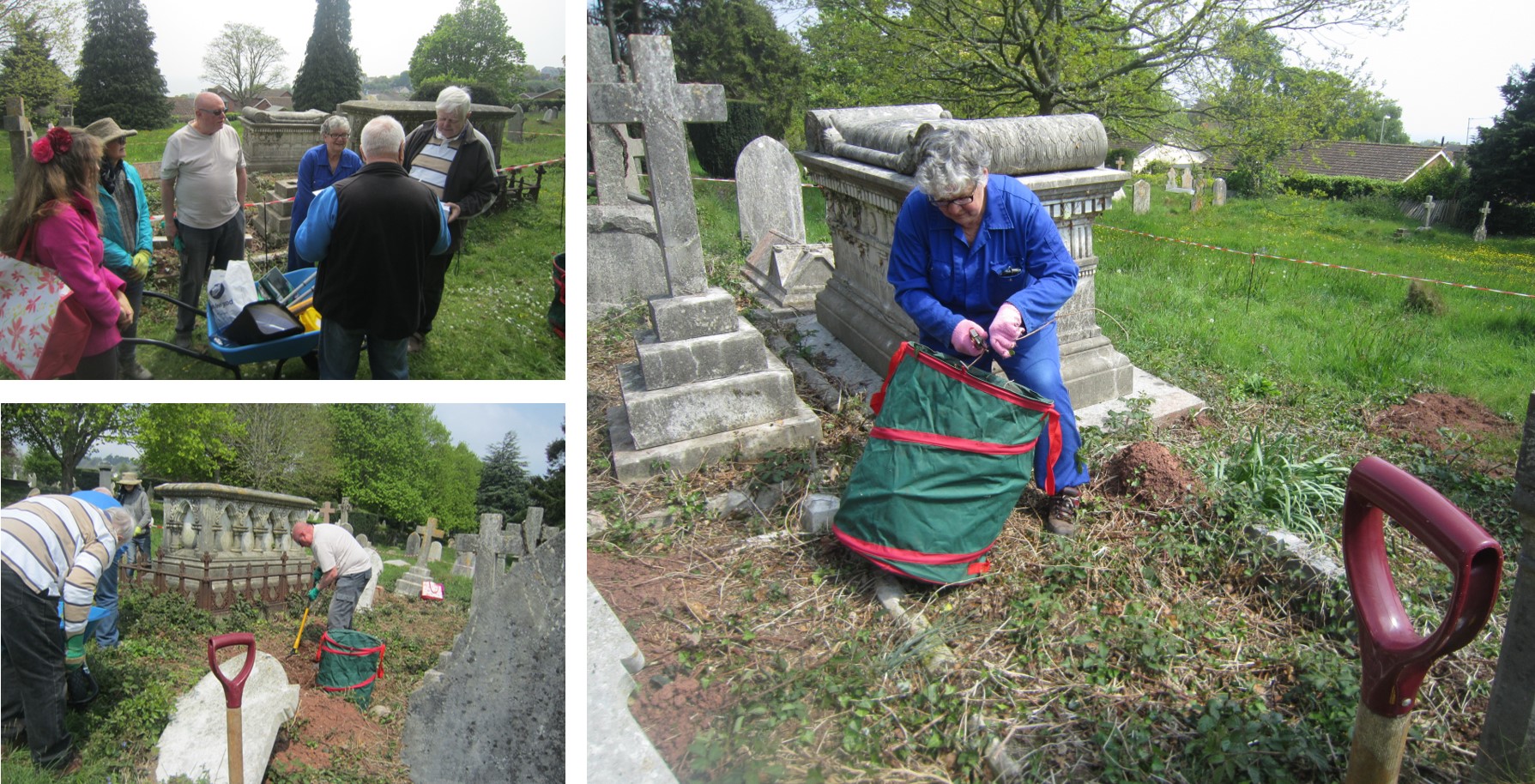
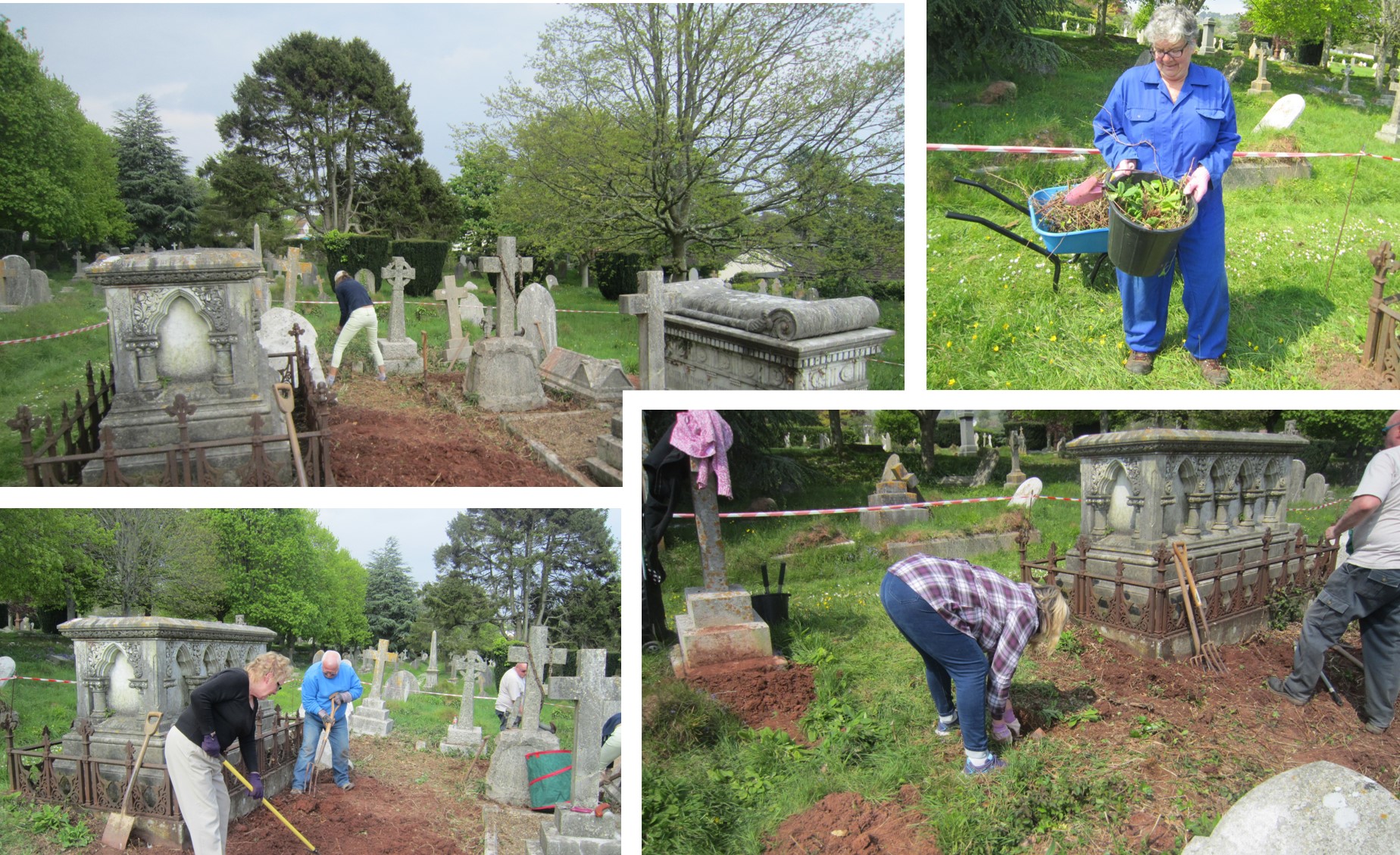
Here are a few pictures showing the progress made so far on the main area of graves we have been working on. It has been HARD work, especially trying to eradicate the many years of growth of brambles and ivy, but we’re getting there. The next stage for this area will be to decide how we plant up to make it more attractive. There is also some work being undertaken around the buildings – pictures to follow. We still have some concerns which we are trying to address with the Council such as removal of all the waste and most importantly whether we can use one of the buildings for storing our equipment.
We found a line of child graves that had been completely overgrown
We have also now had a response from Teignbridge District Council about our proposal for the renovation of the buildings for community use. Click here to see that response. We are currently reviewing how we should respond to it since it does not match with our proposal or subsequent meetings we had with the Council. Our reply will be published here as well.
Charles Ethelred
Finally we have decided to create a separate Facebook page. Whilst this website is good for keeping a record of everything being done related to the Cemetery it is not as immediate as Facebook. Facebook will enable us to post information and photos very quickly which is important now that we are getting into a regular system of work parties. Details to follow.
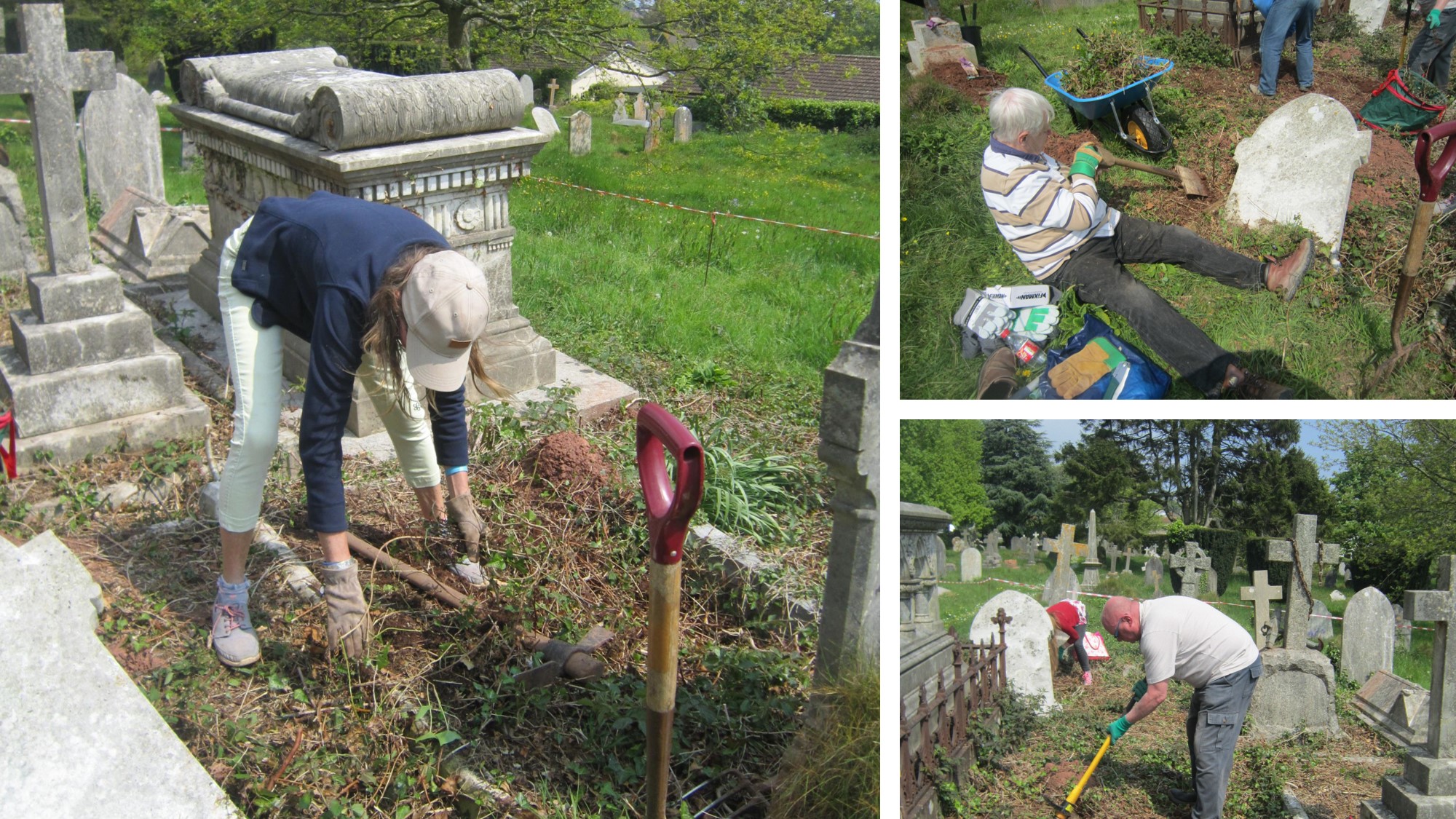
I missed it!! Thursday May 4th saw the first working party on the first site we had marked out for clearance and I missed it – away in sunny climes. But there was a lot of activity as you can see from the photographs below and I am told that much progress was made. Thanks to everyone who made it that day and to Elaine for capturing the moments.
Finally we have our public liability insurance and a completed risk assessment. This means that Teignbridge have now been able to give us official permission to be able to work in the cemetery.
Last Thursday a group of us visited the Cemetery to survey the first area which we will be clearing. This gave us a chance to test out the risk assessment document and to mark out the area – this now cordoned off with barrier tape in accordance with the risk register. Looks a bit like a crime scene, doesn’t it?!!
Survey site from below
We photographed all the graves and have also made written records of what could be deciphered on the graves. Interestingly (more to come) we have been offered some assistance with cutting edge technology (associated with Exeter University) which can photographically reconstruct wording which may be unclear or eroded.
One of our volunteers will be starting some historical research on the graves and we also carried out a quick flower survey of the area. We will be attempting to conserve any interesting wild plants which may be dug up as part of the clearance.
Close up of two of the large tombs
Now the hard work can start in clearing the graves. Fortunately much of the bramble and ivy had been cut away previously by Dawlish Garden Trust but there are still roots to be grubbed out. The first working party is planned for next Thursday 4th May at 1pm – anyone who would like to help is most welcome. We are still in the process of purchasing tools so for this first working party it would help if everyone could bring a fork or spade or some hand-tools themselves.
This first area will be significant for us in testing out what the best approach to clearance could be and also how long it takes. That will help in mapping out a long-term plan.
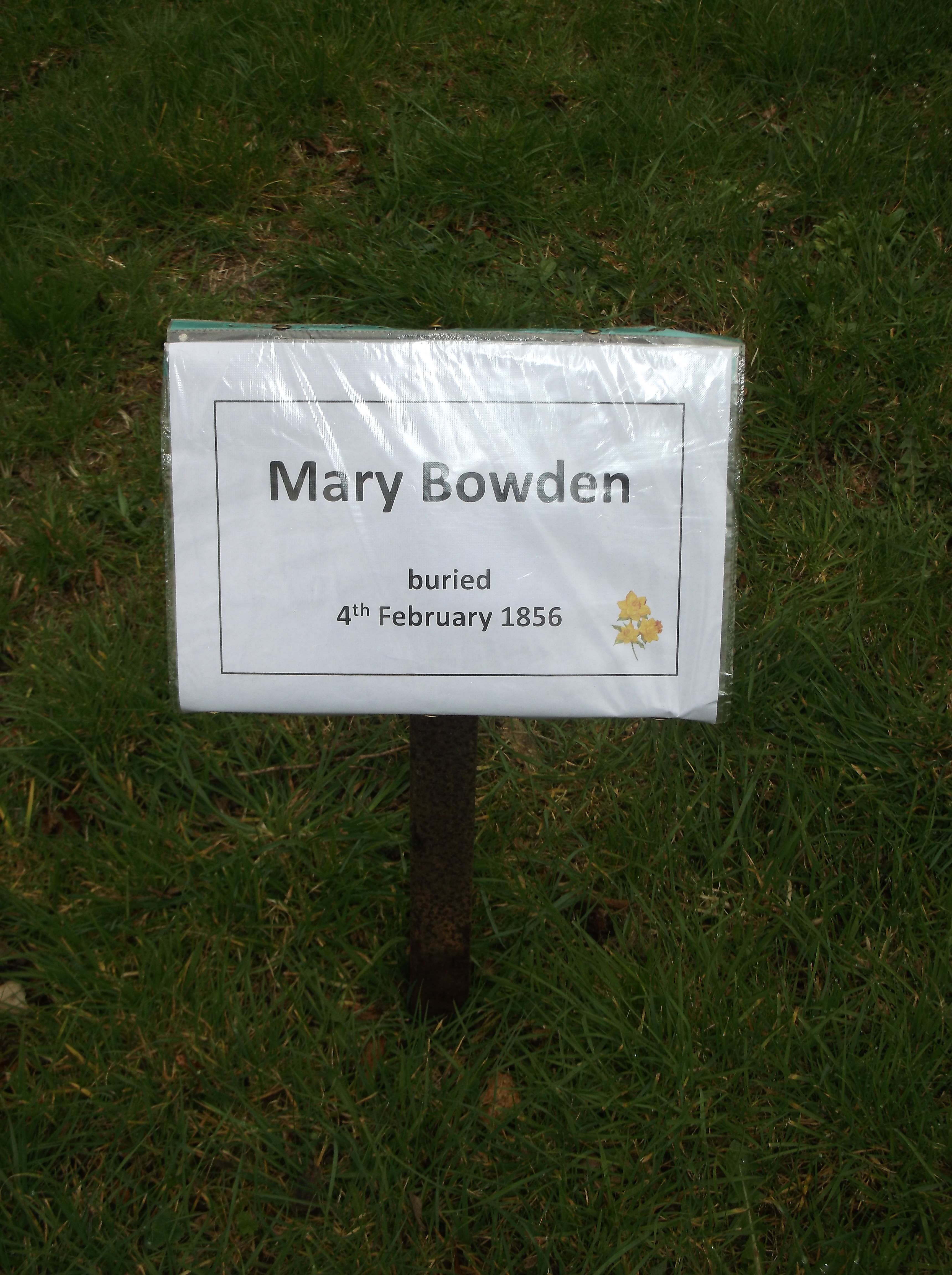
Last Thursday I went up to the cemetery armed with a stake and a hammer ….. and before anyone says it, no I wasn’t vampire hunting – I also had a makeshift plaque and a tape-measure.
I was there to meet up with Katrine Smith, the Cemetery Officer from Teignbridge. She came clutching two maps which were the plot maps from two areas of the cemetery marked as “F”.
We were in search of the unmarked grave of Mary Bowden, the first person to be buried in the cemetery on 4th February 1856.
It turned out I didn’t need the tape measure since Katrine was skilled in pacing the area and ‘feeling’ the ground to ascertain whether there was actually a grave at the spot we were standing on. We meticulously cross-referenced the spot against nearby marked graves so that there could be a cross-check later, back at the office.
The improvised plaque
One hour later, SUCCESS!! We were 99% certain that we had identified Mary Bowden’s grave and planted the stake and plaque in the ground there. Katrine double-checked the records later and confirmed the location of plot F51.
A job well done.
It would be nice to mark the spot a little more ceremoniously in the future – perhaps with a special memorial plaque.
Adjacent grave of Henry Earl, Jane Earl and Thomas Finch
In the process we came across the adjacent grave which had been purchased 50 years after the original interment and with a headstone erected at that time – it looks like there might be an interesting story there for the future.













 Teignmouth Old Cemetery