Last Thursday I went up to the cemetery armed with a stake and a hammer ….. and before anyone says it, no I wasn’t vampire hunting – I also had a makeshift plaque and a tape-measure.
I was there to meet up with Katrine Smith, the Cemetery Officer from Teignbridge. She came clutching two maps which were the plot maps from two areas of the cemetery marked as “F”.
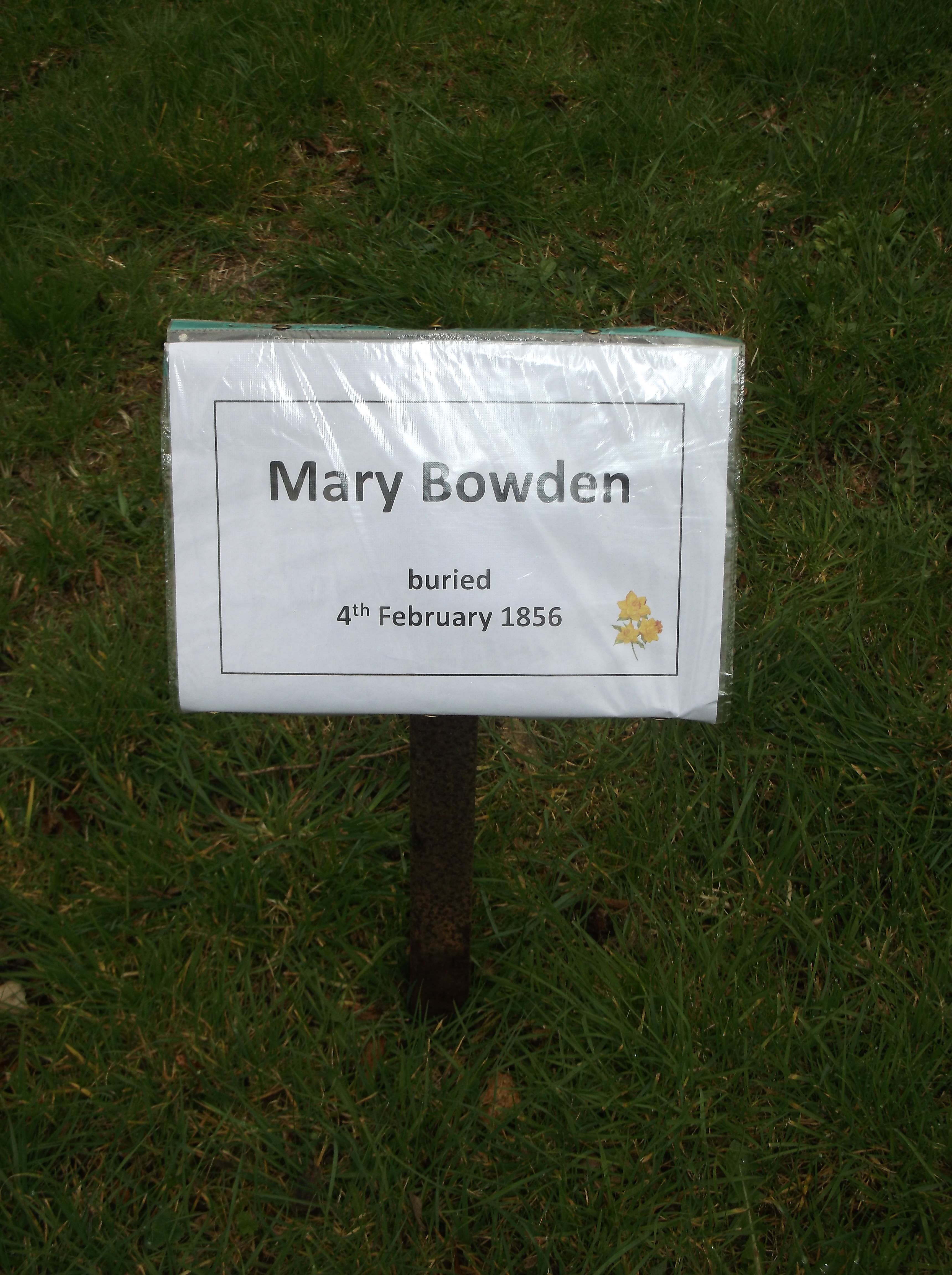
We were in search of the unmarked grave of Mary Bowden, the first person to be buried in the cemetery on 4th February 1856.
It turned out I didn’t need the tape measure since Katrine was skilled in pacing the area and ‘feeling’ the ground to ascertain whether there was actually a grave at the spot we were standing on. We meticulously cross-referenced the spot against nearby marked graves so that there could be a cross-check later, back at the office.
The improvised plaque
One hour later, SUCCESS!! We were 99% certain that we had identified Mary Bowden’s grave and planted the stake and plaque in the ground there. Katrine double-checked the records later and confirmed the location of plot F51.
A job well done.
It would be nice to mark the spot a little more ceremoniously in the future – perhaps with a special memorial plaque.
Adjacent grave of Henry Earl, Jane Earl and Thomas Finch
In the process we came across the adjacent grave which had been purchased 50 years after the original interment and with a headstone erected at that time – it looks like there might be an interesting story there for the future.
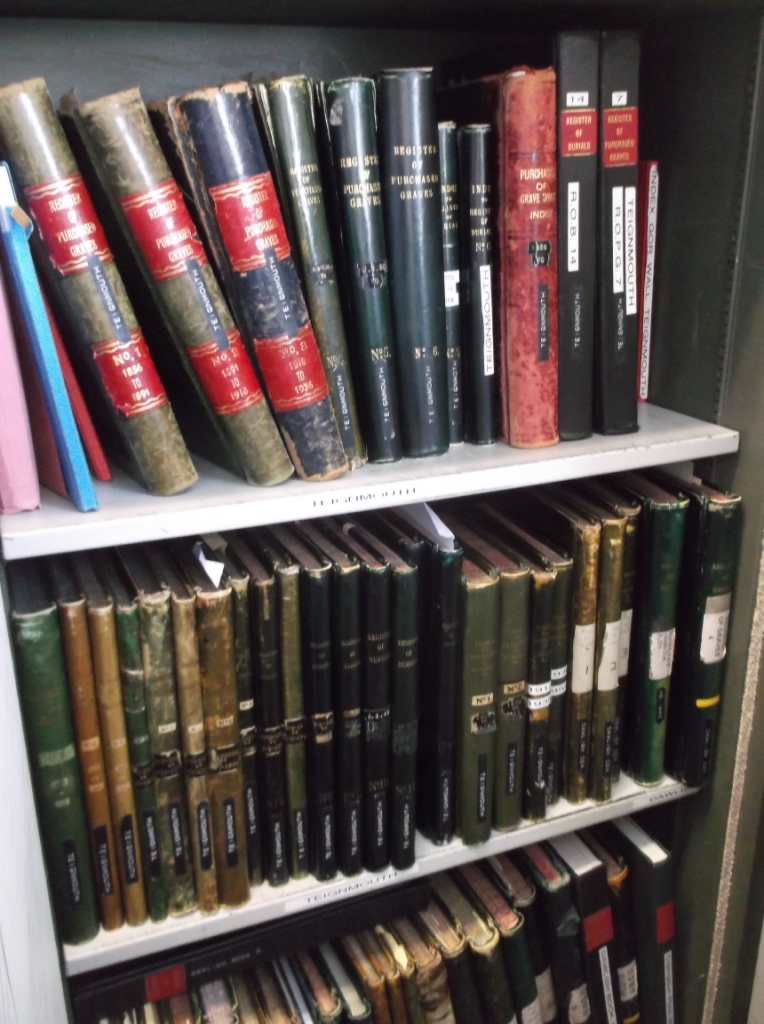
Last week I met with Katrine Smith, the Cemetery Officer for Teignbridge District Council. She very kindly, and with great enthusiasm, showed me the records that are held on the Teignmouth Old Cemetery.
We looked at the fascinating old map of the burial plots and looked up the records of Leah Laforgue, the first person whose grave we cleared as part of this project.
We also identified the records of Mary Bowden, the first person to be buried in the cemetery on 4th February 1856 and is in an unmarked grave.
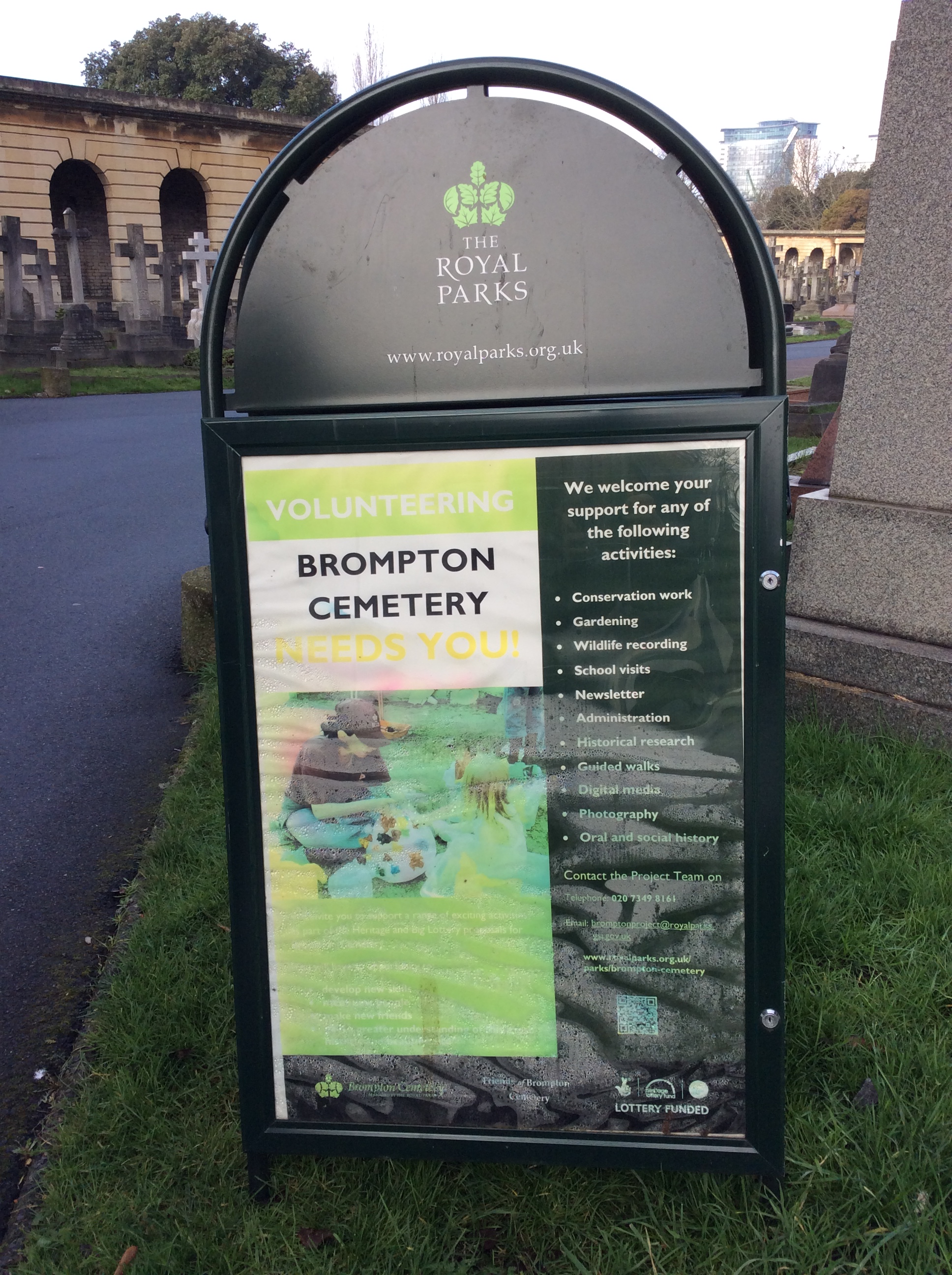
A few days ago I received an email from Jaki, one of the FOTC Friends:
“Was just in London and friend’s flat backs onto Brompton Cemetery. Walked through there. Some areas totally overgrown but they are clearing and working to restore and have an ongoing project.”
So WE ARE NOT ALONE!
Accompanying the text below are some of the photos that Jaki took.
National Federation of Cemetery Friends
Protect our cemetery for everyone
All over the country there are groups working to restore local cemeteries. We have contacted the National Federation of Cemetery Friends which represents groups of volunteers interested in conserving cemeteries large and small. The Cemetery Friends give their time clearing and maintaining areas, often working with local ecology groups to maintain a balance between wildlife and heritage. Friends may also provide guided walks, open days and special events and work on projects with English Heritage and other organisations. Some groups have restored memorials and chapels.
Associate members of the National Federation include trusts, councils, organisations who manage cemeteries and burials and individual members who are not part of a Friends group but share in their values.
They have produced an excellent booklet “Saving Cemeteries, A Handbook for Cemetery Friends” which draws on experiences from a number of Friends groups across the country. It includes case studies on: Arnos Vale Cemetery, Bristol; Woodbury Park Cemetery, Tunbridge Wells; Flaybrick Cemetery, Birkenhead; Sheffield General Cemetery; Beckett Street Cemetery, Leeds; The Rosary, Norwich; Nunhead Cemetery, SE London.
Why should our cemeteries be saved?
A Green Sanctuary
Cemeteries are pieces of ground set aside for burials. There are around 14,000 cemeteries in the UK. Many cemeteries are closed for new burial plots, although they may be open for the interring (burying) of ashes. Many cemeteries are attached to churches, some are operated privately and many are run by Local Authorities.
However, urban burial grounds in the 19th century were originally envisaged as public open spaces, and were professionally designed to be attractive places to visit in their own right. As well as functioning as burial sites, they were also regarded as places for visiting and promenading of “a more dignified and morally uplifting kind”. The nineteenth-century legislation that provided for new burial grounds seemed to have envisaged that they would in due course become public open spaces (for which provision was made in the Open Spaces Acts 1887 and 1906).
Today, many cemeteries are neglected, with little to attract anyone apart from those visiting specific burial plots. This lack of design, planning and ambition means that the potential health and environmental benefits of cemeteries are not being realised.
Incredible Heritage Assets
There is a strong case to be made that cemeteries have especial architectural and landscape interest because they have often been trapped in a time-warp, and have not been modified, adapted, overlaid, or even destroyed, as has so much else in the historic environment.
This is an argument that is becoming increasingly heard elsewhere in Europe. There are a very large number of listed buildings in cemeteries, according to the National Monuments Record Centre, including lodges and houses, boundary walls, gates, mortuary chapels, cemetery chapels, tombs, and mausoleums.
So cemeteries are a unique mirror on our history and heritage whilst offering an opportunity for the future – a return to the original concept of “Open Space”, providing opportunities for encouraging wide community use.
The above includes extracts from the following sources:
To the left of the lodge is the remains of a second chapel. Until a couple of weeks ago this was covered with ivy and full of bramble and ivy. The overgrowth has now been cut back but there is still quite a bit of work left to bring the inside down to its original floor level. As the clearance progressed a lot of masonry came to light. It appears that fragments of broken headstones have been left here – it would be interesting to trace their original grave locations. Click Here to see some photos:
On 30th January Teignbridge opened up the Lodge buildings for us to have a look inside. There is evidently quite a lot of internal damage although the buildings themselves seemed to be reasonably structurally sound. Click on the following page to see some pictures:
We have recently submitted to Teignbridge District Council an Expression of Interest for the community use of the Old Cemetery buildings and site. As part of that we were also asked to submit a business plan.
Our response to that particular point was:
“With only two weeks, and no prior notice, to produce such a plan it would be disingenuous to produce anything which purported to be a definitive business proposition. However, we do have a clearly thought through view which is presented in this Outline Business Strategy. Our strength as a group is that we can call upon a wide range of skills, experiences and views to shape a cogent way forward for full community use of the site.
Our understanding is that at least one other organisation has had prior notice of the Expression of Interest and dealings with Teignbridge about the future of the site. They will, therefore, have had more time to prepare a full business plan. We hope that this is not pre-determination and that our proposition will not be discounted simply on the basis of not having had sufficient time or access to knowledge to produce such a plan.”
Teignbridge have said that they will be evaluating all Expressions of Interest over the next couple of weeks. It is probably best, in case we jeopardise our submission, that we hold back on publicising the full content here. But you can see a brief summary of the approach we have suggested at the following page: Expression of Interest Summary.
We have recently officially established the “Friends of Teignmouth Cemetery” (FOTC) to promote the restoration and conservation of the Old Cemetery grounds and buildings and to encourage broad community use of those amenities in any way which is sympathetic to the site.
Details of FOTC and its activities are posted on a separate page on the Main Menu.
If you would like to become a Friend just follow the joining instructions posted there.
TEIGNBRIDGE Council has withdrawn its change of use plans for the old cemetery chapel in Teignmouth. In 2015, the council had put in an application to convert…
Last Wednesday (25th January 2017) we were given access to the inside of the boarded up chapel. Obviously we took the opportunity to take some photos which have been placed on the “Cemetery” page which you can reach through the main menu or just click on the following link: In The Chapel
All this community pressure has brought interest in the Cemetery out into the open. There was an excellent spread in the Torquay Herald Express of 23rd January. You can see this online through our publicity page. Just click HERE and select the item.
There has also been a front page and inner page spread in the Teignmouth Post of 27th January which is reasonably balanced although it does lead with the proposal from the company we managed to unearth as a result of our media activity. There is also a little journalistic licence to create a good story by portraying us as “competing groups”, whereas what we are trying to ensure is that there is complete transparency and community consultation about the restoration of the buildings with broad multi-purpose community use in mind. There isn’t an on-line link to the story but, for those who have not been able to see a copy of the paper, I have scanned in the article by reporter John Ware below.




 Teignmouth Old Cemetery