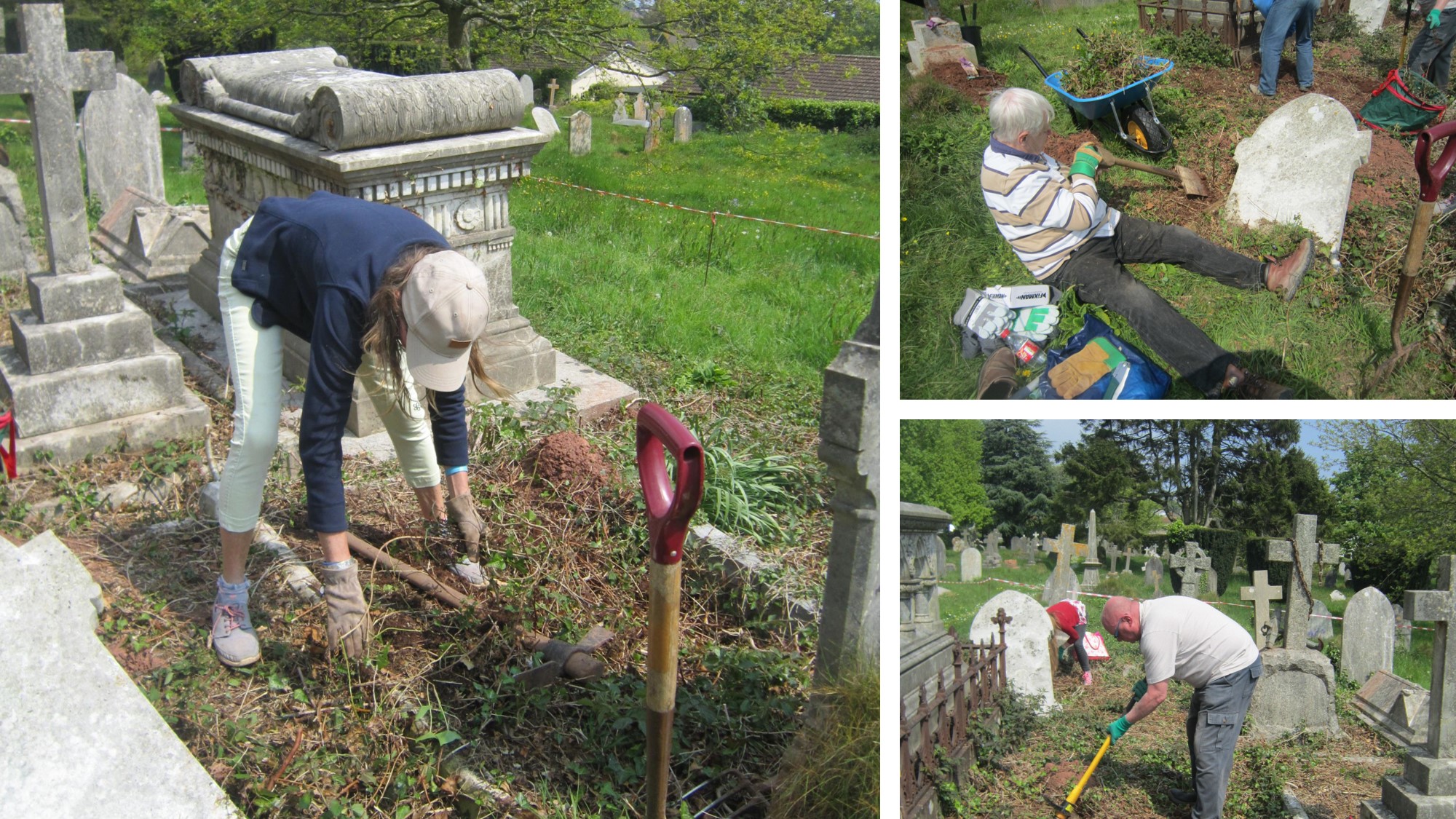
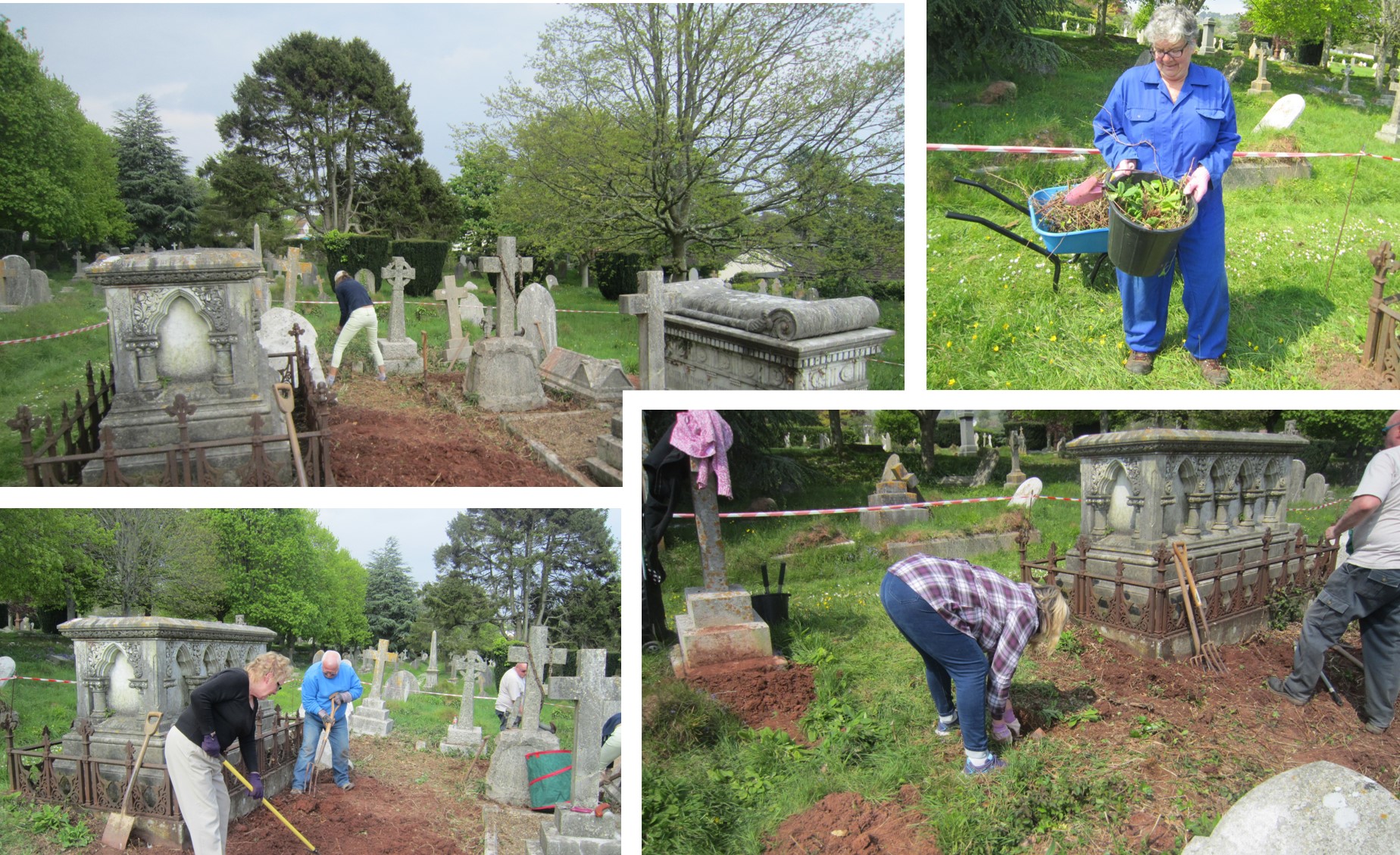
This year has seen the 200th anniversary of the period that Keats stayed in Teignmouth. He was here for only two months, arriving on 6th March 1818 after an horrendous journey from London through torrential storms. He had come to look after his brother Tom who had been staying in Teignmouth as part of the ‘treatment’ of his TB, from which he died later in the year.
Whilst he was here John Keats completed the fourth book of Endymion, wrote another epic poem ‘Isabella’, a number of smaller pieces which he described as doggerel or ‘bitcherel’ and, from an important historical point of view, he wrote letters back to his friends which revealed his thought, emotions, worries.
So what’s the connection between Keats and the Cemetery?

In 1901 a notable local historical author, Beatrix Cresswell, wrote a book about Teignmouth – “Teignmouth, its History and its Surroundings”. In it she refers to Keats and makes the first written mention of where Keats stayed in Teignmouth:
“A year or two ago, Dr Lake and Mr H Buxton Forman, C.B. (the latter then busy in searching for memorials of Keats), were at some pains to ascertain, if possible, the house in which he stayed. By studying his letters they concluded that the young poet lodged in a house (now 35, Strand) at the corner of Queen Street, a turning toward the river.”
Nine years later this was disputed in a letter to a local paper:
“John Keats lived here and at Teignmouth finished his masterpiece ‘Endymion’ dating the introduction to the poem Teignmouth, October 1818. The house he lived in is now 21 Northumberland Place (adjoining the King William Inn, facing Queen Street) and is not , as Miss Cresswell in her guide states, No. 35 Northumberland Place at the corner of Queen Street nearly opposite. For this statement I have the authority of Dr Lake, Mr W R Hall Jordan and Mr Forman Buxton (sic) CB who although neither of them are patriarchal enough to have been the contemporary of Keats each remembers this house to have been pointed out to them by those of the former generation as the Teignmouth home of the poet”
The author of that letter was Frederick C Frost.
The debate on where Keats actually stayed rumbled on and even resurfaced in another newspaper article in 2005 (Herald Express, Viv Wilson MBE), even though an official plaque had been assigned in 1931:
“The connection between John Keats and Teignmouth has not diminished with time, and many people still seek out the place where he stayed in 1818. The red granite plaque on Keats House in Northumberland Place satisfies the majority but there is another contender for the title. A school of thought supports the idea that Old Place, just opposite, with the canon protecting its corner wall, was the place where he stayed.”
The decision on where to place the official plaque was ultimately based on the earlier work of three men: Dr William C Lake, Frederick C Frost and William Risdon Hall Jordan. The latter two are buried in Teignmouth Old Cemetery, whilst Dr Lake would have been had his family not already secured a family vault at St James’ Church.
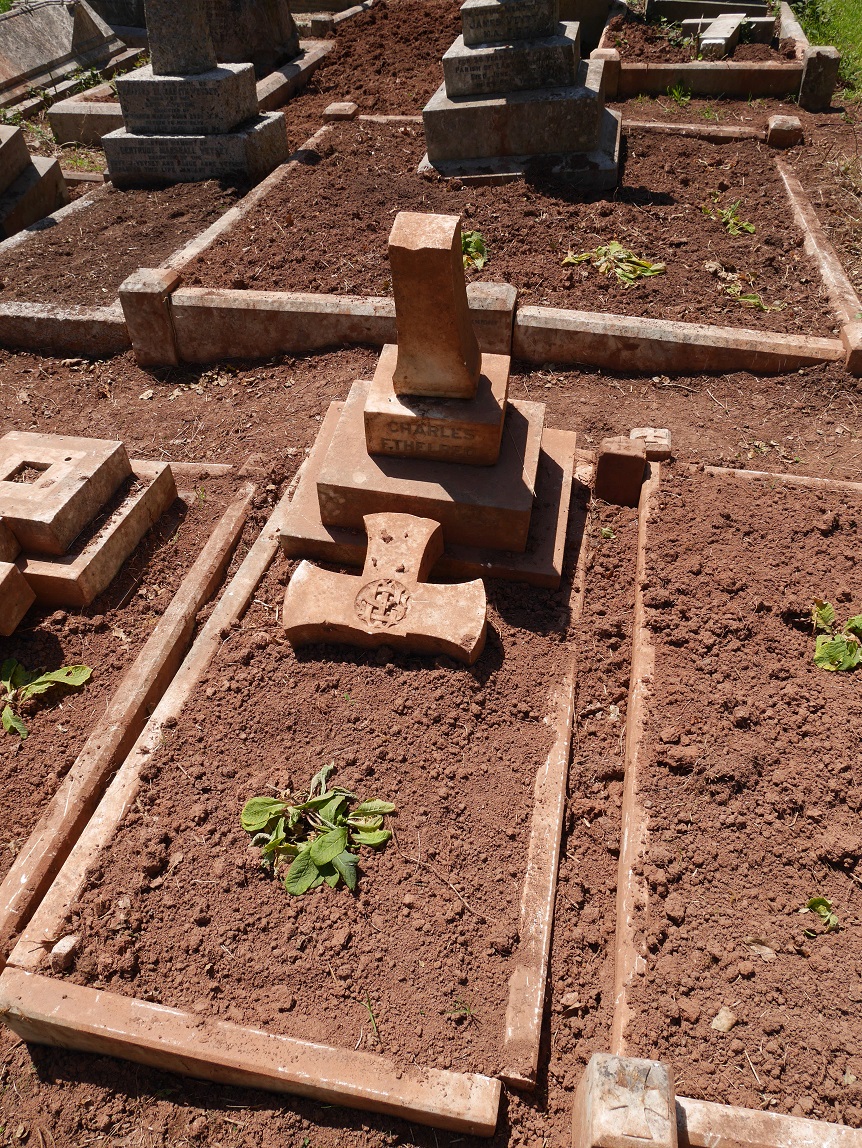
Frederick C Frost (1855-1914)
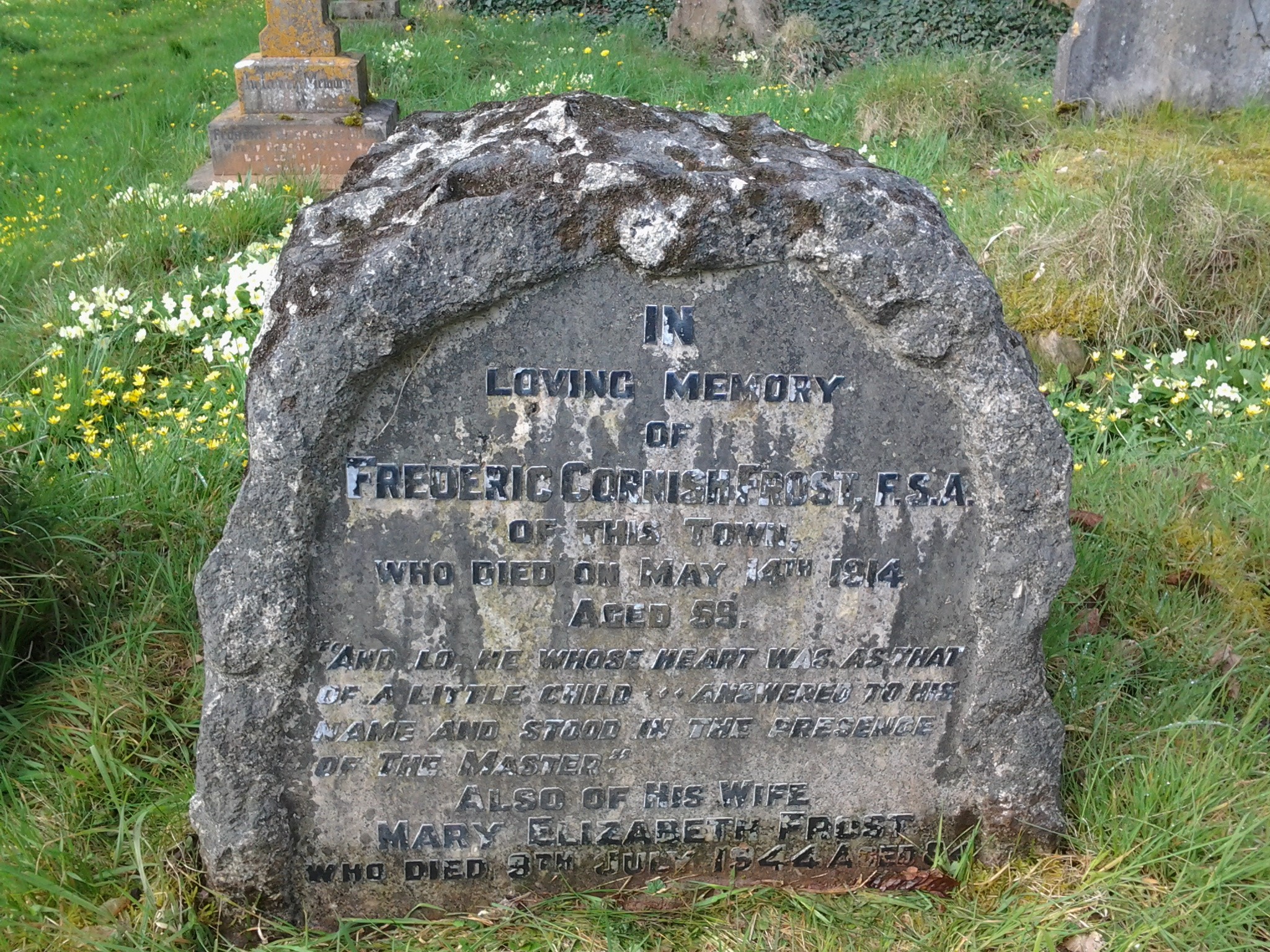
He married in Newton Abbot in 1886 and was an antiquarian who ran the local family business of auctioneers, established by his father. The family lived at 5 Regent Street and Fred would have known Dr Lake well since they were both members of the Freemasons Benevolent Lodge 303. He was a Fellow of the Society of Antiquaries and also a member of the Devonshire Association, making contributions to that organisation and to the “Antiquary” and “Notes & Queries, a Medium of Intercommunication, for Literary men, General Readers etc” on subjects as diverse as the Devon dialect, medieval religious orders and heraldry. He used the initials FSI after his name which could mean he was a Fellow (full member) of the Surveyors Institution, awarded a royal charter in 1881 and the forerunner of the Royal Institute of Chartered Surveyors (although ‘FSA’ is actually inscribed on his headstone as a Fellow of the Society of Antiquaries’)..
His contribution to the Keats debate
Judging by the letter he wrote, as reported in the Exeter and Plymouth Gazette of 16 April 1910, he was vociferous in championing the cause of Teignmouth celebrating various historic figures associated with the town by putting up commemorative plaques throughout the town. My guess is that he was raising awareness and doing some local campaigning because two years later in the Western Daily Mercury of 12 March 1912 the following appeared:
“Teignmouth boasts some interesting literary memories, but the associations of Keats with the town are the most notable. Keats came to Teignmouth for his health’s sake in 1818, and there he finished his ‘Endymion’ and wrote its remarkable preface. Hitherto the house on the Strand, where the poet lodged, has never borne any name or indication that Keats spent any time there. Now the house has passed to another tenant, and he, acting on the suggestion of a Fellow of the Society of Antiquarians, resident in the locality, has decided to christen the residence “Keats’s House”. There was a dispute as to the exact house where the poet stayed but the present tenant, before deciding on the title, sought the advice of several old Teignmouthians who well remember the ’bonnet shop’.”

Shortly after this a popular author of the time, Francis Gribble, wrote a book “The Romance of the Men of Devon” in which he included a section on Keats together with a photograph of Keats’ House with its name newly inscribed on the front door. The house was subsequently officially recorded as “Keats’s House” in the title deeds of 1925.
William Risdon Hall Jordan (1821-1911)
The Jordan family in Teignmouth goes back to at least the 17th century and the most complete description of William R H Jordan’s life that I have found is in his obituary published in the Reports and Transactions of the Devonshire Association (Vol 44 of 1912). I have simply transcribed this below, with any notes of my own in italics:
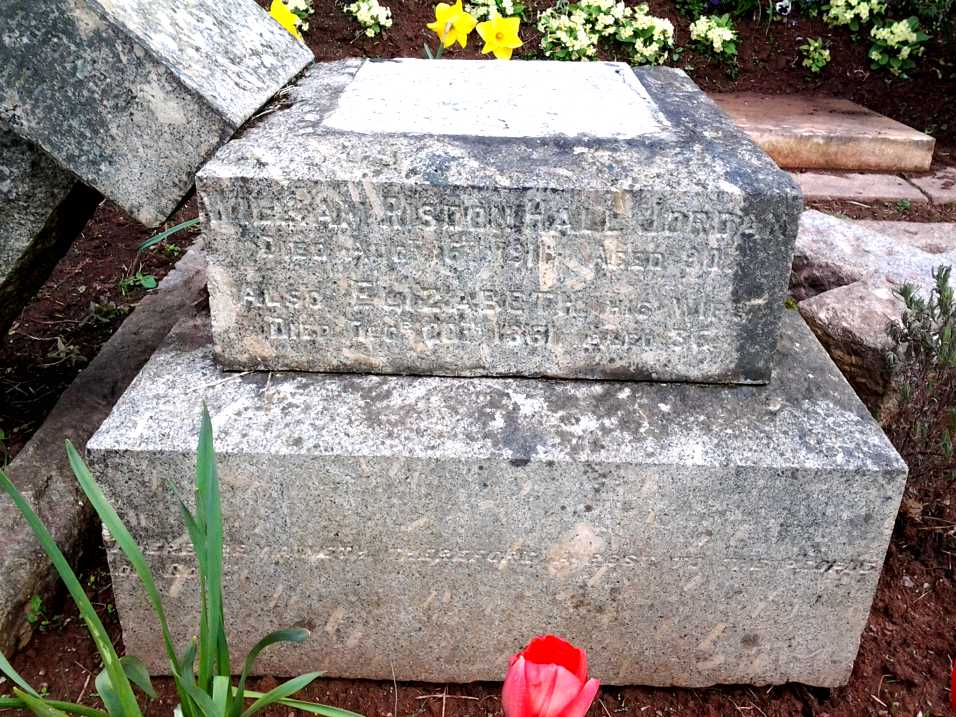
William Risdon Hall Jordan was born at Teignmouth, his family having settled there as far back as 1650. His grandfather (Robert Jordan), in the early part of the last century, founded, with the late Mr Langmead, the South Devon Bank, which was subsequently merged into that of Messrs. Watts, Whidborne and Co., and later in the Capital and Counties Banking Company. (Note that Robert Jordan was also a key driver behind the scheme to infill the old marshy areas of Teignmouth along the river Tame, which flowed into the Teign, creating the land that is the centre of Teignmouth as we know it today).
Mr Jordan was educated at Dr. Edwards’ School, at Teignmouth, and served his articles with his father. He was admitted a Solicitor in 1844, and for some years acted successively as managing clerk to Messrs. Tozer and Whidborne, of Teignmouth. In 1848 Mr. Jordan practised on his own account, and on the retirement of the late Mr. John Chapell Tozer from the clerkship to the Teignmouth Improvement Commissioners in 1852, he became Clerk to that body.
Mr. Jordan subsequently held the appointment of Clerk to the Teignmouth Local Board, under the Local Government Act of 1856, and the Public Health Act of 1875, and was the first Clerk to the Teignmouth Urban District Council. This post he resigned in 1900 (when he was only 79!!), but he retained the position of Clerk to the Burial Board, which he had held since the inauguration of that body in 1853 (so he was also one of the founding members of the Board that ran Teignmouth Old Cemetery when it was opened).
Mr Jordan also took a great interest in educational work, and acted as Clerk to the Teignmouth School Board from its inception in 1875. He in later years continued as correspondent to the school managers, from which post he retired in 1910, being succeeded by his son, Mr. W F C Jordan. To the Bread and Coal Society and the Soup Kitchen in Teignmouth he acted as Hon. Secretary.
He became a member of the Association (I.e. the Devonshire Association) in 1871, serving on the Council for many years, and contributed the following papers to its Transactions: Notes on the Natural History of Teignmouth and its Vicinity (1874); Migration of Insects (1885); Teignmouth Gleanings (1904). Mr. Jordan was also a member of the Teign Naturalists’ Field Club.
In his earlier days his recreations were shooting and rowing, and he had a great predilection for Natural History. He died at Teignmouth on 17 August, 1911, aged ninety years.
His contribution to the Keats debate
Fred C Frost had quoted William Risdon Hall Jordan in his letter to the local paper but the actual connection with the Keats story is via his father, William Rufus Jordan. He is recorded as living in 1822 at No 11 Northumberland Place, in other words just up the road from where Keats would have stayed.
It appears that William Rufus Jordan had told his son that he had known Keats well and that he had stayed at No 20 Northumberland Place; his son, William Risdon Hall Jordan, had passed that information on probably shortly before he died.
Dr William Charles Lake (1825-1920)
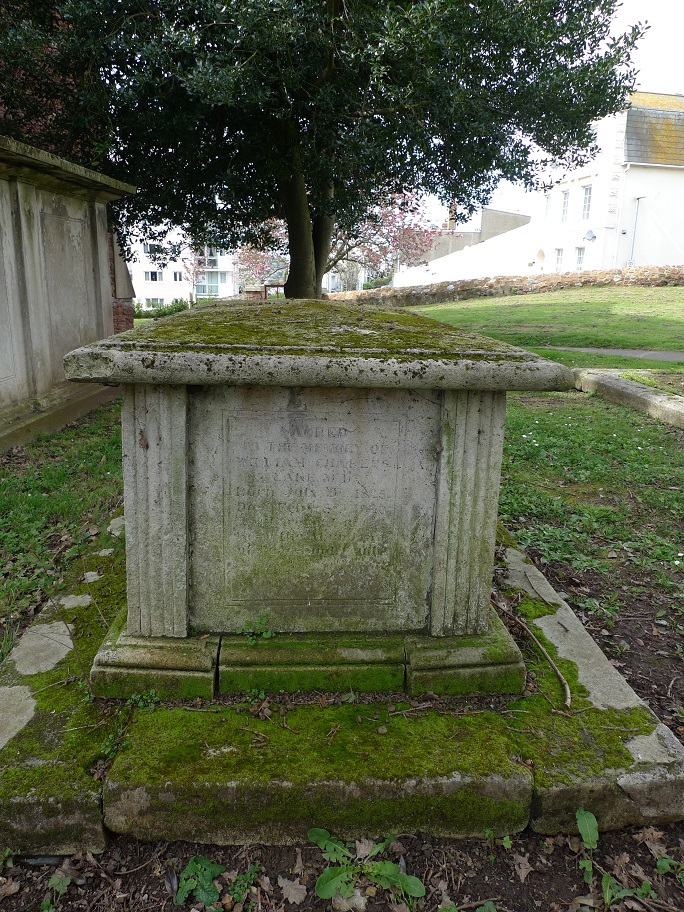
Dr William Charles Lake is the third of the local men involved in this jigsaw. He is actually interred in the family vault in the grounds of St James Church but I am including him here to complete the picture.
His role was international communications! But first, something about his life and contribution in Teignmouth; again I shall take it direct from his obituary in the Transactions of the Devonshire Association (Vol 52, 1920), with my own notes in italics:
Dr Lake was born at Teignmouth on July 9th, 1825, being the eldest son of Anthony Proctor Lake, surgeon, R.N., and of Elizabeth Kirsopp, both of Northumberland. (Note: his father registered for naval service in 1806, arrived in Teignmouth in 1817 and is registered in 1822 as a surgeon living at 16 Northumberland Place, just up the road from Keats House and close to William Rufus Jordan). He was educated at Exeter Grammar School under Dr. Mills, and could number amongst his schoolfellows Mr J. H. Tozer, Mr R. W. Templer, and Dr. Robert C. R. Jordan, uncle of Mr W. F. C. Jordan (and brother of William Risdon Hall Jordan).
Dr. Lake followed his father’s profession, and for a time was his father’s pupil, and subsequently of the late Dr. Cartwright, of Brimley House. He completed his professional education at King’s College, London, and at the University of St. Andrews, where he took his degree of M.D. He practised in Teignmouth as a physician and surgeon for forty-two years, being Medical Officer of Health for fourteen years. He was one of the pioneers of the old Dispensary in Bitton Street and later joined the staff of the Teignmouth Infirmary and Dispensary. On the death of Capt. A. G. Paul, Dr. Lake was appointed Chairman of the Hospital Management Committee, and at the time of his death was consulting physician to the Institution.
During the cholera epidemic of 1867 Dr. Lake undertook the work in connection with the outbreak, and in many cases he actually laid out the dead bodies. He was presented with a clock and purse by the townspeople for his devoted and unselfish work.
Dr. Lake became a member of the Devonshire Association in 1871, and contributed, besides many papers on meteorology, a “Sketch of the History of Teignmouth”; on the “Frosts of 1855 and 1895 as observed at Teignmouth,” and “Notes on the Origin of Teignmouth Streets and their Nomenclature”. He was also a member of the Royal Meteorological Society and supplied meteorological observations for close on fifty years.
He was for many years a sidesman at St. James’s Church, and had written articles on the Books of the Bible for the Parish Magazine. He was chairman and one of the original trustees of the Risdon Charity which is distributed annually in the vestry of St. James’s Church. In politics he was an enthusiastic Conservative and frequently presided at meetings of the party in the town. (He was also, as mentioned previously, together with Fred C Frost, a member of the Freemasons Benevolent Lodge 303).
In the sixties Dr. Lake was a member of the now defunct Local Board, and the newspapers of those times bear witness of his keen interest in sanitary matters. He retired from practice in 1891 and was then the recipient of a public presentation.
Having been born in the middle of the reign of George IV – thus having lived under five sovereigns – his reminisces of the past were most interesting. When at Exeter he often saw the mail coach pass over Cowley Bridge for London. He had travelled in Brunel’s atmospheric railway, some of the towers of which yet remain. He remembered when the Tame Brook, which runs through the town, was an open stream with bridges for crossing opposite the Royal Library and at the bottom of Orchard Gardens, and when the site of the railway station was an old farm, and when living in the house in which he was born in the Strand he had an uninterrupted view from his residence of the Den and the sea, and remembered the then Duchess of Clarence riding round the Den. He was one of the oldest and most esteemed and respected residents of Teignmouth. His affable and kind manner won a place in the hearts of rich and poor alike. A sincere Christian he was in every sense much beloved, and his loss will be greatly felt.
His contribution to the Keats debate

Much of the historical memorabilia of Keats is now held in collections in American universities. One of the foremost collectors was an illustrator, art editor, and print dealer in Boston, Massachusetts, called Louis A Holman. His collection now forms part of the Houghton Library at Harvard University. In 1913 he contacted Dr Lake who responded with two letters which now form part of that collection.
In those letters Dr Lake confirmed that Keats had stayed at No 20 Northumberland Place and sent Louis Holman a couple of photographs of the house. That information found its way into the literature in 1958 when Prof Hyder Edward Rollins, professor of English at Harvard University, published his definitive up-to-date collection of the “Letters of John Keats”.
The Keats commemorative plaque was eventually placed on the house at 20 Northumberland Place in 1931 based on a recommendation from the curator of the Keats museum in London. That decision itself was largely based on the previous work done by those three men of Teignmouth:
– Frederick C Frost,
– William Risdon Hall Jordan, and
– Dr William Charles Lake
all of whom shared an interest in history and contributing to life in Teignmouth.
The above is just a small part of the story of where Keats lived when he stayed in Teignmouth. If you are interested in the full story there is a complete set of blog-posts on the “Teignmouth in Verse” web-site under the title ‘The Hunt for Keats House‘. (Note: this link takes you to the first of the series of blog-posts; at the end of that post scroll down slightly and you can then navigate through to the next in the series, and so on)