A group of us met on this fine Saturday morning to clear the area around another grave, that of Albert Best, which is to be found just behind the surviving chapel in the Old Cemetery. I will post up a separate story about Albert Best since he was quite a leading light in Teignmouth during his time and has left us a legacy of contemporary social history through his diaries.
However, there was another reason for getting together. Thanks to Tacy Rickard I had been pointed to an electronic copy of a lithograph print of the Cemetery, dated 1864. I thought it would be interesting to try to take a modern photograph to compare with the original picture.
Teignmouth Cemetery 1864
(The lithograph has been reproduced with kind permission of the Devon Archives and Local Studies Service based at the Devon Heritage Centre in Exeter)
Starting with the original lithograph, the view appears to have been taken from the direction of the Higher Buckeridge Road end of the cemetery uphill from the current main entrance. So enter through the main entrance, turn right and take the first main path to the left.
The path in the lithograph appears to be wide and cobbled, which is supported by the discovery of cobblestones close to the first grave that was cleared (Leah Laforgue). The present day path is narrower and grassed but there seems to be a tarmac layer underneath. So we could speculate that tarmac at some time was laid over the cobbles and then couch grass has over time taken over the tarmac.
There seems to be a little artistic licence in the picture. For example: the chapel roof angles differ from the actual roof (unless there has been reconstruction); and the view is as though you are looking down onto the cross (X) in the picture and up towards the chapel. It is difficult to see where this viewpoint could have been.
There are four reference points marked on the lithograph, only two of which are visible today. ‘A’ I think is St. Michael’s Church; ‘B’ seems to be the slightly hillier area next to Rocky Lane along Exeter Road; ‘C’ is the chapel itself; and ‘X’ is the cross which is the closest fix-point for the picture.
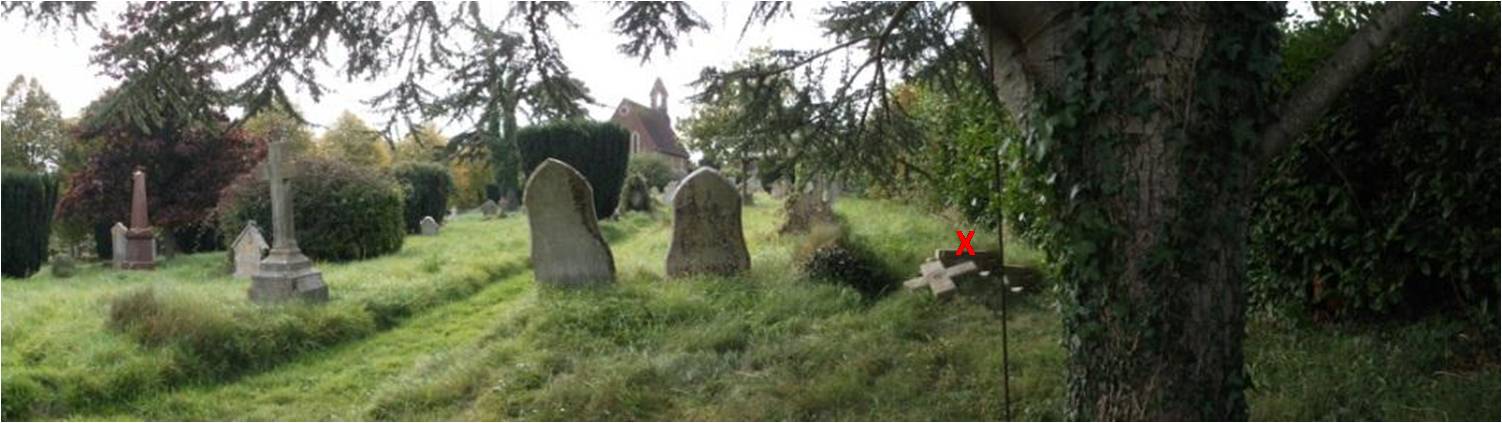
Present day photograph
Comparing the lithograph with the present-day photograph you can see that:
The reference points ‘A’ and ‘B’ are no longer visible, blocked by trees;
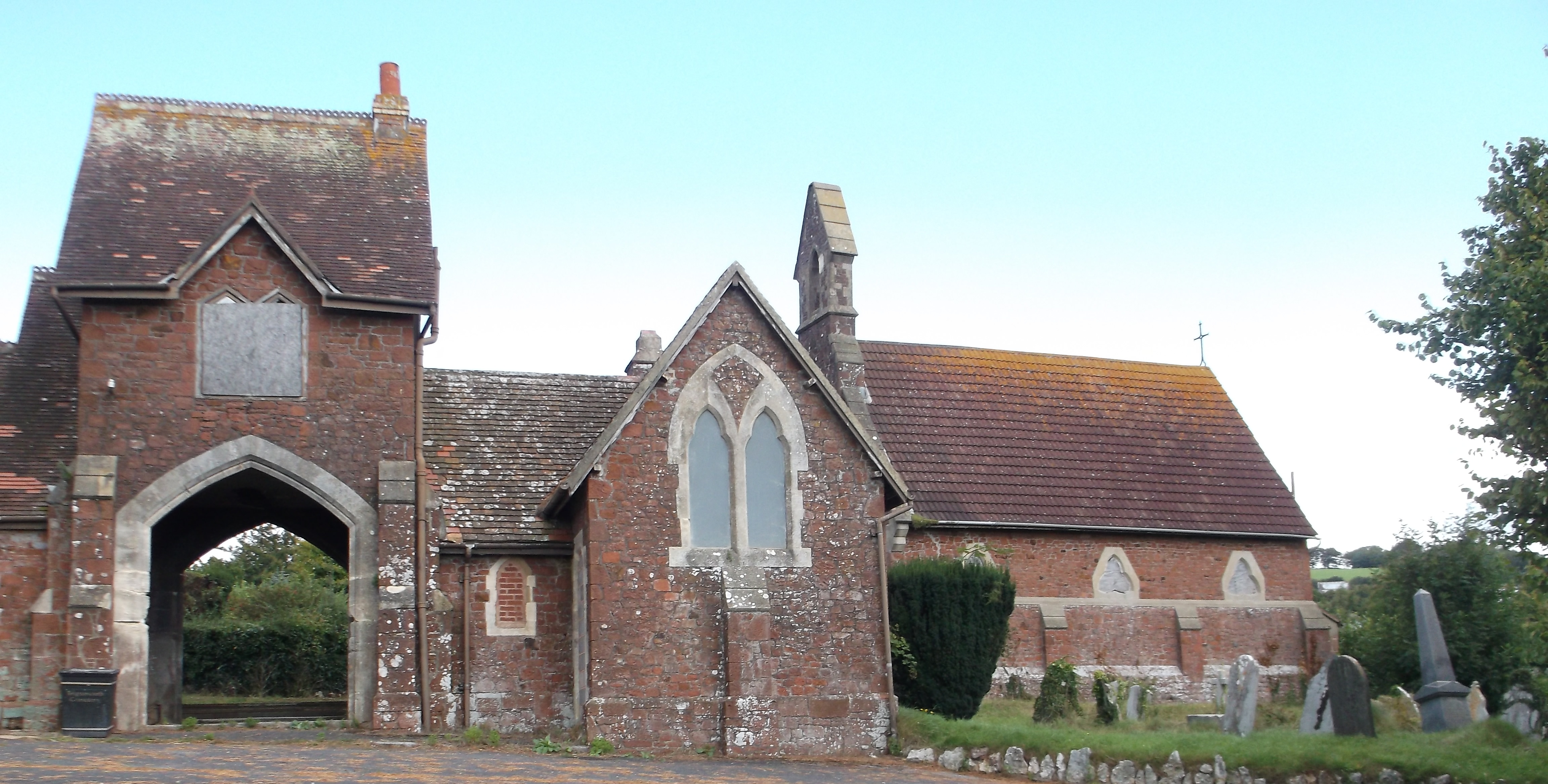
The chapel ‘C’ is slightly different in shape;
The cross ‘X’ is now broken and its position suggests that the original viewpoint was further to the right of the position from where the photo was taken. However, as can be seen in the photo, there is now a tree obscuring the view at the front and also there is a dense hedge to the right of the cross which prevents taking a stand further to the right.
The broken cross is dated 1862 so fits well with the date of the lithograph; and the shape of both the plinth and the cross itself match the lithograph picture. This grave is of a child age 8, Wilhelm Carl Edward Bodnar, who may be at the heart of an interesting story – the research is ongoing.
Campaigners trying to preserve a derelict chapel and lodge at the old Teignmouth cemetery have suffered a setback.
Teignbridge Council, which owns the properties, has applied for planning permission for a change of use to convert the ‘surplus assets’ into a dwelling, and demolition of a store to provide a garden. But opponents are objecting and want to see the historic buildings restored.
The town council submitted a ‘community right to bid’ application to Teignbridge. This would allow it to try to acquire the chapel and lodge, if and when they are put on the market by the district council.
The chairman of the Finance and General Purposes committee, Cllr Geoff Bladon, is leading the fight to retain the buildings. He told a town council meeting on Tuesday that the application had been refused by Teignbridge. ‘But I will be appealing against that decision,’ he declared.
Cllr Bladon said later that many people in the town would be angry at the refusal because there was a lot of support for restoring the buildings. Local funeral directors had expressed an interest in using the chapel for services in the future.
Born in 1861, Leah Lee has been described as “a black-eyed, chestnut-haired Devonshire beauty”. She was the daughter of Samuel Lee, a well-to-do draper of Teignmouth, and his wife, also named Leah.
Her story is quite extraordinary. – a young Victorian woman who left the small town of Teignmouth and England to become governess to the children of Empress Augusta in Berlin.
There she met a young Frenchman, Jules Laforgue, who was a Reader to the Empress Augusta and who took English lessons from Leah. Importantly, though, he was also a poet.
Jules Laforgue
It appears they had a whirlwind romance, left Berlin, got married on December 31st 1886 in England at the Church of St Barnabas in Kensington and then returned to Paris where Jules Laforgue could immerse himself in the cultural maelstrom that was Paris in the 1880s.
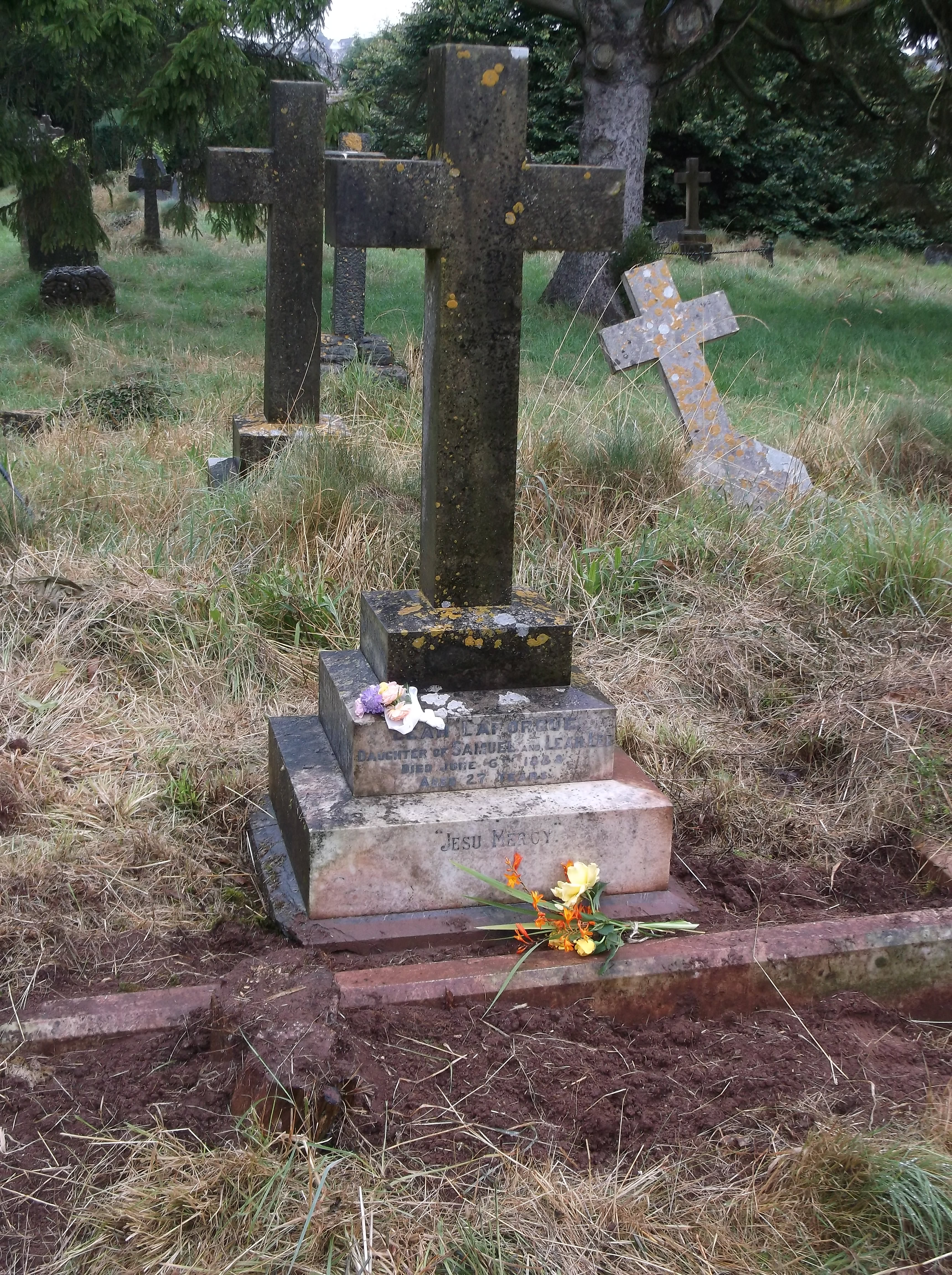
Less than a year later Jules was dead (20th August 1887), having contracted TB. Leah died a year later (6th June 1888) from the same disease. Leah was in London when she died but was buried in the main cemetery off Exeter Road in Teignmouth.
Leah Lee’s grave in Teignmouth Cemetery
Looking for Laforgue – the Biography
The story of Leah Lee and Jules Laforgue has been written as an ‘informal’ biography Looking for Laforgue (1979) by journalist David Arkell. It was he who discovered, in 1965, the identity of Laforgue’s wife and among the many photographs and drawings in this volume are a photograph of Leah Lee, of her tombstone in the churchyard in Teignmouth, and a reproduction of an extract from The Teignmouth Gazette showing an advertisement for S. Lee’s Paris Wove Corsets, for she was the daughter of a well-to-do draper.
Laforgue the Dandy
Arkell described Laforgue as a handsome cigar-smoking dandy who relished the opportunity to wear frock coats, toppers, and morning dress when he went over to sit with the old empress and read her the tony Revue des deux mondes in the language she preferred to German – just the thing for an artist whose parents weren’t rich. During 1883 he had a stormy affair with a mysterious woman known only as ‘R’, believed to be a German woman twice his age who was a Woman of the Royal Wardrobe.
But for a long time he had admired Englishwomen – he once wrote to a friend “As you know, there are three sexes – men, women and English girls”. So perhaps it is no surprise that he started to take English lessons from Leah, whom he called his “Petit Personage”. She was impossible to describe, he informed his sister: “imagine a baby face, with a malicious smile and big eyes (tar-coloured) always astonished, and a little voice, and a funny little accent in French”. This was the start of a change in his life and his poetical focus.
During 1886 there was a burst of creativity; the interesting women in Laforgue’s new poems, Des fleurs de bonne volonte, and his stories, Moralites legendaries, are perhaps his finest achievement. Leah became the model for his tender portrait of the red-headed Andromede, an impatient girl who declines to be rescued from a vulnerable dragon by a smug hero.
Jules Laforgue, the father of modern poetry
We only know as much as we do now about Jules Laforgue and his works because Leah had kept all of his manuscripts and, on his death, had handed them over to a friend, Teodor de Wyzewa, in Jules’s literary circle. This ensured that his work lived on to become the primary influence in modern poetry.
Jules Laforgue was no ordinary poet. He is widely recognised as the father of modern poetry and the creator of “free verse” or “vers libre” as it was known at the time. French poetry was particularly rigorous, with strict rules of rhyme and scansion so Laforgue was breaking all the rules. He was the Impressionist or Cubist of poetry – “I forget to rhyme,” Laforgue wrote, “I forget the number of syllables, I forget to set it in stanzas – the lines themselves begin in the margin like prose. The old regular stanza only turns up when a popular quatrain is needed.”
Modern poetry was launched in France in 1886 with the launch of La Vogue whose first issue was confiscated for obscenity (note that Laforgue was the first French poet to use the word “clitoris” in verse) and only lasted 20 issues. But this “little magazine” contained the most powerfully influential work of the three “onlie begetters” of Modern poetry: Walt Whitman, Arthur Rimbaud and Jules Laforgue.
T S Eliot discovered Laforgue in 1908 when he was at Harvard and it changed his life. Eliot’s reading of Laforgue that summer changed his style completely, sent him to Paris, and emancipated him from the last traces of Victorian America’s genteel style. It may have turned him into a poet. Eliot’s first book of poems, Prufrock and other observations, owes its very existence to Laforgue’s magnetism. Pound marvelled that Eliot was the only writer he met who had “modernised himself on his own;” but if he had tried to do it without Laforgue, it is unlikely he would have been anything other than a professor of philosophy. Eliot said “Laforgue was the first to teach me how to speak, to teach me the poetic possibilities of my own idiom of speech”. Eliot was so influenced by Laforgue that he even married his wife Valerie in the same church, St Barnabas, where Leah and Jules were wed.
Ezra Pound described Laforgue as “an angel with whom our modern poetic Jacob must struggle,” and “perhaps the most sophisticated of all French poets”; in 1913 he added, “Practically the whole development of the English verse-art has been achieved by steals from the French.”
Laforgue’s poetic output includes Les complaintes (1885), L’Imitation de Notre Dame de la lune (1886), and his masterpiece, Derniers vers (1890). He also produced some short prose pieces, notably Moralités légendaires (1887).
The above has been collated from various sources:
Gravestone of Leah Laforgue, her father Samuel Lee and mother Leah




 Teignmouth Old Cemetery