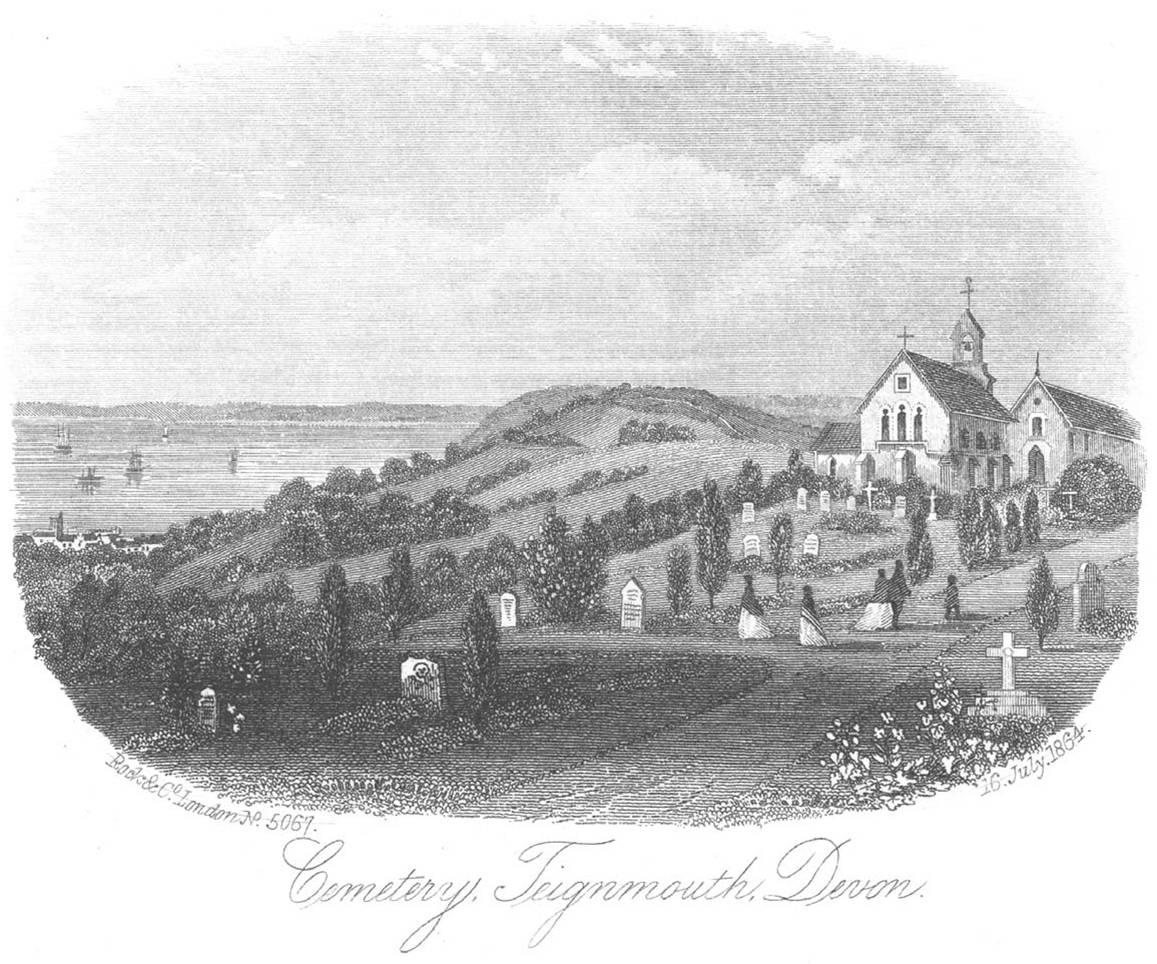
William Frederick Rock was a British publisher and philanthropist. Having worked with the printer and inventor Thomas de la Rue he started his own printing business with help from his brothers. They specialised in publishing topographical steel-engraved prints, one of which was the 1864 etching (No 5067) of Teignmouth Cemetery.
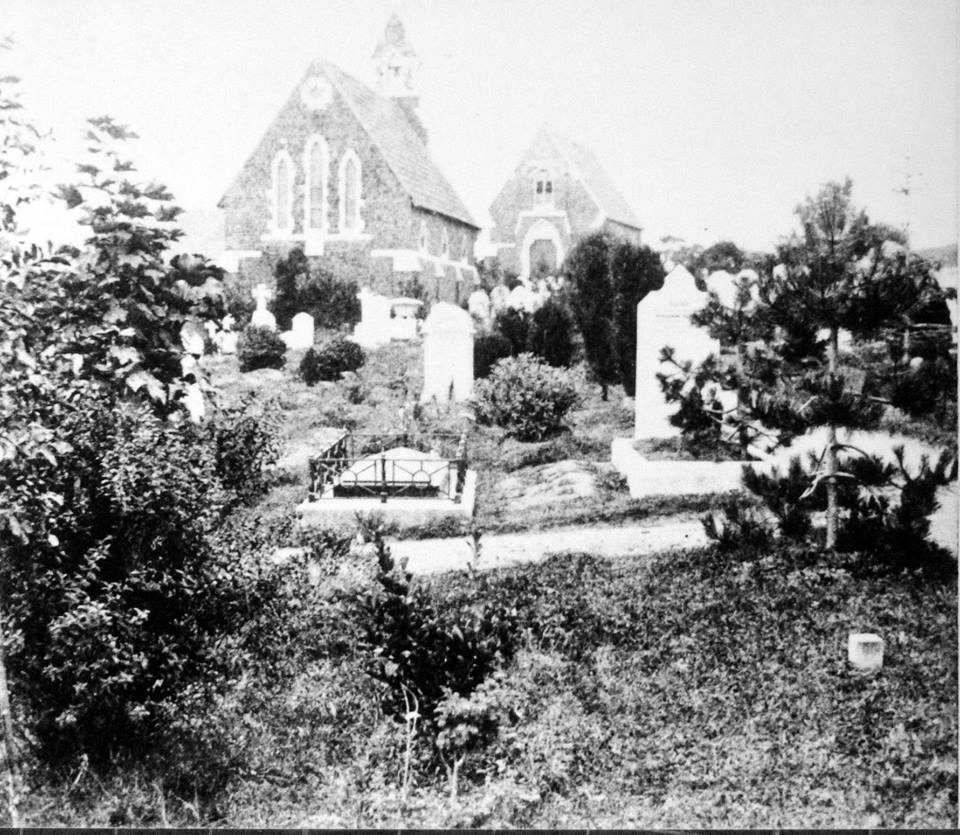
Thanks to local historian Viv Wilson MBE, who has kindly given us access to an old photograph from her archive, and an equivalent up-to-date picture we now have a unique comparison of almost the same cemetery scene over 150 years.
The three pictures are shown below as thumbprints. Click on any picture to get a larger view. It’s fantastic to see both chapels in a photograph, looking so similar to the original etching. All the more sad that the second of those chapels is now just a ruin.
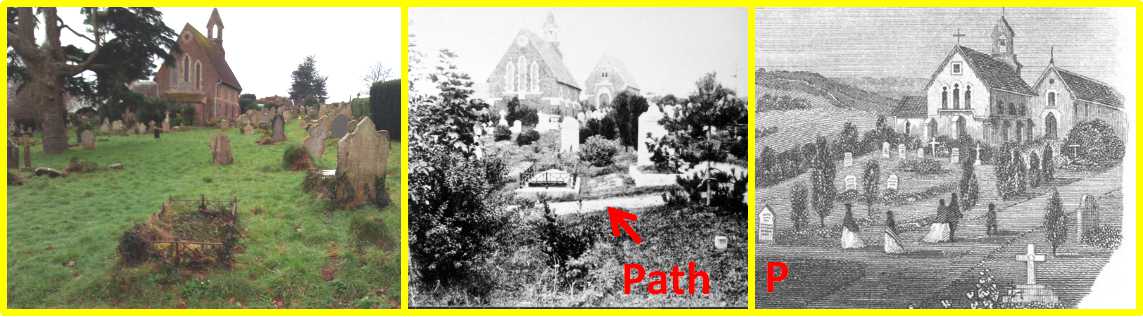
Below the individual pictures are some close-up comparisons of all three pictures together.
Current View
Date unknown – from Viv Wilson MBE archive
Teignmouth Cemetery 1864
The angles and distances are obviously slightly different but cropping what appears to be roughly the same area from each picture and scaling so that the main chapel is approximately the same size in each gives the following montage:
The “P” on the right-hand etching represents roughly where it would seem that the middle photograph was taken. Note the path on the etching which still appears to be a stone path in the photograph. That is now long gone. The key marker for the modern photograph is the central grave in the middle photograph which is surrounded by low iron fencing, now untidy and slightly overgrown.
There is one constant in all three pictures though – the white cross standing below the left-hand window of the main chapel:
150 years …. a long time in the life of the cemetery.
It would be nice to think that news of Teignmouth Cemetery has gone global. We’re not quite there but we have had another international contact recently, this time from Tom Williams of Anaheim, California.
Kerb inscription 2015
Tom had visited the cemetery in 2015 and, amongst the overgrowth and brambles, had managed to find the grave of his great-grandparents – Henry John and Elizabeth Mary Williams.
Two of the FOTC volunteers, Jean Gitsham and Geoff Wood, went in search of their grave and described what they found:
“We were expecting the Williams grave to be covered in dense brambles however when we located the grave it was completely hidden under dense tangled ivy plus had a large anthill on it as well …
Cleared grave, ready for planting
Around 8 large tubs of ivy pulled off the grave with lots of stubborn roots removed with mattocks …around 10.30am Mal joined us helping with our mammoth ivy clearance task…lots of heavy work resulting in muddy conditions … “
According to the 1939 register Henry was a private gardener. They both died on 2nd September 1942 in a bombing raid on Teignmouth in which their house, 11 Higher Brook Street, was hit. Henry was 82 and Elizabeth 79. Two other residents there, Alice Jemima James and Rosa Victoria Turpin, were also killed along with neighbours nextdoor in number 10.
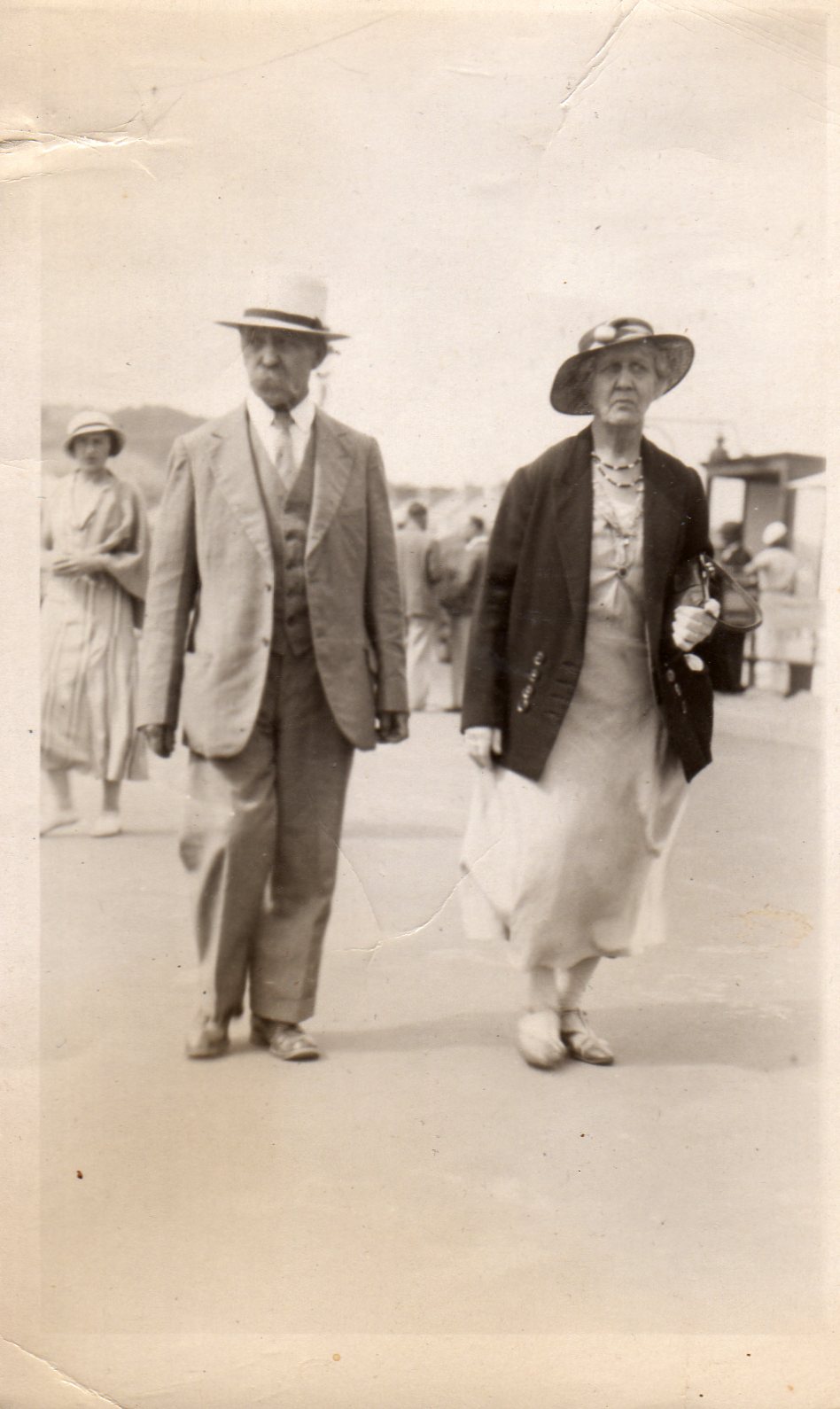
On Teignmouth Seafront 1935
This was just one incident in ten raids that Teignmouth suffered between 1941 and 1943. More details of these and a full list of those who died in the bombings and are buried in the Cemetery are given on the Bombing Casualties page.
Tom sent us this wonderful picture of his great-grandparents promenading along Teignmouth seafront before the war.
Tales from the Grave so far have focussed on stories surrounding those who are buried in the Cemetery. But the Cemetery itself has its own tales to tell such as this one from the Western Morning News of Friday 5th March 1880 – a tale of apparent mystery, intrigue and skulduggery which prompted rumours to be spread throughout the town. I have left the story verbatim as reported in the paper to give it the appropriate ‘period’ feel of a Victorian melodrama but I have broken the single paragraph item up into several for ease of reading.
Curious Proceedings in Teignmouth Cemetery
“At the monthly meeting of the Teignmouth Burial Board yesterday, Mr C H Stooke presiding, Messrs J Tothill and N Hudson also being present, a letter was read by the clerk (Mr Jordan) from Mr G A Hole, gardener, of Fore Street, in which the writer complained that he had found on visiting the cemetery, that a shrub had been taken from his mother’s grave, and on enquiry where the shrub was he discovered that it had been planted on another grave.
The lodge-keeper (Mills) said he knew nothing about it.
The Chairman proposed that, taking all the facts of the case into consideration, the monthly visitor (Mr G Jarvis) be written to, requesting him to have Mills replace the shrub at once. He (the chairman) heard Mr Jarvis give Mills particular orders not to touch any shrub belonging to any private individual, and Mills should have obeyed those orders.
Mr Tothill thought it possible that Mills might not have been present at all when the shrub was transplanted. The Chairman thought Mills must have been there the whole of the time. Mr Hudson inquired whether anyone could plant shrubs on the graves of their relatives. The Clerk said they could with a “pass” which Mr Hole evidently had.
The Chairman said it appeared that a rumour had gone through the town about this particular shrub, altogether a false rumour, which was got up for a purpose; there was no doubt about that. He had heard Mills suggest, in Mr Jarvis’s presence, that some of the shrubs in the cemetery should be transplanted, as they were too thick, and were injuring each other, and Mr Jarvis told Mills he must do nothing of the kind with the shrubs planted by private individuals.
Mr Tothill said that might be all very well, but the shrub was removed from a private grave, and placed upon his (Mr Jarvis’s) father’s grave. It was a thing which he (Mr Tothill) would not have allowed to be done. Mr Hudson thought it would have been far more satisfactory if both the visitor and the lodgekeeper had been present. Mr Hudson did not believe that Mills would have allowed the shrub to be removed without Mr Jarvis’s sanction.
It was resolved to order the restoration of the shrub, and to further investigate the matter.
Was Jarvis, the appointed ‘visitor’, the mastermind villain behind this heinous act? Was Mills, the trusted lodgekeeper, the fall-guy? What was the nefarious purpose of the “false rumour”? Did Stooke, the Chairman, have a hidden vested interest and was he attempting to pervert the course of cemeterial justice? Was the further investigation a cover-up, perhaps in the national interest?
We may never know the answers to these important questions – I can find no further report. The statute of limitations may have passed but this Victorian whodunnit remains a mystery.
The Cemetery continues to raise bizarre connections with the outside world.
In April 2012 Charles Taylor, the former president of Liberia, was found guilty by a Special Court in the Hague of eleven charges of atrocities including terror, murder and rape. He was subsequently sentenced to 50 years in prison of which the Presiding Judge, Richard Lussick, said: “The accused has been found responsible for aiding and abetting as well as planning some of the most heinous and brutal crimes recorded in human history.”
A gruesomely true story which has a strangely ironical connection with Teignmouth.
Charles Taylor was born in Arthington, Liberia, a small town situated on the St Paul river northwest of Monrovia, the capital city. Arthington was first settled in 1869 and was named after Robert Arthington, a Victorian philanthropist whose life and beliefs are diametrically opposed to those of Charles Taylor.
Robert Arthington is buried in Teignmouth Old Cemetery and his story is extraordinary. A millionaire, he lived like a pauper and gave his wealth to initiatives that spread the gospel across the world in Africa, Asia and South America.
As usual the story began with the discovery of his grave and its strange epitaph which reflects the Victorian aethos of his philanthropy.
“Robert Arthington, His life and wealth was devoted to the spread of the Gospel among the Heathen.”
A Brief History
Robert Arthington – From Leeds Photographic Archive collection
Robert Arthington was born in Leeds on 20 May 1823. He was one of four children, and the only son, of Robert and Maria Arthington, a wealthy Quaker family. Perhaps somewhat surprisingly for a Quaker, his father ran a successful brewery business but his conscience eventually caused him to give it up and devote himself to the cause of temperance.
Robert jr studied at Cambridge University where he apparently excelled as a student but chose not to take a degree. Following his mother and two of his sisters, he left the Society of Friends and joined the South Parade Baptist Church in 1848. When his parents died in 1864 (within a couple of months of each other) he found that he had inherited an enormous fortune of over £200,000. Despite this capital he never started his own business but invested his money instead, mostly in British and American railways, which proved a very successful way of increasing his wealth.
We may never know whether this was fortuitous or whether he really had an astute business sense. What is widely documented though is that he had a clear purpose and vision of what he wanted to do with his wealth. He was determined to direct it to good causes, in particular the promotion of missionary work around the world in the unknown areas then being explored and opened up particularly in Africa and Asia.
It appears that a second major change in his life occurred in his late forties. The story goes that around 1870 he fell in love and he had a large new house built in Headingley Lane for himself and his prospective bride – but he was jilted at the last minute. Whether true or not, it seems that from this point he drifted further and further into a reclusive life in the house he had built.
Headingley House – From Leeds Photographic Archive collection
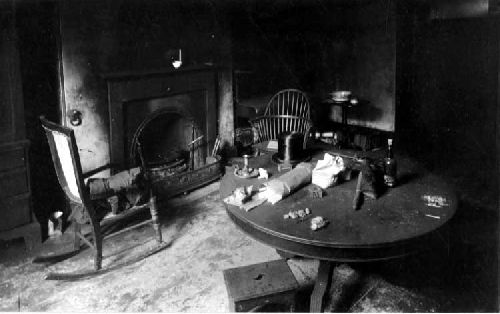
He occupied a single room, cooked his own meals, wore the same coat for seventeen years and made friends with students who were in need. He slept on a chair, wrapping himself with his coat. He did not allow anyone access to his room, except special visitors. He would not even light the room for visitors, as he believed that “it was possible to speak as well in the dark as you could in the light“. He limited his weekly expenditure to half-a-crown. This self-imposed austerity and eccentricity earned him a nickname – the “Headingley Miser”. No one saw him smile, and his greeting was always an enquiry after your soul.
The Thoresby Society (The Historical Society of Leeds and District) portray him thus:
“In the later years of the nineteenth century an odd, gloomy figure was to be seen from time to time in Headingley village, buying a few necessities of life, dressed in old clothes green with age and an ancient stovepipe hat passed down from his father. This was Robert Arthington, often called ‘the Headingley miser’, the subject of much talk and speculation in his lifetime and legendary after his death for his legacies of over a million pounds.”
Found amongst his belongings after his death was a letter from a missionary who wrote:
“Were I in England again, I would gladly live in one room, make the floor my bed, a box my chair, another my table, rather than the heathen should perish for the lack of knowledge of Jesus Christ.”
Maybe this influenced his style of life.
As for his links with Teignmouth I have found one reference, in “Olive Trees”, a monthly journal of the Reformed Presbyterian Church of North America:
His life in his Teignmouth retreat was cleaner, if humbler, for on arriving be inquired of an old boatman for lodgings. The boatman, seeing an aged man of poverty-stricken appearance, offered him quarters in his own house. And there Robert Arthington ended his days among kindly people, who had no suspicion of his fabulous wealth.
Press reports at the time of his death suggest that his health had been failing and he moved to Teignmouth for that reason in 1896. There was a small personal bequest in his Will to Mr & Mrs Bennett, with whom he lodged, and a suggestion that the bequest be given to their daughter. Was Mr Bennett that boatman?
However he came to be in Teignmouth we know that Robert Arthington died on 9 October 1900. In his deathbed, he requested to have read to him the Sermon on the Mount and Psalm 72. After the reading, he said, “Yes, it is all there – all!”
His works and beliefs
When informed once of the size of his fortune he replied “No man has a right to so much money”. His subsequent generosity can perhaps be attributed to the teachings of his mother who believed “a man should do his duty to his fellow creature”.
Arthington was a “premillennialist” who believed that when the unevangelized had heard the gospel, Christ would return. Acting upon this belief, he devoted his time and fortune to those parts of the world where the gospel had not been heard.
In October 1886, Arthington wrote a letter to all the missionary societies of Europe and America, pleading with them to “lose no time” in dividing up the world for the preaching of the gospel. His letter begins:
“It may be assumed that all real Christians would rejoice in heart if every living person was a Christian indeed. But do we indeed expect that more than a few comparatively, in any one locality, will ever be real Christians? Look to the Scriptures and to secular history for the answer. Of course, as seen at the last, the saved are an innumerable multitude, coming out of every nation and tribe.” (Missionary Review, January 1887:18)
Arthington continued by suggesting that if the world were divided up, success would be sure – nothing would be lost by trying, which is what he did.
A selection of the works supported by Arthington’s philanthropy during his lifetime include:
In 1859 he informed the London Missionary Society:
“.. to assist to [sic] the accomplishment of my anxiously cherished desire for the evangelization of the Deccan — that is the distinct publication of the Gospel throughout it – I have resolved to invest money in the extension lines of the Great Indian Peninsula Railway Comp. knowing that the railway is the great means of spreading news, and so this the best of all news the glad tidings of the Gospel. At the same time I have in view the developement [sic] of the resources of India as they concern especially the production of cotton, so as to counteract American Slavery. The Railway once extensively existing all over India, people will, I anticipate confidently, travel into the parts adjoining those to which it facilitates the entrance, and tracts Gospels etc. will be more widely and largely distributed and disseminated.”
Boys at Arthington House 1880
In 1868 he financed the voyage of fifteen families of freed American slaves from South Carolina and Georgia to Liberia where they settled in the new town he established, later named Arthington. In agreeing to the finance he instructed the American Colonisation Society (ACS) to establish an inland settlement “consisting as much as possible of men of Missionary spirit and deeply and prayerfully interested in the moral redemption of all Africa”. He insisted “We must have universal elementary education in Liberia” and reminded the ACS:
“I am set for the redemption – the deliverance from the curse of slavery and the evangelisation of Africa”.
His passionate anti-slavery beliefs are also evidenced in his correspondence with William Lloyd Garrison, prominent American abolitionist, journalist, suffragist, and social reformer who was one of the founders of the American Anti-Slavery Society, and promoted “immediate emancipation” of slaves in the United States.
In 1869 Queen Victoria appointed Robert Arthington as the Consul at Leeds for the republic of Liberia.
Launch of the Congo Mission in 1877
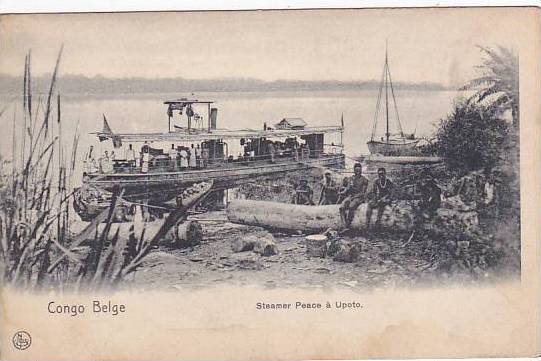
Believed to be the same steamer Peace on the Congo river
Purchase of the steamer Peace in 1880 to advance the mission up the Congo river. Built by Thornycroft at Chiswick, it was constructed to draw only eighteen inches when carrying six tons of cargo, and to take to pieces at the cataracts.
Some interesting features were described in the Press at the time:
”engines of sufficient power to steam 12½ knots so as to escape from any attack of hostile native canoes ….” (Poole & Dorset Herald) ”a wire awning is fitted to stop the arrows and missiles, which there is every reason to anticipate will be shot or hurled at the passengers in some regions of the Congo ….” (North Devon Journal).
Getting the steamer to her ultimate destination would not be a trivial task:
”She will be taken to pieces and sent to the mouth of the Congo. From thence it will be borne by 800 men a distance of 300 miles up to Stanley Pool, where the steamer will be reconstructed by missionaries”
In 1886, or thereabouts, he supported the missionary work of John Ross in Korea by paying for the publication of the Korean New Testament which Ross had translated. Ross was known as the father of Protestant churches in Manchuria and Korea.
Establishment of the Arthington Aborigines Mission in 1889 for the evangelisation of tribal people (reputedly “fierce headhunters”!) in northeast India. This included formal education of the Mizos and documentation of their language. Arthington himself reached Mizoram on 11thJanuary 1894 which is now a public holiday known as “Missionary Day” in Mizoram.
Extension of mission funds in 1892 to reach the Upper Nile
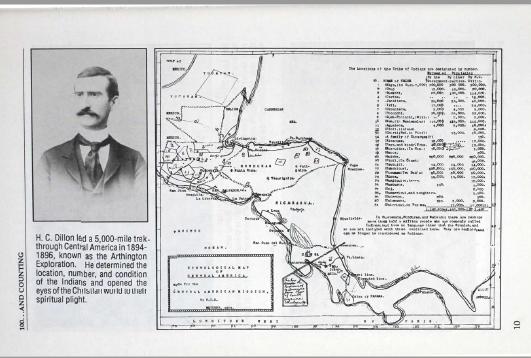
Central America Expedition
1894-1896 he financed the Arthington Exploration, led by H C Dillon, in Central America whose purpose was “to gather information on the Indian population toward the objective of reaching these people with the Gospel.”
He contributed to advance missionary work in China
He paid for the construction of a steamer built in America to be used in South America
Continued support to the Leeds Hospital for Women and Children throughout his lifetime (in recognition of his charity a new hospital he financed at Cookridge and which opened in 1905 was named the Robert Arthington Hospital).
Not surprisingly he had dealings with both Livingstone and Stanley during his funding of missionary works in Africa. However, he was very clear about supporting work that was directly relevant to his evangelism. So when Stanley wrote to him in 1887 to ask for the use of the SS Peace in his rescue expedition of Emin Pasha he got short shrift:
“Leeds January 15th 1887 Dear Mr Stanley, I have much regard for you personally although I can not, dare not, sanction all your acts. I am very sorry if I cannot give assent to your request, but I fully believe you will be no sufferer by the circumstance of not having the SS Peace. Yesterday I was able to come to a decision. Mr Baynes, of the Baptist Missionary Society, Holborn, will, he hopes, make you any communication he judges proper. If you have any reverential regard for the “Man of Sorrows”, “the King of Peace”, may He mercifully preserve and save your party. I have no doubt of the safety of Emin, till his work is done. I believe he will be brought through his trial in perfect safety. God seems to have given you a noble soul (covers for the moment, if on your sad sin and mistakes), and I should like you should “repent and believe the Gospel” with real sense and live hereafter in happiness, light and joy for ever. Here delay in you is more dangerous than delay for Emin. Your faithful friend, Robert Arthington”
After his death
On 9 June 1900 he prepared his last will and testament in which he bequeathed a major portion of his estate to Christian missions, and only one-tenth of it to his first cousins, or if they were deceased, to their children.
To put his will into perspective, the Leeds Times of 22 December 1900 reported:
“The charitable bequests of Mr Robert Arthington will make the present year a record one in respect of the amounts given to charity. A million and a half of money has already been bequeathed to charity this year and, with Mr Arthington’s bequest, the amount will be nearly two millions and a half.”
His will was poorly drafted though and it took five years for it to be approved by the High Court of Chancery in 1905. Because of outstanding claims from the family it was another five years before the actual distribution of the estate took place. By then the monetary value had risen to £1,273,894. After 21 cousins received their share and other miscellaneous charitable requests the balance of almost £1 million was divided (5:4) between the Baptist Missionary Society (BMS) and the London Missionary Society (LMS).
This became know as ‘Arthington’s million’ and helped to provide hospitals and schools as well as missions in remote areas in India and Africa, some of them still in existence today. The bequest was to be used within twenty-five years. Alfred Henry Baynes, the General Secretary of BMS, became the trustee until his death in 1914. He fervently pursued evangelisation of Africa, which had been the pre-dominant interest of Robert Arthington. The LMS on the other hand extended their mission to China and India, in addition to Africa. The Trust disbanded in 1936.
In his Will he also left small bequests to other beneficiaries amongst which was £100 to Teignmouth hospital.
Summary
This has been a revealing journey and the above only scratches the surface of Robert Arthington’s life. There is probably enough material around to write a book on the impact that his work achieved. He was certainly a remarkable man, possibly the most significant British philanthropist at the time of his death. It was probably because of his strong religious faith and principles, starting from his Quaker roots and subsequent conversion to Baptism, that his philanthropy was focussed on evangelical activities. I would venture though that it goes back further to his mother who believed a man should ‘Do his duty to his fellow creature‘.
Whilst his type of evangelism may seem quaint or strange (or out-of-place) to us these days I think that Robert Arthington undoubtedly believed that it was his path, his way to “do his duty” with the resources that had been made available to him. He had the nous to realise though that evangelism wasn’t simply about sending out a missionary with a bible; it required the logistics behind it. So if we look at his endowments we see that much of the money was spent on the infrastructure behind evangelism – boats, railways, missions, schools and education, hospitals, settlements. When he died he made provision for that to continue for a further 25 years. Maybe that’s what he meant when he said on his deathbed “Yes, it is all there – all!”
Sources
There are literally hundreds, if not thousands, of newspaper articles about Robert Arthington – before his death in relation to the various endowments he made and projects he supported; and after his death concerning his Will and the subsequent activities supported through the Arthington Trust. They can not all be mentioned here.
The above story is a compilation from a number of other sources which are often repetitive; unless otherwise stated in the text, I haven’t referenced them individually in connection with separate facts or statements. So this is simply a list of other sources I have looked at, all on-line. All reference links are correct as at the time of posting.
As an interesting by-product of all this work we have been doing on the war graves we have come across a number of other graves of people who have died in service but who are not in official Commonwealth War Grave Commission sites. There are also others, non-military, who died during particularly the Second World War as a result of enemy action.
We are clearing those graves as well and affording them the same respect of attention that has been given to the official graves.
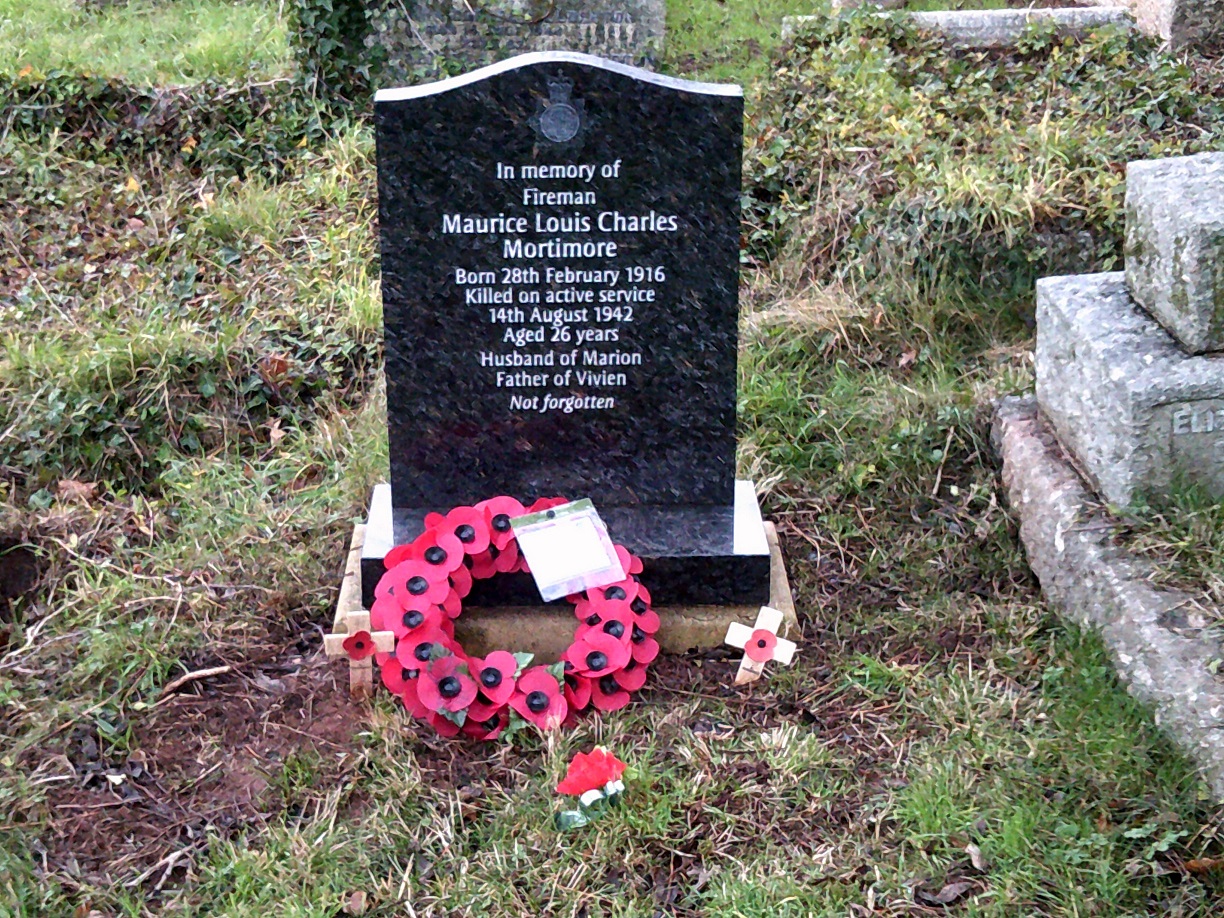
One of those graves is that of Maurice Louis Charles Mortimore.
Maurice was a fireman during WW2 and was killed during a bombing raid on the town. Little is known about the exact circumstances of his death other than that the building he was in suffered a direct hit; he apparently made it out alive but died subsequently in hospital.
After this year’s remembrance service I had the privilege to meet with his daughter, Vivien Roworth, who was 9 months old when he died. Vivien had discovered his unmarked grave some years ago in the wilderness that was the cemetery and had erected a headstone in his memory.
I had received an earlier email from Vivien from which I would like to quote:
“I can’t begin to tell you how pleased I am to know that the Teignmouth War Graves are now in such enthusiastic and caring hands. A few years ago I contacted Teignbridge and the Teignmouth Post, as it was so distressing to see the unkempt graves of the war dead. I had to search for them in thigh-height grass. Since I retired, I have been visiting Teignmouth (from the Isle of Man) annually to see my father’s grave and place a poppy wreath for him, around the 11th of November. I also visit other family graves at the same time.
My father was the only fireman to be killed, in Teignmouth, in WW2 and he has a headstone which I think he deserved for his efforts in the Plymouth and Exeter Blitzes in 1941 and 1942, and in memoriam, of course. His name was Maurice Louis Charles Mortimore. Also, I have an uncle who is on your list of war dead. He was Edward Palmer and I always place flowers on his grave and that of my aunt and grandmother who are buried in the same grave with him.”
Although Maurice was originally buried in an unmarked grave he has been commemorated elsewhere as well:
He is listed on the Roll of Honour Board of what is now Devon and Somerset Fire and Rescue Service near Exeter
He is also listed on Devonheritage.org amongst the casualties of the bombings of Teignmouth:
“RAID OF 13 AUGUST 1942 (Albion Place, Park St. and Barnpark) – Fourteen killed, ten severely injured and thirty two injured.
MAURICE LOUIS CHARLES MORTIMORE: Civilian Fireman, N.F.S. Husband of Marion Eleanor Mortimore, of Sunny Crest, Bitton Hill, Teignmouth. Injured 13 August 1942, at Market Place; died at Teignmouth Hospital 14 Aug 1942 aged 26”
Finally, he is remembered in a dedication at the Town Council offices in Bitton House, Teignmouth. In the foyer is a large brass bell, a photograph of Maurice and the following dedication:
“Bell from the last Pump Escape
owned by the Teignmouth Urban District Council
before the creation of the National Fire Service. Presented by the Devon County Council in 1960 Dedicated to the memory of Fireman Maurice Louis Charles Mortimore who lost his life by enemy action
when the Town Hall and Fire Station were destroyed on 13th August, 1942”
On Saturday November 3rd 2018 at 11am at Teignmouth Old Cemetery there was a unique historic event – the first time ever that the war graves of Teignmouth Cemetery had been commemorated.
You can see a record of this ceremony on the following link: War Graves Ceremony
We have come a long way since this project first started in the summer and we are now approaching the end of the first phase.
This will be marked in a short ceremony at the cemetery on Saturday November 3rd at 11am. This will commemorate the 100th anniversary of the end of World War 1 and recognise those who died in service and are buried in the 49 war graves scattered throughout the cemetery. As part of the ceremony a small cross and poppy will be placed on each grave.
Everyone is welcome to attend this historic event – the first time ever that the war graves of Teignmouth Cemetery have been commemorated in this way.
The provisional agenda for the ceremony is as follows:
Introduction
Neil Howell, Chairman FOTC
Prayers and Blessing of Poppies
Minister Jamie Redfern, Teignmouth Baptist Church
Exhortation
Remembrance Committee/Royal British Legion
Last Post, two minute silence, Reveille
Terry Aisthorpe, Trumpeter
Kohima Epitaph
Remembrance Committee/Royal British Legion
Closing words and unveiling of the War Graves Commemorative Board
Dispersal to lay Poppies on War Graves. Trinity School CCF
Returning to what the Friends of Teignmouth Cemetery have achieved since earlier this year?
We have identified the location of each grave, both those solely with Commonwealth War Grave Commission (CWGC) headstones and those recognised by the CWGC but in family plots;
We have secured a contract with the CWGC to tend for the graves which involves keeping the area around each grave clear of overgrowth and also providing access to the graves from the main paths;
All the graves have now been cleared and are maintained on a regular basis by our group of committed volunteers;
We have photographed every grave and those can be seen on the record pages on this site;
A small group has been researching those people buried in the war graves and we are now starting to consolidate that information. This is very much work in progress; the information we gather will be added to the record pages over the next month or so and supplemented as and when new information comes to light;
In our efforts we have been working with the Teignmouth branch of the Royal British Legion and the Town Council Remembrance Committee;
We have produced a commemorative display board which will be unveiled at the ceremony on November 3rd. This lists everyone who is buried in the war graves and shows a map of the various war grave locations;
Finally, as an interesting by-product of all this work we have come across a number of other graves of people who have died in service but who are not in official CWGC sites. We are clearing those graves as well and affording them the same respect of attention that has been given to the official graves.
In phase 2 of the project we shall be continuing the historic research and developing the web-site pages as more information comes to light. We are also planning to place some appropriate plants on or near each of the war graves.
This has been a significant project for us and has only been achieved through the energy and enthusiasm of our group of volunteers in all areas . We look forward to seeing everyone who can make it to the unique ceremony on November 3rd.
We have just started a special project to clear the 49 war graves scattered throughout the old cemetery in readiness for a commemoration on Saturday November 3rd to mark the ending of the First World War 100 years ago.
For more information on the project as it progresses just click on the following links:
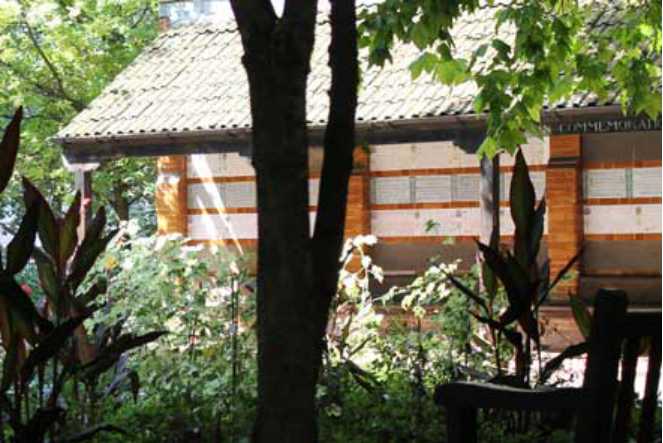
A short distance north of St Paul’s Cathedral is a small area of land which once formed part of the site of the former churchyard and burial ground of St Botolph’s Aldersgate church.
Following the Burial Acts of 1851 and onwards it was decided to convert this land into a public park which subsequently opened in 1880. Being adjacent to the new headquarters of the GPO it became popular with the workers there who would use it on their breaks and, hence, it became known as “Postman’s Park”.
Memorial Wall
In 1900 though the park took on a different and important significance. It became the location for George Frederic Watts’s Memorial to Heroic Self Sacrifice, a commemoration of ordinary people who died while saving the lives of others and who might otherwise be forgotten.
This took the form of a loggia and long wall housing ceramic memorial tablets. Only four of the planned 120 memorial tablets were in place at the time of its opening, with a further nine tablets added by the time of Watt’s death in 1904.
His wife, Mary, took over the management of the project and oversaw the installation of further memorial tablets together with a small monument to Watts. Following her death in 1938, and with both George and Mary Watts increasingly out of fashion, the memorial was abandoned half-finished, with only 52 of the intended 120 spaces filled.
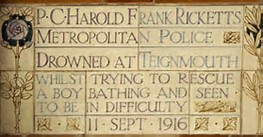
One of those memorial tablets is the subject of this story – that of PC Harold Ricketts.
The memorial is simple:
“PC Harold Frank Ricketts, Metropolitan Police, Drowned at Teignmouth whilst trying to rescue a boy bathing and seen to be in difficulty. 11 Sept 1916”.
The story, however, is more complex and reflects the bravery of local fishermen as well. There is an on-line summary of the story at the London Walking Tours site .
There is also a book “Heroes of Postman’s Park” by John Price. However, I have gone back to the original accounts posted in the local papers of the time – the Exeter & Plymouth Gazette, the Western Times, the Western Morning News, the Western Gazette.
PC Harold Ricketts
Harold Ricketts was not from Teignmouth but had married a young Teignmouth woman, Kate Gilpin, in London only three weeks before his death. They had returned to Teignmouth for their honeymoon.
Harold actually came from Wimborne, Dorset and was described as “well-known and esteemed in Wimborne by a large circle of friends” and was a member of Wimborne Football Club “rendering excellent service as right-back”.
Harold was the son of Police Superintendent Ambrose Ricketts who himself had died just over a year previously. He had three brothers one of whom, Ambrose, was his twin, and three sisters the eldest of whom, Charlotte, who described as the head-mistress of Wimborne Minster Girls’ School. He attended Wimborne Grammar School and then, with his twin brother, served an apprenticeship as a turner at the famous Eclipse Works.
However, that was not to be his career. Both he and his twin brother decided to follow in their father’s footsteps and in 1913 they both joined the police force. For some reason though they did not enrol in Wimborne but chose to join the London Metropolitan Police, the Met. Maybe they didn’t want to be in the shadow of their father or maybe there were simply more vacancies in the Met where pay and conditions (e.g. police housing) were better.
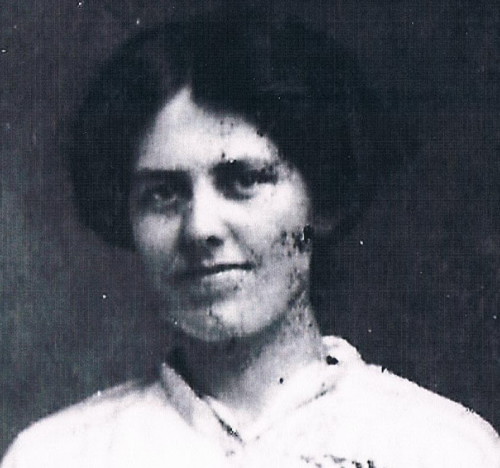
Believed to be Kate Gilpin (from family tree)
At the time of his death Harold was living in Kensington and had been acting for several months as an assistant clerk at one of the divisional offices of the Met. I am curious to know how he and his wife-to-be, Kate Gilpin, met. There is no reference to Harold having been to Teignmouth before, nor to any family connections so was Kate living and working in London as well at the same time?
From the 1911 census records it appears that Kate was living in a solicitor’s house in Limpsfield, Surrey. There is no occupation shown for her but perhaps we can assume that she was in service and that a move to London in a similar role would have been likely. When they married she was shown as living in Warwick Gardens and had no occupation. At the time of Harold’s death she gave her address as Irene House, Belgrave road, Shepherds Bush.
However it happened they met, married at St Barnabas Church, Kensington, and came down to Teignmouth for the fateful honeymoon. Harold was only 23 at the time, whilst Kate was the older woman, aged 28. They stayed with Kate’s mother, Elizabeth Gilpin who lived in Teign View Terrace.
The Boat Trip
It was about six o’clock on the evening of Monday 11th September 1916 that the family decided to take a boat trip on the river.
There were six people in the boat on that evening – Kate and Harold, her mother, one of her sisters, Florence (Florrie) Westlake, and two children – Florrie’s four-year old daughter Beatrice and another six-year old girl Alice Hannaford (or Hooper?). Florrie lived in Bishopsteignton and the family had decided that they would take her upriver by boat as as far as Shaldon bridge from where she would then walk home. Florrie was actually doing the rowing – “she was quite used to this work, having been rowing all her life”. Her mother sat in the stern whilst Harold and Kate were on either side with the two children between them.
The boat had belonged to Kate’s father, William Henry Gilpin, who had been a Trinity pilot on the river. He had died two years before so the ownership and licence for the boat had passed to her mother. It was a ‘stiff-built’ boat 11ft long and 4½ft in beam, large enough to carry five persons. These were both factors explored at the inquest (see later).
The Incident
Starting from Teign View beach they had rowed up past the second quay as far as the acetylene stores by Polly steps when they heard cries of “Help” and Kate Ricketts saw a young lad in difficulty in the water. The place used to be a favourite bathing spot for youngsters but with the spring tide running high at the time the boy, Stanley Drew, had obviously got into trouble and was hanging on to a chain attached to the Custom House boat moored in the river.
Kate apparently called out to the boy asking him if he could get back to the shore. He replied “No” so Florrie turned their boat and rowed back towards him. When they reached him the boy let go of the chain, Harold got hold of him and managed to pull him half-way into the boat. The boy though unexpectedly threw his arms around Harold’s neck and both of them fell back into the water.
The jerk made the boat heel over and half-fill with water causing everyone else to fall into the river as well. What had started as a well-intentioned rescue of a young lad had now turned into a major incident with seven people struggling in the fast-running tide.
The Rescue
Fortunately the screams of people in the water were heard and the capsizing had also been seen so help soon arrived from various directions.
The three people key to the rescue were:
John Fraser, a seaman on board the schooner Rhoda Mary which was lying at buoys. He was in the ship’s boat heading for the schooner when he heard cries of “Come back, come back” and he “proceeded with all haste” to rescue two women and one of the children
Frank Loosemore who was going out mackerel fishing had seen the incident from the New Quay. He ran round to the Old Quay and brought in the third woman and a child.
Thomas Hitchcock, a young fisherman of Brunswick Street, Teignmouth. He was at New Quay with Frank Loosemore and ran round to the scene with him. He was the one who saved Stanley Drew, the original boy who had been in difficulty.
Rescue was too late for Harold Ricketts though. He was unable to swim and, according to Kate, when he went over he struggled in the water, went down, re-surfaced but then disappeared. A fisherman, William Henry Hitchcock, found his body later at about 10pm in six feet of water about 25 yards away.
Tom Hitchcock
When Thomas and Frank arrived on the scene it appeared that people were being rescued apart from the boy, Stanley Drew, who seemed to be drifting down river. They saw the boy going down and Thomas immediately dived in to rescue him. He brought him up and swam back to the quay with him. A passing Belgian (an interesting detail in the story!) leant over with his walking stick for the boy to grab and be pulled up. However, according to the evidence, the Belgian let him go and the boy went down again. Thomas dived down for him again and eventually the boy was brought back to land.
Whilst this was going on Florrie, who was able to swim a little, was managing to keep her mother and the two children afloat until John Fraser arrived in his boat saving first the younger girl (Florrie’s daughter) then Florrie. She and John Fraser between them were then able to pull her mother from the water. According to Florrie he arrived just in time because “her mother and the two children had been down twice.” By this time Frank Loosemore had also arrived, having jumped from the quay and swum across to save the other little girl who he handed to John Fraser in the boat. It was just in time to save the girl’s life. The girl was given artificial respiration and recovered within about five minutes.
Before reaching the little girl Frank Loosemore had swum to Kate Ricketts who was hanging on to a chain. In Frank’s words though she shouted to him “For God’s sake, save the child!”. Kate could swim and managed to reach a life-buoy which was being held by a soldier over the side of the quay. After Frank had rescued the little girl he returned for Kate Ricketts. John Fraser had no oars in his boat so Frank had to tow it into position close to Kate. He then swam behind her and pushed her legs up to get her into the boat.
Everyone was brought to shore where by this time Dr G H Johnson had arrived at the scene together with Sgt G A Bilton and Pte Fursdon of the St John’s Ambulance Association. Stanley Drew apparently had suffered no ill-effects but the two younger children were taken to the hospital. The adults were taken back to Elizabeth Gilpin’s house in Teign View Terrace.
The Inquest
An inquest on Harold Ricketts’ death was held quite quickly – only two days later. It was presided over by the County Coroner Mr Sidney Hacker with Mr G Pedrick as foreman of the jury. They took statements from all the parties and those, as reported in the various local papers of the time, form the basis of the above story. However, the inquest was concerned with more than just Harold’s death itself; it identified what may have been contributory factors in the chain of events that led to his death.
Polly Steps
Frank Loosemore was asked whether the place (I.e. Polly Steps) was dangerous for boys bathing and he confirmed that that was the case. He said there was a strong current, especially at spring tides, and that “boys were swept off their legs before they knew where they were”. One of the jurymen, Mr W Shapter, also referred to the danger of boys bathing at the place but, although several other jurymen agreed, no recommendation was made.
It turns out that there had been previous incidents of boys getting into difficulty off Polly Steps. The Teignmouth Old Quay Company who had built the slip had applied in 1901 for powers to make bye-laws controlling the quay, including preventing bathing at the slipway at Polly Steps.
The Boat
The inquest explored the licence for the boat in which Harold Ricketts made that fateful trip. The boat had been owned by Elizabeth Gilpin’s husband the Trinity pilot William Gilpin. It appears though that on his death the licence to carry up to five people had lapsed and had not been renewed. A Mrs Back, one of Mrs Gilpin’s other daughters, had been instructed by the coroner to find the licence but had come back with the explanation that the licence had not been renewed because the boat had not been let out on hire since her father’s death and was for private use only.
As to the number of people in the boat William Hitchcock testified that the boat was big enough to carry five people ‘provided they sat still’. Kate Ricketts testified that everyone did sit still even during the attempt to rescue Stanley Drew and denied that anyone had “jumped up”. Florence Westlake explained that though there had been six in the boat they thought it was all right because “the two children were no more than one grown-up”. The other curious fact that was brought to the attention of the jury was that the mother, Mrs Gilpin, who was sitting in the stern weighed 12 stone!
The Outcome
The jury returned a verdict of accidental death by drowning.
The coroner and the jury offered their sincerest condolences to Harold’s mother, who had only a year before lost her own husband, and to the other family members. In turn they were thanked by Kate’s brother, Frank Gilpin, who was a naval seaman.
The jury commended those who took part in saving lives and the foreman was asked to bring their gallant conduct to the attention of the local agent of the Royal Humane Society. One of the jurymen, Mr E Bennett, remarked that Frank Loosemore had saved other lives in the past – more of this to come in a separate story. The coroner expressed to Frank Loosemore and Thomas Hitchcock the jury’s appreciation of their successful efforts.
The Aftermath
The funeral of Harold Ricketts took place in Teignmouth Cemetery on the afternoon of Thursday 14th September. The vicar of East Teignmouth, Rev J Veysey, officiated. The mourners were listed as: his mother, Mrs F Ricketts; his eldest sister, Miss C Ricketts; three of his brothers – H, B and A Ricketts; Kate’s sisters – Mrs J Back, Mrs F Waldron, Mrs H Westlake and Miss E Gilpin; Kate’s brother, Mr Frank Gilpin; Mr & Mrs Greenslade (brother-in-law and sister-in-law) and a Mr C Pedrick (foreman of the jury?). Policemen of the Teignmouth District, under Sergeant Partridge acted as bearers and amongst the floral tributes was a trophy from the officers and men of F Division of the Metropolitan Police.
It is unclear what happened to Kate afterwards. From the records, it doesn’t appear that she had children or even remarried. She may be buried in Melbury Abbas having died in 1953 in Shaftesbury.
Frank Loosemore and Thomas Hitchcock did receive the fitting recognition for their bravery as recommended by the inquest jury. On Wednesday 26th January 1917, at the Teignmouth Petty Sessions Court held at the Customs House, Mr Hamilton Young asked the chairman, Mr M L Brown, to present the Royal Humane Society’s medal to Frank Loosemore and the Society’s vellum to Thomas Hitchcock. The Chairman congratulated Frank and said “You are what I call an Englishman”. He remarked to Thomas Hitchcock “You keep this up, it gives me great pleasure to present it to you.”
It was not until 1930 though that Harold Ricketts’ part in the event was recognised. The Metropolitan Police had applied to the ‘Heroic Self-Service Memorial Committee’ for the addition of three new tablets on the memorial wall in Postman’s Park. This was agreed and the unveiling ceremony took place on October 15th 1930. The Bishop of London delivered an address on ‘courage’ and specifically mentioned the three police constables, each of whom had given his own life while attempting to save another:
“.… the excellent way in which they carried out their arduous duties and the courage and heroism subsequently displayed which so frequently passed by without any acknowledgment ….. they did not commemorate enough or think enough of those who gave their lives in the service of their country in civil life”
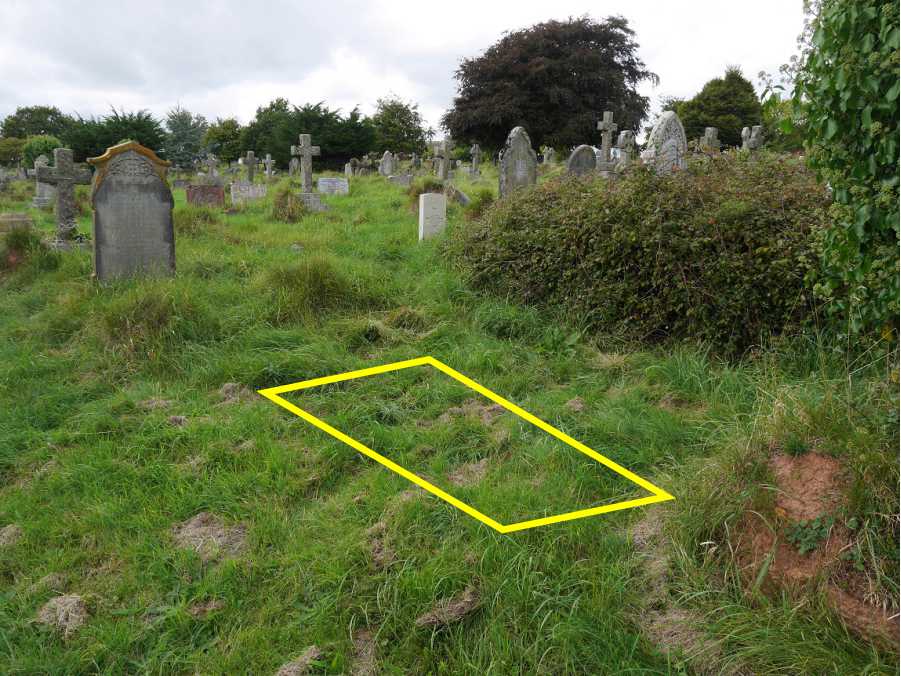
Approximate location of unmarked grave
Strangely, Harold had been interred in an unmarked grave. Over time, with the gradual deterioration of the cemetery, this became overgrown. Through the dedication of volunteers of the Friends of Teignmouth Cemetery it has been rediscovered and is being cleared to make it a more fitting memorial to a young man who died in the attempt to save the boy, Stanley Drew.
A Twist in the Tale
Nine years later on Saturday 14th February 1925 another inquest took place, this time in Newton Abbot. A Great Western Railway pensioner, William Henry Davies, jumped from the bridge near Ball’s garage into the canal. The incident was spotted by a young lad who raced to the scene and dived into the canal to rescue the man. He brought the man back to shore and other passers-by gave artificial respiration but to no avail. The coroner complimented the “conspicuous gallantry” of the 16 year old lad and he too received a vellum from the Royal Humane Society a month later.
The name of that lad was Stanley Drew. It would be nice to think that he was the same Stanley Drew who was rescued himself as a young boy nine years earlier. There is no proof of that though, but even so what a coincidence!
Some Biographical Notes
Whilst researching this story I put out a call on Facebook for any relatives of the three fishermen John Fraser, Frank Loosemore and Thomas Hitchcock. This is the reply I received from Angela Healy:
First of all, it seems to be a tradition in the Hitchcock family not to use the given name. This makes tracing them through records very confusing. Some of my information has come from family, local people who knew them years ago and from my own memories.
The younger Hitchcock, Tom, was my great uncle and was officially William Thomas Hitchcock (1896-1974). He was a fisherman by trade. At the time of the rescue, he was living in Brunswick Street. His father, Thomas Gilly Hitchcock, was a member of the lifeboat crew, Bowman during the rescue of the Russian schooner Tehyva in 1907 and, at the time of his death in 1938, Cox.The name Gilly was my great-great-grandmother’s maiden name and was given to my great-grandfather as a middle name. I believe this was common practice. He was known only as Tom.
In March 1908, young Tom was summoned along with two other boys for stealing a book. The newspaper report states that “the offenders were dealt with under the First Offenders Act but the father of Hitchcock asked that his son should be birched.” The birching seems to have worked and young Tom later joined the lifeboat crew and worked as a lifeguard, rowing a boat along the front beach. I’m told that he saved many lives there because he knew the places where bathers were likely to get into trouble and was able to warn them of the danger. Tom married Edna Clements and had four children, three daughters and one son. They lived in Hounslow (if I remember correctly) and later moved to Plymouth, where he died.
The older Hitchcock, William Henry, was generally known as Peter. He lived in Teign View Terrace, along from the young widow’s family. (“Teign View Terrace” has been renamed “Teign View Place” for some reason, just as “Salty” has become “The Salty” in recent years). He was the brother of Thomas Gilly Hitchcock and young Tom’s uncle. I believe he lost a son through drowning but I don’t know when that happened nor the full details. I must do some more research.
And here is a reply from Sharon Williams in Canada:
I was back in the UK last month, (I live in Canada) and Angela and I visited the old cemetery looking for family graves, to no avail. Thomas Hitchcock is our Great Grandfather, but his first wife Ellen, is Angela’s Great Grandmother, his second, Susan, is mine. Ellen has her own grave, but Thomas and Susan are buried together. I found it very sad to see how neglected the cemetery has become over the years, my paternal Gran and I tended her parents grave regularly over the years and it was always so well kept. I wish the FOTC all the best in the restoration.
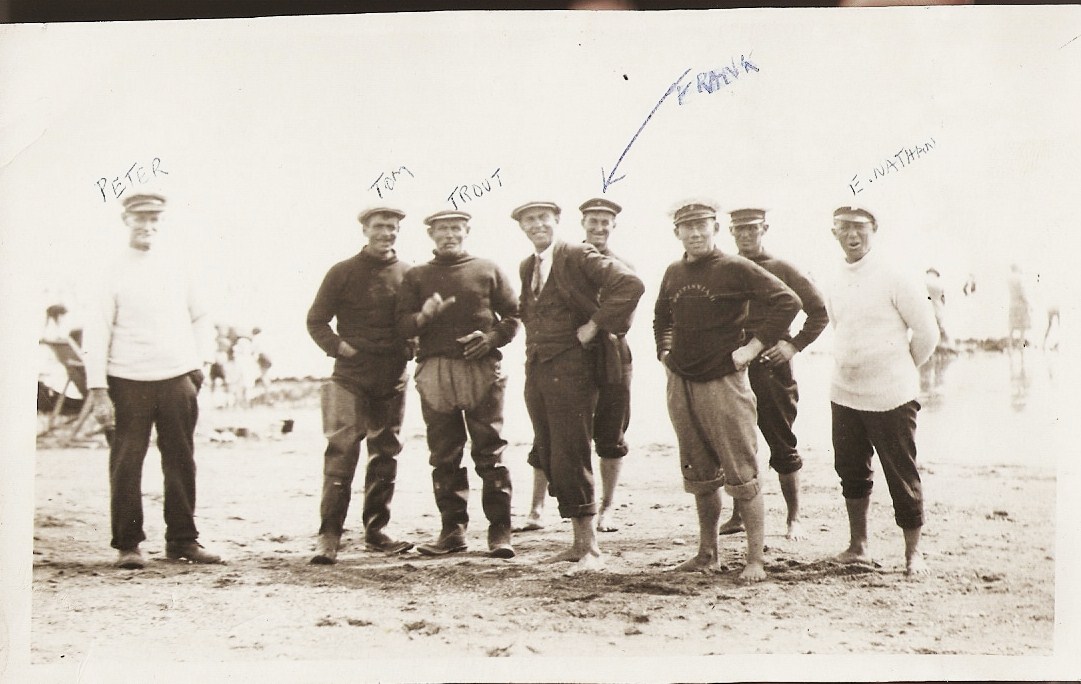
Teignmouth Fishermen 1938 – William Henry Hitchcock (aka Peter) is shown on the left. Thomas Hitchcock (Tom) is on the left of the main group.
This year has seen the 200th anniversary of the period that Keats stayed in Teignmouth. He was here for only two months, arriving on 6th March 1818 after an horrendous journey from London through torrential storms. He had come to look after his brother Tom who had been staying in Teignmouth as part of the ‘treatment’ of his TB, from which he died later in the year.
Whilst he was here John Keats completed the fourth book of Endymion, wrote another epic poem ‘Isabella’, a number of smaller pieces which he described as doggerel or ‘bitcherel’ and, from an important historical point of view, he wrote letters back to his friends which revealed his thought, emotions, worries.
So what’s the connection between Keats and the Cemetery?
Cresswell’s incorrect view of Keats House
In 1901 a notable local historical author, Beatrix Cresswell, wrote a book about Teignmouth – “Teignmouth, its History and its Surroundings”. In it she refers to Keats and makes the first written mention of where Keats stayed in Teignmouth:
“A year or two ago, Dr Lake and Mr H Buxton Forman, C.B. (the latter then busy in searching for memorials of Keats), were at some pains to ascertain, if possible, the house in which he stayed. By studying his letters they concluded that the young poet lodged in a house (now 35, Strand) at the corner of Queen Street, a turning toward the river.”
Nine years later this was disputed in a letter to a local paper:
“John Keats lived here and at Teignmouth finished his masterpiece ‘Endymion’ dating the introduction to the poem Teignmouth, October 1818. The house he lived in is now 21 Northumberland Place (adjoining the King William Inn, facing Queen Street) and is not , as Miss Cresswell in her guide states, No. 35 Northumberland Place at the corner of Queen Street nearly opposite. For this statement I have the authority of Dr Lake, Mr W R Hall Jordan and Mr Forman Buxton (sic) CB who although neither of them are patriarchal enough to have been the contemporary of Keats each remembers this house to have been pointed out to them by those of the former generation as the Teignmouth home of the poet”
The author of that letter was Frederick C Frost.
The debate on where Keats actually stayed rumbled on and even resurfaced in another newspaper article in 2005 (Herald Express, Viv Wilson MBE), even though an official plaque had been assigned in 1931:
“The connection between John Keats and Teignmouth has not diminished with time, and many people still seek out the place where he stayed in 1818. The red granite plaque on Keats House in Northumberland Place satisfies the majority but there is another contender for the title. A school of thought supports the idea that Old Place, just opposite, with the canon protecting its corner wall, was the place where he stayed.”
The decision on where to place the official plaque was ultimately based on the earlier work of three men: Dr William C Lake, Frederick C Frost and William Risdon Hall Jordan. The latter two are buried in Teignmouth Old Cemetery, whilst Dr Lake would have been had his family not already secured a family vault at St James’ Church.
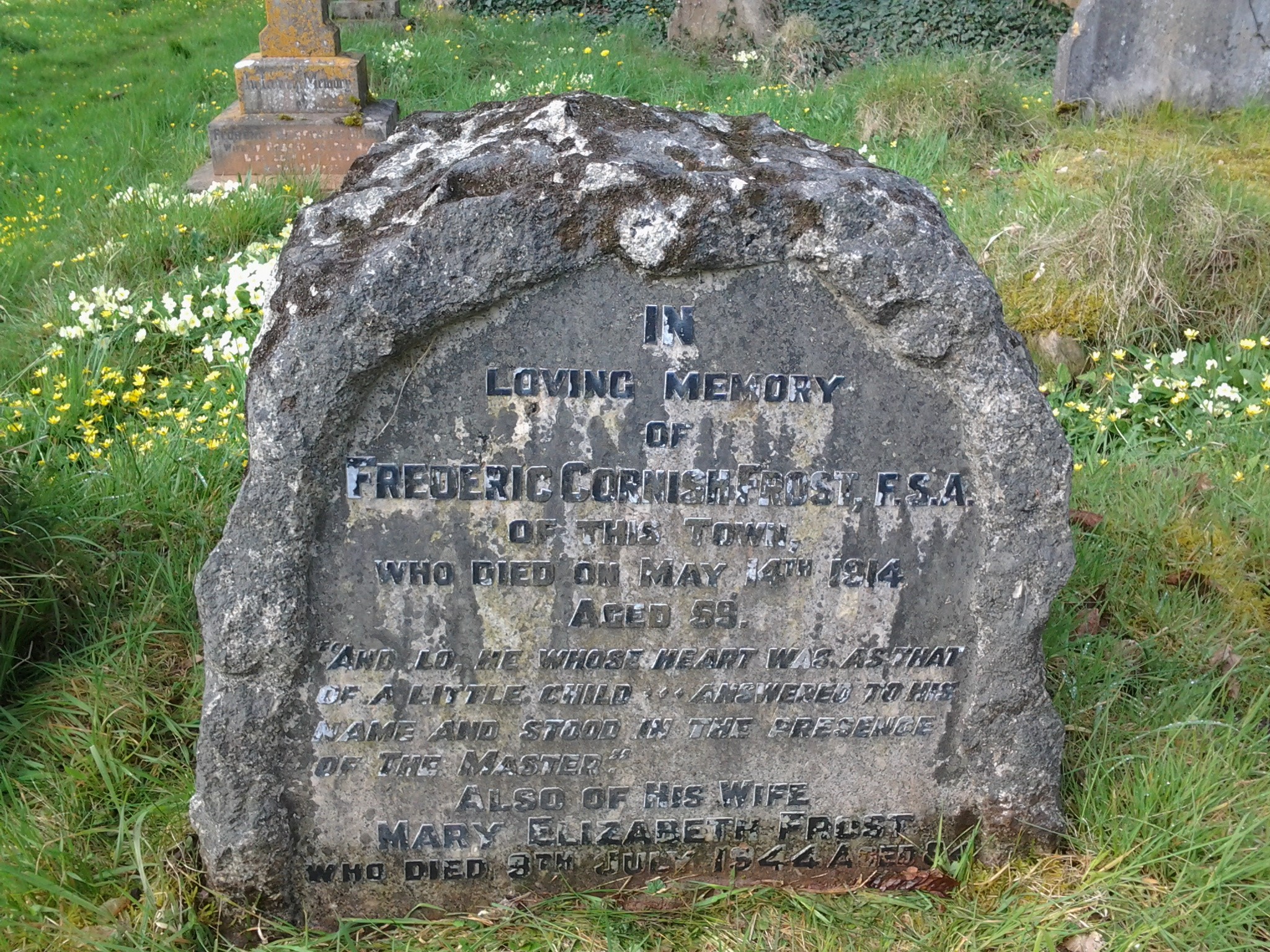
Frederick C Frost (1855-1914)
Photo by Dave Tovey
He married in Newton Abbot in 1886 and was an antiquarian who ran the local family business of auctioneers, established by his father. The family lived at 5 Regent Street and Fred would have known Dr Lake well since they were both members of the Freemasons Benevolent Lodge 303. He was a Fellow of the Society of Antiquaries and also a member of the Devonshire Association, making contributions to that organisation and to the “Antiquary” and “Notes & Queries, a Medium of Intercommunication, for Literary men, General Readers etc” on subjects as diverse as the Devon dialect, medieval religious orders and heraldry. He used the initials FSI after his name which could mean he was a Fellow (full member) of the Surveyors Institution, awarded a royal charter in 1881 and the forerunner of the Royal Institute of Chartered Surveyors (although ‘FSA’ is actually inscribed on his headstone as a Fellow of the Society of Antiquaries’)..
His contribution to the Keats debate
Judging by the letter he wrote, as reported in the Exeter and Plymouth Gazette of 16 April 1910, he was vociferous in championing the cause of Teignmouth celebrating various historic figures associated with the town by putting up commemorative plaques throughout the town. My guess is that he was raising awareness and doing some local campaigning because two years later in the Western Daily Mercury of 12 March 1912 the following appeared:
“Teignmouth boasts some interesting literary memories, but the associations of Keats with the town are the most notable. Keats came to Teignmouth for his health’s sake in 1818, and there he finished his ‘Endymion’ and wrote its remarkable preface. Hitherto the house on the Strand, where the poet lodged, has never borne any name or indication that Keats spent any time there. Now the house has passed to another tenant, and he, acting on the suggestion of a Fellow of the Society of Antiquarians, resident in the locality, has decided to christen the residence “Keats’s House”. There was a dispute as to the exact house where the poet stayed but the present tenant, before deciding on the title, sought the advice of several old Teignmouthians who well remember the ’bonnet shop’.”
Keats House 1912 – Francis Gribble
Shortly after this a popular author of the time, Francis Gribble, wrote a book “The Romance of the Men of Devon” in which he included a section on Keats together with a photograph of Keats’ House with its name newly inscribed on the front door. The house was subsequently officially recorded as “Keats’s House” in the title deeds of 1925.
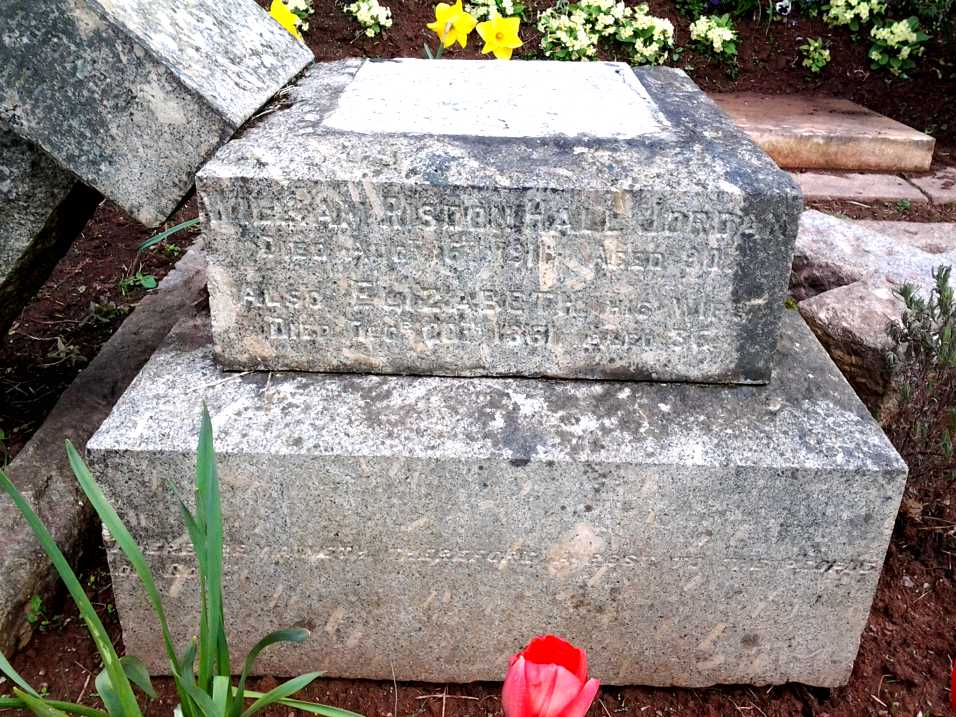
William Risdon Hall Jordan (1821-1911)
The Jordan family in Teignmouth goes back to at least the 17th century and the most complete description of William R H Jordan’s life that I have found is in his obituary published in the Reports and Transactions of the Devonshire Association (Vol 44 of 1912). I have simply transcribed this below, with any notes of my own in italics:
Photo by Dave Tovey
William Risdon Hall Jordan was born at Teignmouth, his family having settled there as far back as 1650. His grandfather (Robert Jordan), in the early part of the last century, founded, with the late Mr Langmead, the South Devon Bank, which was subsequently merged into that of Messrs. Watts, Whidborne and Co., and later in the Capital and Counties Banking Company. (Note that Robert Jordan was also a key driver behind the scheme to infill the old marshy areas of Teignmouth along the river Tame, which flowed into the Teign, creating the land that is the centre of Teignmouth as we know it today).
Mr Jordan was educated at Dr. Edwards’ School, at Teignmouth, and served his articles with his father. He was admitted a Solicitor in 1844, and for some years acted successively as managing clerk to Messrs. Tozer and Whidborne, of Teignmouth. In 1848 Mr. Jordan practised on his own account, and on the retirement of the late Mr. John Chapell Tozer from the clerkship to the Teignmouth Improvement Commissioners in 1852, he became Clerk to that body.
Mr. Jordan subsequently held the appointment of Clerk to the Teignmouth Local Board, under the Local Government Act of 1856, and the Public Health Act of 1875, and was the first Clerk to the Teignmouth Urban District Council. This post he resigned in 1900 (when he was only 79!!), but he retained the position of Clerk to the Burial Board, which he had held since the inauguration of that body in 1853 (so he was also one of the founding members of the Board that ran Teignmouth Old Cemetery when it was opened).
Mr Jordan also took a great interest in educational work, and acted as Clerk to the Teignmouth School Board from its inception in 1875. He in later years continued as correspondent to the school managers, from which post he retired in 1910, being succeeded by his son, Mr. W F C Jordan. To the Bread and Coal Society and the Soup Kitchen in Teignmouth he acted as Hon. Secretary.
He became a member of the Association (I.e. the Devonshire Association) in 1871, serving on the Council for many years, and contributed the following papers to its Transactions: Notes on the Natural History of Teignmouth and its Vicinity (1874); Migration of Insects (1885); Teignmouth Gleanings (1904). Mr. Jordan was also a member of the Teign Naturalists’ Field Club.
In his earlier days his recreations were shooting and rowing, and he had a great predilection for Natural History. He died at Teignmouth on 17 August, 1911, aged ninety years.
His contribution to the Keats debate
Fred C Frost had quoted William Risdon Hall Jordan in his letter to the local paper but the actual connection with the Keats story is via his father, William Rufus Jordan. He is recorded as living in 1822 at No 11 Northumberland Place, in other words just up the road from where Keats would have stayed.
It appears that William Rufus Jordan had told his son that he had known Keats well and that he had stayed at No 20 Northumberland Place; his son, William Risdon Hall Jordan, had passed that information on probably shortly before he died.
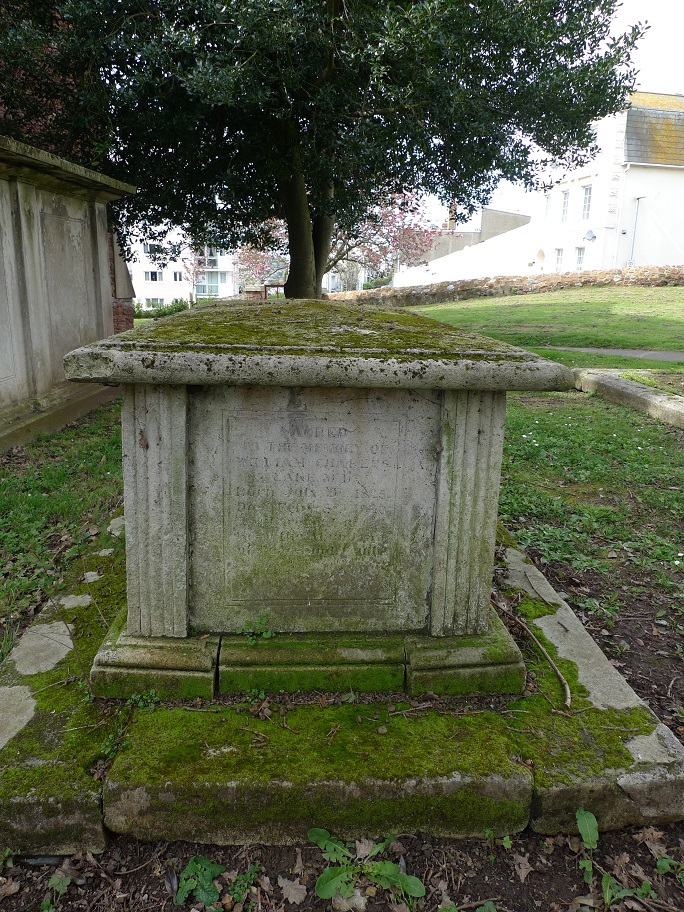
Dr William Charles Lake (1825-1920)
Photo by John Silverman
Dr William Charles Lake is the third of the local men involved in this jigsaw. He is actually interred in the family vault in the grounds of St James Church but I am including him here to complete the picture.
His role was international communications! But first, something about his life and contribution in Teignmouth; again I shall take it direct from his obituary in the Transactions of the Devonshire Association (Vol 52, 1920), with my own notes in italics:
Dr Lake was born at Teignmouth on July 9th, 1825, being the eldest son of Anthony Proctor Lake, surgeon, R.N., and of Elizabeth Kirsopp, both of Northumberland. (Note: his father registered for naval service in 1806, arrived in Teignmouth in 1817 and is registered in 1822 as a surgeon living at 16 Northumberland Place, just up the road from Keats House and close to William Rufus Jordan). He was educated at Exeter Grammar School under Dr. Mills, and could number amongst his schoolfellows Mr J. H. Tozer, Mr R. W. Templer, and Dr. Robert C. R. Jordan, uncle of Mr W. F. C. Jordan (and brother of William Risdon Hall Jordan).
Dr. Lake followed his father’s profession, and for a time was his father’s pupil, and subsequently of the late Dr. Cartwright, of Brimley House. He completed his professional education at King’s College, London, and at the University of St. Andrews, where he took his degree of M.D. He practised in Teignmouth as a physician and surgeon for forty-two years, being Medical Officer of Health for fourteen years. He was one of the pioneers of the old Dispensary in Bitton Street and later joined the staff of the Teignmouth Infirmary and Dispensary. On the death of Capt. A. G. Paul, Dr. Lake was appointed Chairman of the Hospital Management Committee, and at the time of his death was consulting physician to the Institution.
During the cholera epidemic of 1867 Dr. Lake undertook the work in connection with the outbreak, and in many cases he actually laid out the dead bodies. He was presented with a clock and purse by the townspeople for his devoted and unselfish work.
Dr. Lake became a member of the Devonshire Association in 1871, and contributed, besides many papers on meteorology, a “Sketch of the History of Teignmouth”; on the “Frosts of 1855 and 1895 as observed at Teignmouth,” and “Notes on the Origin of Teignmouth Streets and their Nomenclature”. He was also a member of the Royal Meteorological Society and supplied meteorological observations for close on fifty years.
He was for many years a sidesman at St. James’s Church, and had written articles on the Books of the Bible for the Parish Magazine. He was chairman and one of the original trustees of the Risdon Charity which is distributed annually in the vestry of St. James’s Church. In politics he was an enthusiastic Conservative and frequently presided at meetings of the party in the town. (He was also, as mentioned previously, together with Fred C Frost, a member of the Freemasons Benevolent Lodge 303).
In the sixties Dr. Lake was a member of the now defunct Local Board, and the newspapers of those times bear witness of his keen interest in sanitary matters. He retired from practice in 1891 and was then the recipient of a public presentation.
Having been born in the middle of the reign of George IV – thus having lived under five sovereigns – his reminisces of the past were most interesting. When at Exeter he often saw the mail coach pass over Cowley Bridge for London. He had travelled in Brunel’s atmospheric railway, some of the towers of which yet remain. He remembered when the Tame Brook, which runs through the town, was an open stream with bridges for crossing opposite the Royal Library and at the bottom of Orchard Gardens, and when the site of the railway station was an old farm, and when living in the house in which he was born in the Strand he had an uninterrupted view from his residence of the Den and the sea, and remembered the then Duchess of Clarence riding round the Den. He was one of the oldest and most esteemed and respected residents of Teignmouth. His affable and kind manner won a place in the hearts of rich and poor alike. A sincere Christian he was in every sense much beloved, and his loss will be greatly felt.
His contribution to the Keats debate
Dr Lake photo of Keats House
Much of the historical memorabilia of Keats is now held in collections in American universities. One of the foremost collectors was an illustrator, art editor, and print dealer in Boston, Massachusetts, called Louis A Holman. His collection now forms part of the Houghton Library at Harvard University. In 1913 he contacted Dr Lake who responded with two letters which now form part of that collection.
In those letters Dr Lake confirmed that Keats had stayed at No 20 Northumberland Place and sent Louis Holman a couple of photographs of the house. That information found its way into the literature in 1958 when Prof Hyder Edward Rollins, professor of English at Harvard University, published his definitive up-to-date collection of the “Letters of John Keats”.
The Keats commemorative plaque was eventually placed on the house at 20 Northumberland Place in 1931 based on a recommendation from the curator of the Keats museum in London. That decision itself was largely based on the previous work done by those three men of Teignmouth:
– Frederick C Frost,
– William Risdon Hall Jordan, and
– Dr William Charles Lake
all of whom shared an interest in history and contributing to life in Teignmouth.
The above is just a small part of the story of where Keats lived when he stayed in Teignmouth. If you are interested in the full story there is a complete set of blog-posts on the “Teignmouth in Verse” web-site under the title ‘The Hunt for Keats House‘. (Note: this link takes you to the first of the series of blog-posts; at the end of that post scroll down slightly and you can then navigate through to the next in the series, and so on)
















 Teignmouth Old Cemetery