Firstly remember the photoshoot tomorrow Sunday 22nd January outside the chapel in Teignmouth Old Cemetery (Exeter Road) at 12 noon. Please let friends know – I have attached a poster which you can circulate to friends. The more people we can get the better so we can demonstrate the strength of community feeling about retaining the buildings in the cemetery for community use.
SECRET CHARITY
I said in my last update that I would be trying to track down the “secret charity” that was proposing to do something. I’m not sure why it was so hush-hush but I have now confirmed that it is Teignmouth Eastcliff Company Limited. This is a small company which manages the building in Eastcliff Carpark used as a music centre (“The Cave”). The pressure we have been able to put on through this community action has led Teignbridge to ask this company to contact me. That company will also be issuing a press release next week.
The Teignmouth Eastcliff Company Limited has three directors: Paul Harrion, Roger Treweek and another company “Teignmouth First”. In 2015 it had total funds of £4682.
Teignmouth First has three directors: Terence Falcao (the mayor), Paul Johnson, and Tracy Scranage (Town development manager). It was served a notice of strike-off from Companies House in August 2016, which was then discontinued. In September 2015 it had no funds. I had already written to Terence Falcao three times this week but received no acknowledgement from him about this company or its involvement in the dealings with Teignbridge.
I met with one of the directors, Tracy Scranage, of Teignmouth First yesterday. We agreed that I could share the following information. Their basic proposition is to move the music centre “The Cave” to the chapel buildings in Teignmouth Old Cemetery and create a broader centre for performing arts. This seems a laudable community use but, because they have done this in isolation, they have ignored other potential community applications for the buildings. I explained some of the proposals which you have made which essentially mean having a more general purpose “hall” available for such things as exhibitions, wedding services, humanist ceremonies, small-scale concerts etc. I said that it would make much more sense if we could show a united community front to Teignbridge by creating such a general-purpose facility. Tracy said that she would take our ideas back to her board and see if they would agree to meet with us.
I NEED HELP
So, some progress. However, there is a lot of work involved here which I can’t do on my own so I’m looking for help for 3 things:
Setting up Friends of Teignmouth Cemetery
Putting together by Feb 6th the Expression of Interest for community use of the buildings
Meeting with the Eastcliff Company Board – it would be wrong for me to meet them on my own.
If I can’t get this help then this community action will stop now. So if any of you are able to give an input over the next 3-4 weeks please let me know as soon as possible and I will set up a meeting to agree how we take all of this forward.
Firstly thankyou so much to everyone so far who has emailed their message of support. That will be very helpful. A number of you have also given some suggestions and offers of help which we would like to take up at some point.
There have been so many replies that it is impossible to reply to everyone individually at this stage but I have put you all onto a mailing list and will use that to keep you informed of progress. If at any time you want to come off that list please email me and I will remove your contact details.
We are in the process of setting up a more formal “Friends of Teignmouth Cemetery” so that we can put in an Expression of Interest to Teignbridge as a community group. I will post on here details of how you can join if you want (I know some of you may have already done that through another route).
We have now had four days of community action and a lot has happened in that time which shows that by putting pressure on our politicians and councils through social media like Facebook we can get things moving.
To bring you up-to-date:
I have been writing every day to all the Teignmouth town councillors and have had some positive response. Firstly, thanks to Alison Eden for having encouraged Teignbridge to extend the deadline. Thanks also to Paul Burgess for proposing a working party to take this matter forward. My concern would be that, even with the two week extension to the submission deadline, that working party would not be able to meet and act in time to enable a submission to be made. Special thanks to Jacqui Orme who has been fighting a sort of rearguard action for the last 2 years but has often been blocked.
I have spoken at length with Jeremy Christophers, the Leader of Teignbridge Council, who has allowed me to quote him and has confirmed that Teignbridge have no intentions to undertake commercial or residential development of the Old Cemetery site. That is very reassuring and will definitely allay the fears of many people such as yourselves and others who have raised the issue with me.
However, the buildings themselves may be a different matter. The Planning proposal for conversion of the buildings to residential use has not been withdrawn and so is still hanging over us like the sword of Damocles. Therefore we will need to put together a strong, coherent plan for renovation of the building and its subsequent use for community purposes.
I am also trying to track down the secret charity which has been quoted but not revealed by Councillor David Cox on Facebook to see if we can get together to work on a joint bid. I don’t know why there is secrecy. Contacts at TAAG have suggested that it might be the “Cave”, or Eastcliff Community Company. However, that would mean that the town council already knows about this because of their representation on the Board but David Cox has said that he has no connection. So I am no further forward but will pursue it. If anyone can shed more light on that please let me know. It is in everybody’s interest that community groups come together to present a common united front for the renovation and use of the buildings.
Once again thanks for all the support and don’t forget the photoshoot at the Chapel on Sunday at 12 noon.
Two years ago Teignbridge announced a proposal to convert the Chapel and other attached buildings in Teignmouth Old Cemetery, Exeter Road to residential accommodation.
There was a huge public outcry and many people wrote to Teignbridge to object to the proposal.
All went quiet and the proposal was never submitted to the Planning Committee.
In the mean time a Community “Right to Buy” proposal was submitted to Teignbridge to enable some protection against any future commercial development of the Chapel. That was rejected by Teignbridge on the grounds that the Chapel was not in community use. Catch 22. Of course it wasn’t in community use because Teignbridge had allowed the buildings to fall into neglect and had boarded them up.
On Friday 13th January Teignbridge issued a new announcement (out of the blue) in the local paper (buried on p64) asking for Expressions of Interest for the renovation of the Chapel etc for community use. They have given only 8 working days to reply.
On the face of it this might suggest that Teignbridge have had a change of heart. But cynically it could be the reverse …. By burying it on p64 and only allowing 8 days to reply they could be hoping that no expressions of interest come forward. They could then say that they have had no expression of community interest and would then legitimately pursue commercial development.
Such a development could in turn lead (legally) to the conversion of the Old Cemetery land into land for building, destroying a significant part of Teignmouth’s history and heritage going back over 150 years.
We need to marshall a lot of community support over the next couple of weeks if we want to protect the cemetery. If you agree to trying to keep the Cemetery and buildings in community use please send an email to that effect to: gravetales@gmail.com.
If you are able to give any direct help in putting together an Expression of Interest, organising publicity and drumming up support please include that in your email as well.
We already planning a few things and will let everyone know as soon as we have definite details.
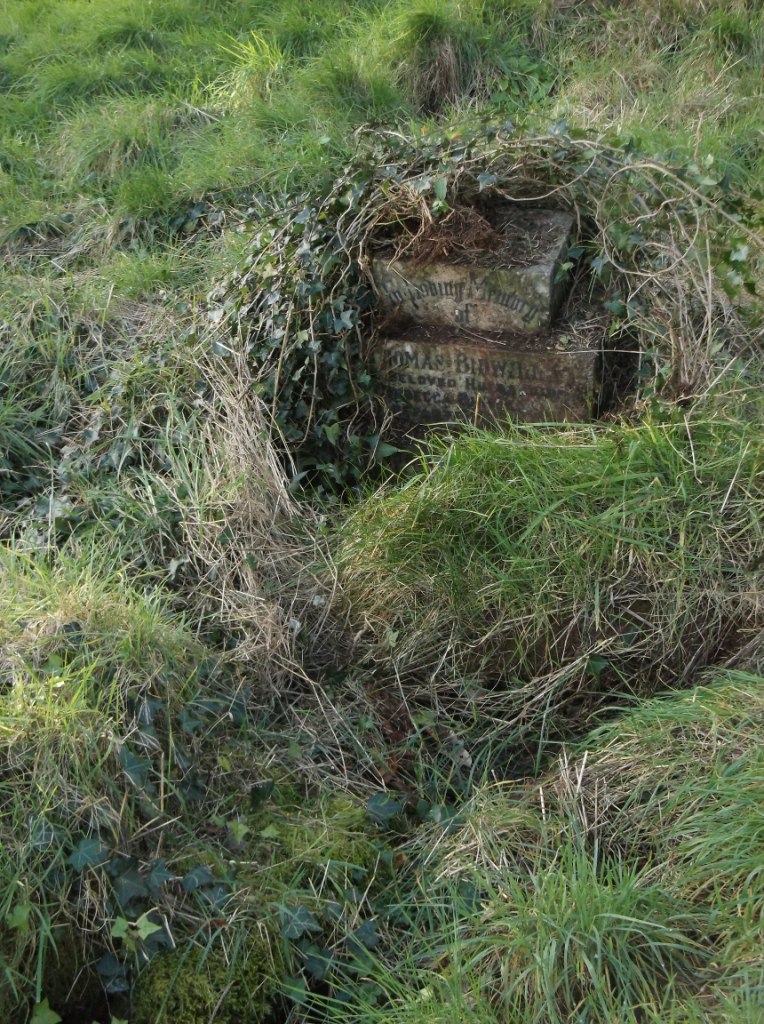
I eventually found the Thomas Bidwill grave which was completely covered in grass and ivy. The only sign a of grave was a slight ivy-covered mound. Pulling back the ivy revealed Thoma Bidwill’s headstone.
Thomas Bloomfield grave
Thomas Bloomfield’s grave was in a different location from where I had originally thought and was more easily identifiable …..
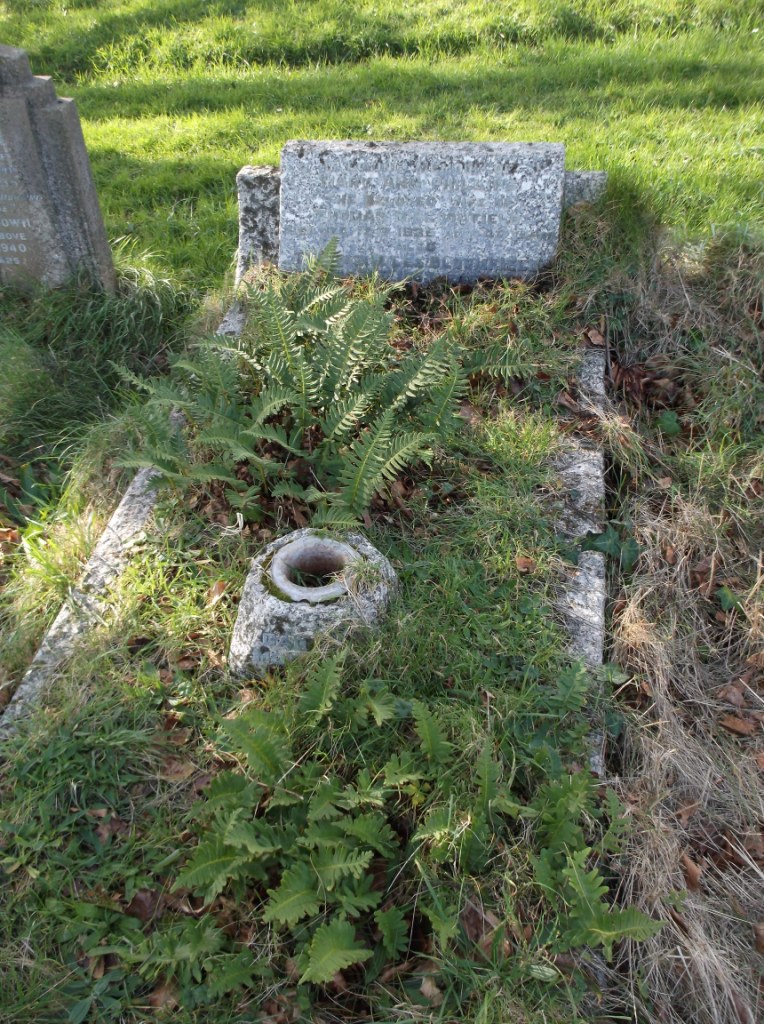
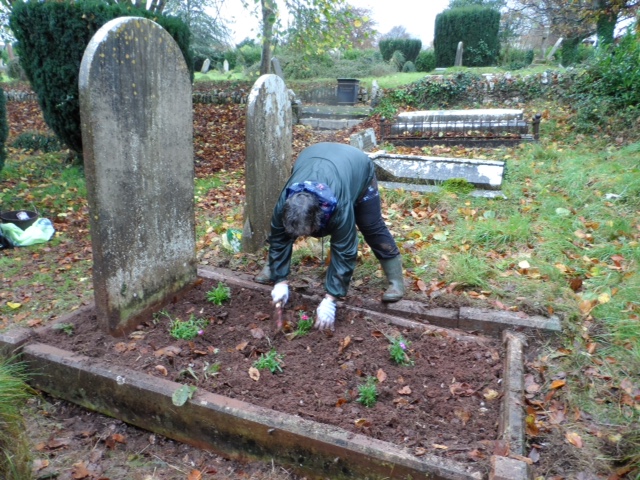
Finally I returned to Leah Lee’s grave for a bit of weeding. Surprisingly there seemd to be hundreds of natural bulbs coming through -yet to flower. In amongst them were snowdrops, crocuses and the geraniums we had planted last summer. Amazing that they had survived the winter; let’s hope that a late frost doesn’t kill them off.
With Christmas and the long spate of wet weather recently there has not been the opportunity for more grave clearance in the past month or so. The next working party is planned for Saturday 6th February at 10am when we are hoping to clear the area of graves of the Croydon family.
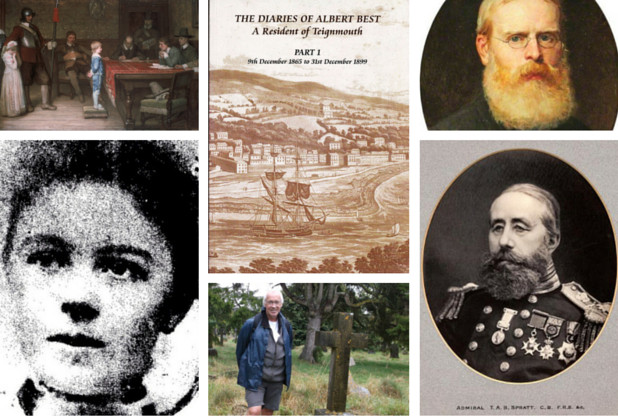
Herald Express collage
However, the project did receive some useful publicity in a double-page spread in the Herald Express in early January. Click on the headline to see the full story:
The article raised awareness and brought a few responses.
Norman White, from Hampshire, contacted us about his grandfather, Thomas Bloomfield who was a chief coastguard officer and is buried in the cemetery.
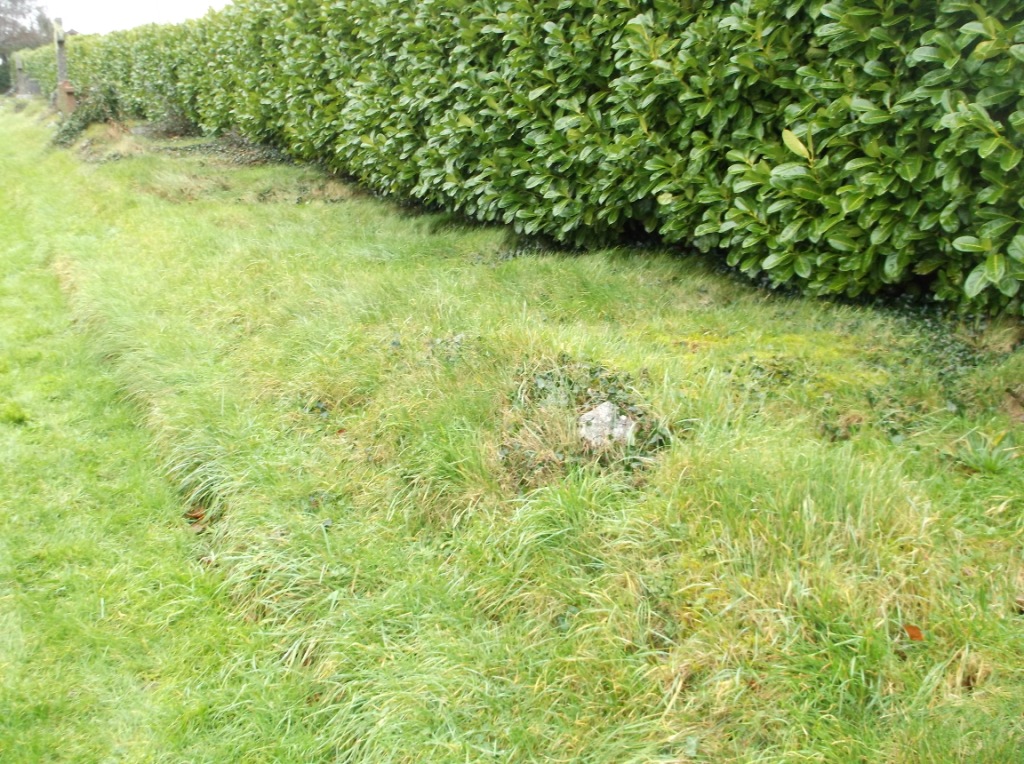
Site of Thomas Bloomfield’s grave
I have tracked down the area of the cemetery but as you can see from the attached photograph, more work is needed to identify the exact plot. The photo gives an idea of how overgrown the cemetery has become – this is only grass but I suspect the hedge has also encroached and hidden all the headstones.
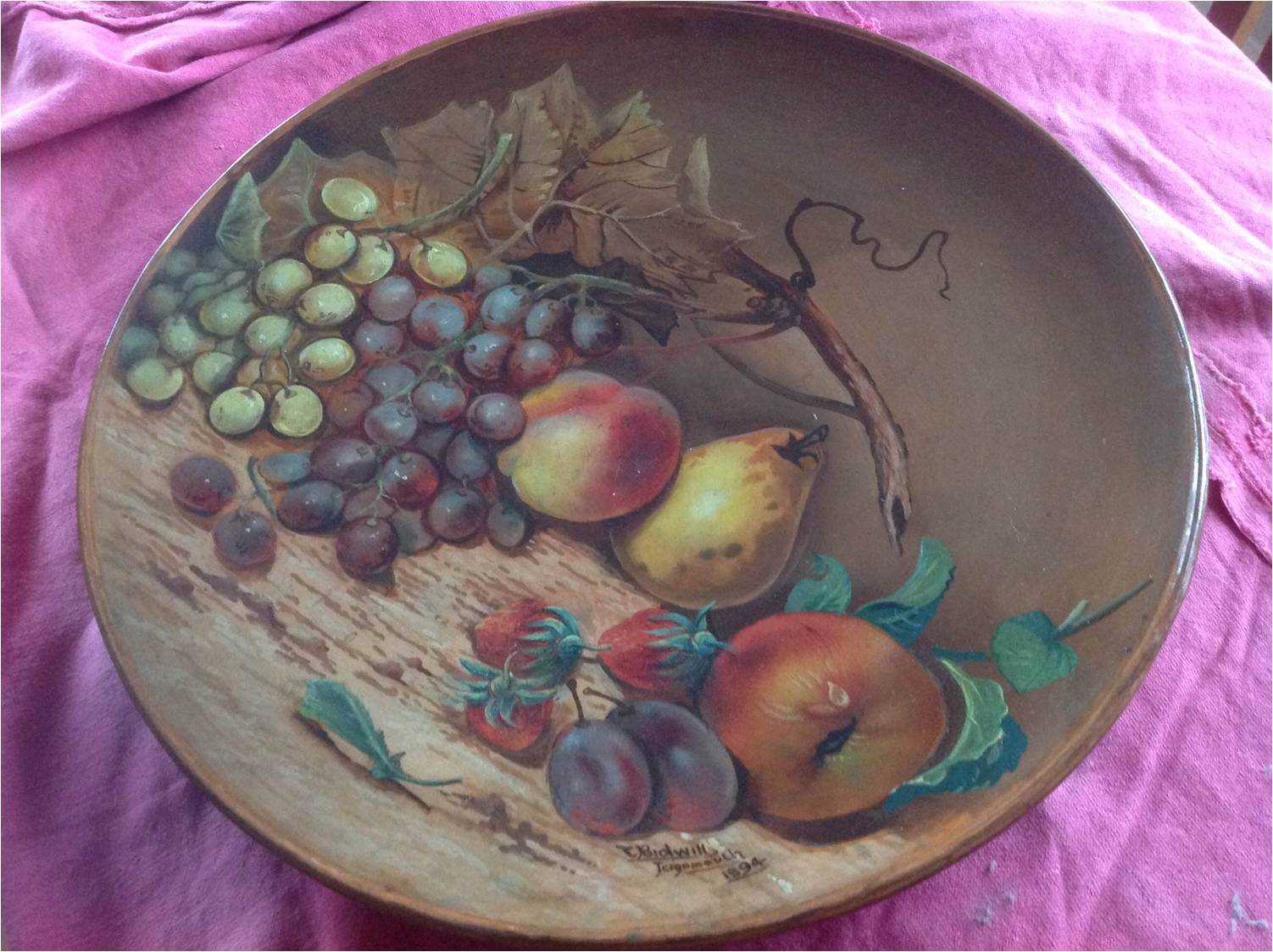
Another letter came from Don Cockman who told us about a terracotta bowl he has with a still-life painting of fruit. The painting is signed “T Bidwill, Teignmouth, 1894”. Again we have identified the area of the cemetery where he is buried but can not locate the exact grave because of the undergrowth. We are awaiting a map showing precise plot locations.
Still Life, Thomas Bidwill
Finally Barbara Donnelly offered to help with the research we are trying to do.
Barbara is keen on Genealogy and has already unearthed family information about Thomas Bidwill. He is listed in the census information as a ‘Painter’ so I wonder if we can discover any more of his works?
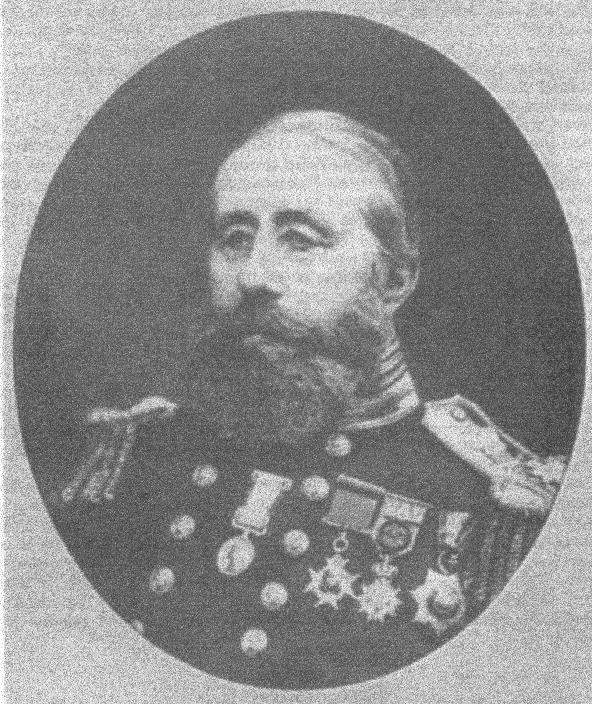
The latest grave to be cleared last Saturday (14th November), by Jean and Kay, was that of Admiral Thomas Abel Brimage Spratt (1811-1888) .………
What a name to conjure with!
Not only was he following in the family tradition of rising through the echelons of the Royal Navy but he also seems to have been a little bit of an Indiana Jones of the period, exploring worlds of ancient civilisations and the boundaries of knowledge. In between his adventurous exploits he, albeit inadvertently, took time to map the waters of the Teignmouth Bar.
Thomas Abel Brimage Spratt was born in 1811 in Woodway House, Woodway Road, East Teignmouth. He was one of thirteen children and also the eldest son of Commander James Spratt RN (who distinguished himself at Trafalgar) and Jane Brimage. (As a complete aside, one of his sisters, Leah born 1828, was known as “Loopy”. She died at sea in 1859 on passage from India to England)
He entered the navy in 1827 and was attached to the surveying branch in which he was engaged almost continuously until 1863 in surveying the Mediterranean. This was interrupted by the Crimean War in which, as commander of the “Spitfire”, he rendered distinguished service in the Black Sea. He was gazetted with especial praise for his services at the fall of Kimbourn for planning the attack to capture the Turkish city and placing buoys which led the fleet to its position. He received the Baltic, Crimean and Turkish medals and the Azof clasp and was awarded Companion of the Order of the Bath after the Crimea War in 1855.
Malaria and Teignmouth
Teignmouth Bar
The Crimean War was not the only disruption to his naval surveying activities though. Following a severe bout of malaria he was sent home on sick-leave and, as a result, spent the years 1848-49 studying the movements of the Bar sands at Teignmouth. He published a book on the subject, dedicated to Sir William Reid, Governor of Malta, entitled An Investigation of the Movements of the Teignmouth Bar. He also gave all his data to the Teignmouth Harbour Commission who, at that time, were struggling to relieve the local trade from an unjust tax, levied annually by the town of Exeter. It has been suggested that Sprat Sands are named after him (though note different spelling).
Isambard Kingdom Brunel congratulated Captain Thomas Spratt on his scheme to improve the promenade and the harbour entrance at the same time; “I never read a more sensible, concise and practical discussion of such a subject”. The main improvements were never carried out; however, some dredging works were implemented in 1857 near the Den Point following complaints from mariners. This was followed by further dredging works in 1865 and the later building of a groyne 330 yards long from abreast of Ferry Point to arrest sand.
Later Service
Vice-Admiral Thomas Abel Brimage Spratt
After serving on the allied council of war at Paris in January 1856 he surveyed the approaches to the Suez Canal, a project then opposed by the British government. 1863 saw the end of his service afloat, due to his recurring malaria. He was appointed a Commissioner of Fisheries from 1866 to 1873 and, although on the “retired” list, he was promoted to Rear-Admiral in 1872 and Vice-Admiral in 1878. From 1879 he was Acting Conservator of the Mersey Conservancy Board.
His Legacy
He died in Tunbridge Wells on the 10th March 1888 leaving a widow, Sophie Dean Spratt (Sophia Price, whom he married in 1844) and three sons Edward James, Frederick Thomas Nelson and Arthur Graves Spratt (they had two other sons who died in infancy and were buried in Malta). He left his journals to his second son Frederick who died in 1934, in turn leaving his property to his son Frederick Graham Spratt Bowring and his daughters. His journals have disappeared. What a loss! We do have some records though because he did publish during his lifetime, but those original journals must have been a fascinating collection of research.
Spratt the Polymath
So Spratt was an illustrious naval officer but he will probably be remembered in history for his contributions, either explicit or incidental, in the fields of exploration of nature, geology and archaeology. In those he was perhaps verging on the typical Victorian polymath of his time. He was recognised in that capacity through being made a Fellow of the Geological Society in 1843, of the Royal Society in 1856, of the Royal Geographical Society in 1859, of the Society of Antiquaries in 1873 and of the Zoological Society of London in 1883. He was also important as an oceanographer, conducting pioneering if ultimately unsuccessful work on currents which brought him into contact with the scientific community. He published books and articles on the Mediterranean, chiefly on the history and antiquities of Crete, an example of which is “Travels and Researches in Crete”, 1865.
I will give a few examples here of his contributions with links to further information if you are interested.
Pygmy Elephant
Pygmy Elephant – Paleoloxodon Falconeri
Spratt investigated the caves at Malta and obtained remains of the pygmy elephant (Elephas melitensis or P. falconeri). This was an example of insular dwarfism, reaching only 90 cm (3 ft) in height. It may have been the source of the legend of the Cyclops. It was described by Hugh Falconer, a contemporary natural scientist who was the first to suggest the modern evolutionary theory of punctuated equilibrium. (As an aside, Spratt himself had two fossil species named in his honour).
Troy
One of the maps made by Thomas Spratt known as “Spratt’s Map” was used by archaeologists Heinrich Schliemann, Wilhelm Dorpfeld, and Carl Blegen, which contributed to the discovery of Troy, because the name Troy with a question mark was added by a German professor of classical antiquities working with Spratt.
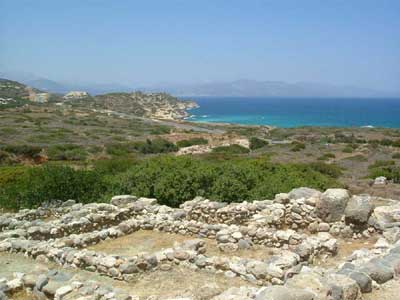
Crete: The Island that Tipped
Crete, the tipping island
It was Spratt who discovered the way in which relative levels of land and sea had changed over the island of Crete in historic times. He wrote of his findings to Sir Charles Lyell, an eminent contemporary geologist, in 1856:
“Dear Sir Charles, Fearing you may be impressed with the idea that the eastern end of Crete had gone down as much as the west, I am induced to write a line to rectify it, if so; and to state that movements in the eastern half of the island have neither been as great nor apparently as uniform as the western movement. Both are subsequent to the historic period and the evidences are in both instances indicated by the elevation or partial submergences of some ancient Greek building or city.”
Phaistos and its Disc
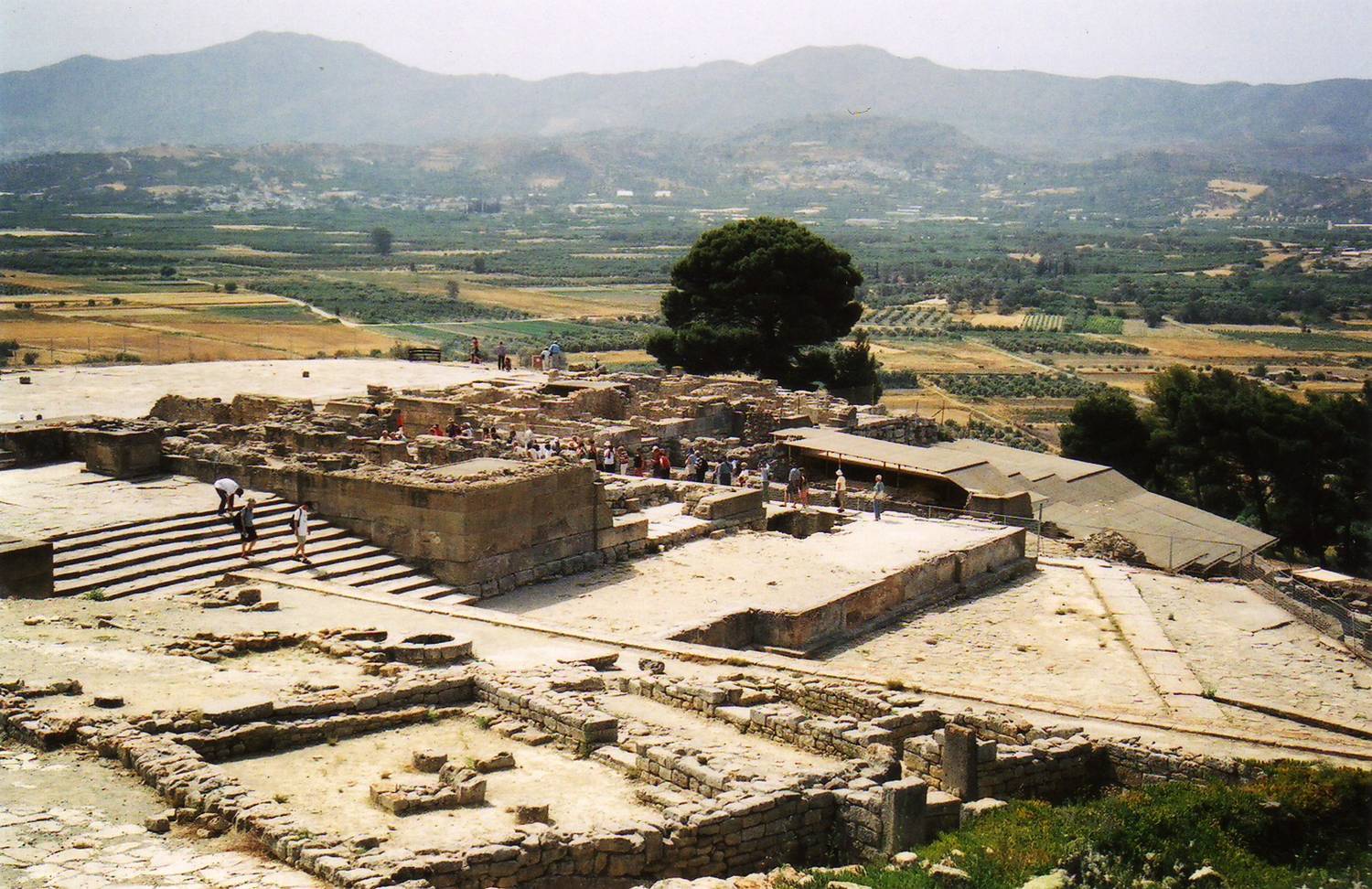
Phaistos
Phaistos was an ancient city on the south coast of Crete, dating perhaps as far back as 6000 BC. The city rose up from the fertile plains of the Messara region and became part of the growing Minoan empire. The first Minoan palace of Phaistos was built around 2000 BC, about the same time as the main palace of the empire was built in Knossos. Both of these Palaces were destroyed by a strong earthquake in 1700 BC and rebuilt on top of the old ones.
Captain Thomas Spratt was the first to establish the precise location of Phaistos during the Mediterranean Survey of 1853 which was cataloguing the topography and settlements of Crete.
Phaistos Disc
And the Disc? This was one of the later discoveries at Phaistos in 1908 which challenged archaeologists until 2014 when the puzzle was solved. It is a clay disc, around 16 centimeters in diameter, both sides of which are covered with symbols, arranged in a spiral pattern, going clockwise around into the centre. The symbols are similar to hieroglyphs and represented a completely new, previously unknown, language. It can now be seen at the Iraklion Archaeological Museum.
In 2014, after 6 years of analysis of this “first Minoan CD-ROM“, Dr. Gareth Owens in collaboration with John Coleman, professor of phonetics at Oxford, have figured out not only what the language sounded like but also some of the meaning it conveys, believed now to be a prayer to a Minoan goddess.
Thomas Abel Brimage Spratt, Admiral, explorer, polymath and humble surveyor of the Teignmouth estuary. A name to conjure with indeed!
His grave is very close to the Higher Buckeridge Road entrance to the cemetery. The headstone is impressively large, as you can see from the photographs, and carries the following inscription:
In the Memory of Admiral Thomas Abel Brimage Spratt CB FRS FGS Who died on the 12th March 1888 Aged 76
Entering the Navy in 1826 he continued a faithful public servant up to his death
In pace requiescat
Also
In the Memory of Sophia Dean widow of the above who died on the 16th February 1900 Aged 84
Before and after pictures of Admiral Spratt’s grave
Just a quick update today about “Tales from the Grave” activities. I will be adding more about these in future posts, but for the moment I just wanted to capture some of the signs of interest and enthusiasm which this project is creating..
Firstly the latest grave to be cleared last Saturday (14th November), by Jean and Kay, was that of Admiral Thomas Abel Brimage Spratt (1811-1888).
The clearance activities and web-site are also starting to create some interest.
Dave Tovey has been in contact about graves related to people connected to Teignmouth pubs and has sent through a number of photos.
Fiona Churchill, who is a keen family researcher, has tracked down three of her great-grandparents who are buried in the Cemetery.
Tim Whiteaway has been doing research into the weird history of Charles Bodnar who married Maria Croydon (the Teignmouth publishing family).
Graham Sly, who lives in Exeter, has a special hobby – photographing Devon graves and uploading them to findagrave.com. In August 2013 he visited the Old Cemetery and took over 600 photographs.
Margaret Brooking has told us about how she and her husband have been clearing around their family graves and her contacts with the War Graves Commission. She has also pointed us to Ford Park Cemetery in Plymouth which seems to have gone through a similar process to that which we are now embarking on.
Finally, Ginny Ware from the Herald Express would like more information about what we are doing.
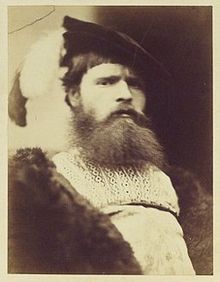
William Frederick Yeames, portrait by David Wilkie Wynfield
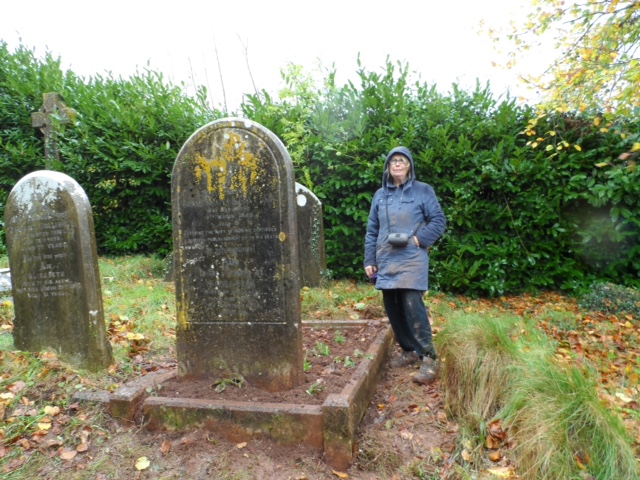
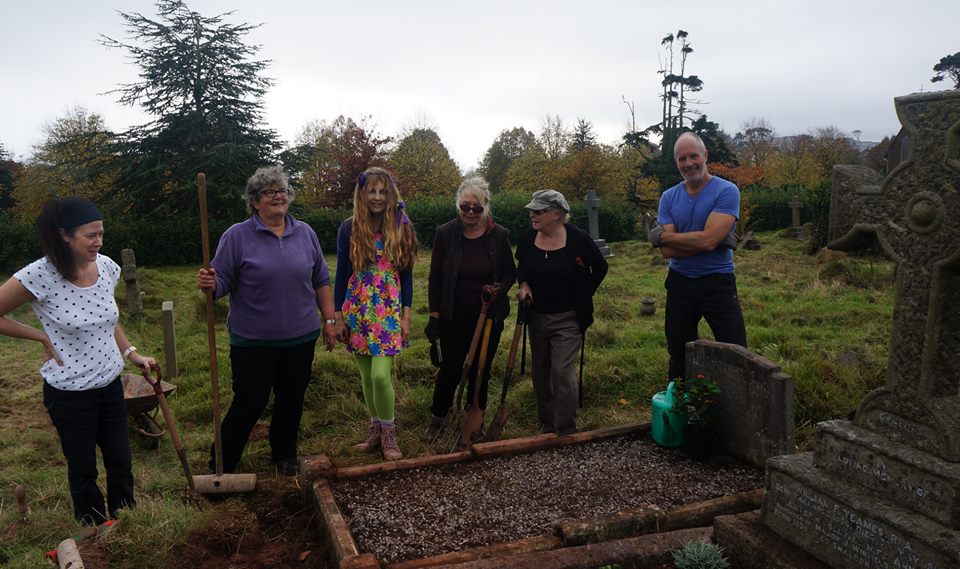
On Saturday 31st October the working group cleared the grave of William Frederick Yeames, a famous artist who came to Teignmouth later in his life for the benefit of his health.
Yeames was born on 18th December 1835 in Taganrog, Russia where his father was the British consul. He was the fourth child of William and Eliza May Yeames. After the death of his father in 1842 and a change in family fortunes, the family moved to Dresden where Yeames began studying painting. They subsequently moved to London in 1848 where Yeames learned anatomy and composition from Sir George Scharf, who was director of the National Portrait Gallery. He also took art lessons from F A Westmacott.
In 1852 he travelled to Florence where he studied with Enrico Pollastrini and Raphael Buonajuti. During his time there he painted at the Life School at the Grand Ducal Academy, drawing from frescoes by Andrea del Sarto, Ghirlandaio and Gozzoli. Continuing on to Rome, he painted landscape studies and copied Old Masters, including the frescoes of Raphael in the Vatican.
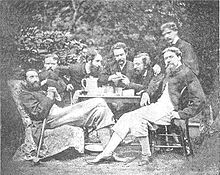
St John’s Wood Clique, 1864 or 1865
In 1859 he returned to London and set up a studio in Park Place. He joined the loose association of artists known as the St John’s Wood Clique who mostly lived in the St John’s Wood area of London. They modelled themselves on ‘The Clique’, an earlier group of English artists formed by Richard Dadd in the late 1830s. The group concentrated on subjects of an historical nature and narrative paintings in which the story was revealed by close study of the actions and expressions of the subjects. In Yeames’s work this technique evolved into the genre known as the ‘problem picture’, in which the narrative of the image creates an unresolved dilemma or paradox for the viewer.
While their work was popular with the public, the St John’s Wood Clique found it difficult to get their work displayed at prestigious galleries and the Royal Academy because it never received critical acclaim. Yeames managed to overcome this problem; he did exhibit there and was made an Associate (ARA) in 1866. He specialised in Tudor and Stuart subjects, but did not always portray the events they depicted with historical accuracy instead using them as inspiration, or thought provocation.
On 18 August 1865 Yeames married Anne Winfield, daughter of Major James Stainbank Winfield of the East India Company. As an aside, it is interesting that Teignmouth’s most famous artist, Thomas Luny, at one time worked in studios close to the East India Company in London and was commissioned to do a number of maritime works for them.
Although a prolific artist, Yeames was also librarian of the Royal Academy and curator of the Painted Hall at the Royal Naval College, Greenwich. Gradually, however, his eyesight deteriorated and he last exhibited in 1910. In 1912 he suffered a seizure from which he never fully recovered.
And when did you last see your father? Walker Art Gallery, Liverpool
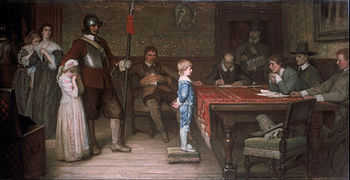
His most famous painting, now on display in the Walker Art Gallery in Liverpool, is entitled “And when did you last see your father?” Painted in 1878, it depicts a scene in an imaginary Royalist household during the English Civil War. The Parliamentarians have taken over the house and question the son about his Royalist father (the man lounging on a chair in the centre of the scene is identifiable as a Roundhead officer by his military attire and his orange sash). Yeames was inspired to paint the picture to show the crises that could arise from the natural frankness of young children. Here, if the boy tells the truth he will endanger his father, but if he lies he will go against the ideal of honesty undoubtedly instilled in him by his parents – an artistic interpretation of moral dilemma.
Grave of William Yeames and his wife Anne
He and Anne moved to Brimley House in Higher Brimley Road, Teignmouth for the benefit of his health and celebrated their Golden Wedding Anniversary in 1915. William Yeames died three years later on 3rd May 1918. Both he and Anne are buried in the Old Cemetery.
His life was documented in a biography by his niece a few years later – “Art and Anecdote: Recollections of William Frederick Yeames, His Life and His Friends”. I found the final paragraph especially poignant:
“And on the cross which marks the spot where we laid him, in that beautiful hillside cemetery, within sight of the sea, changeful as life itself, on one hand, and the still purple moors on the other, my aunt had the same word inscribed which marks the tomb of Albert Durer in Nüremburg :
EMIGRAVIT.”
(Note: “Emigravit” is short for the Latin expression “Ex hac vita ad Dominum emigravit” – “He emigrated from this life to the Lord.”)
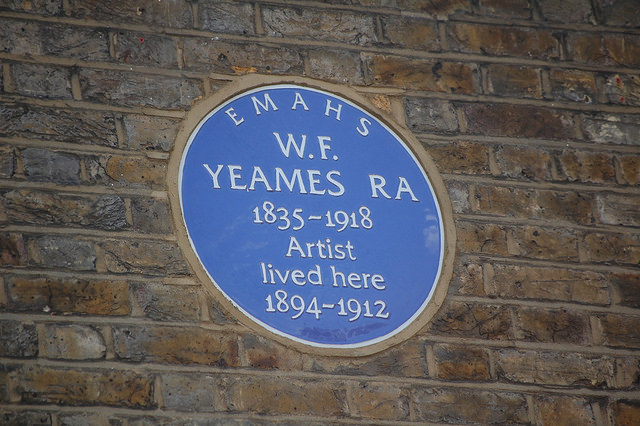
Finally, in 2000, a blue plaque commemorating Yeames was installed at his former home, 8 Campbell Road, Hanwell, London, where he lived from 1894 until 1912.
Maybe Brimley House should carry such a plaque as well?
The inscription on their grave (MM77) reads:
EMIGRAVIT (barely visible at the base of the cross)
William F Yeames RA Born Taganrog 1835 Died 3rd May 1918 And of his beloved wife ANNE Daughter of Major J Winfield Indian Army Born 1839 Died Shaldon 26th Nov 1934
Grave of William Yeames after clearing
The above information has been compiled from the following sources:
Wikipedia – William Frederick Yeames ….. Wikipedia – St John’s Wood Clique ….. General Books ….. Art and Anecdote: Recollections of William Frederick Yeames, His Life and His Friends, M H Stephen Smith, published by Hutchinson & Co, London
On Saturday, October 17th, a small working group of volunteers cleared the grave of Albert Best, located just to the rear of the surviving chapel in the Old Cemetery.
Albert Best was born in Teignmouth in 1840 only 25 years after the Battle of Waterloo and lived here his whole life, the final 20 years being at 32 Bitton Street.
He started work on his 14th birthday, serving a seven year apprenticeship to become a plumber, and later set up on his own, establishing a family business. His firm became a major employer in the town in his lifetime and a testament to this is an extract from the Teignmouth Post in 1919:
“At the supper to demobilised and discharged men last week, 28 of the men that sat down are employed by the firm of A Best Ltd., Plumbers, Builders & Contractors of Somerset Place”.
The firm later became J.G. Best and Sons, Builders and Ironmongers at 11 to 15 Somerset Place. That business finally closed down in the late 1970’s.
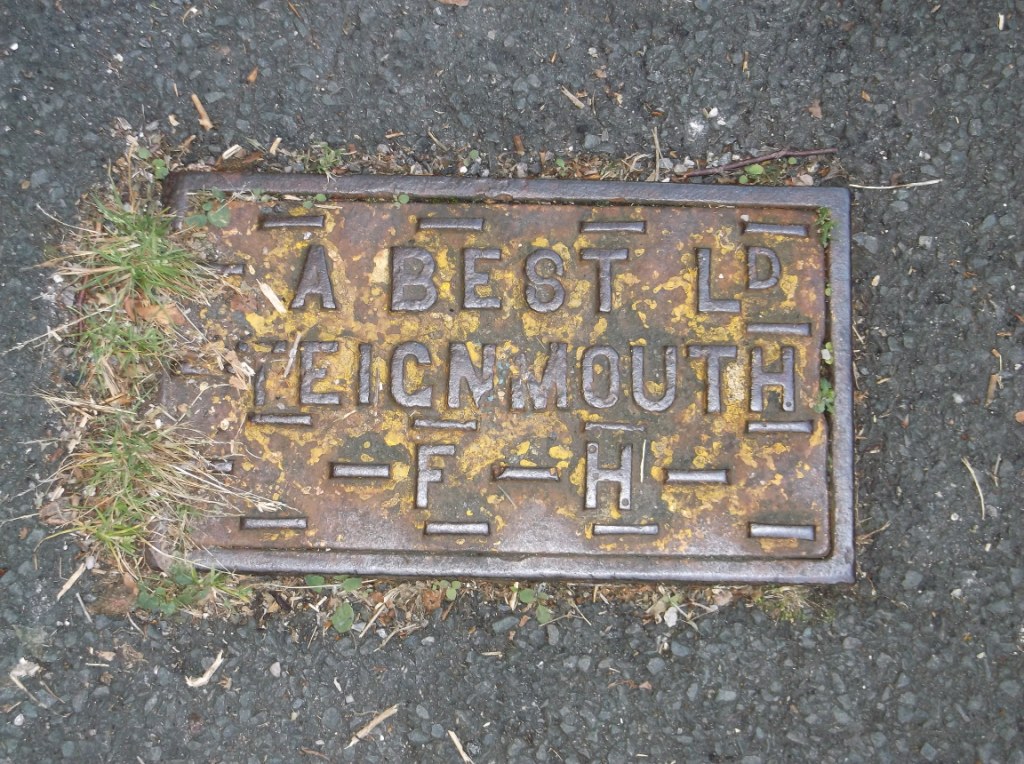
Although he started as a plumber it is clear from the range of activities he undertook that that profession had a much broader meaning at that time. His plumbing origins are still in evidence in Teignmouth. If you walk around looking at the ground beneath your feet you will occasionally find cast-iron drain or manhole covers with the mark of “A.Best Ltd”.
Albert Best drain cover just outside cemetery entrance in Higher Buckeridge Road
But he would also make lead coffins and perhaps this part of his business benefitted from being located close to the mortuary at Gales Hill. There is an interesting anecdote in the book “The Benedictine Nuns of Dunkirk” which involves Albert Best taking part in nocturnal activities at St Scholastica’s Abbey off Dawlish Road, helping with the coffin of the Abbess.
Hi firm also built the Shaldon memorial clock tower, erected in 1921 to commemorate the twenty-six local men who had lost their lives during the First World War.
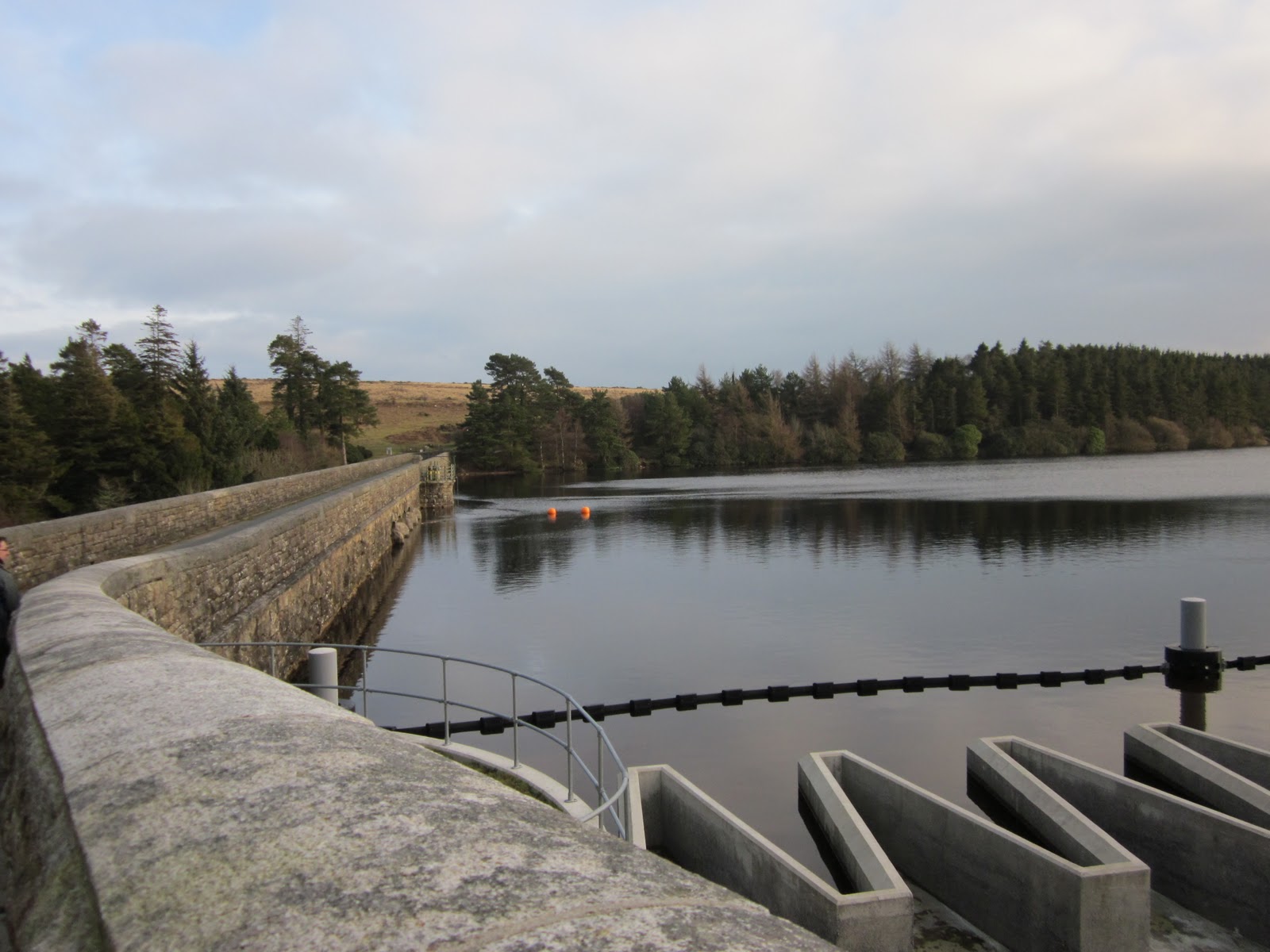
Venford Reservoir
However, probably the pinnacle of his professional career showed a transition into large scale engineering. As the 20th century got underway, his firm won a significant contract in conjunction with W Hawking of Dawlish. The project was to create Venford Reservoir in a beautiful segment of Dartmoor, just above the village of Holne.
Plaque at Venford Reservoir
The project started in 1901 and formally opened in 1907. It holds approximately 198 million gallons of water, covers around 33 acres and provides Paignton’s water supply. It must have been a proud day when a granite plaque bearing the name of A Best & Co was fixed up and the reservoir officially opened.
If Albert Best were just a plumber and engineer his contribution to Teignmouth’s life and development would have been worthy of historic note in its own right. However, he also had outside interests which occupied much of his spare time.
He spent much of that spare time on voluntary work for the Independent Order of Odd Fellows, a Friendly Society formed to provide members of the working classes with a form of insurance against sickness and unemployment. Weekly contributions were paid by members into the Lodge and benefits paid out when required.
He was also a member of the Yeomanry Volunteers from 1860 to 1884, coming out as a Sergeant. He was in the Devonshire contingent that marched past Queen Victoria at the Windsor Review in 1881.
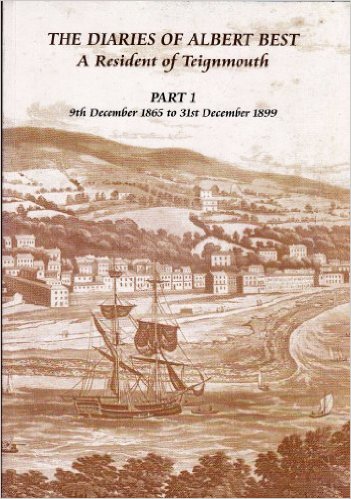
Albert Best Diaries Part 1
Finally, inadvertently perhaps, he became an amateur social historian. He did this through keeping a diary from 1865 until a week before his death in 1920. The diaries have been collated and published in three volumes by his great-great nephew Alan Best who has commented: “When he started writing there were people who could still remember the Battle of Waterloo, when he died there were people born who are still alive today.”
Part I of the Diaries covered the period from December 1865 to the end of the century. It is in A4 format size, 128 pages long and contains supplementary notes taken from newspapers of the time, and a list of some 150 recorded deaths. Part II is similar in construction and covers the period from 1900 to 1913. Possibly the most interesting volume though is the third which captures Teignmouth during the pre-war period through to the Great War’s conclusion and its immediate aftermath.
As a personal observation, the entries in his diaries tend to be quite a succinct and pragmatic, or factual record of his day-to-day activities. It is interesting that he didn’t take the opportunity to offer much by way of opinion about the events taking place, such as the bread riots in Teignmouth for example or his nocturnal adventure at St Scholastica’s Abbey. Perhaps local running clubs would like to take up the challenge of the race he described from the Teignmouth Inn in Dawlish to the Dawlish Inn in Teignmouth! I was also intrigued that he wasn’t married. As a successful businessman you would think that he would be quite a catch in the Teignmouth of his day.
Plumber, reservoir builder, businessman, philanthropist, social historian – that was Albert Best.
Albert Best, 3rd May 1840 – 16th September 1920
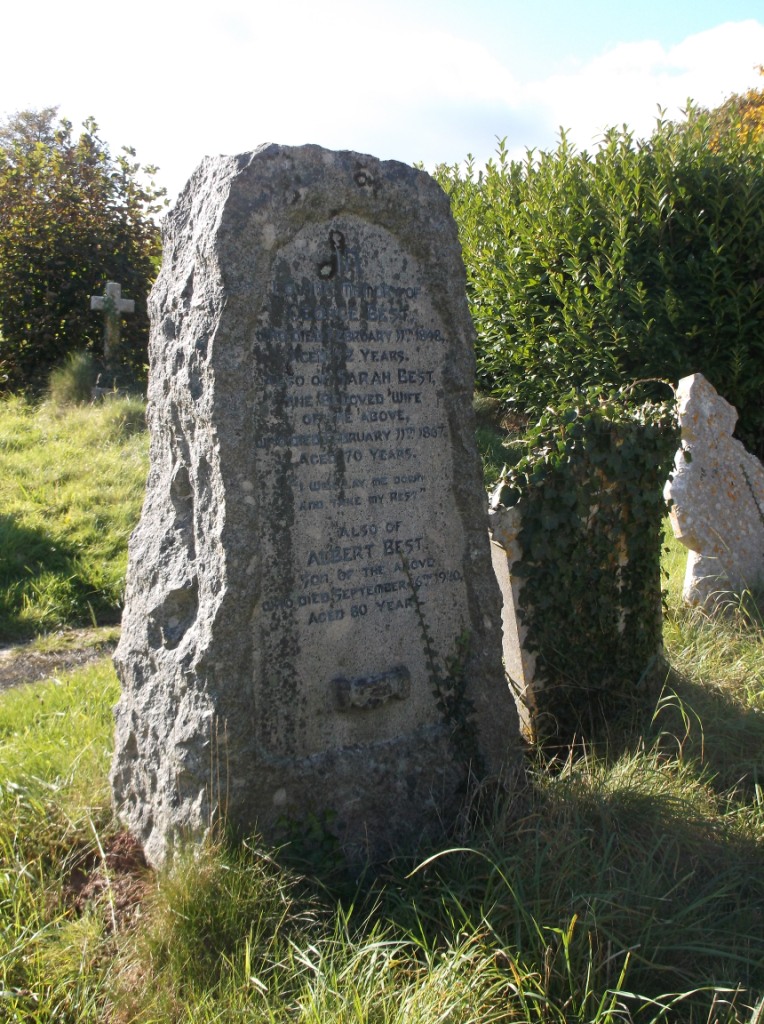
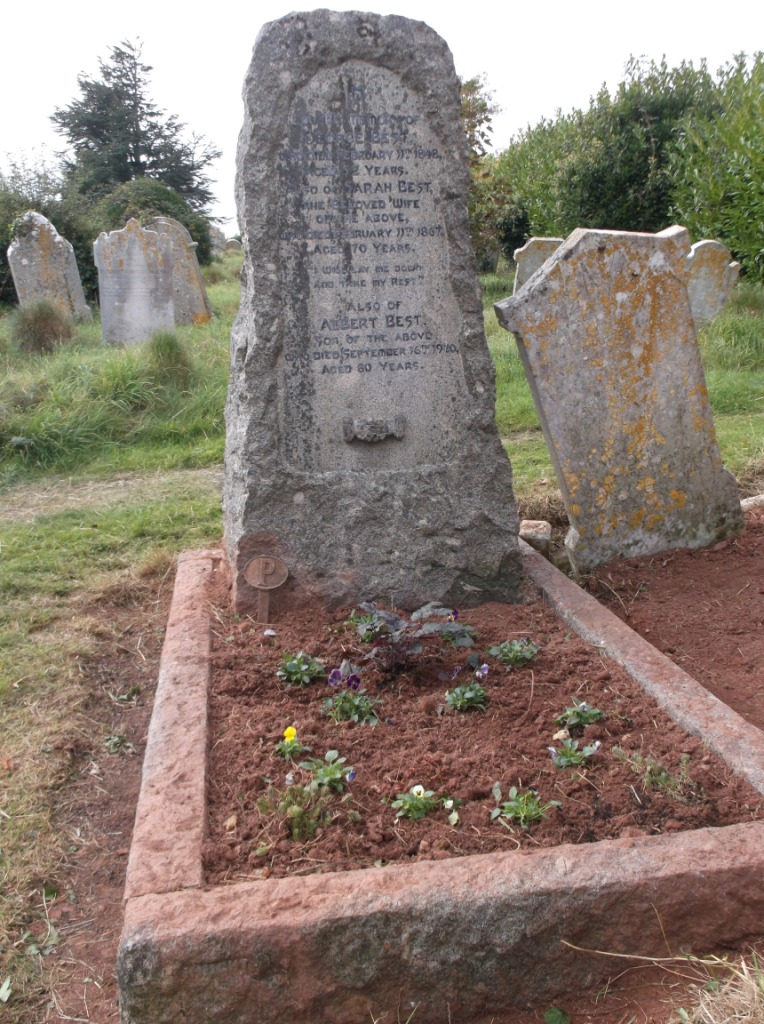
His grave is located close to the rear of the chapel and the impressive granite headstone bears the inscription:
In Loving Memory of George Best Who died February 11th 1848 Aged 52 Years
Also of Sarah Best The Beloved Wife of the above, Who died February 11th 1867 Aged 70 Years
I will lay me down and take my rest
Also of Albert Best Son of the Above Who died September 16th 1920 Aged 80 Years
Albert Best’s grave before and after clearance and showing location close to chapel












 Teignmouth Old Cemetery